
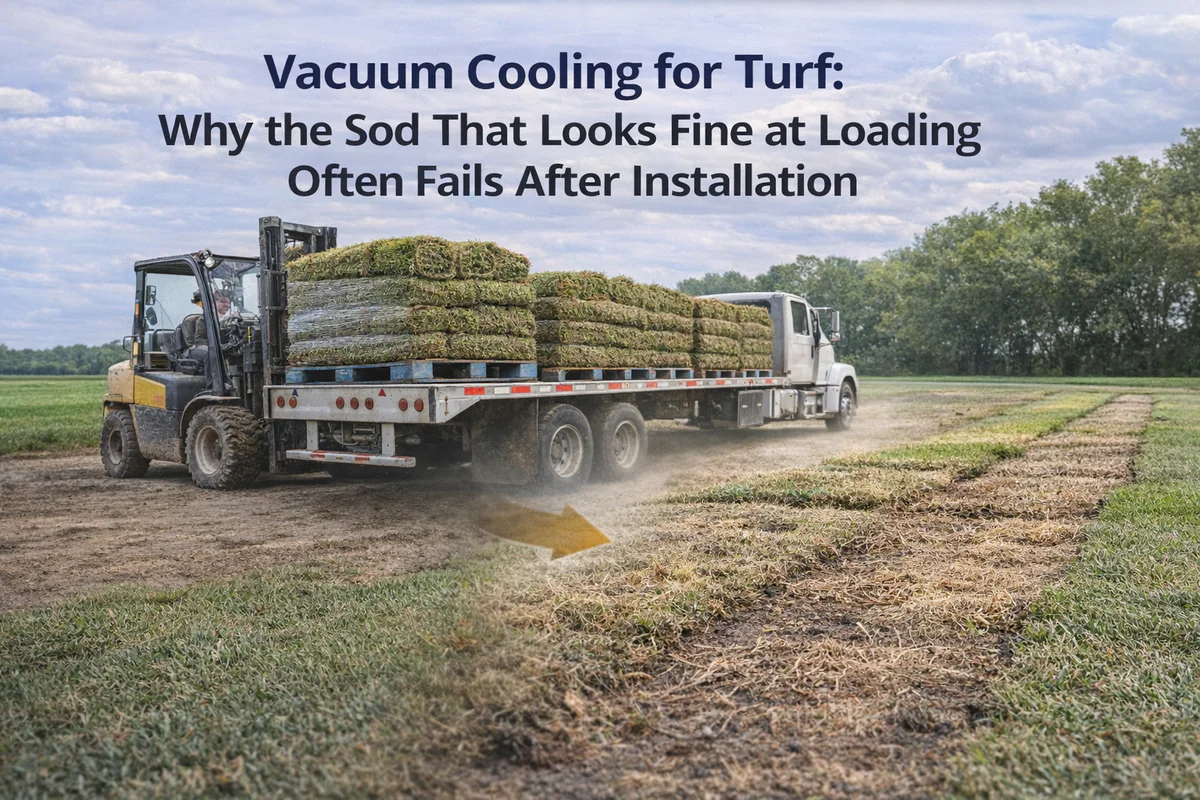
Vacuum Cooling for Turf: Why the Sod That Looks Fine at Loading Often Fails After Installation
Sod producers who have dealt with post-installation failure complaints often hear the same version of events from the contractor or buyer: the turf looked fine when it arrived, installation went normally, and then within a few days the grass started dying in patches or across the whole area.
The easy explanation is installation error or site conditions. Sometimes that is correct. But in many cases, the failure was decided before the pallet ever left the farm. The turf looked acceptable at loading. What the loading team could not see was the heat still trapped inside the roll — heat that continued working on the grass through every hour of transport, every hour of staging on-site, and every hour before the roots could establish contact with the soil.
From our factory-side perspective, this is one of the most commercially damaging mismatches in sod supply chain management: the product condition that determines installation survival is not visible at the point where most quality checks actually happen.
Vacuum cooling for turf is not simply about making the grass colder. It is about removing the field heat trapped inside the roll before it spends more of the grass’s remaining viability during transport and site staging. That distinction is what separates operations that consistently deliver turf that establishes well from operations that keep losing margin to post-installation complaints they struggle to explain.
Why Sod Pallets Retain Heat Differently From Most Other Produce
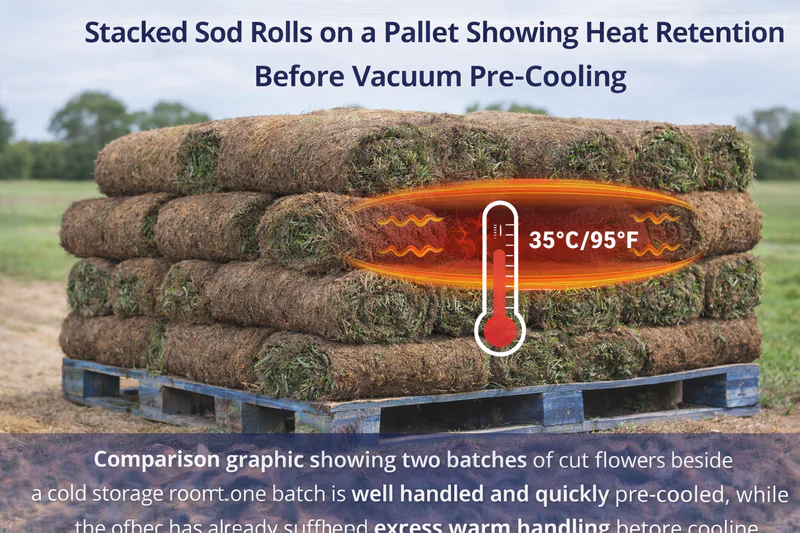
Most produce can be inspected at surface level and give a reasonable indication of its temperature and condition. Sod rolls cannot.
A pallet of harvested turf is typically a dense, tightly stacked mass of grass, soil, and root material. The outer layers may cool relatively quickly once the pallet moves out of direct sun. The interior is a different environment. Heat generated by respiration in the root zone accumulates between layers, and the density of the stack prevents meaningful air circulation from reaching the core.
This is why ambient cooling — moving pallets into shade, increasing airflow, or staging in cooler areas — often fails to produce the result producers expect. The surface temperature may drop. The core temperature does not follow at the same rate. And because turf rolls are not transparent, the operator cannot see or easily measure what is happening inside the stack.
This thermal behavior is not a design flaw in how sod is harvested or stacked. It is a physical consequence of the product’s geometry and density. But it means that the standard visual and surface-level checks used in most dispatch workflows are genuinely unreliable as quality indicators for sod destined for long transport windows.1
The Delivery Window for Turf Is Shorter Than Most Operations Plan For
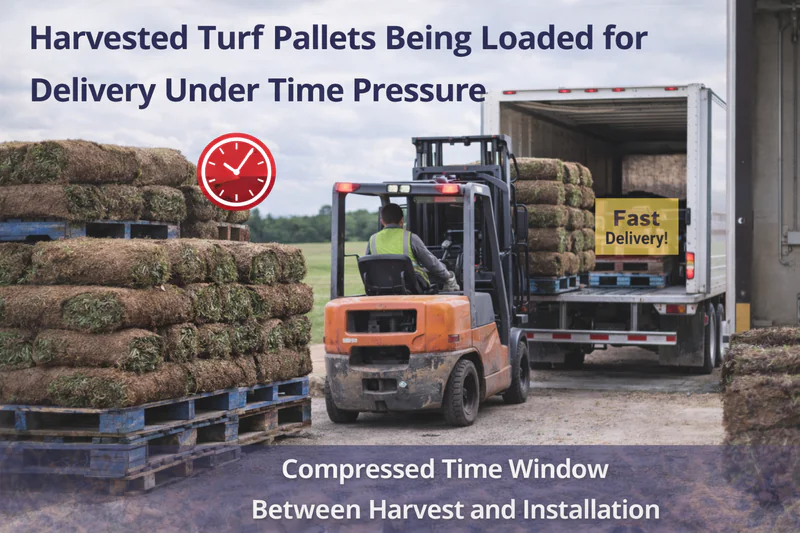
Most produce categories have some tolerance for measured cold-chain delay. Properly pre-cooled vegetables or flowers can hold reasonable quality through a well-managed transport window. Turf is significantly less forgiving.
Harvested sod is a living product that has been cut away from its primary water and nutrient supply. From the moment of harvest, it is drawing on its own reserves. How long those reserves last depends heavily on the temperature history between harvest and installation. At elevated internal temperatures, that draw accelerates sharply.
In practical terms, most sod operations work with a delivery window somewhere between 24 and 48 hours from harvest to installation, depending on species, season, and ambient conditions. That window is not generous. And every hour spent at elevated internal temperature before transport shortens the margin available for installation establishment.2
Many producers still plan logistics around a nominal 24- or 36-hour delivery assumption without accounting for the pre-transport thermal history of the product. If a pallet spent two hours in warm field conditions after harvest before loading, and another period staged in a warm yard before the truck departed, the effective quality window at installation is already shorter than the delivery schedule implies.
This is where a significant portion of post-installation complaints originate: not in the delivery leg, but in the compressible warm-handling period before dispatch that the producer no longer controls once the truck leaves.
Looking Green at Loading Is Not the Same as Being Viable for Establishment
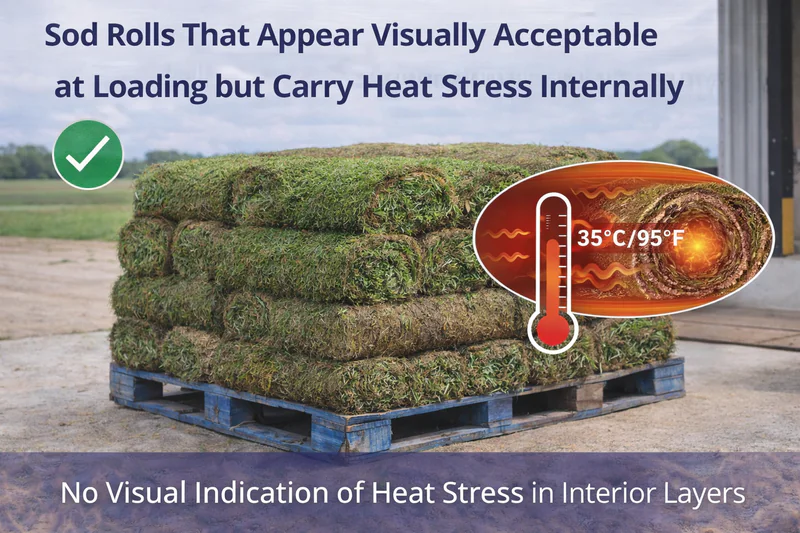
This is the operational trap that makes post-installation sod failure so commercially frustrating: the product passed the only check that was performed.
At loading, the grass still looks green. The soil still feels moist. The roll surface still appears fresh. The dispatch team sees a load that looks ready to ship and signs off. That visual confirmation is not wrong in any specific way — the outer appearance genuinely does look acceptable. The problem is that visual checks at dispatch are measuring the wrong thing.
What actually determines whether the turf will establish correctly after installation is not the color of the leaf blade at loading. It is the cumulative thermal stress the root zone has absorbed from harvest to installation. That stress is largely invisible at dispatch. It may not express itself visibly until days after installation, when root establishment fails and the damage becomes impossible to reverse.
This creates a difficult commercial situation. The producer believes the product was dispatched in good condition because it looked acceptable. The buyer believes the product was defective because it failed after installation. Both observations are consistent with their own evidence. The actual cause — pre-dispatch heat stress that was not visible but was commercially decisive — falls into a gap that neither party was measuring.3
What Actually Determines Whether Turf Survives Installation
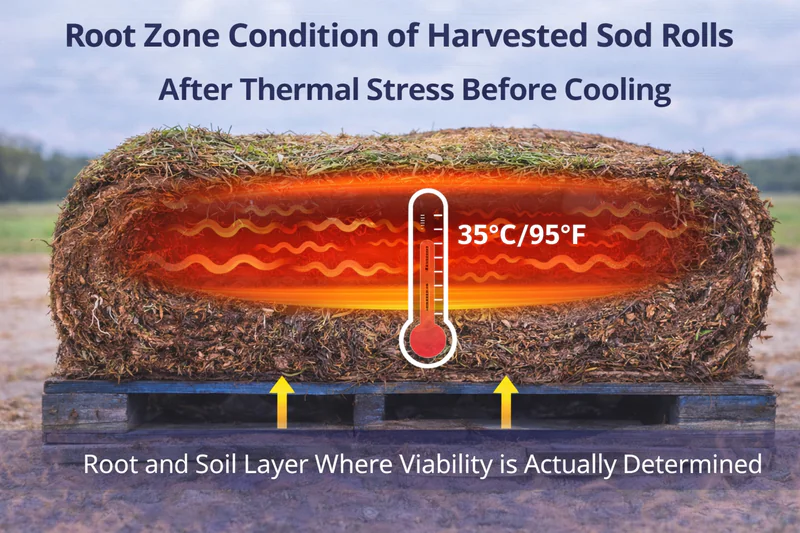
The grass blade is not where the installation decision is made. The root zone is.
After a sod roll is installed, the grass’s ability to re-establish contact with the new soil environment and resume normal metabolic function depends on root viability. Roots that have been subjected to prolonged heat stress above their tolerance threshold are physiologically compromised even when they still appear intact. They may not die immediately, but their ability to take up water and nutrients from the new soil is reduced.
This is why turf can fail after installation in ways that look dramatic and sudden, even though the product appeared visually acceptable at every handling point before installation. The visual check was tracking leaf blade condition. Root viability was tracking thermal history.
The practical implication for sod producers is that the quality of their product at the point of installation is significantly shaped by decisions made before harvest, at harvest, and in the handling window before pre-cooling. Specifically:
- how long the grass stayed in field conditions after cutting before temperature pull-down began
- how tightly rolls were stacked and how much time passed before internal temperatures started dropping
- how consistently pre-cooling was applied across the whole pallet, not just the outer layers
- how quickly the product moved from pre-cooling into a protected transport environment
Vacuum cooling addresses this more effectively than surface or ambient cooling methods because it works by reducing pressure across the entire load simultaneously, drawing moisture and heat from the interior of the stack rather than only from the outer surface.4
Why Ambient Staging and Forced-Air Cooling Often Fail to Reach the Interior of the Stack
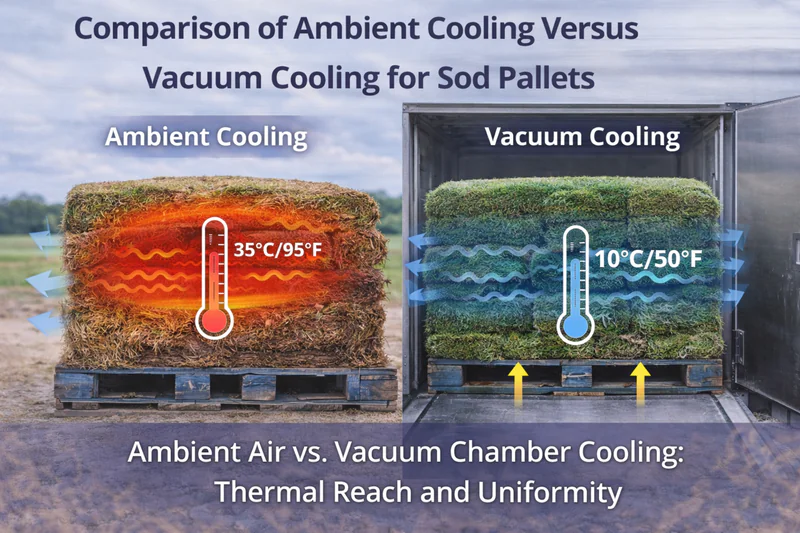
The challenge with most conventional cooling approaches for sod is geometry. Air cooling — whether forced or ambient — depends on surface contact. The outer layers of a sod pallet are accessible to airflow. The interior layers are not.
Forced-air cooling improves on open ambient staging, but it still works primarily from the outside in. For loosely packed or openly structured produce, this is often sufficient. For tightly stacked sod rolls, the inner layers may remain significantly warmer than the outer layers even after an extended period in a cold room or forced-air environment.
This is not a failure of cold-room design. It is a consequence of how sod is harvested and stacked. The product geometry creates an insulating effect that conventional airflow cannot fully penetrate within a commercially useful time window.
Vacuum cooling works differently. The pressure reduction inside the chamber applies uniformly across the entire load, causing water to evaporate from root and soil material throughout the interior of the stack, not only at the surface. This draws heat from the core of the pallet more effectively and more consistently than surface-driven cooling methods.5
For sod producers working with tight delivery schedules, this matters practically. The goal is not simply to achieve an acceptable surface temperature before loading. The goal is to move the internal temperature of the pallet — the temperature the root zone will carry through transport — below the threshold where further heat stress accumulates during the delivery window.
| Cooling method | Heat removal from pallet interior | Typical time to reach core temperature | Practical use in tight dispatch window |
|---|---|---|---|
| Open ambient staging | Minimal | Very slow or incomplete | Unreliable |
| Cold room storage | Moderate | Hours, often incomplete for dense stacks | Borderline for short windows |
| Forced-air cooling | Better than cold room | Faster but still surface-biased | More useful, still limited for stack interiors |
| Vacuum cooling | Uniform across interior | Minutes for the full load | Well-suited for dispatch-window constraints |
Turf Species, Season, and Harvest Conditions All Change the Cooling Requirement
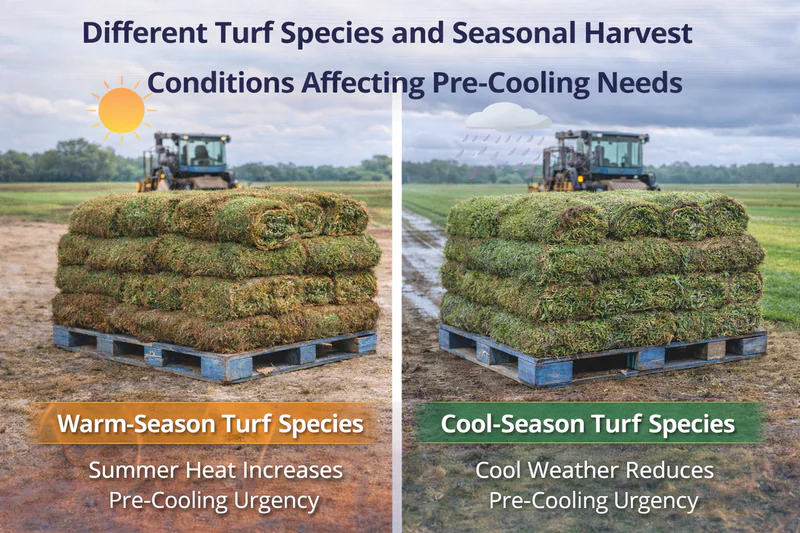
Not all sod operations have the same pre-cooling requirements, and buyers comparing vacuum cooling projects should not assume one configuration works identically across all applications.
The most commercially relevant variables are:
Species and stress tolerance. Warm-season grasses such as bermudagrass and zoysiagrass generally have higher heat tolerance than cool-season species such as kentucky bluegrass or tall fescue. This means cool-season products are often more urgently in need of rapid temperature pull-down before transport, particularly during warm months.
Harvest temperature and field conditions. Turf harvested during the cooler morning hours in spring starts with a lower initial thermal load than turf harvested during a hot afternoon in summer. The starting field temperature is a major factor in how much pre-cooling work is needed and how much quality margin is available before the delivery window becomes critical.
Delivery distance and transport duration. A one-hour local delivery provides more tolerance than a six-hour regional haul. Producers with longer delivery windows should treat pre-cooling as more urgent, not less, because the transport leg gives heat stress more time to accumulate if internal temperatures are not adequately pulled down before loading.
Stacking density and roll format. Operations that stack more densely or use larger roll formats create more challenging internal cooling conditions. These operations should be more conservative in their pre-cooling targets, not less.
From our perspective, this is why vacuum cooling specifications for turf should be reviewed against the specific harvest season, species mix, typical delivery distance, and stacking format of the operation, rather than applied as a single generic configuration.
What Sod Producers Should Confirm Before the Delivery Season Begins
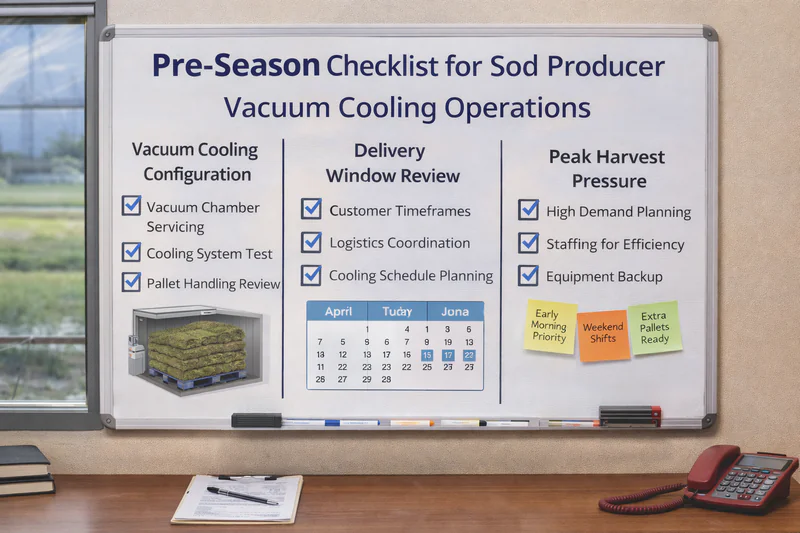
Turf is a seasonal business. The window between early-season soil temperature readiness and late-season heat pressure is relatively narrow in most markets. Operations that have not confirmed their pre-cooling setup before the first peak delivery demand often discover problems under the worst possible timing.
Before the delivery season begins, sod producers should confirm:
Pre-Season Turf Cooling Readiness Checklist
- target internal pallet temperature after pre-cooling is defined, not only surface temperature
- cooling cycle time has been tested against actual harvest stacking format and density, not only an ideal load
- peak-hour harvest volume is estimated for the busiest delivery days, and cooling capacity is reviewed against that figure rather than average weekly output
- the time window between harvest and truck loading has been reviewed and any controllable delay points identified
- delivery route temperature data has been reviewed for the hottest expected transport conditions during peak season
- operator training covers why internal temperature matters and how to confirm cooling consistency across the full pallet, not only the outer layers
- spare parts and service contacts are confirmed before the season starts, not after the first breakdown
- the cooling step is positioned as early as possible in the harvest-to-loading workflow, not as a last step before the truck arrives
Operations that complete this review before the first busy week are in a much stronger position than operations that discover gaps during peak delivery pressure.
FAQ
Is vacuum cooling necessary for all sod operations, or only for long-distance delivery?
Vacuum cooling is most clearly valuable when delivery windows are longer, ambient temperatures during harvest are high, or when cool-season species are being handled during warm months. For short local deliveries in cool conditions, the case is less urgent. But any operation that has experienced unexplained post-installation failure complaints should review whether pre-cooling depth and internal pallet temperature were adequate before ruling out pre-dispatch thermal stress.
Why do sod failures sometimes appear several days after installation if the problem was pre-shipping heat stress?
Because the visible failure of turf after installation depends on what happens when the grass attempts to re-establish root contact with the new soil. Roots compromised by heat stress may still look structurally intact at installation but lack the metabolic capacity to compete for water and nutrients against drying conditions in the establishment period. The failure shows up when establishment demand peaks, not necessarily immediately after installation.
How do producers measure whether vacuum cooling is reaching the interior of the stack?
The most direct method is to use a probe thermometer in the center of a pallet after cooling and compare that reading to the surface temperature. If there is a large discrepancy, the interior of the stack has not been adequately cooled. Over time, tracking this gap across batches helps producers understand which stacking formats and load configurations are most challenging and adjust cycle parameters accordingly.
What is the most common pre-cooling mistake in sod operations?
In our experience, the most common mistake is treating pre-cooling as a staging step rather than a targeted thermal pull-down step. If the cooling cycle time is too short, the load was stacked too densely for the configuration, or the product went into cooling already carrying significant field heat from a long post-harvest wait, the result often looks acceptable on the surface while still failing to reach an adequate internal temperature.
Final Thoughts
The sod that fails after installation rarely failed at installation. In most cases, it was already carrying a thermal debt from the pre-dispatch workflow — a debt that remained invisible through every handling and loading check, and only became visible when the grass ran out of the reserve it needed to establish in the new environment.
From our factory-side perspective, the sod producers who consistently receive fewer post-installation complaints are not always the ones with the best seed varieties or the most experienced installation contractors. They are the ones who treat the harvest-to-loading window as the most commercially consequential quality-protection step in the whole supply chain — and who use pre-cooling not as a box to check before dispatch, but as a genuine tool for protecting what happens after the pallet leaves the farm.
If you want to review your current pre-cooling setup against your species mix, harvest schedule, stacking format, and delivery window, send us those details. We can help you identify where your current workflow is most likely creating a gap between what the product looks like at loading and what it can deliver at installation.
Footnotes
UC Davis Postharvest Technology guidance on turf grass post-harvest handling and temperature sensitivity: https://postharvest.ucdavis.edu/ ↩
Turfgrass Science research on harvested sod thermal stress and viability windows: https://www.turfgrassscience.org/ ↩
FAO guidance on post-harvest temperature management and quality preservation in perishable products: https://www.fao.org/3/x5055e/x5055e00.htm ↩
ASHRAE Refrigeration Handbook — vacuum cooling and evaporative cooling principles for perishable products: https://www.ashrae.org/technical-resources/bookstore/refrigeration-handbook ↩
Turfgrass Producers International — sod industry resources and handling guidance: https://www.turfgrassproducers.com/ ↩
Looking for the right vacuum cooler for your operation?
Allcold engineers work with packhouses and exporters to spec the right system for your product, volume, and site conditions.