
How Vacuum Cooling Removes Bakery Cooling Bottlenecks
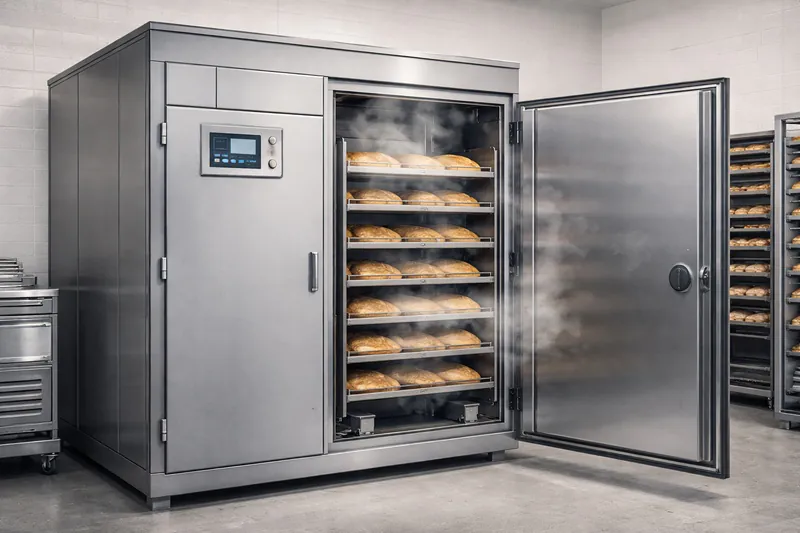
A bakery vacuum cooler can remove a cooling bottleneck by replacing long, variable ambient cooling with a short, controlled batch process. In Allcold bakery catalogue conditions, bread is typically cooled to about 28°C in approximately 3–5 minutes. This is a selection reference, not a universal guarantee: the final cycle depends on bread type, piece size, recipe, loading density, starting temperature, target temperature, and the selected pressure curve.
The useful question is therefore not whether a machine can “double production.” It is whether the existing cooling stage is restricting oven output, slicing, packaging, dispatch, or floor-space utilization—and how much of that restriction can be removed after a product trial.
What Cooling Result Should a Bakery Use for Initial Planning?
For many bread projects, Allcold uses the following catalogue values as the starting point for equipment selection:
| Planning item | Typical reference | What must be confirmed |
|---|---|---|
| Target product temperature | About 28°C | Packaging, slicing, recipe, and customer quality requirement |
| Typical cooling time | About 3–5 minutes | Bread type, piece size, load, starting temperature, and cycle settings |
| Loading method | Trays and bakery trolleys | Trolley width, depth, height, tray spacing, and door clearance |
| Chamber size | Custom-designed | Actual trolley or pallet dimensions and required batch quantity |
| Performance acceptance | Product trial and recorded cycle | Final temperature, cooling uniformity, product weight, texture, and throughput |
Products with different structures cannot be assigned the same cycle automatically. A dense loaf, a soft roll, a cake, and a laminated product may need different pressure reduction rates and holding stages. Before quotation, provide actual product and loading information so the chamber, vacuum system, condenser, and controls can be matched to the application.
How Does Vacuum Cooling Shorten the Cooling Stage?
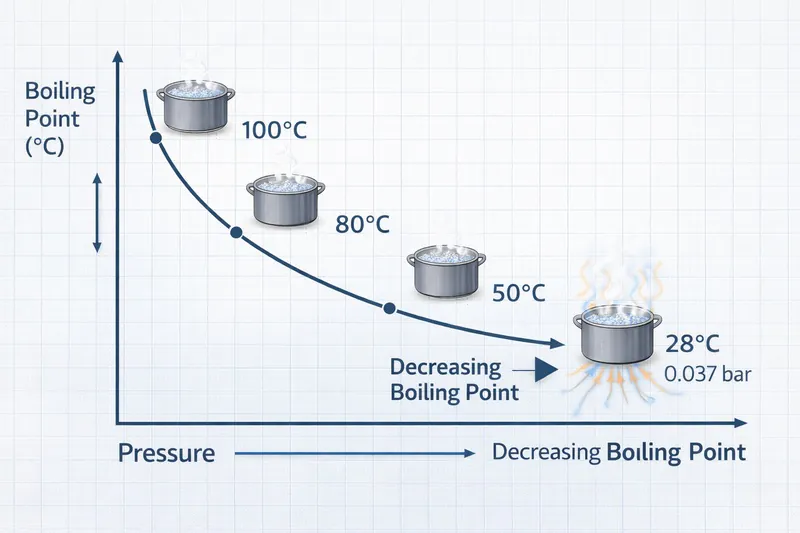
Vacuum cooling lowers the pressure inside a sealed chamber. Under reduced pressure, a small amount of moisture within the hot product evaporates at a lower temperature. That phase change absorbs heat from the product, producing rapid cooling through the load rather than relying only on air reaching the product surface.1
This is why the method can cool bread much faster than leaving loaded trolleys in an ambient room. However, “fast” does not mean uncontrolled. The PLC recipe should manage the pressure reduction rate, target pressure, holding time, and end temperature for the specific product.
The engineering questions include:
- How hot is the product when it enters the chamber?
- What core and surface temperatures are required before the next process?
- How many kilograms, trays, and trolleys are loaded in each batch?
- Is the product exposed, covered, or packed?
- How much variation exists between small and large pieces?
- What cooling-water temperature and site utilities are available?
These inputs determine the actual cycle and equipment configuration.
How Do You Control Product Weight and Bread Quality?
Vacuum cooling removes heat through evaporation, so product weight must be measured during trials. It is not responsible to promise the same moisture result for every recipe.
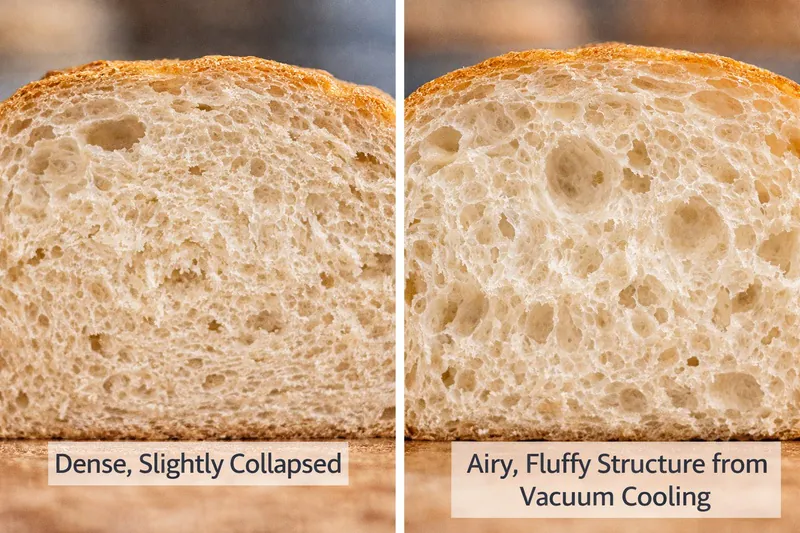
Allcold’s bakery catalogue reports a typical 3–5 minute cooling time and moisture retention above 90% under the stated catalogue conditions. For a real project, the acceptance test should record:
- Product weight before and after cooling.
- Core and surface temperature at several positions in the load.
- Crust, crumb, volume, slicing behavior, and texture.
- Cooling uniformity between the top, center, and bottom trays.
- Quality after the customer’s normal packaging and storage period.
If weight loss is higher than expected, the solution is not to make a blanket claim. The pressure curve, holding time, loading pattern, and target temperature should be reviewed using the actual product. The aim is a repeatable balance between cooling speed and required product quality.
How Can Faster Cooling Improve Packaging and Scheduling?
A shorter, predictable cooling stage can make downstream planning easier, but the gain should be calculated from the bakery’s real line data.
Potential improvements include:
- Reducing the waiting time between oven discharge and slicing or packaging.
- Making packaging start times more predictable between batches.
- Reducing the number of trolleys parked in a cooling area.
- Releasing trolleys and trays sooner for the next production cycle.
- Helping dispatch teams work from a controlled cooling schedule.
- Reducing exposure to changing ambient temperature and humidity.
The best baseline is a simple time study. Record when each batch leaves the oven, reaches the required packaging temperature, enters packaging, and leaves the facility. After a trial, repeat the same measurements with vacuum cooling. This shows the real throughput improvement without relying on phrases such as “90% more productivity” or “double capacity.”
How Is the Chamber Designed Around Trolleys or Pallets?
The chamber should be designed around the customer’s loading system—not the other way around. Allcold normally needs the trolley or pallet footprint, total loaded height, number of units per batch, tray spacing, and aisle or forklift requirements.
A practical selection process is:
- Define the product: bread type, piece weight, recipe, starting temperature, target temperature, and required quality.
- Define the batch: kilograms per batch, trays per trolley, trolley or pallet quantity, and loading frequency.
- Measure the load: trolley or pallet width, depth, total height, wheel or runner arrangement, and door clearance.
- Confirm utilities: electrical supply, cooling-water temperature and flow, drainage, compressed air if required, and installation environment.
- Run a product trial: agree on cooling time, final temperature, temperature uniformity, weight change, and quality checks.
- Confirm line integration: loading direction, door arrangement, floor level, cleaning access, safety area, and connection with oven and packaging schedules.
This information is more useful than selecting a chamber from nominal dimensions alone.
How Can Vacuum Cooling Change Floor-Space Requirements?
A vacuum cooler uses a chamber and batch loading area rather than a long passive cooling route. This may reduce the number of trolleys waiting between the oven and packaging, but the actual space saving depends on the existing factory layout and production schedule.
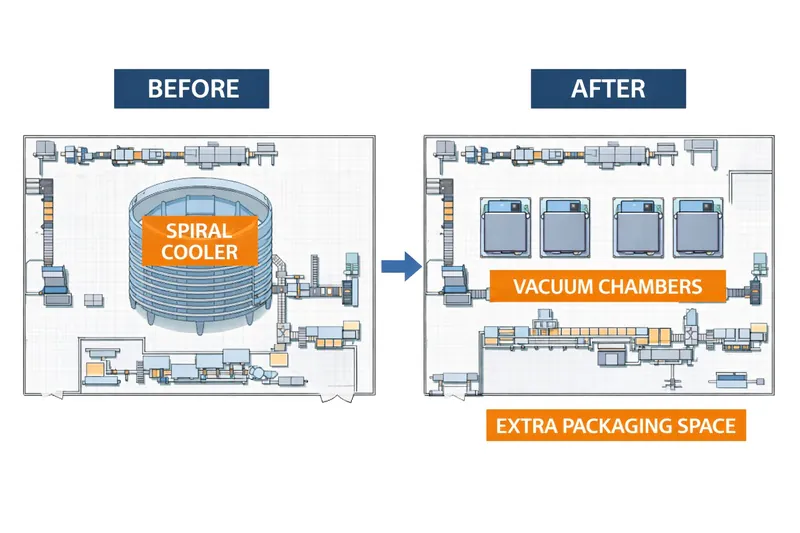
Before claiming a space saving, compare:
- Existing cooling-room or conveyor footprint.
- Trolley parking and circulation area.
- Vacuum chamber, service clearance, and loading area.
- Peak queue length between oven and packaging.
- Future production expansion and maintenance access.
A layout drawing with the real trolley path is normally more reliable than comparing equipment dimensions in isolation.
How Should a Bakery Evaluate Energy and Total Cost?
Peak motor power alone does not show the total cost per kilogram of product. A vacuum cycle uses significant power for a short period, while conventional systems may use lower power for much longer. The comparison should be based on measured energy, actual batch weight, and the complete cooling process.
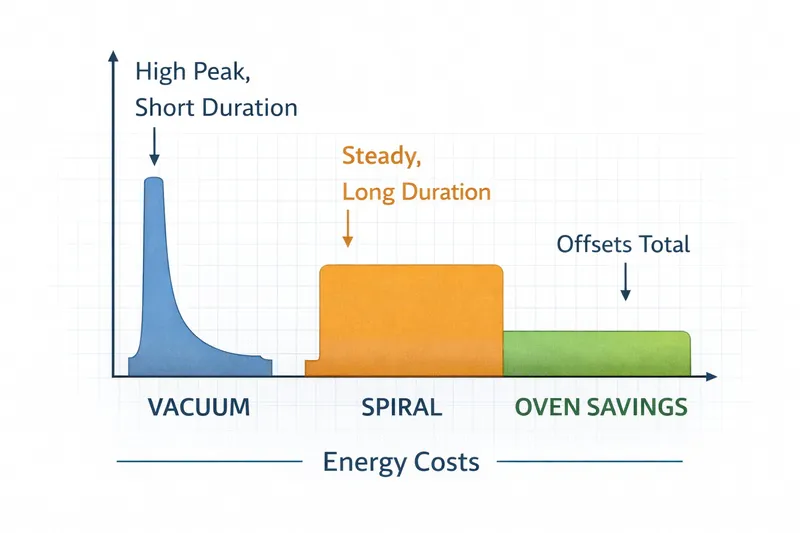
Use the following inputs:
| Cost area | Data to collect |
|---|---|
| Electricity | kWh per cooling cycle and kWh per kilogram |
| Water | Cooling-water flow, temperature, treatment, and seasonal variation |
| Labor | Loading, unloading, trolley handling, cleaning, and supervision |
| Floor space | Cooling area, trolley queue, service clearance, and expansion value |
| Maintenance | Pumps, refrigeration system, seals, filters, controls, and scheduled service |
| Product result | Weight change, rejects, slicing performance, and verified saleable yield |
| Throughput | Batches per shift and the actual constraint at oven, cooler, packaging, or dispatch |
Do not include assumed oven-time reductions or guaranteed shelf-life gains unless they have been demonstrated with the customer’s recipe and process. A sound investment calculation separates measured trial results from projected operational savings.
When Is Vacuum Cooling a Good Fit?
Vacuum cooling is most attractive when cooling is a measurable bottleneck, products can be loaded consistently, the target temperature is clearly defined, and rapid batch cooling improves the next production step.
It may require further testing when products have unusual fillings or coverings, very different sizes in the same batch, strict surface-moisture requirements, or packaging that limits evaporation. In those cases, a product trial and an agreed acceptance protocol should come before the final equipment specification.
Conclusion
Bakery vacuum cooling should be evaluated as an engineered process, not as a universal promise to double production. The catalogue starting point—cooling bread to about 28°C in roughly 3–5 minutes—can remove a major waiting stage, but the real business result must be calculated from the customer’s product, trolleys or pallets, batch flow, utilities, and downstream packaging requirements.
View Allcold bakery vacuum-cooling systems or send your product and trolley details for selection.
The relationship between vapor pressure and temperature explains why water can evaporate at lower temperatures when pressure is reduced: USGS Water Science School. ↩

Mila
You May Also Like

When Should You NOT Use Vacuum Cooling for Your Bakery?
Are you tired of waiting hours for your bread to cool down while your profits evaporate? You might think vacuum

Is Your Cooling Strategy Burning Your Profits? A Cost-Benefit Analysis of Vacuum vs. Conventional Cooling
As a bakery owner, you look at your balance sheet every month. You see the cost of ingredients, labor, and
Hybrid Cooling Solutions: Can Combining Vacuum and Traditional Methods Save Your Bakery?
Are you torn between the speed of new technology and the reliability of traditional freezing? Many bakery owners feel they
Blast Freezers vs Vacuum Coolers: Which Is the Right Choice for Your Bakery?
Are you tired of watching your freshly baked bread sit on racks for hours, taking up valuable space while you

Bakery Vacuum Cooling vs Spiral Cooling Systems: Which Is Better for Your Business?
Are you struggling with slow production lines because your bread takes forever to cool down? You are not alone. Cooling
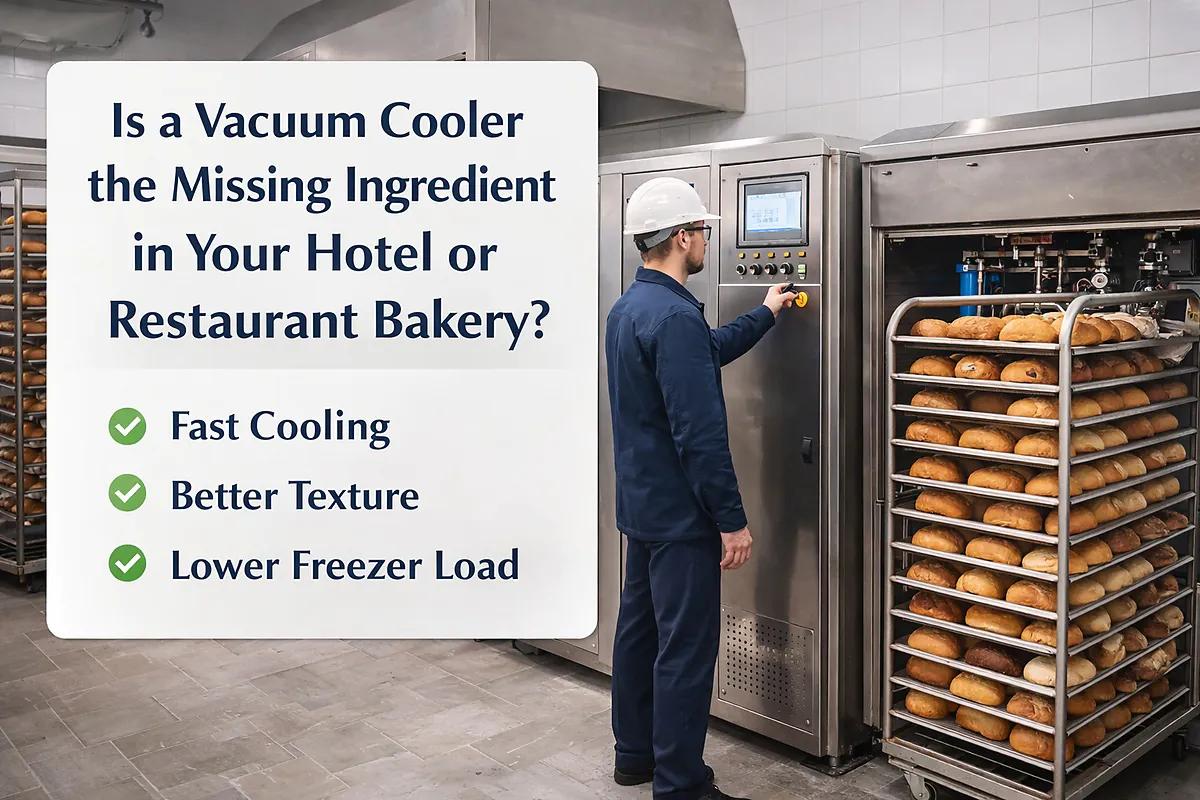
Is a Vacuum Cooler the Missing Ingredient in Your Hotel or Restaurant Bakery?
Imagine your kitchen is in full swing, and the freshly baked bread is finally out of the oven, but it
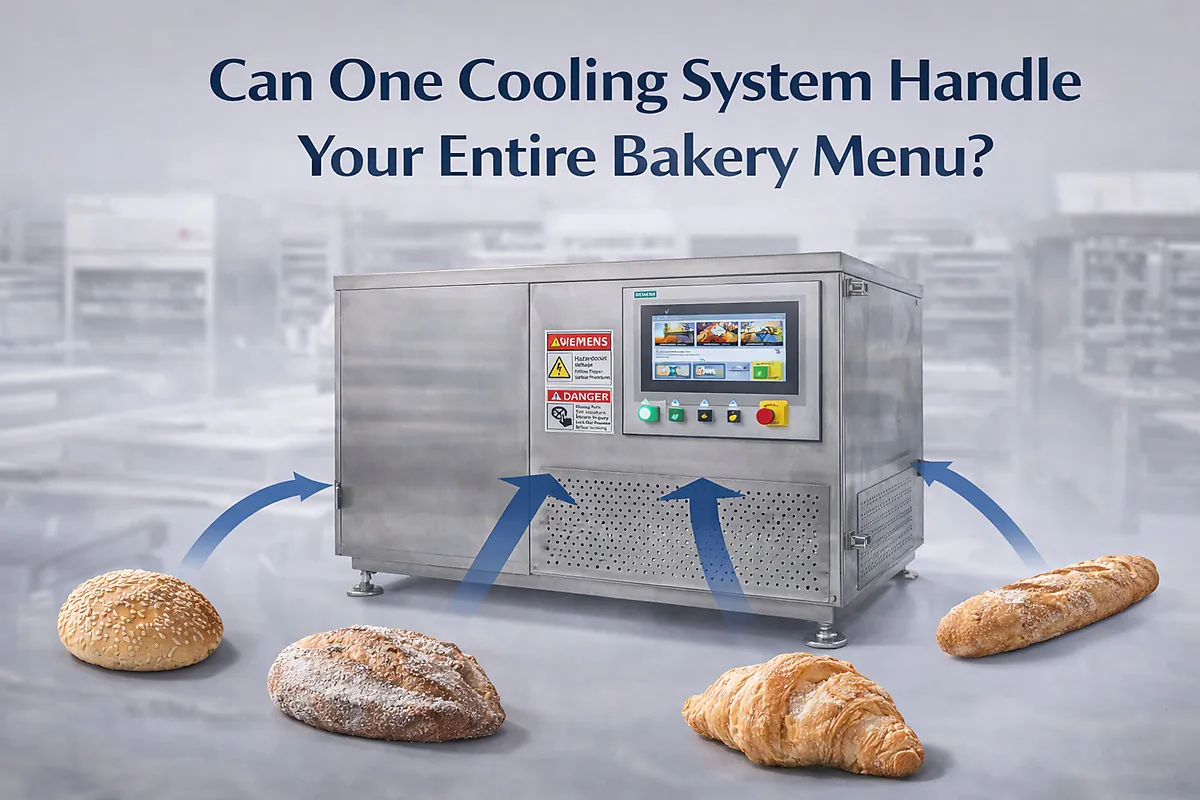
Can One Cooling System Handle Your Entire Bakery Menu?
You juggle sourdough, delicate pastries, and frozen dough lines daily. Yet, one cooling mistake ruins the texture of your artisan

Is Your Frozen Dough Production Losing Quality Before It Hits the Freezer?
You watch your energy bills climb month after month while your blast freezers work overtime. You see production bottlenecks form
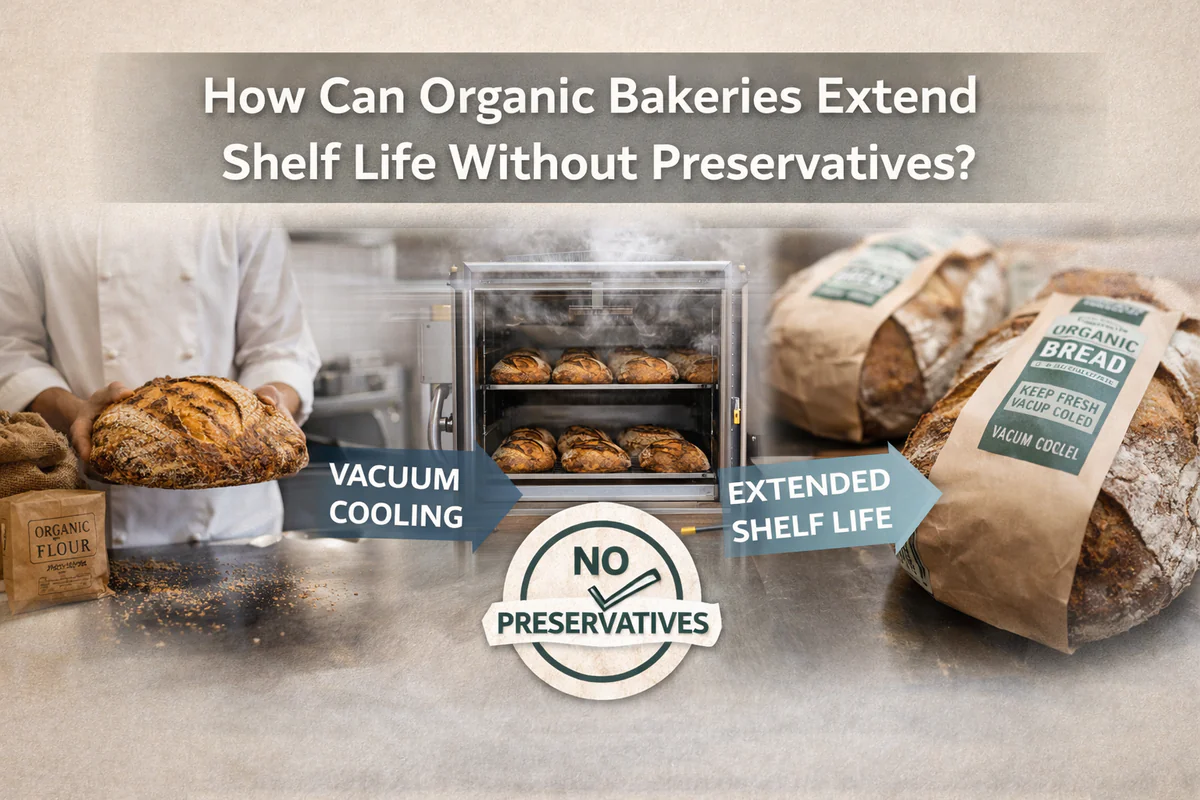
How Can Organic Bakeries Extend Shelf Life Without Preservatives?
You pour your heart into sourcing the finest organic flours and perfecting natural fermentation, only to watch your hard work
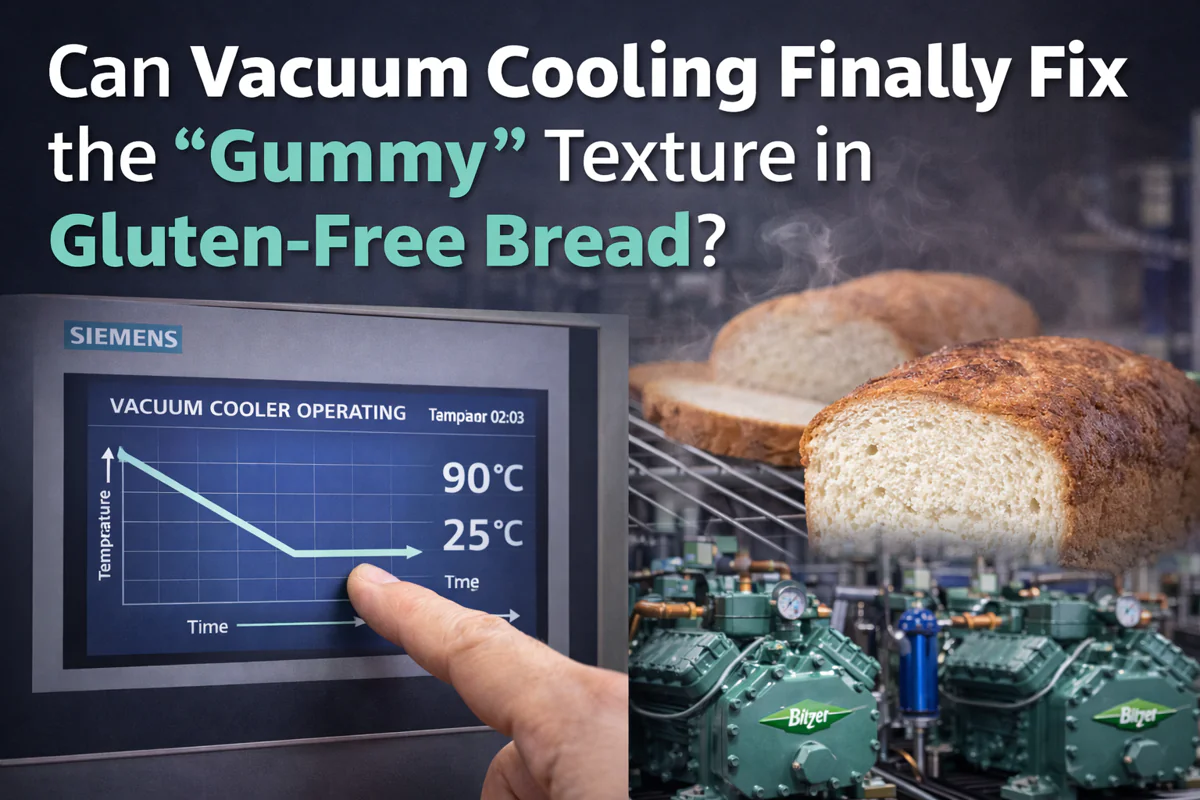
Can Vacuum Cooling Finally Fix the "Gummy" Texture in Gluten-Free Bread?
You watch your perfectly risen gluten-free loaves come out of the oven, only to see them sink or turn gummy