
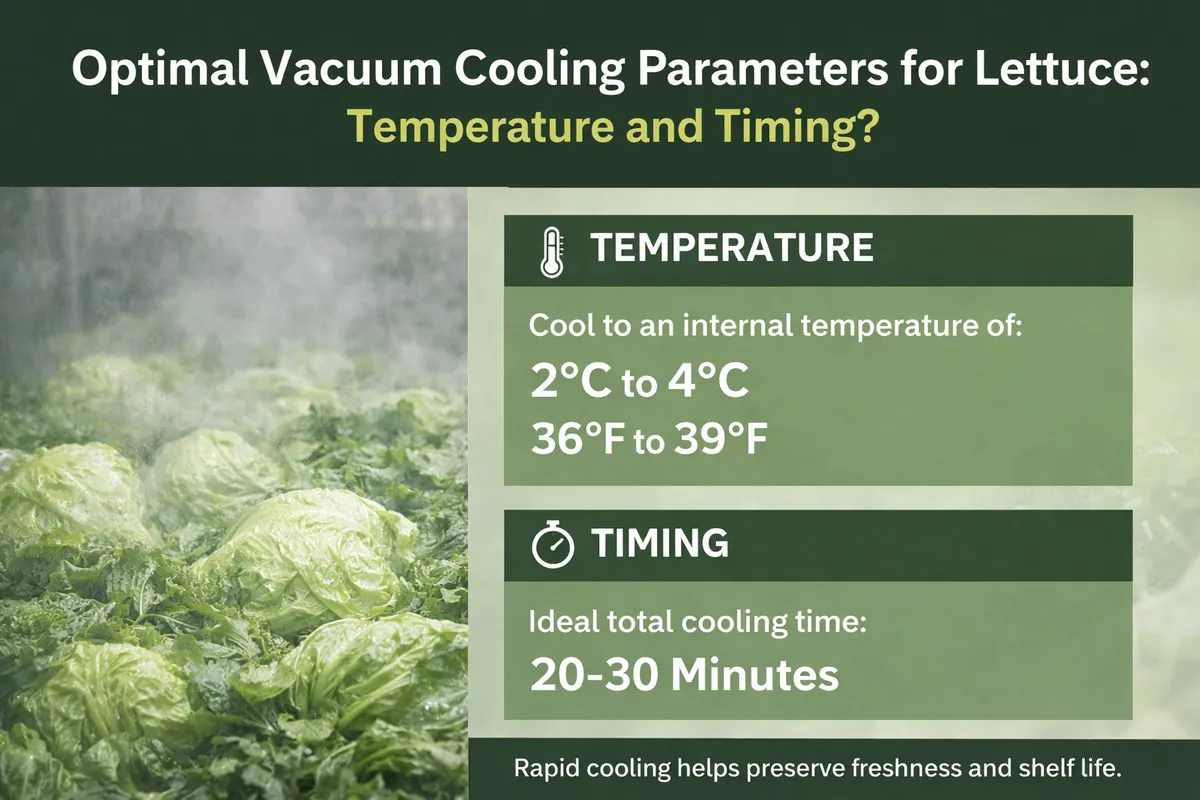
Optimal Vacuum Cooling Parameters for Lettuce: Temperature and Timing?
In the world of post-harvest preservation, precision is the difference between a crisp, profitable shipment and a slimy, rejected claim. Cooling lettuce isn’t just about making it cold; it’s about hitting the exact biological sweet spot before the tissue degrades.
The optimal vacuum cooling parameters for most lettuce varieties involve reaching a core temperature of 2°C to 4°C within a cycle time of 20 to 30 minutes. Achieving this requires managing the "Flash Point" (approx. 6 millibars), controlling the pressure drop rate to prevent freezing, and utilizing soak times to ensure the heart of the product equals the surface temperature.
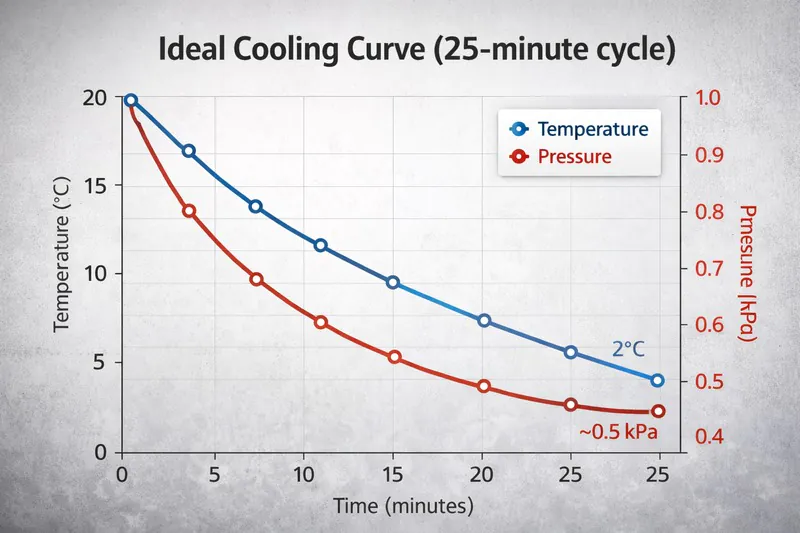
At Allcold, I often tell my clients like Norman in the USA or Carlos in Mexico: "A vacuum cooler is a time machine, but only if you set the dial correctly." If you cool too slowly, the lettuce continues to respire and decay. If you cool too aggressively, you risk freezing the outer leaves or exploding the cell structure of delicate greens. Finding the perfect recipe involves balancing thermodynamics with biology. In this deep dive, I will walk you through the critical parameters—Flash Point, Target Temperature, Cycle Duration, and Holding Time—that we program into every Allcold AVC machine to guarantee perfection.
The Flash Point: At What Pressure Does Cooling Actually Start?
Many operators think cooling begins the moment they press "Start." It doesn’t. The machine is just pumping air until physics takes over. When does the magic happen?
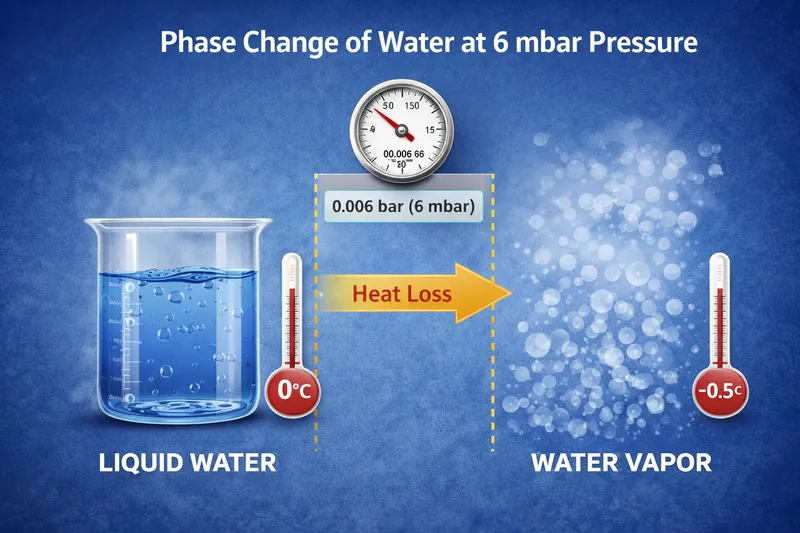
Cooling only begins at the "Flash Point," which occurs at approximately 6.0 to 6.6 millibars (mbar) of pressure. Until the vacuum chamber reaches this specific level, the water inside the lettuce remains liquid. Once this threshold is crossed, the water "flashes" into vapor, absorbing heat instantly.
Understanding the Physics of 6 Millibars
To master vacuum cooling, you must understand the relationship between pressure and the boiling point of water.
At sea level (1013 mbar), water boils at 100°C. That is useless for cooling lettuce.
As our vacuum pumps evacuate the air from the AVC chamber, the pressure drops rapidly.
- 1013 mbar to 30 mbar: Nothing happens to the lettuce temperature. The machine is simply removing air.
- 20 mbar: The boiling point of water drops to about 17°C. If your lettuce is 30°C coming from the field, evaporation starts here, but slowly.
- 6.6 mbar: This is the magic number. At this pressure, the boiling point of water is exactly 1°C to 2°C. This is the Flash Point1.
The Operator’s Goal
The goal of the first phase of the cycle is to get from atmospheric pressure down to the Flash Point as quickly as possible.
In our AVC systems, we use high-capacity vacuum pumps (often Busch or Leybold) to sprint to this 6 mbar line.
Why speed matters here: Every minute spent getting to the Flash Point is a minute the lettuce is still respiring and generating heat.
However, once we hit 6 mbar, we must slam on the brakes. If we continue pumping at full speed past 6 mbar, the pressure will drop to 4 mbar or 3 mbar. At 4 mbar, water boils at -5°C. This means the water inside your lettuce will turn to ice, destroying the cell walls.
Therefore, the Optimal Parameter2 for the start phase is: Maximum Pump Speed until 10-12 mbar, then regulate.
Table: Pressure vs. Boiling Point
| Chamber Pressure (mbar) | Water Boiling Point (°C) | Status for Lettuce |
|---|---|---|
| 1013 mbar | 100°C | No Cooling |
| 50 mbar | 33°C | No Cooling (Field Temp) |
| 23 mbar | 20°C | Slow Evaporation Starts |
| 12 mbar | 10°C | Active Cooling |
| 6.1 mbar | 0°C | DANGER ZONE (Freezing) |
The Target Temperature: Is 1°C Better Than 3°C?
Farmers often want "as cold as possible." But in the fresh produce business, there is a fine line between "cold" and "frozen." What is the safest, most effective target?
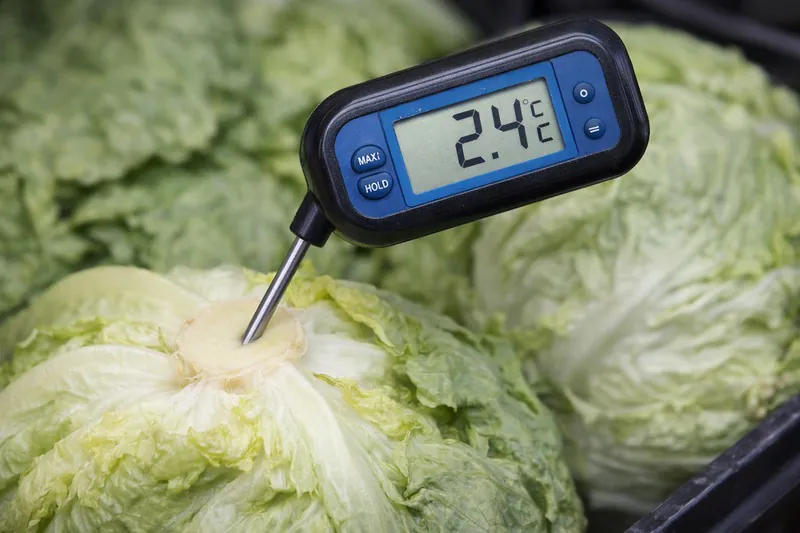
For most lettuce varieties (Iceberg, Romaine, Butterhead), the optimal target temperature is between 2°C and 4°C. Aiming for 1°C is dangerous because slight sensor inaccuracies or variations in product density can lead to localized freezing damage, which ruins the texture and shelf life.
The Margin of Safety
I have seen clients set their machines to 0.5°C because they want to impress their buyers. This is a mistake.
Lettuce is mostly water, but it contains salts and sugars, which depress the freezing point slightly below 0°C (typically around -0.2°C to -0.5°C). However, vacuum cooling is not perfectly uniform at the microscopic level.
If your target is 1°C, the outer leaves—which have the most surface area and least mass—might hit -1°C momentarily while the core is still at 2°C. That momentary dip causes Freezing Injury3. The leaves will look dark, glassy, and water-soaked upon thawing.
My Recommendation for Allcold Clients
I advise programming the Cut-Off Temperature4 (the point where the cycle stops) at 2.5°C for Iceberg and 3.0°C for Romaine.
Why? Because of "coast-down." Even after the vacuum pump stops and the chamber begins to repressurize, the core of the lettuce will continue to equalize with the outer layers. A product stopped at 3°C will often stabilize at a uniform 2°C within 10 minutes of sitting in the cold room.
This conservative approach guarantees you avoid freezing while still achieving the massive respiration reduction needed for a 21-day shelf life.
Cycle Duration: Speed vs. Quality?
Time is money. Every minute the machine runs costs electricity and creates a bottleneck in the packing house. But can you cool too fast?
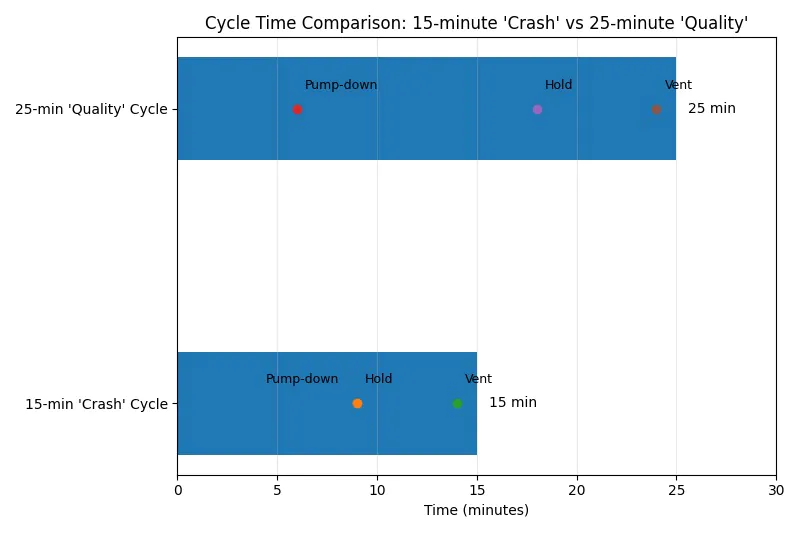
The ideal cycle duration is typically 20 to 30 minutes. While it is physically possible to cool faster (e.g., 15 minutes), rapid pressure drops can cause "explosive boiling," damaging the cell structure of delicate leaves. A slightly longer cycle allows for gentler evaporation and better temperature uniformity.
The Risk of Explosive Boiling
Imagine opening a bottle of soda that has been shaken. That is what happens inside a plant cell if you drop the pressure too fast.
When water turns to vapor under vacuum, it expands roughly 1,700 times in volume. This vapor needs to escape through the natural pores of the lettuce.
If we force the cooling cycle to finish in 15 minutes, the rate of vapor generation exceeds the rate at which it can escape. The internal pressure builds up and ruptures the cell walls.
- Iceberg Lettuce5: Can tolerate faster cycles (18-22 mins) because it is structurally robust.
- Spinach / Baby Leaf: Needs slower cycles (25-30 mins) to allow vapor to escape gently.
Optimizing the Curve
In our AVC software, we use a Pulsed Pull-Down6.
Instead of a straight line drop in pressure, the machine pulls down to, say, 20 mbar, holds for 60 seconds, then pulls to 15 mbar, holds, and so on.
This creates a "Step-Down" curve.
- Benefit 1: It prevents the violent boiling that damages tissue.
- Benefit 2: It allows heat from the center of the stem (Romaine heart) to migrate to the surface.
While this adds 5-8 minutes to the cycle, the improvement in quality—crisper leaves, less bruising—is worth it for premium markets.
Soak Time: The Secret to Uniformity?
When the probe hits 2°C, should the door open immediately? No. This is where amateurs make mistakes. The "Soak" is where quality is locked in.
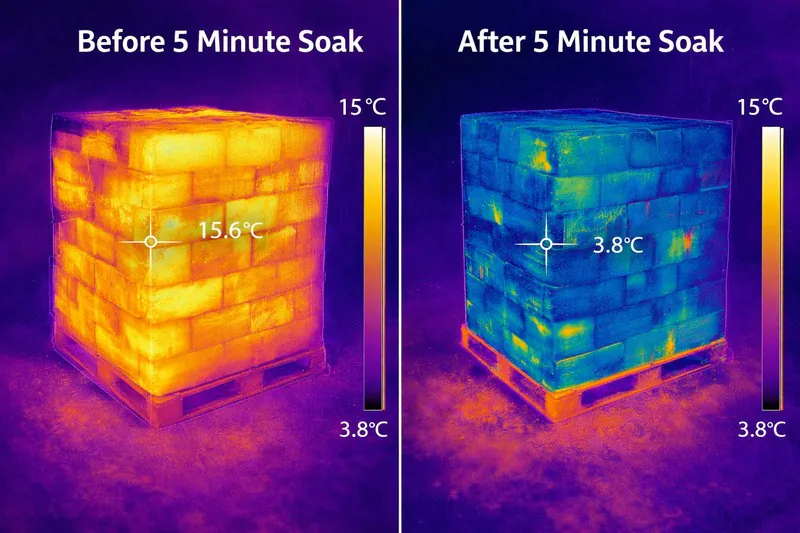
"Soak Time" or "Holding Time" is a period kept at the final vacuum level (e.g., 6 mbar) for 2 to 5 minutes after the target temperature is reached. This ensures that the core temperature of dense products (like Romaine hearts) equalizes with the surface temperature, eliminating hot spots.
The Core-Surface Lag
Temperature probes are usually placed in one or two representative heads of lettuce. But a pallet contains hundreds of heads.
There is always a slight lag between the surface temperature and the absolute geometric center of a dense vegetable.
If the machine cuts off the moment the probe hits 2°C, the center might actually be 4°C.
Once the pressure is released and the pallet goes into storage, that 4°C heat will radiate out, warming the whole box back up to 3°C or higher.
Implementing the Soak
We program a Holding Phase7 at the end of the cooling curve.
Once the sensors read the target (e.g., 2.5°C), the vacuum pump modulates to maintain that exact pressure for an additional 3 to 5 minutes.
During this time, no further cooling of the surface happens (because we aren’t dropping the pressure lower), but the internal heat from the core has time to travel out and evaporate.
This ensures that when the door opens:
- The core is 2.5°C.
- The surface is 2.5°C.
- The box is 2.5°C.
This absolute uniformity is the hallmark of professional vacuum cooling and prevents "Pink Rib8" in Romaine and slime in bag salads.
Pre-Wetting: When and How Much Water to Add?
Vacuum cooling dries things out. For some products, this weight loss is money loss. How do we cool without losing weight?
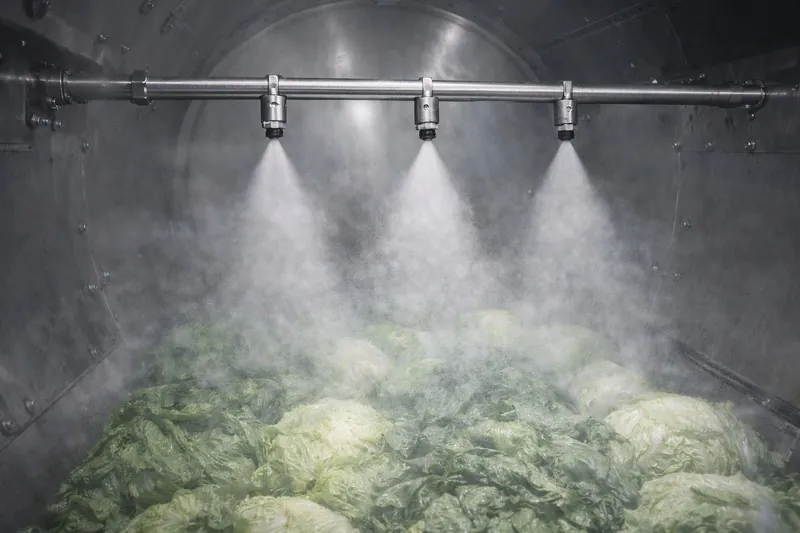
For wilt-sensitive crops or when selling by weight, "Hydro-Vacuum" parameters should include a pre-wetting cycle. Spraying 2-3% of the product’s weight in water before cooling allows the machine to evaporate the added surface water instead of the plant’s internal moisture.
The Economics of Weight Loss
Physics dictates that to cool lettuce by 30°C (from 32°C to 2°C), you must evaporate about 3% of its mass9.
If you are shipping 10,000 kg of lettuce a day, that is 300 kg of product disappearing into thin air. That is lost revenue.
Furthermore, for delicate items, losing 3% moisture might make them look limp.
The Hydro-Vacuum Parameter
To counter this, our AVC machines have a Hydro-Spray Option10.
- Timing: The spray happens inside the chamber, immediately before the vacuum pump starts.
- Quantity: We program the spray duration to add exactly the amount of water we expect to lose (e.g., 20 liters for a 1-pallet cycle).
- Result: The vacuum pump evaporates this "free water" first. The latent heat of vaporization is satisfied by the surface water. The lettuce cools down, but its internal cell water remains 100% intact.
Critical Parameter: The water used must be sanitized and chilled if possible, though tap temperature is acceptable since it will boil off immediately. This parameter is essential for clients in arid regions like the Middle East or Arizona.
Venting Speed: The Final Danger Zone?
The cycle is done. The lettuce is cold. Can we just open the door? Not so fast. Rushing the repressurization can undo all your hard work.
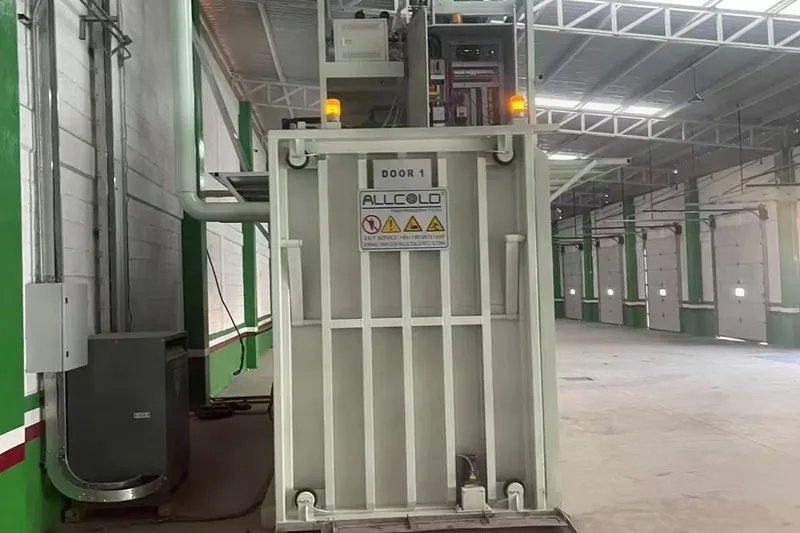
The "Venting" or "Repressurization" phase must be controlled. If air rushes back into the chamber too quickly (under 60 seconds), the turbulence can damage packaging and even bruise the delicate leaves. A controlled vent time of 2 to 3 minutes is optimal.
The Wind Tunnel Effect
When the vacuum cycle finishes, the chamber is at near-zero pressure. Outside, the atmosphere is heavy.
If you open the main vent valve fully, air rushes in at almost the speed of sound.
I have seen this happen on older, manual machines:
- Packaging Damage: Cardboard boxes collapse or blow open.
- Product Damage: The sheer force of the wind can bruise the outer leaves of Spinach or Butterhead lettuce.
- Contamination: If the incoming air is not filtered, you are blasting dust and spores deep into the clean lettuce.
The Soft Vent Parameter
On Allcold AVC machines, we use a Soft Vent parameter.
- Stage 1 (0-60 seconds): A small bypass valve opens, allowing air to trickle in slowly. This brings the pressure up gently, preventing turbulence.
- Stage 2 (60+ seconds): Once the pressure differential is lower, the main valve opens to finish the job.
- Filtration: All intake air passes through a 5-micron filter to ensure that the air re-entering the chamber is as clean as the lettuce inside.
This final step, often overlooked, ensures the product looks pristine when the customer opens the box.
Conclusion
Optimizing vacuum cooling is not about maximum power; it is about maximum control. The perfect cycle for lettuce is a carefully choreographed dance: a sprint to the Flash Point (6 mbar), a controlled deceleration to prevent freezing (stopping at 2.5°C – 3°C), a steady soak to ensure uniformity, and a gentle repressurization to protect the package. By mastering these parameters—Temperature, Pressure, Time, and Venting—you transform your Allcold AVC machine from a simple cooler into a precision instrument for profit. It’s the difference between shipping a vegetable and shipping a promise of quality.
-
Understanding the Flash Point is crucial for effective vacuum cooling, ensuring optimal temperature control for produce. ↩
-
Exploring the Optimal Parameter helps in mastering vacuum cooling techniques, enhancing efficiency and preserving quality. ↩
-
Understanding Freezing Injury is crucial for maintaining lettuce quality. Explore this link to learn prevention techniques. ↩
-
Discover the best practices for setting Cut-Off Temperatures to ensure optimal freshness and shelf life for your produce. ↩
-
Discover the unique properties of Iceberg Lettuce that allow it to withstand faster cooling, ensuring better preservation. ↩
-
Explore this link to understand how Pulsed Pull-Down technology enhances food quality and safety during processing. ↩
-
Understanding the Holding Phase is crucial for achieving uniform cooling in vegetables, ensuring quality and freshness. ↩
-
Exploring the causes of Pink Rib can help in preventing this issue, ensuring better quality and marketability of Romaine lettuce. ↩
-
Learn about the implications of losing 3% of mass in food shipping and how it impacts revenue and product quality. ↩
-
Explore this link to understand how the Hydro-Spray Option can enhance food preservation and reduce product loss. ↩

Mila
You May Also Like
Buying a Vacuum Cooler for Fresh Produce Export? Avoid These Costly Procurement Mistakes
Buying a vacuum cooler for fresh produce export is not simply a machine purchase. It is a project decision that
How Much Produce Shrink Can Better Pre-Cooling Prevent in Export Projects?
Produce shrink in export projects is not simply a freshness problem. It is a commercial problem that compounds across every
Technical Specifications of Industrial Lettuce Vacuum Cooling Systems?
Buyers often look at a quote and only see the price. They ignore the technical specifications. This is a mistake.
Lettuce Vacuum Cooler Capacity Guide: Sizing for Your Operation?
Investing in a vacuum cooler is a significant decision, but choosing the wrong size can be an even more expensive
Field-to-Fork: Lettuce Vacuum Cooling in the Cold Chain Process?
We often talk about "freshness" as if it were magic, but in the lettuce business, freshness is purely a matter
Vacuum Cooling Organic Lettuce: Best Practices for Premium Quality?
Organic lettuce is a promise to the consumer: no chemicals, no shortcuts, just nature. But without the safety net of
Pre-Cooling Lettuce: Why Vacuum Cooling is the Industry Standard?
In the fresh produce industry, the clock starts ticking the moment a knife cuts a stem. For lettuce, heat is
Vacuum Cooling Different Lettuce Varieties: Is One Setting Enough for All?
Not all lettuce is created equal. A dense head of Iceberg is a fortress of water, while delicate Baby Spinach
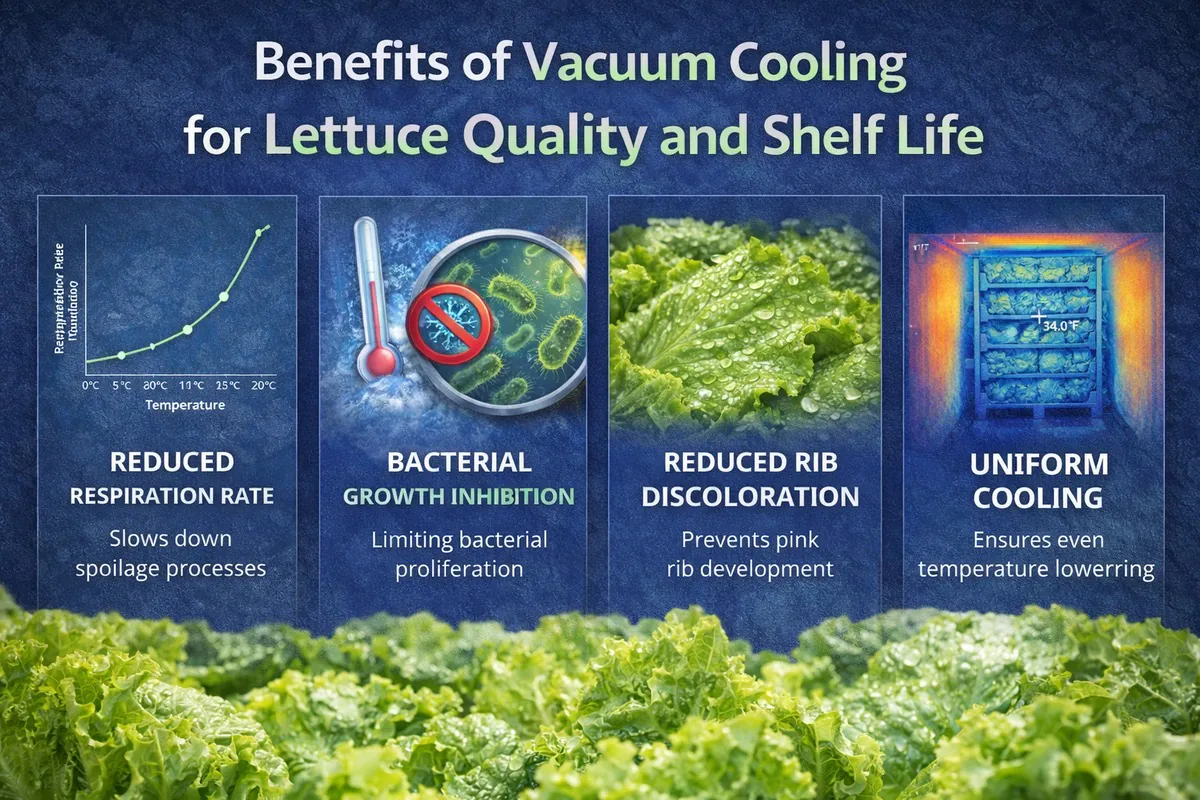
Benefits of Vacuum Cooling for Lettuce Quality and Shelf Life?
Lettuce is 95% water, wrapped in cdsfvxgba fragile green skin. Once harvested, it is fighting a losing battle against heat
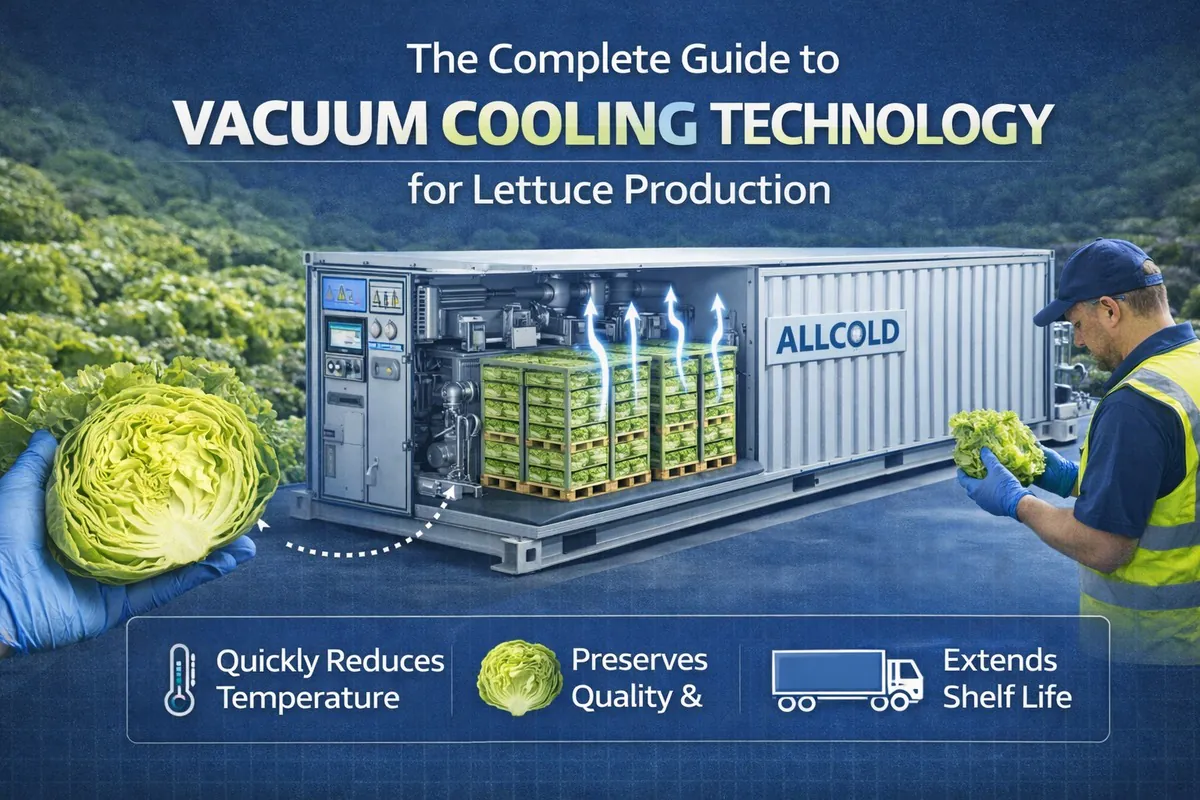
The Complete Guide to Vacuum Cooling Technology for Lettuce Production?
Lettuce is a race against nature. From the moment the stem is cut in the field, respiration heat begins to