
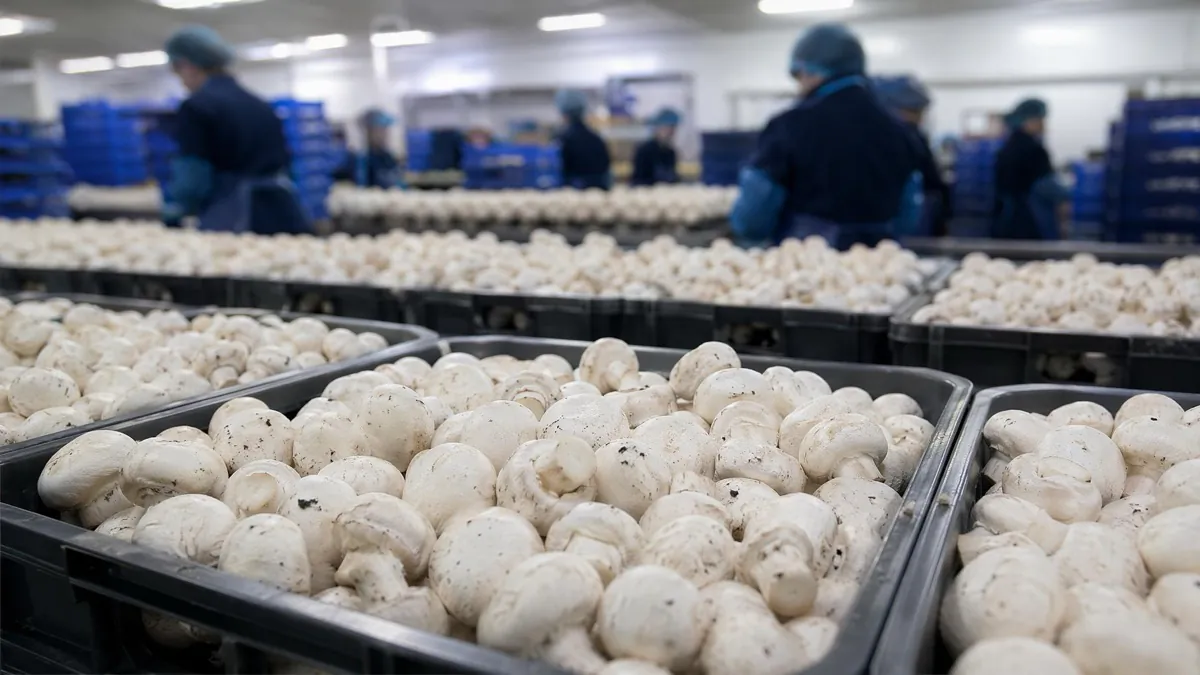
Why Mushroom Exporters Lose the Most Shelf Life in the First Hour After Harvest
The complaint usually sounds the same: the mushrooms looked fine at packing, temperature was controlled during transport, and the cold room checked out. But the buyer is still reporting softening, browning, or shelf life below expectation. The exporter reviews every step they can measure and finds nothing obviously wrong.
In most cases like this, the problem was decided before the packing team ever handled the product.
Fresh mushrooms have one of the highest respiration rates of any commercial produce category. At typical harvest temperature, a mushroom is metabolically active at a rate that may be 10 to 15 times higher than it would be at near-zero storage temperature. Every minute at ambient temperature after cutting is not neutral waiting time. It is quality being spent at the fastest rate it will ever be spent in the whole post-harvest chain.
The first hour after harvest is not a logistics window. It is a biological countdown. What happens inside it determines more about destination quality than most of what comes after.
Most mushroom export operations track quality from packing onward — temperature at dispatch, carton integrity in transit, cold room performance at destination. Those are reasonable checks. They are also focused on the wrong part of the timeline. By the time packing begins, the shelf-life margin available for export has already been shaped by what happened in the first hour. This article is about what that looks like in practice, why it is so commercially damaging, and what operations can do to close the gap.
Mushrooms Respire Faster Than Almost Any Other Export Produce, and Temperature Controls the Rate
To understand why the first hour matters so much for mushrooms, it helps to understand what is happening inside the product immediately after harvest.
When a mushroom is cut, it does not stop its biological activity. Respiration continues, drawing on carbohydrates, releasing heat, and gradually breaking down the cellular structure that gives the cap its firmness and the surface its commercial appearance. The higher the temperature, the faster this process runs.
For mushrooms, the respiration rate at typical harvest temperatures is substantially higher than it is for most vegetables. At 20°C, a fresh mushroom may respire at a rate 10 to 15 times higher than it would at 0°C. That ratio is not unusual for mushrooms specifically — it reflects the fact that fungi in general are highly metabolically active at warm temperatures, and that commercial mushroom varieties have been selected for rapid growth rather than post-harvest durability.[^1]
What this means commercially is that the damage from one hour at harvest temperature is not equivalent to one hour in transit at 2°C. It is not even close. The warm first hour consumes quality margin at a rate that controlled cold storage simply cannot match in reverse. Cooling can slow the rate of further loss. It cannot restore what the first warm hour already spent.
This is the foundation of the whole argument for rapid pre-cooling in mushroom export. Not that cooling is useful. But that the window in which it must happen — to actually protect the destination result — is much narrower than most export workflows are designed to respect.
The First Hour Is When Cap Opening, Browning, and Moisture Loss Begin
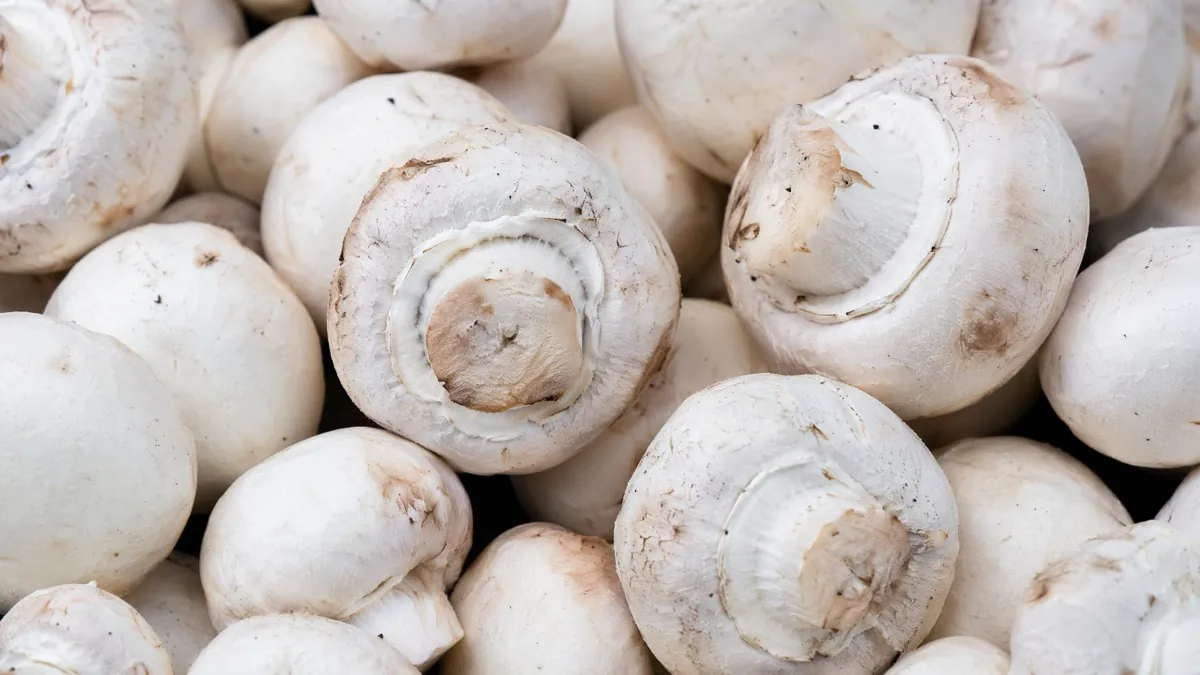
The commercial quality of an exported mushroom is judged on a small number of visible and tactile attributes: cap closure, surface color, firmness, and absence of browning or weeping. All of these attributes begin changing from the moment of harvest. The question is how fast.
Cap opening is driven partly by continued growth activity and partly by temperature-driven respiration. A mushroom that is kept at warm ambient temperature for an extended period after harvest will open its cap faster than one that is pulled down to near-zero temperature within minutes. For export mushrooms, cap closure is a direct market-value attribute. An opened cap reduces price tier, triggers quality disputes, and narrows the window between dispatch and usable destination shelf life.
Surface browning in mushrooms is an enzymatic process that accelerates with temperature and mechanical stress. Every handling step at warm temperature increases the enzymatic activity that drives surface discoloration. The first hour, when the product is at its warmest and often being moved, sorted, and staged, is when enzymatic browning potential is at its highest.
Moisture loss from the surface and from the gills begins immediately after harvest and is temperature-dependent. Mushrooms that lose moisture before cooling are not only lighter — they also carry more condensation risk once cold-room entry compresses the remaining moisture against the cooled surface.[^2]
These three processes — cap opening, browning, and moisture loss — are not prevented by cooling after they have started. They are slowed. The first hour determines how far they have already progressed before the cooling step has any chance to help.
Most Harvest-to-Cooler Workflows Have More Delay Than Operations Realize
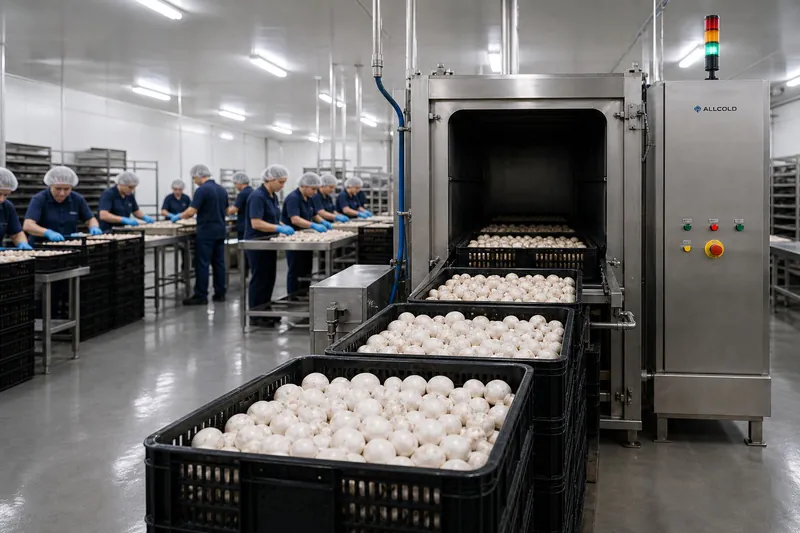
One of the most consistent findings when we review mushroom export operations is that the actual time between harvest and the start of cooling is longer than the operation believes it to be.
This is not because operations are careless. It is because the delay is distributed across multiple small steps that individually look unremarkable:
- the harvest is completed in batches, and the first tray waits while the rest of the flush is finished
- trays are moved to a staging area before grading or sorting begins
- grading takes longer than expected when the flush is large or product condition is variable
- the cooler is running a previous batch, and the new harvest waits
- the operator does not recognize urgency because the mushrooms still look acceptable
Each of these is a reasonable-looking step in an operation that appears to be functioning normally. The cumulative effect is that mushrooms harvested at 8:00 AM may not enter cooling until 9:30 or 10:00 AM — and this delay happens at the highest temperature of the processing day.
In our experience, operations that have formally measured the harvest-to-cooler interval for the first time are consistently surprised by the result. The estimate is almost always shorter than the measured figure. We have seen operations where this interval routinely exceeded 90 minutes without anyone on the team knowing it. The mushrooms still looked acceptable throughout. The shelf-life gap at destination was real, recurring, and previously unexplained.[^3]
The gap between estimated and actual delay time is usually where a significant portion of shelf-life loss is being created — and it is the gap that most buyer complaints never trace back to correctly, because by the time the complaint arrives, nobody is measuring what happened in the first hour.
Batch Size and Harvest Timing Create Peaks That Cooling Capacity Is Often Not Designed For
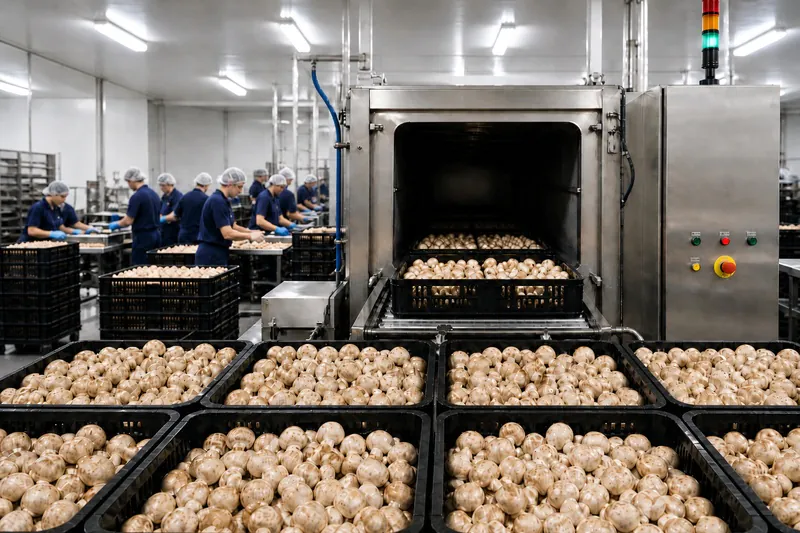
Mushroom flushes do not arrive evenly. The biology of commercial mushroom production creates concentrated harvest periods — flushes — where a large volume of product becomes ready within a narrow time window. This is fundamentally different from most vegetable operations, where harvest is more continuous.
The practical consequence is that a vacuum cooling setup sized around average daily output may be consistently undersized for the real peak load it faces during each flush.
If a flush produces 2,000 kg of mushrooms within a 90-minute harvest window, and the cooling system can handle 500 kg per cycle with a 20-minute cycle time, the math creates a queue. Some portion of the harvest will wait at ambient temperature while earlier batches are processed. That wait is not a scheduling inconvenience. It is quality loss occurring in the most time-sensitive product in commercial produce export.
This is why we always ask mushroom operations about flush dynamics, not just daily volume. The relevant capacity question is not “how much do you cool per day” but “how much harvest arrives in the first 90 minutes of your heaviest flush, and how does your cooling throughput compare to that figure?” Most operations that have gone through this exercise find a gap that was not visible when they compared daily volume to daily capacity.[^4]
Sorting and Grading Before Cooling Is One of the Most Expensive Workflow Decisions in Mushroom Export
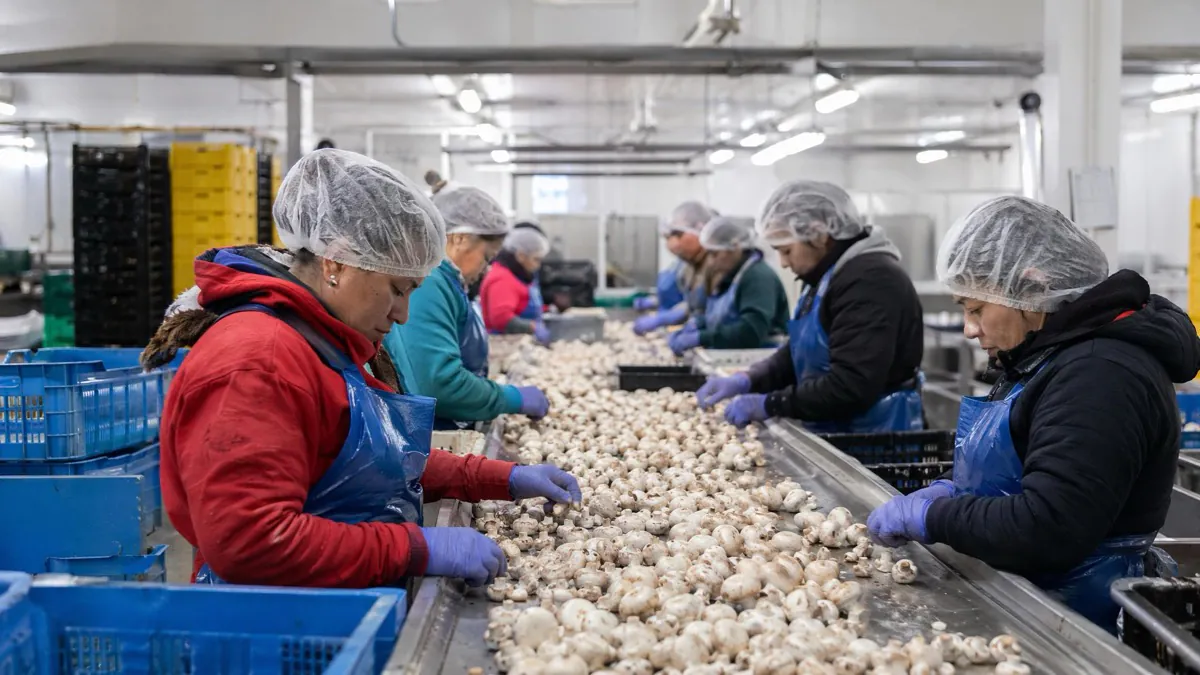
In many mushroom export operations, sorting and grading happen before cooling. The logic is understandable: sort first, then cool only what will be exported. This avoids cooling product that will be rejected, and it helps the packing team work with consistent product.
The commercial cost of this logic is that sorting and grading at ambient temperature after harvest means the product with the most export value — the premium export-grade mushrooms — is spending its most metabolically expensive time in the worst temperature conditions.
From our perspective, the decision to sort before or after cooling should be made with full awareness of what sorting before cooling actually costs. Every minute of sorting time at warm ambient temperature is quality-spending time. A well-organized operation that takes 40 minutes to sort a flush is spending 40 minutes of the first hour’s quality window at the highest respiration rate.
Some operations find ways to move at least a rough pre-sort earlier in the harvest flow, or to conduct detailed grading after a first cooling pass, using the cooling step to protect the best product while sorting is completed. There is no single right answer for every operation, but the question should be actively addressed, not left as a default inherited from convention.
In mushroom export, sorting before cooling is often the single workflow decision that costs the most shelf life — and the one that most operations have never questioned because it came with the building. Nobody designed it as the optimal sequence. It just became the way things are done. That is the most expensive kind of inefficiency to fix, because it is invisible until someone measures what it actually costs.
What Operations Should Measure If They Want to Know Where Shelf Life Is Really Being Lost
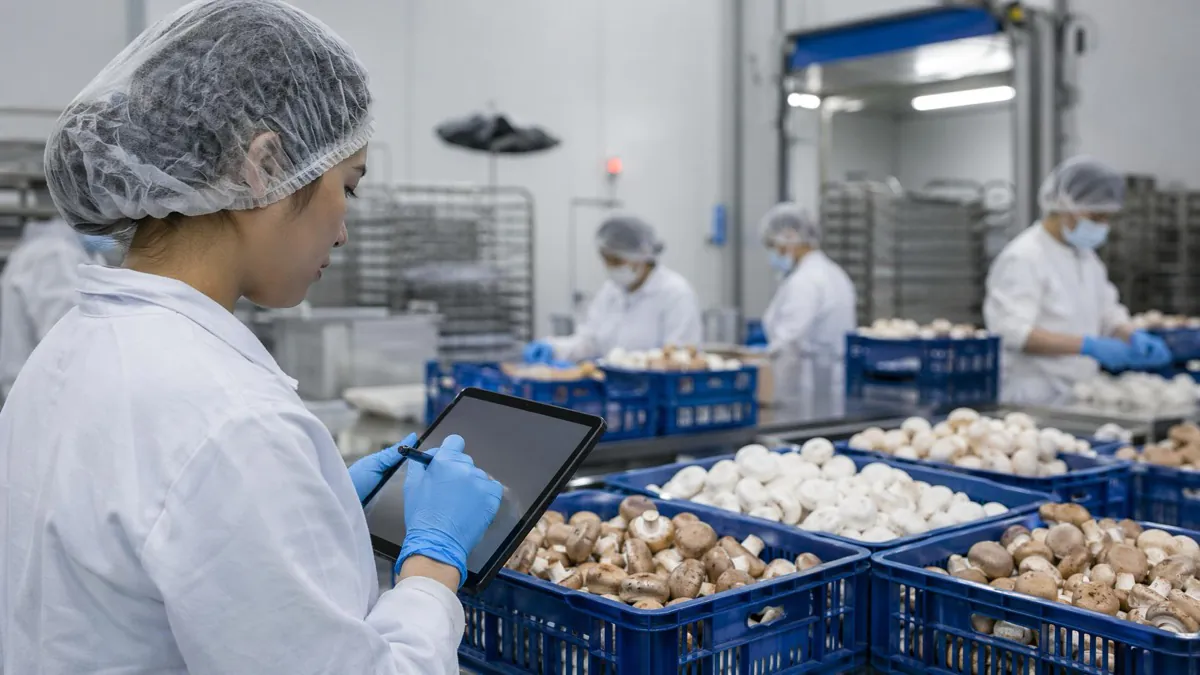
Most mushroom operations track temperature inside the cold room and temperature during transport. Very few track what happens between harvest and the cooler — the interval where, as we have argued throughout this article, the most commercially relevant quality decisions are actually being made.
If an operation wants to understand where its shelf life is really being lost, the most useful data points to start collecting are:
- Harvest completion time per batch or tray — when exactly did each portion of the flush finish harvest?
- Cooler entry time per batch — when exactly did each batch enter the cooling step?
- Harvest-to-cooler interval — the gap between those two timestamps, per batch and per day
- Queue time at the cooler — how long did batches wait outside the cooler before entry?
- Flush peak volume — how much product arrived in the peak 60–90 minutes of each flush?
- Destination shelf-life feedback — what result did the export buyer measure, and can it be linked back to the harvest-to-cooler data from that batch?
Operations that collect these data points consistently across one export season almost always identify two or three specific timing patterns that account for a disproportionate share of their destination quality complaints. The complaints that previously looked random or transport-related often turn out to correlate directly with batches where the harvest-to-cooler interval was longest.
First-Hour Quality Tracking Checklist
- harvest time per batch is recorded, not estimated at end of day
- cooler entry time per batch is recorded separately from harvest time
- harvest-to-cooler interval is calculated and reviewed, not assumed
- flush peak volume is estimated before the season and compared to cooling throughput
- sorting and grading time is measured at least periodically to confirm real duration
- destination shelf-life feedback is actively requested and matched to upstream batch data
- any batches with unusually long harvest-to-cooler intervals are flagged for review
FAQ
Why is the first hour after harvest so much more damaging than later delays in the cold chain?
Because respiration rate — and therefore the rate of quality loss — is highest when temperature is highest. Mushrooms harvested at 18–22°C are metabolically active at a much faster rate than mushrooms at 2°C. An hour at harvest temperature consumes quality margin at a rate that may be 10 to 15 times faster than an equivalent hour in cold storage. That asymmetry means the first warm hour is the most commercially expensive period in the whole post-harvest timeline.[^1]
Is it better to sort before or after vacuum cooling for mushrooms?
There is no single answer, but sorting before cooling should be recognized as a quality-spending tradeoff, not a neutral default. Operations where the sort is fast and immediately follows harvest may tolerate pre-cooling sorting reasonably well. Operations where sorting is slow, labor-constrained, or happens in warm ambient conditions should seriously consider moving at least a rough pre-sort before cooling, or doing detailed grading after a first cooling pass. The key question is: how much of the first hour is the premium export product spending at harvest temperature while waiting for sorting to finish?
How do I know if my cooling capacity is matched to my flush dynamics?
Calculate the peak harvest volume in your heaviest flush — the kilograms or trays that become ready in a 60–90 minute window at peak productivity. Then calculate how much your cooling system can process in that same window at full throughput, including loading and unloading time between cycles. If the harvest figure exceeds the cooling figure, your cooling capacity is creating a queue during your most critical quality window.
What should exporters ask their vacuum cooling supplier about mushroom-specific applications?
At minimum: what cycle parameters are recommended for the mushroom variety and weight, whether the system can handle the flush peak volume without creating a queue, and how moisture loss during the cooling cycle should be managed for different packaging formats. Mushrooms are sensitive to over-cooling and to the moisture change during the vacuum cycle, and those variables need to be matched to the actual product and packing format.
Final Thoughts
Mushroom export quality is not primarily a cold room problem or a transport problem. It is a first-hour problem.
The window between harvest and stable cold protection is where the most consequential quality decisions happen for fresh mushrooms. That window is short, it is metabolically aggressive, and it is largely invisible to the checks that most export operations actually perform. The product can look acceptable throughout the entire pre-packing period while already carrying a significantly reduced shelf-life margin for the export journey ahead.
From our factory-side perspective, the mushroom exporters who consistently deliver stronger destination results are the ones who have made the first hour after harvest a managed process rather than an assumed one. They know how long each batch waits. They know what flush peak volume means for their cooling throughput. They know whether sorting before cooling is protecting their product or spending its quality window at the worst possible time.
The improvements that matter most are rarely in the machine. They are in the 60 minutes before the machine has a chance to help.
Most destination complaints about mushroom quality are filed against the cold room, the transport leg, or the packaging format. Most of them originate in the harvest floor, in the sorting queue, in the wait outside the cooler during a heavy flush. Those are the gaps that do not appear in any temperature log, do not show up in any transit record, and do not get caught by any carton inspection at dispatch.
The first hour after harvest is when mushroom export quality is actually decided. Protecting it requires measuring it first.
If you want to review your harvest-to-cooler workflow, flush timing, and cooling capacity against your real export pressure, send us your flush schedule, product type, packaging format, and cooling setup. We can help you identify where the first-hour gap is largest before your next export season begins.
Footnotes
[^1]: UC Davis Postharvest Technology guidance on mushroom handling, respiration rates, and temperature sensitivity: https://postharvest.ucdavis.edu/commodity-resources/commodity-fact-sheets/
[^2]: FAO guidance on post-harvest handling of mushrooms and the role of temperature control in quality preservation: https://www.fao.org/3/x5055e/x5055e00.htm
[^3]: Penn State Extension — mushroom production and post-harvest handling guidance for commercial growers: https://extension.psu.edu/mushroom-production
[^4]: ASHRAE Refrigeration Handbook — refrigeration load calculation and cooling system design for perishable products: https://www.ashrae.org/technical-resources/bookstore/refrigeration-handbook
[^5]: Royal Horticultural Society / industry guidance on mushroom postharvest physiology and temperature management: https://www.rhs.org.uk/
Looking for the right vacuum cooler for your operation?
Allcold engineers work with packhouses and exporters to spec the right system for your product, volume, and site conditions.

Mila
You May Also Like
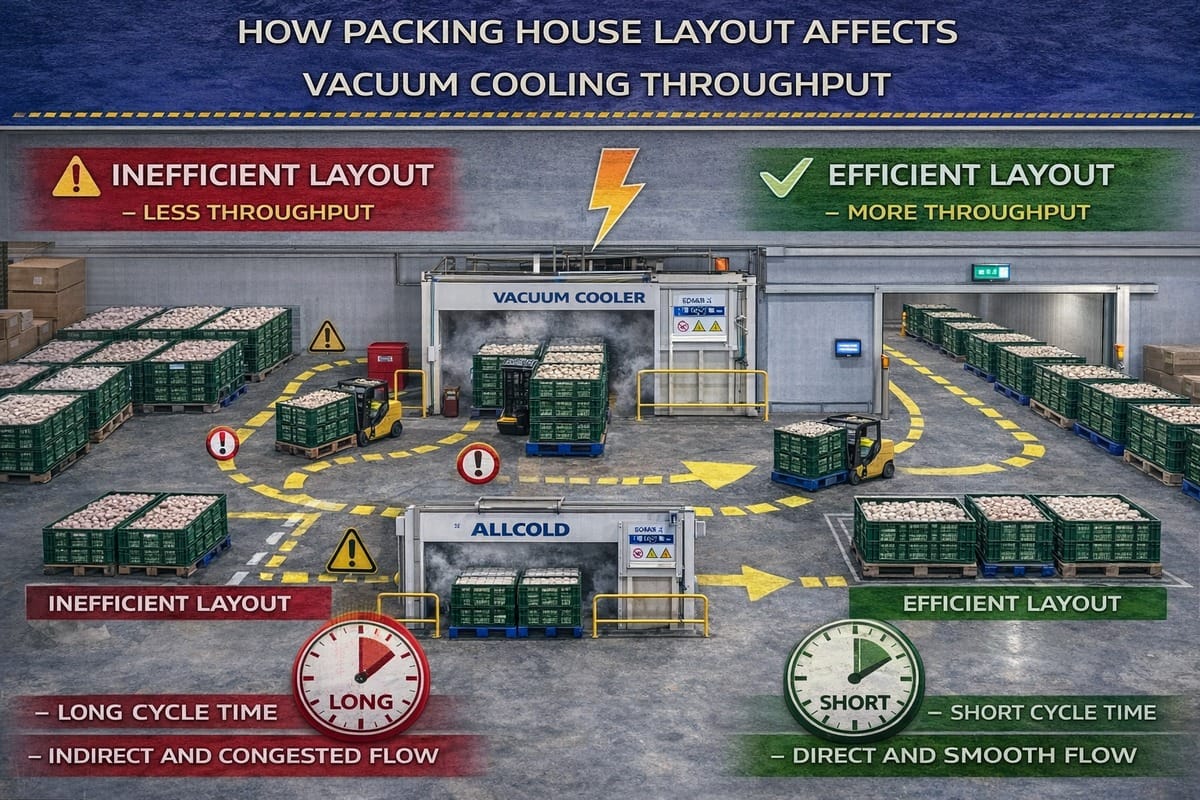
How Packing House Layout Affects Vacuum Cooling Throughput
Learn how packing house layout affects vacuum cooling throughput, including staging space, forklift flow, cold-room connection, and peak-hour pallet movement.
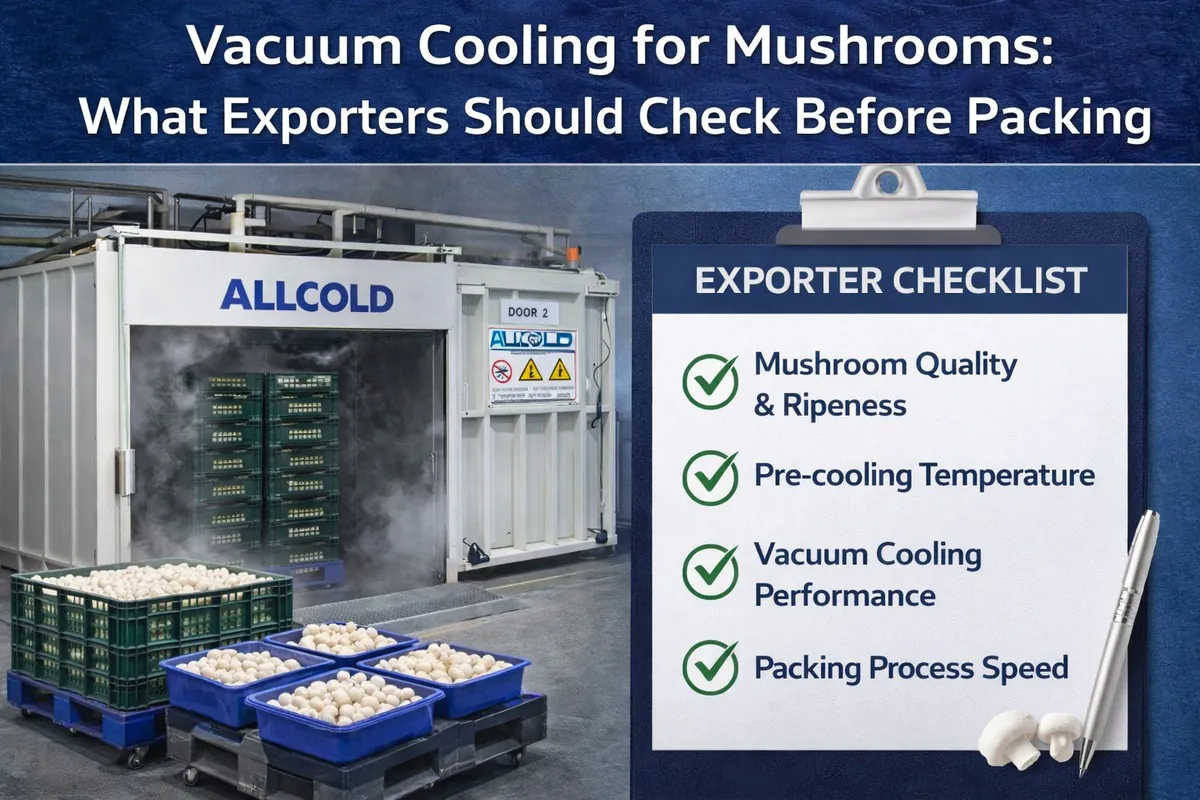
Vacuum Cooling for Mushrooms: What Exporters Should Check Before Packing
Learn what mushroom exporters should check before packing, including timing, cooling workflow, packaging format, condensation risk, and peak-hour handling pressure.