
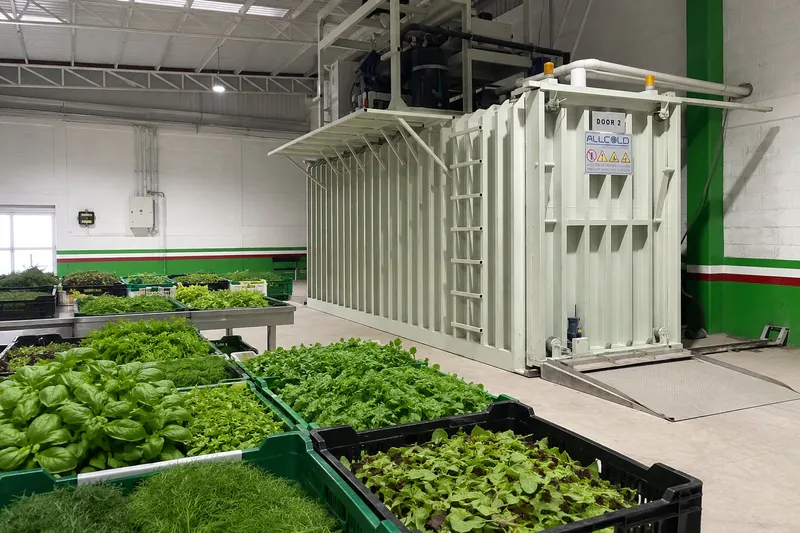
Why Vacuum Cooling Herbs and Baby Leaves Requires a Different Approach Than Standard Vegetable Pre-Cooling
Herbs and baby leaves are often treated as “small lettuce” in pre-cooling discussions. That assumption causes real problems. The product may look similar from a distance because it is leafy, light, and packed for fresh markets, but the cooling behavior is different. The surface-area-to-mass ratio is higher. The leaves are more delicate. Moisture loss becomes visible faster. Packaging formats are more restrictive. A cooling cycle that works for lettuce may create wilting, tip burn, bruising, or uneven temperature in herbs and baby leaf packs.
For exporters and fresh-cut processors, this is not a small technical detail. Herbs and baby leaves are premium products. Buyers judge them on aroma, color, leaf shape, crispness, and absence of dark edges. If a standard vegetable pre-cooling recipe damages the product, the shipment may still be cold but no longer premium.
From our factory-side perspective, the correct approach is to design the cooling protocol around product fragility, packaging format, and batch mix. Vacuum cooling can be effective for herbs and baby leaves, but only when cycle control is tighter than for heavier vegetables.
Why herbs and baby leaves are not small lettuce
Lettuce is already sensitive, but many herbs and baby leaves are even less forgiving. Basil, coriander, parsley, mint, baby spinach, arugula, and micro-style leaf products each behave differently. Leaf thickness, stem structure, natural moisture content, cut surfaces, and packaging style all influence cooling response.
The first difference is surface area. Herbs and baby leaves expose a large surface area compared with their weight. This allows heat to leave quickly, but it also allows moisture loss to show quickly. A small percentage of moisture loss that might be acceptable in a heavier vegetable can be visible as limpness or edge stress in a delicate herb.
The second difference is mechanical strength. Many baby leaves cannot tolerate rough airflow, compression, or aggressive vacuum cycles. If the product is packed loosely, it may move or settle. If it is packed densely, the center may cool differently from the outer layer. Either condition can create inconsistency.
This is why a supplier should never recommend a standard lettuce cycle without testing the actual herb or baby leaf product. The correct starting point is product classification: whole bunch herbs, loose leaves, fresh-cut baby leaves, clamshell-packed retail units, MAP bags, or foodservice bulk packs.
Once the product format is clear, the cooling protocol can be adjusted. Without that step, the exporter is guessing with a high-value product.
The over-cycling problem: too much vacuum damages delicate tissue
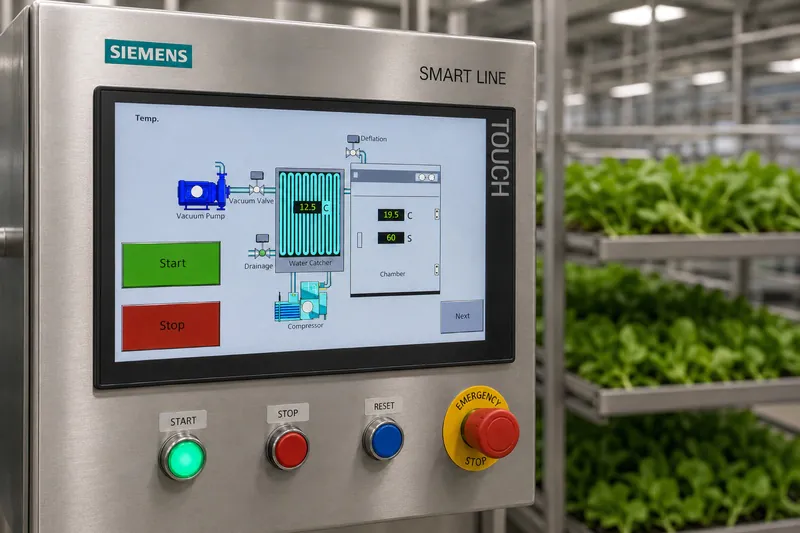
Over-cycling is one of the most common risks when buyers apply standard vegetable settings to herbs and baby leaves. In simple terms, the cycle continues too long or too aggressively after the product has already reached the useful cooling point. The result can be unnecessary moisture loss, edge stress, darkening, or visible wilt.
Vacuum cooling removes heat through evaporation. That is the strength of the method, but also the reason control matters. Delicate leaves have less margin.
This is not always obvious immediately. A batch may look acceptable when it leaves the chamber but show deterioration later during storage or destination inspection. The exporter then sees a shelf-life problem but may not connect it to the cooling cycle.
A better protocol uses product temperature, time, pressure profile, and visual quality checks together. Do not judge only by the final temperature. Check leaf condition before cooling, after cooling, after cold storage holding, and after a simulated distribution period if the product is for export.
For mixed operations, over-cycling risk increases because not all products need the same treatment. A batch of parsley bunches and a batch of baby arugula may not tolerate the same cycle. If the operation uses one recipe for everything, the strongest product may survive while the most delicate product loses grade.
The goal is not maximum cooling force. The goal is controlled heat removal with acceptable moisture balance. For herbs and baby leaves, that often means building product-specific recipes rather than relying on one general vegetable setting.
Moisture loss control: the balance is narrower for herbs
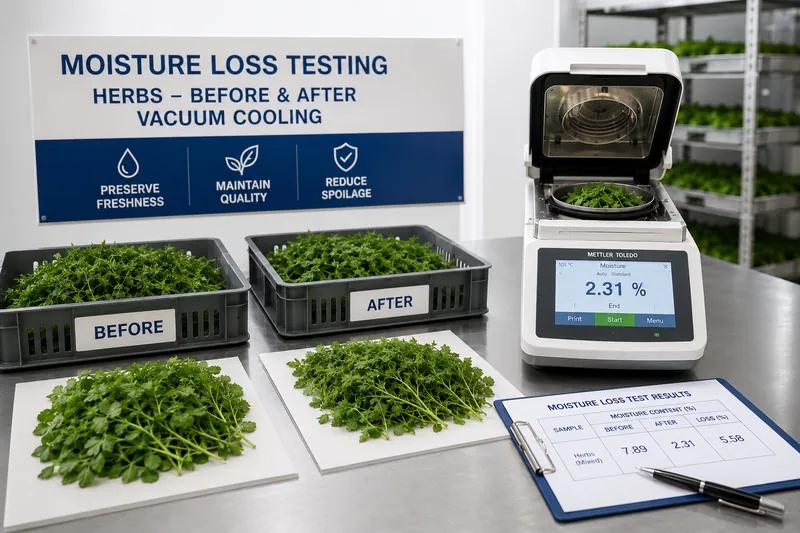
Moisture loss is not only a yield issue. For herbs and baby leaves, moisture condition is part of visual quality. A small loss can change the way leaves stand, fold, or shine. Buyers may describe the product as tired, dry, or stressed even if the temperature is acceptable.
At the same time, leaving too much heat in the product is not an option. Warm herbs respire faster and can deteriorate quickly. Fresh-cut baby leaves also carry a higher handling burden because cut surfaces and dense packaging can accelerate quality problems if temperature control is weak.
This creates a narrow operating window. Under-cooling reduces shelf life. Over-cooling or over-evaporation damages appearance. The correct balance depends on initial temperature, product type, leaf maturity, water status at harvest, packaging format, and target discharge temperature.
Exporters should use weight checks during trial cycles. Weigh representative samples before and after cooling, then combine this with temperature readings and visual scoring. If weight loss is acceptable but leaf edges look stressed, the cycle still needs adjustment.
Moisture control also depends on pre-cooling timing. Product that waits too long after harvest may already be moisture-stressed before entering the chamber. The cooling equipment then gets blamed for damage that began earlier. For herbs and baby leaves, harvest hydration, shade, receiving time, and pre-cooling delay all matter.
We often recommend that exporters write an internal standard for each product group: maximum waiting time before cooling, acceptable starting temperature range, target discharge temperature, maximum weight-loss tolerance, and visible quality acceptance criteria. This turns cooling from operator habit into a repeatable export process.
MAP and clamshell packaging formats change the cooling dynamic
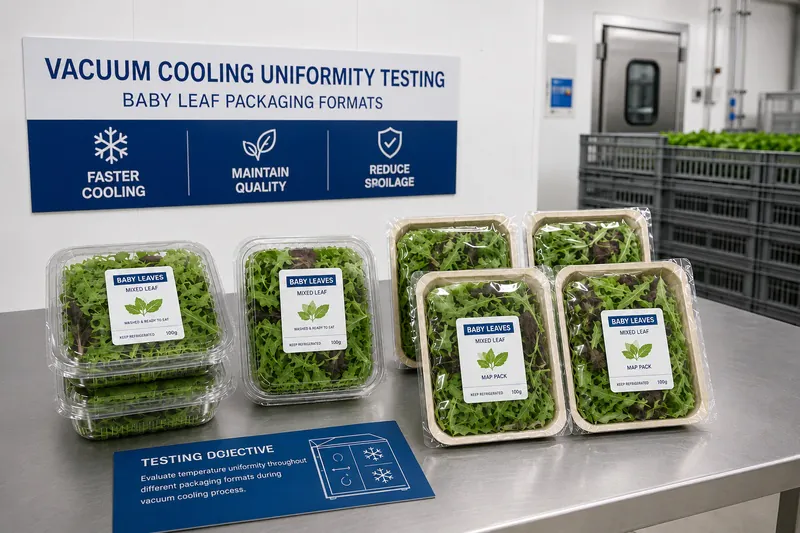
Many herbs and baby leaves are not shipped in open crates. They may be packed in clamshells, modified atmosphere packaging, bags, liners, sleeves, or foodservice cartons. These formats protect the product commercially, but they also change cooling behavior.
Packaging can slow heat removal if it blocks vapor movement or creates dense product layers. Clamshells may create air spaces that behave differently from loose leaves. MAP films may restrict exchange. Bags can collapse or press against leaves under certain handling conditions. Carton ventilation patterns may not match the cooling method.
This is why packed-product testing is essential. Cooling loose leaves in a test chamber does not prove that retail clamshells will cool uniformly. The exporter must test the actual pack: number of units per carton, liner use, carton vent area, pallet pattern, and load height.
Packaging also affects temperature measurement. A probe placed in an easy-access outer pack may show target temperature while the center of a carton remains warmer. For export programs, the measurement plan should include difficult positions, not only convenient ones.
Allcold has previously discussed the broader issue of cooling products after packaging in can you vacuum cool vegetables after they are packaged. Herbs and baby leaves are a good example of why the answer depends on packaging details, not a simple yes or no.
For buyers comparing equipment, packaging compatibility should be part of the quotation discussion. Ask suppliers how they will validate cooling in clamshells, MAP bags, or bulk cartons. If the answer is only a general claim about chamber performance, the risk remains with the exporter.
What temperature targets and parameters work for common export herbs
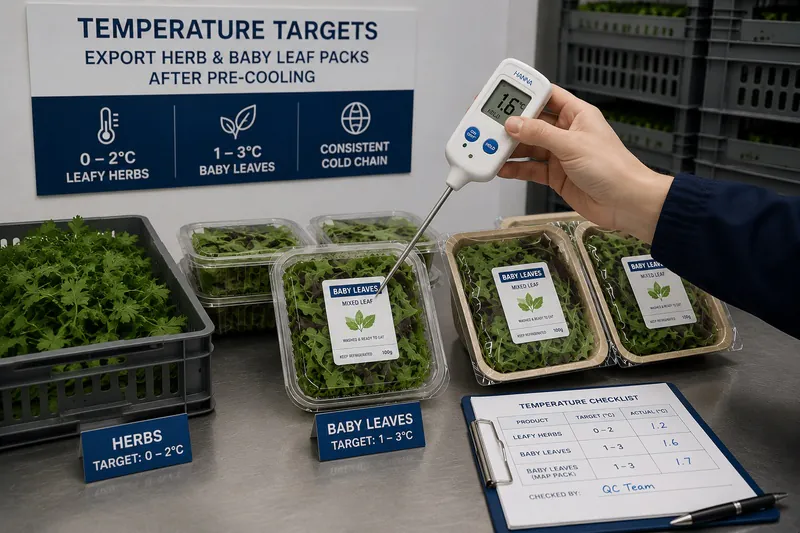
Temperature targets for herbs and baby leaves should be set by product type and buyer specification. Many leafy products benefit from rapid cooling to low safe holding temperatures, but not all herbs tolerate the same conditions. Some herbs are chilling-sensitive, while others perform well near low cold-chain temperatures. This is why the project specification must separate product groups.
A practical exporter should avoid one universal target for all herbs. Parsley, coriander, mint, basil, baby spinach, and arugula may need different handling rules. Basil, for example, is often more sensitive to chilling injury than many cool-season leafy products. Baby spinach and similar leaves may require strong cold-chain control but also careful moisture management.
Operating parameters should include initial temperature, target product temperature, pressure profile, cycle duration, weight-loss tolerance, packaging format, and post-cooling transfer time. If packaging is restrictive, cycle time may increase. If the product is delicate, the pressure profile may need to be gentler.
This is why trial data matters more than generic numbers. Start with reputable postharvest guidance and buyer requirements, then validate with the actual product. Run trial batches, measure multiple locations, record visual quality, and review shelf-life results after storage.
For more general background on vegetable parameter thinking, Allcold has a related article on optimal vacuum cooling parameters for different vegetables. Herbs and baby leaves require that same logic, but with narrower tolerance and more product segmentation.
A supplier who treats “herbs” as one category is oversimplifying. The project should define product families and cooling recipes before full commercial operation.
How to design a protocol for a mixed herb and baby leaf operation
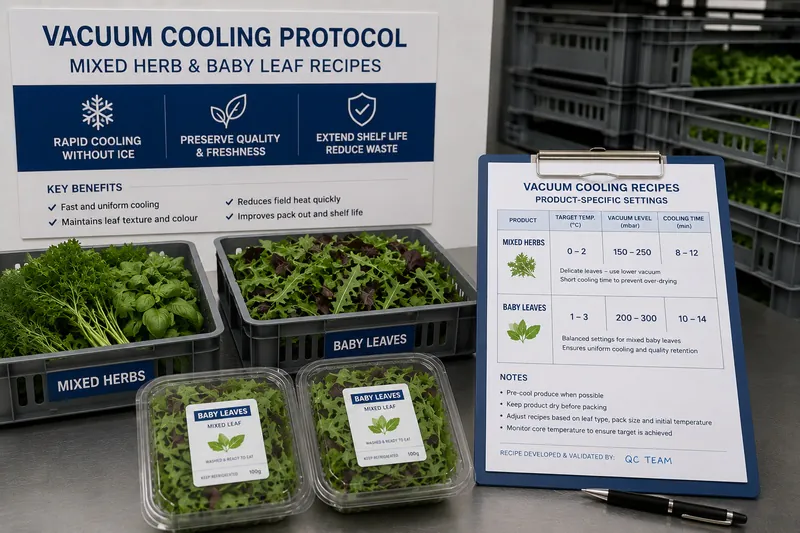
A mixed herb and baby leaf operation needs a protocol, not just equipment. The protocol should tell operators what to do when products differ, when packaging changes, and when incoming temperature is higher than expected.
Start by grouping products by cooling behavior. For example, robust bunch herbs may sit in one group, delicate baby leaves in another, chilling-sensitive herbs in another, and sealed retail packs in a separate group. Each group should have its own target temperature range, cycle settings, maximum waiting time, and inspection checklist.
Next, define batch rules. Do not mix products in the same cycle if they require different targets or tolerate different moisture loss. If mixed loading is unavoidable, use the most sensitive product as the control point and confirm that the heavier or denser product still reaches temperature. This needs trial data, not guesswork.
The protocol should also define packaging approval. A new clamshell, film, liner, carton, or pallet pattern can change cooling performance. Treat packaging changes as process changes. Test them before full export use.
Operators need simple records: product name, pack format, batch ID, starting temperature, cycle recipe, discharge temperature, visual inspection, weight sample if required, and cold room transfer time. These records help management see whether quality variation is coming from harvest, packing, cooling, or storage.
For herbs and baby leaves, the best cooling system is the one that protects product condition consistently across many small variations. That requires a controlled process, not a copy of a lettuce recipe.
Conclusion
Herbs and baby leaves need a different pre-cooling approach because they are delicate, high-surface-area products with narrow tolerance for moisture loss and over-cycling. Treating them as small lettuce can create wilting, edge damage, uneven cooling, and shorter shelf life.
Vacuum cooling can work well, but the process must be built around product type, packaging format, target temperature, pressure profile, and visual quality results. The more mixed the operation, the more important product-specific recipes become.
If you are planning a herb or baby leaf export project, send us your product list, packaging formats, peak-hour volume, and buyer temperature requirements. We can help you review whether the cooling protocol is realistic before you compare vacuum cooler suppliers.
External References
- UC Davis Postharvest Technology Center, commodity fact sheet resources
- FAO, *The role of post-harvest management in assuring the quality and safety of horticultural produce*
- FAO, *Manual for the preparation and sale of fruits and vegetables: From field to market*
- ASHRAE Handbook resources
- Postharvest Biology and Technology journal
- International Journal of Refrigeration
Looking for the right vacuum cooler for your operation?
Allcold engineers work with packhouses and exporters to spec the right system for your product, volume, and site conditions.

Mila
You May Also Like
Why Fresh Herb Exporters Often Blame the Vacuum Cooler When the Real Problem Is Packaging
Many herb exporters believe they are testing a vacuum cooler. In reality, they are often testing whether their packaging allows