
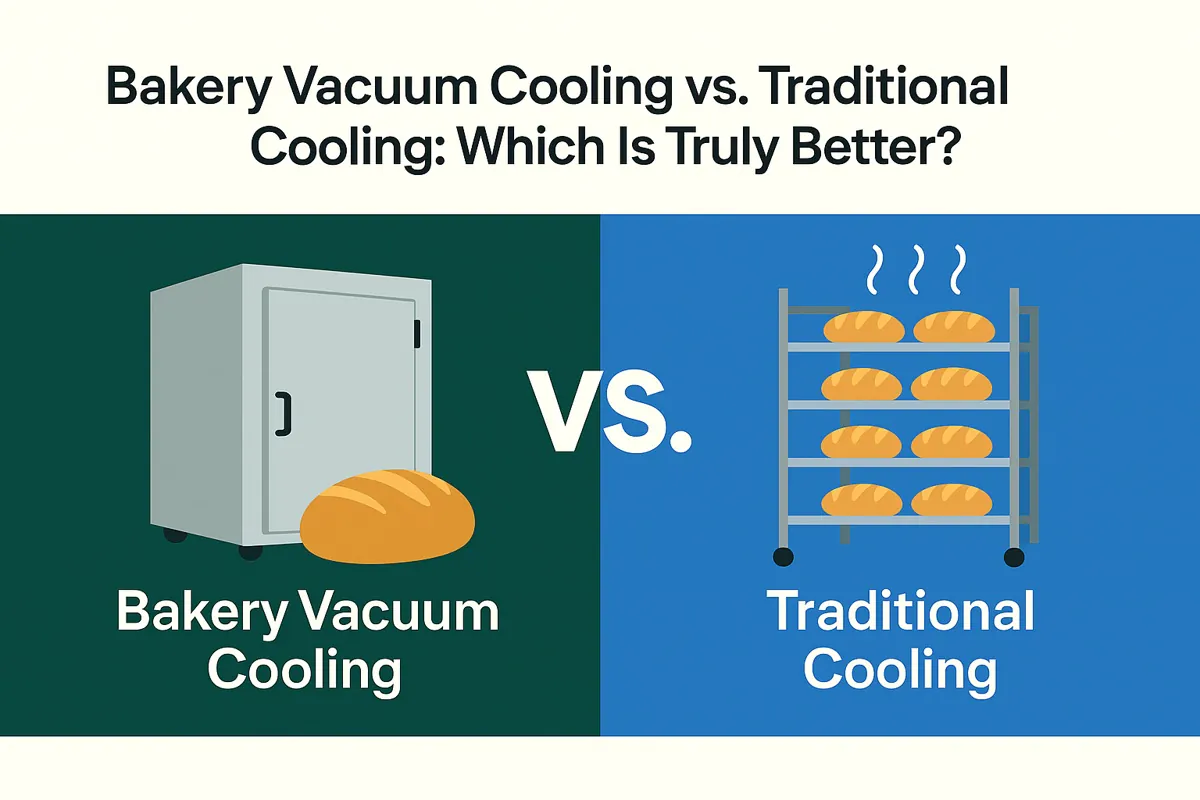
Bakery Vacuum Cooling vs. Traditional Cooling: Which Is Truly Better?
You’ve perfected your baking process, but your entire operation grinds to a halt at the final step: cooling. Your bakery floor is a maze of hot racks, you’re waiting hours to slice and package, and you are losing time and money with every minute that ticks by.
This production bottleneck is infuriating. It feels inefficient and outdated, forcing your entire schedule to revolve around this slow, passive process. You worry about the space it wastes and the quality you lose as your perfect crusts slowly turn soft and soggy.
For any serious commercial bakery, vacuum cooling is overwhelmingly better than traditional methods across every key metric: speed, product quality, space efficiency, and long-term profitability. Traditional rack cooling is only "better" for hobbyists or very small-scale operations where the low initial cost is the only factor.
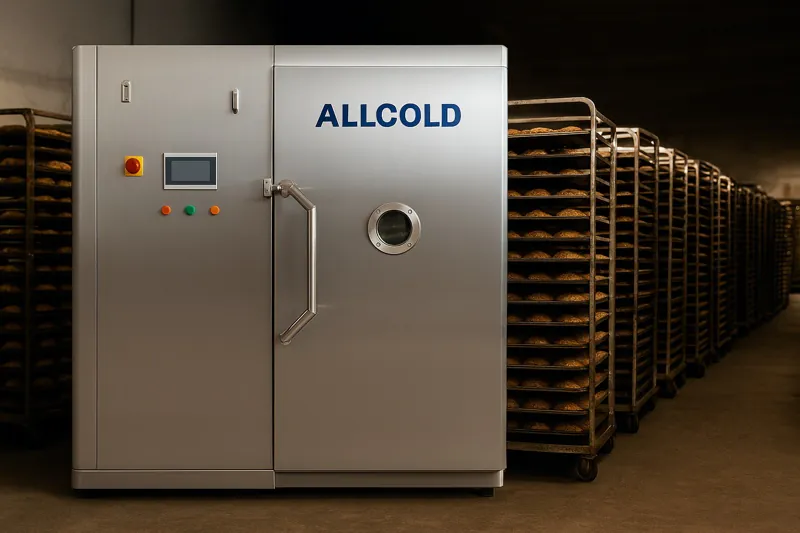
As an engineer and manufacturer, I talk to bakers every day who are struggling with the limits of traditional cooling. They know there has to be a better way. My goal is not just to tell you that vacuum cooling is superior, but to show you why. Let’s break down this comparison across the four areas that truly matter to your business: speed, quality, space, and cost.
Which Method Is Faster and More Efficient?
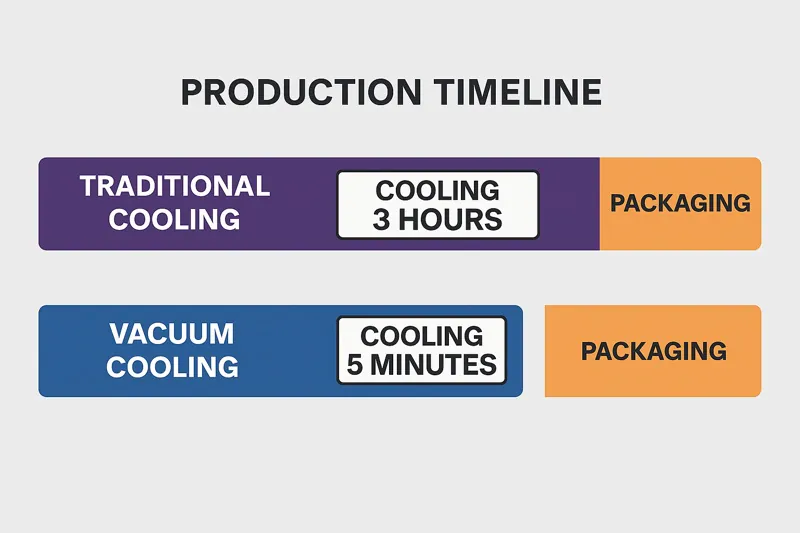
The most painful part of traditional cooling is the waiting. You can bake bread in 20 minutes, but then it sits for two or three hours. This isn’t just a minor delay; it’s a fundamental barrier that dictates your entire production capacity and workflow.
You are constantly playing a waiting game. Your ovens can produce more, but you have nowhere to put the finished product. Your staff is waiting, your slicer is sitting idle, and your delivery schedules are constrained, all because of this one slow, inefficient step.
The Allcold bakery catalogue gives a typical vacuum-cooling stage of about 3-5 minutes. Its illustrated two-trolley example compares a 30-minute conventional cooling stage with 2.5 minutes under vacuum, about a 90% reduction for that example. A bakery should compare total door-to-door cycle time, including loading and unloading, against its own baseline.
The Impact of a Continuous Workflow
The operational value depends on the current bottleneck. Measure oven output, rack residence time, trolley movement, slicing temperature, and packaging rhythm before estimating the effect on the production floor.
The End of Bottlenecks
When cooling residence is longer than the oven rhythm, racks and floor space can constrain production. A validated vacuum cycle can shorten that stage, but the new line balance must include loading, unloading, slicing, packaging, staffing, and demand. The bottleneck may move rather than disappear.
A New Level of Responsiveness
For a real capacity calculation, model a representative urgent order using the bakery’s oven batch size, available trolleys, validated cooling cycle, slicer rate, and packaging capacity. Vacuum cooling can remove a cooling bottleneck, but it cannot guarantee an order deadline when another process is limiting.
| Metric | Traditional Rack Cooling | Allcold Vacuum Cooling | Impact on Bakery Operations |
|---|---|---|---|
| Cooling Time | Measure the current rack or spiral baseline | Catalogue reference: about 3-5 minutes for the cooling stage | Include loading, unloading, and downstream handling in the comparison. |
| Production Model | Batch-and-Wait | Continuous Flow | Maximizes oven output and daily capacity. |
| Labor Workflow | Stop-and-go, inefficient | Smooth, predictable, and efficient. | Reduces staff downtime and improves morale. |
| Order Flexibility | Very Low (long lead times) | Very High (can accept rush orders) | Creates a major competitive advantage. |
Which Method Produces Higher Quality Bread?
You’ve invested in the best ingredients and perfected your baking process to create a delicious loaf with a beautiful, crispy crust. But then, during the long cooling process, you watch that quality degrade. Moisture from the inside migrates out, making your perfect crust soft and leathery.
It’s disheartening to lose quality at the very last stage. Furthermore, as the bread sits for over an hour in the temperature "danger zone," it creates a breeding ground for mold and bacteria, forcing you to use preservatives or accept a shorter shelf life for your products.
Vacuum cooling can support crust setting, crumb stability, and faster release to slicing or packaging. Shelf-life performance is not a fixed number: it must be validated for the actual recipe, hygiene programme, packaging, storage temperature, and distribution route.
The Science of a Superior Loaf
The cooling mechanism is physical, but the quality result remains product-specific. A procurement team should review trial data for core temperature, moisture retention, crust, crumb firmness, slicing quality, condensation, and the intended shelf-life protocol.
Locking in Texture
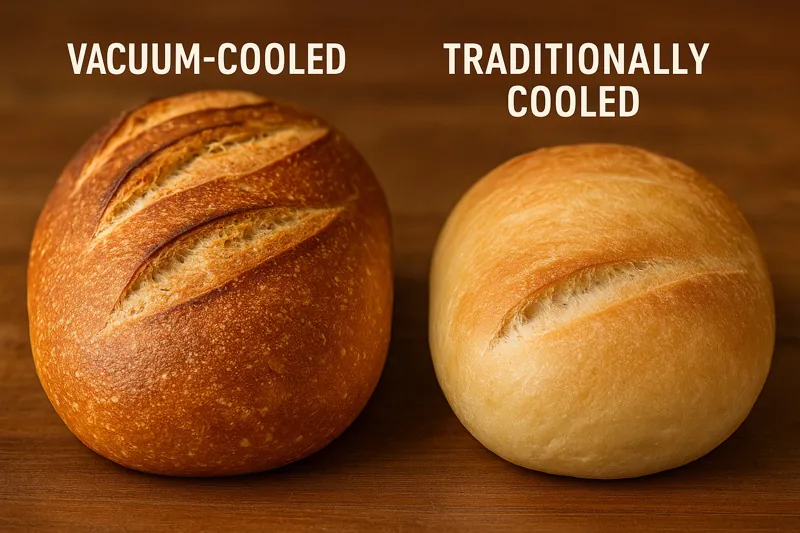
Crust and crumb change during cooling as heat and moisture redistribute. Vacuum cooling uses controlled evaporation and can support faster structural setting, but crispness, collapse, slicing quality, and storage performance must be measured for the actual formula and package.
Shelf-Life Control Must Be Validated
This is perhaps the most powerful quality benefit. The temperature range between 60°C and 10°C (140°F – 50°F) is where mold spores and bacteria thrive. A loaf of bread on a cooling rack will spend over an hour in this zone. A vacuum cooler takes the bread through this entire danger zone in less than 5 minutes. By preventing this initial microbial bloom from ever starting, you are not killing microbes—you are preventing them from ever getting a foothold. This allows you to extend the natural, preservative-free shelf life of your packaged bread by days. For a business looking to expand its distribution area or reduce waste from stale returns, this is a game-changer.
| Quality Attribute | Traditional Rack Cooling | Allcold Vacuum Cooling | Reason for Difference |
|---|---|---|---|
| Crust Texture | Becomes soft, soggy, and leathery. | Stays audibly crispy and stable for longer. | Vacuum actively removes surface moisture. |
| Crumb Structure | Can be prone to collapsing or tearing. | Stronger, more stable, perfect for slicing. | Rapid "gelatinization stop" locks the internal structure. |
| Shelf-Life Performance | Record the current validated baseline | Confirm by controlled product trial | Formula, hygiene, packaging, storage, and distribution all affect the result. |
| Preservative Strategy | Determined by formula and required shelf life | Not decided by cooling alone | Any reduction requires food-safety and shelf-life validation. |
Which Method Saves More Space and Reduces Costs?
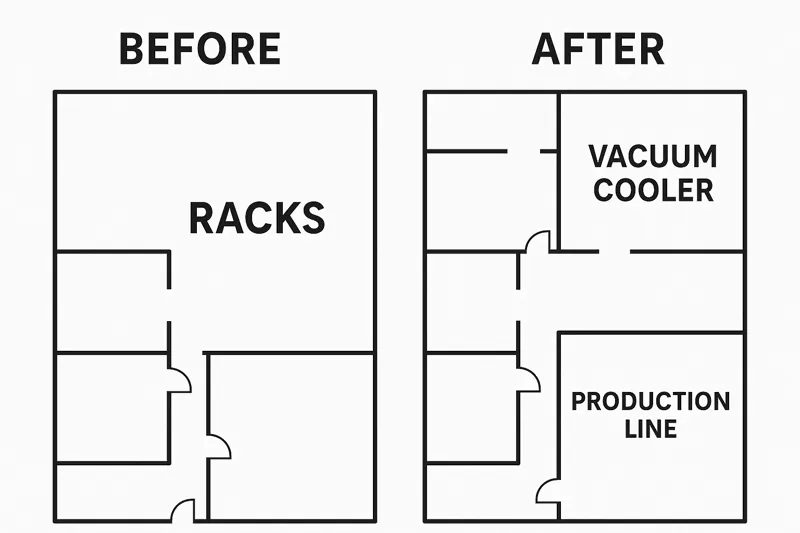
Walk onto any large bakery floor, and you’ll see it: a sea of metal cooling racks. They occupy a massive footprint, clog up walkways, cause damage to walls, and create a chaotic, inefficient working environment. This isn’t just clutter; it’s a huge operational cost.
You are paying for every square foot of your facility. Dedicating a huge portion of that valuable space to the passive, unproductive task of storing hot bread is a massive hidden expense. You are paying for space that you could be using to generate more revenue.
A vacuum cooler offers monumental space savings and reduces operational costs. A single machine can replace the need for 30, 40, or even more cooling racks, freeing up hundreds of square feet of valuable production space and cutting down on labor and maintenance costs.
The Tangible Value of Space
For a bakery owner, space is money1. Freeing up a large area of your floor opens up possibilities that have a direct impact on your bottom line. You can use that newly available space to add another oven, install a new packaging line, or simply de-clutter your operation to improve workflow and safety.
Calculating Your Space ROI2
Let’s do some simple math. A standard cooling rack holds about 15-20 trays and takes up about 1 square meter of space. To hold 3 hours of production from a medium-sized oven, you might need 30-40 of these racks, consuming 30-40 square meters (or around 300-400 sq. ft.) of your floor. A vacuum cooler that can handle that same capacity might only take up 5-6 square meters. You have instantly reclaimed a massive, valuable area of your factory. If you are leasing your facility, you can calculate the monthly cost of that wasted space and see it as a direct saving.
The Hidden Costs of Racks3
The cost of traditional cooling goes beyond just the space. There are ongoing operational costs that many people overlook.
- Labor: Your staff spends time moving these heavy, cumbersome racks around—from the oven to the cooling area, then from the cooling area to the slicer. This is unproductive labor.
- Maintenance: Racks get damaged. Their wheels break, they get bent, and they need to be replaced. They also cause damage when they are inevitably bumped into walls and other expensive equipment.
- Energy: All of those hot trolleys of bread are radiating heat directly into your facility for hours. This places a significant extra load on your air conditioning system, driving up your energy bills, especially in warmer climates. A vacuum cooler contains all the heat and expels it efficiently through its refrigeration system.
| Cost Factor | Traditional Rack Cooling | Allcold Vacuum Cooling4 | Financial Impact |
|---|---|---|---|
| Floor Space Required | Very High (e.g., 30-40 m²) | Very Low (e.g., 5-6 m²) | Frees up valuable space for revenue-generating activities. |
| Labor Costs5 | High (staff needed to move and manage racks). | Minimal (load and press a button). | Reduces unproductive labor hours. |
| Energy Costs6 | Increases air conditioning load significantly. | Self-contained; no significant impact on room temp. | Lowers overall factory energy consumption. |
| Maintenance & Damage | Racks need frequent repair/replacement; damage walls. | Contained system with low maintenance needs. | Reduces repair budgets and equipment damage. |
What About the Initial Investment and Return?
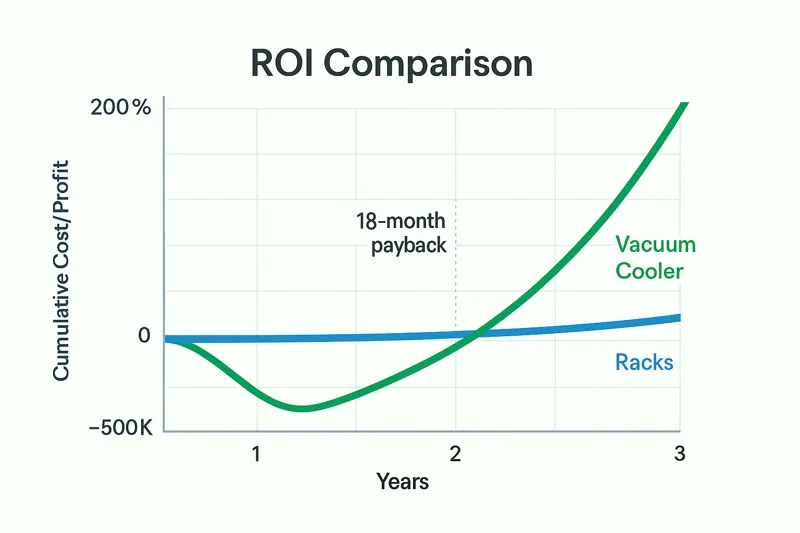
This is the most direct and important question for any business owner. Cooling racks are cheap, costing a few hundred dollars each. A bakery vacuum cooler is a serious piece of industrial machinery and represents a significant capital investment.
You see the price tag for a vacuum cooler and you hesitate. It’s a big number, and it’s easy to get sticker shock. You wonder if you can truly justify the expense, and how long it would take to get your money back. This is the final hurdle for most people.
Return on investment must be calculated from the bakery’s measured baseline. Relevant inputs include saleable output, labor actually removed or reassigned, energy per batch, floor-space value, maintenance, financing, and validated product-loss reduction. Allcold does not use a universal payback period.
Thinking Like an Investor
The purchase price is only one input. Smaller and larger bakeries can both evaluate the system, but the result depends on batch utilisation and the value of the bottleneck removed. A low-utilisation machine may not generate an acceptable return.
How to Calculate Your Payback
The ROI comes from multiple streams. You can calculate your potential payback period with a simple formula:
Payback Period = (Upfront Machine Cost) / (Monthly Savings + Monthly New Profit)
Let’s break down the savings and profit drivers:
- Output Scenario: The catalogue’s illustrated line increases daily output from 8,000 to 9,600 pieces, or 20%, under that example’s conditions. Use the bakery’s own oven, cooling, slicing, staffing, and sales constraints before applying an output value.
- Labor Savings: Calculate the hours your staff currently waste waiting for bread to cool or moving racks. Re-deploying them to more productive tasks is a direct cost saving.
- Waste and Returns: Use the bakery’s actual reject and return records, then count only the verified change from the trial.
- Energy Savings: Lower air conditioning bills contribute to the monthly savings.
The resulting payback period is project-specific. Use documented monthly savings and incremental contribution margin, then test the result against conservative utilisation and maintenance assumptions.
Investment vs. Expense
Cooling racks and vacuum coolers have different capital, space, handling, maintenance, and operating profiles. Treat a vacuum cooler as a capital project: approve it only when the measured bottleneck and verified operating benefits justify the installed cost and risk.
| Financial Metric | Traditional Rack Cooling | Allcold Vacuum Cooling | The Bottom Line |
|---|---|---|---|
| Upfront Cost | Low | High (Significant Capital Investment) | Racks are an expense; a vacuum cooler is an investment. |
| Return on Investment | Low initial equipment cost, but ongoing space and handling requirements | Project-specific | Calculate from measured costs and incremental saleable output; no universal payback period. |
| Key ROI Drivers | Current cooling time, space, handling, and energy | Validated throughput, labor, energy, quality, and maintenance changes | Count only savings or additional sales supported by site data. |
| Long-Term Value | Depreciating, low-value assets. | A core asset that drives business growth and quality. | Enhances the overall value and capability of your company. |
Conclusion
For commercial bakeries, the choice is clear. Traditional cooling is a costly bottleneck, while vacuum cooling is an investment in speed, quality, and efficiency that provides a rapid and substantial return. It is the superior method in every meaningful way.
Understanding the financial implications of space can help bakery owners optimize their operations. ↩
Learn effective methods to calculate ROI on space to maximize profitability in your bakery. ↩
Discover the often-overlooked expenses associated with traditional cooling methods in bakeries. ↩
Find out how Allcold Vacuum Cooling can save space, reduce costs, and improve efficiency. ↩
Explore how labor costs can affect your bakery’s efficiency and profitability. ↩
Understanding energy costs can help bakeries make informed decisions about cooling systems. ↩

Mila
You May Also Like

When Should You NOT Use Vacuum Cooling for Your Bakery?
Are you tired of waiting hours for your bread to cool down while your profits evaporate? You might think vacuum

Is Your Cooling Strategy Burning Your Profits? A Cost-Benefit Analysis of Vacuum vs. Conventional Cooling
As a bakery owner, you look at your balance sheet every month. You see the cost of ingredients, labor, and
Hybrid Cooling Solutions: Can Combining Vacuum and Traditional Methods Save Your Bakery?
Are you torn between the speed of new technology and the reliability of traditional freezing? Many bakery owners feel they
Blast Freezers vs Vacuum Coolers: Which Is the Right Choice for Your Bakery?
Are you tired of watching your freshly baked bread sit on racks for hours, taking up valuable space while you

Bakery Vacuum Cooling vs Spiral Cooling Systems: Which Is Better for Your Business?
Are you struggling with slow production lines because your bread takes forever to cool down? You are not alone. Cooling
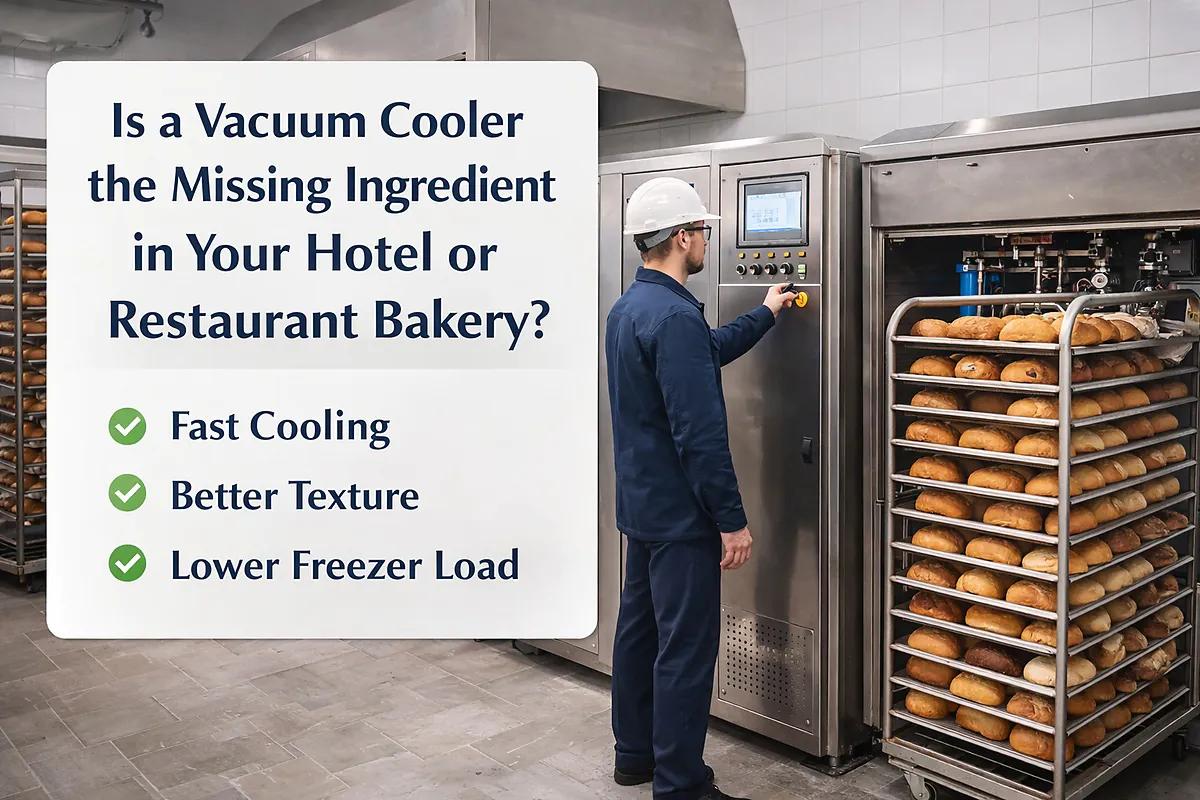
Is a Vacuum Cooler the Missing Ingredient in Your Hotel or Restaurant Bakery?
Imagine your kitchen is in full swing, and the freshly baked bread is finally out of the oven, but it
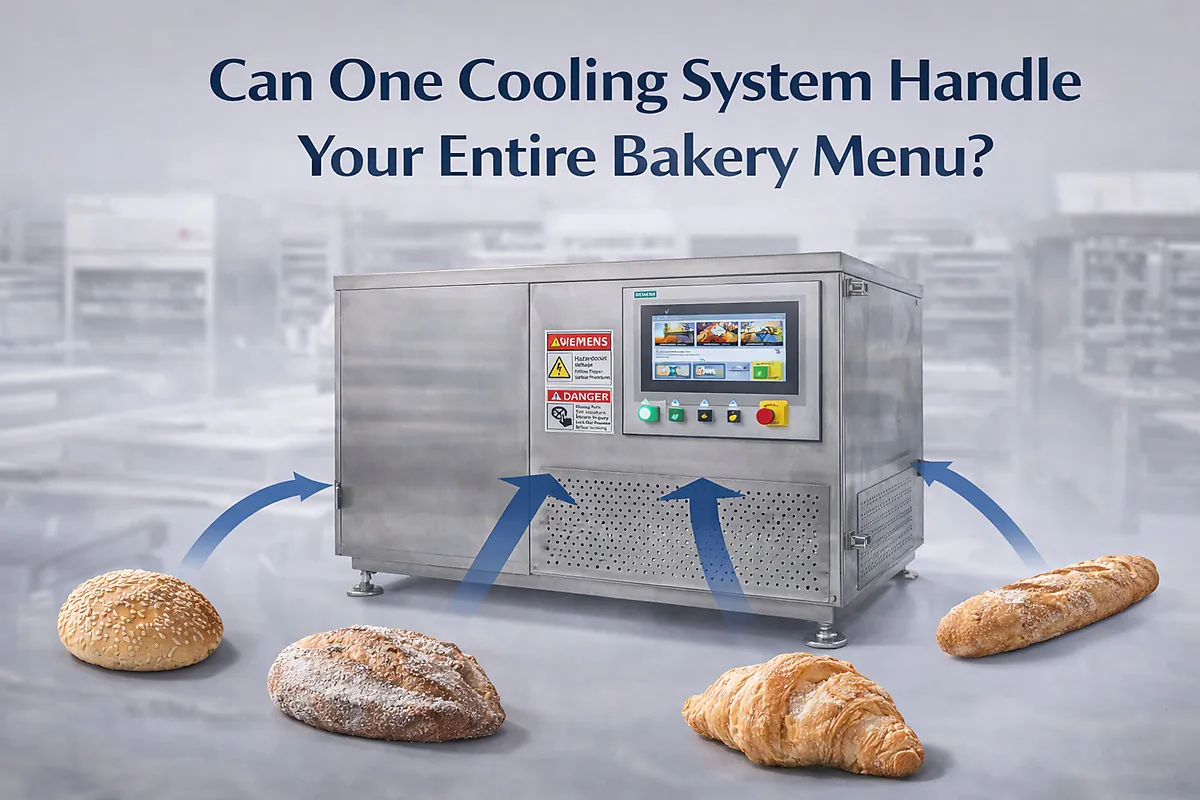
Can One Cooling System Handle Your Entire Bakery Menu?
You juggle sourdough, delicate pastries, and frozen dough lines daily. Yet, one cooling mistake ruins the texture of your artisan

Is Your Frozen Dough Production Losing Quality Before It Hits the Freezer?
You watch your energy bills climb month after month while your blast freezers work overtime. You see production bottlenecks form
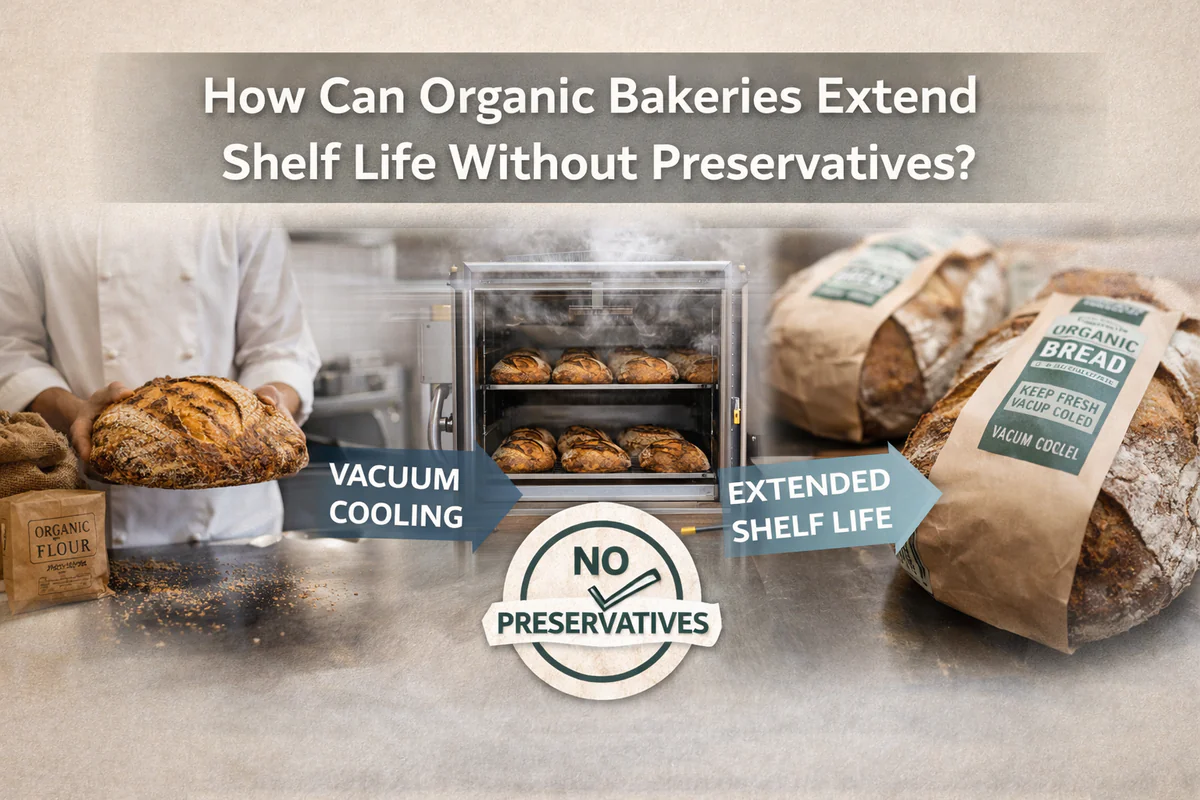
How Can Organic Bakeries Extend Shelf Life Without Preservatives?
You pour your heart into sourcing the finest organic flours and perfecting natural fermentation, only to watch your hard work

Can Vacuum Cooling Finally Fix the "Gummy" Texture in Gluten-Free Bread?
You watch your perfectly risen gluten-free loaves come out of the oven, only to see them sink or turn gummy