
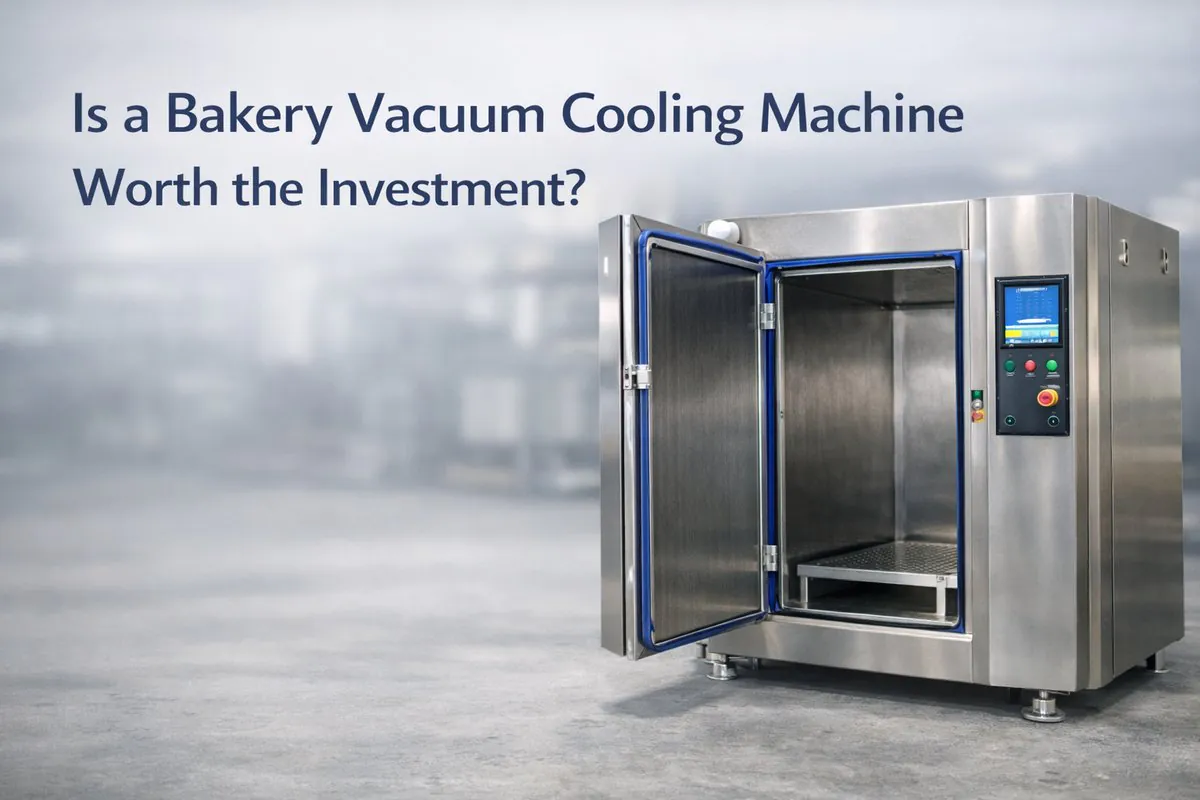
Is a Bakery Vacuum Cooling Machine Worth the Investment?
You look at the price tag of a vacuum cooler. It shocks you. You wonder if this shiny machine is a luxury for giant factories or a necessity for your own survival. You need to know if the numbers make sense.
A bakery vacuum cooler is a capital investment whose return depends on the site’s measured bottleneck, utilisation, labor, energy, space, quality, financing, and saleable output. The Allcold catalogue provides process examples, but it does not establish a universal payback period.
The correct business case starts with the selected quotation and the bakery’s own operating records. The method below shows which inputs to collect; it does not promise that every project will pay back within the same period.
How Does a 5-Minute Cycle Reduce Labor Costs?
Your biggest expense is your people. You pay skilled bakers to bake, not to stand around watching bread cool. Every minute they spend moving racks or waiting for bread to reach slicing temperature is money leaking out of your business.
The catalogue gives about 3-5 minutes as a typical bakery cooling stage. Labor value must be measured from the current and proposed workflow, including loading, unloading, trolley movement, waiting, slicing, and packaging. A shorter cycle does not automatically remove a fixed number of labor hours.
The "Dead Time1" Calculation
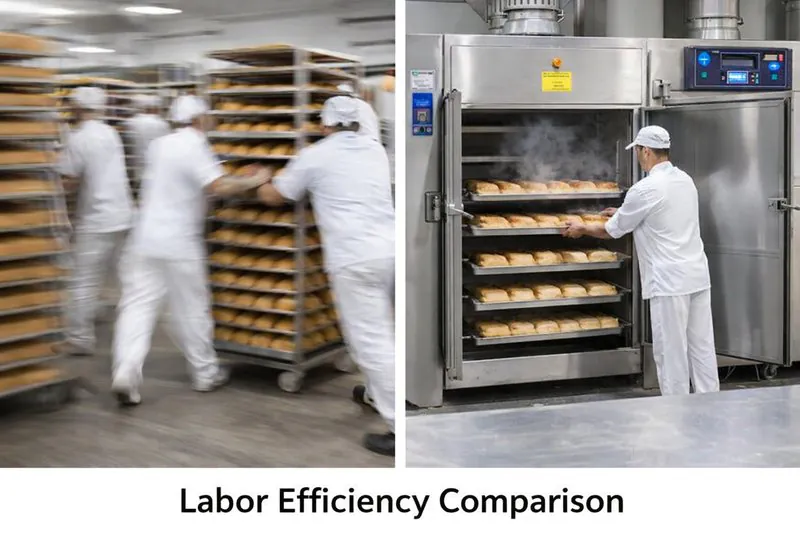
Let’s dig into the reality of a busy bakery. I want you to think about your current workflow. In a traditional setup, the bread comes out of the oven. A baker has to move it to a cooling area. Then, they wait. This is "Dead Time." This wasted time is a huge, hidden cost that destroys your efficiency.
Labor efficiency depends on line balance. Map every touch point from oven discharge to packaging, then test whether the proposed cooler removes waiting or simply moves the queue to slicing or packing. Use the validated total cycle, not only the chamber cooling time.
Let’s look at the math for a typical mid-sized bakery.
| Factor | Traditional Cooling Scenario | 5-Minute Vacuum Cooling Scenario |
|---|---|---|
| Workflow | Bake -> Move Racks -> Wait (90-120 min) -> Slice | Bake -> Cool (5 min) -> Slice |
| Handling | Multiple "touch points" per rack | One "touch point" per rack |
| Idle Time | Significant for bakers and slicers | Nearly eliminated |
| Labor Hours Wasted | 2-4 hours per shift | ~0.25 hours per shift |
The ROI Formula:
- Let’s be conservative and say you save 3 hours of labor per day.
- Enter the bakery’s actual loaded labor cost.
- Multiply only the verified daily labor change by that rate.
- Annualize using actual operating days; distinguish removed hours from reassigned hours.
This is just the direct labor saving. It does not account for the fact that your bakers are now less tired and more productive on the actual baking tasks. By removing the physical burden of managing hot, heavy racks across a large room, you also reduce the risk of workplace injury2, which is a hidden cost no one likes to talk about until it happens. A 5-minute cycle makes your bakery a safer and more efficient place to work.
Can a 5-Minute Cycle Lower Your Energy and Rent Bills?
Real estate is expensive. Renting a large space just to store hot air and cooling racks is a waste of your budget. Furthermore, trying to cool that space with air conditioning is one of the most inefficient ways to use energy.
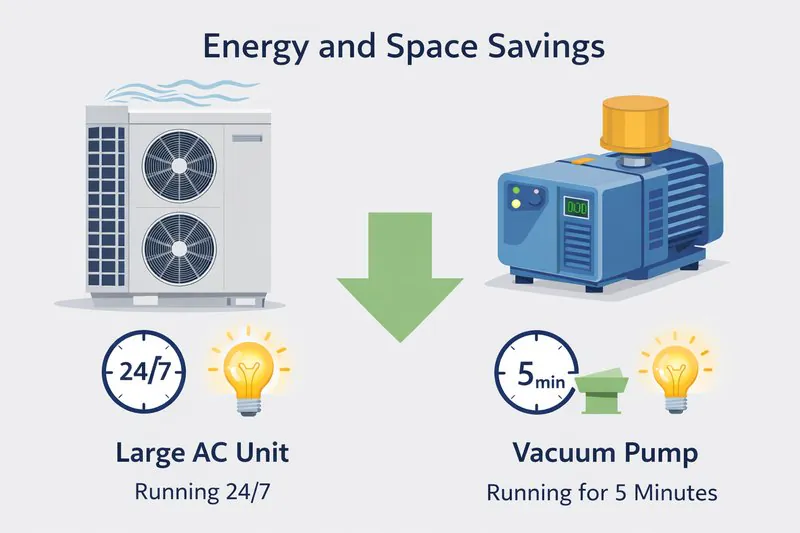
Vacuum cooling concentrates the cooling process in a chamber and can reduce long rack residence. The catalogue includes an energy example of about 1-2 kWh per 100 kg during the illustrated final bake/cooling stage and a separate footprint illustration of about 25 m² versus 250 m². Treat both as catalogue examples and verify them against the selected model and site layout.
The "Cost per Loaf" Energy Analysis
Compare energy using total metered kWh per saleable kilogram. Rated kW and cooling-stage duration alone do not capture loading, standby, auxiliaries, water systems, maintenance condition, or the current room-cooling load.
Let’s analyze the physics.
Traditional Cooling Room:
- You have a room full of hot bread (95°C).
- You are trying to cool it with cold air from an Air Conditioning (AC) system. Air is a terrible insulator, so it’s a very poor conductor of heat.
- Your AC compressors must run constantly for hours to fight the heat load from the bread. They run for 2, 3, or even 4 hours to cool down one batch.
- You also cool the racks, the floor, the walls, and all the air in the room. This is wasted energy.
Allcold 5-Minute Vacuum Cooling3:
- Our machine uses a powerful pump, but it only runs for 5 minutes.
- All the energy is focused on one thing: making the water inside the bread evaporate. This evaporation is what removes the heat. We are not trying to cool the steel chamber or the air around it.
- Our systems use a Variable Frequency Drive (VFD)4, which acts like a dimmer switch for the motor. It only uses the exact amount of power needed. It might run at 100% for the first 2 minutes, then ramp down.
| Factor | Air Conditioning Room | Allcold 5-Minute Vacuum Cooler |
|---|---|---|
| What is Cooled? | Entire Room (Air, Walls, Racks) | Only the Product |
| Run Time per Batch | 2-4 hours | 5 minutes |
| Energy Transfer | Inefficient (Convection) | Highly Efficient (Evaporation) |
| kWh per Comparable Batch | Enter metered baseline | Enter validated full-cycle consumption for the selected model |
The ROI Formula (Energy):
- Calculate the energy difference only after both cases use the same product load and temperature endpoints.
- Apply the site’s actual energy tariff, demand charges, and operating schedule.
- Multiply by the validated number of utilised batches per day.
- Annualize the verified result using actual production days.
The ROI Formula (Space):
Where floor-space cost is material, use the site’s actual occupancy cost and confirm whether reclaimed area can be released or reused.
- Current footprint: measure racks, aisles, buffers, and any conditioned cooling room; apply the site’s actual space cost.
- Proposed footprint: use the selected chamber drawing plus operating clearance, loading buffer, utilities, and trolley routes.
- Count a space saving only when the area can actually be avoided, released, or used productively.
Combine only verified energy, space, labor, maintenance, and quality changes. Keep assumptions separate from measured results.
How Does a 5-Minute Cool Down Increase Your Saleable Product?
Every loaf of bread you throw away is money you burned. Whether it is crushed during slicing because it was too soft, or it went moldy before you could sell it, waste destroys your bottom line.
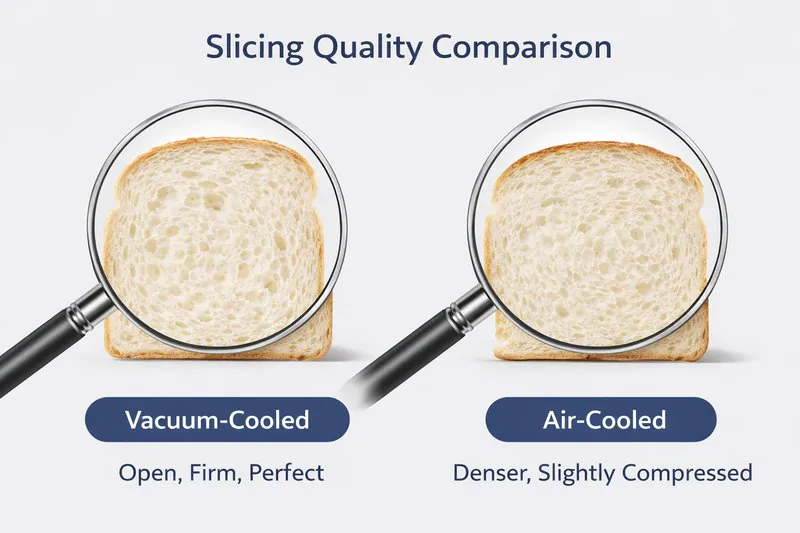
Rapid cooling can support earlier slicing and reduce warm holding, but it does not sterilize bread or guarantee shelf-life extension. Measure slicing loss, condensation, microbiology, packaging performance, and returns in a controlled trial.
The Economics of Yield and Shelf Life
This is where the ROI calculation gets very powerful. We are no longer just saving costs; we are protecting the value of what you have already produced. A 5-minute cool-down is the key to locking in this value.
1. The Slicing Yield
Slicing performance depends on core temperature, formula, loaf geometry, cooling profile, and slicer setup. Record the current reject rate and compare it with bread cooled to the validated slicing temperature; do not assume a universal reject rate or zero deformation.
- Saleable-output baseline: enter actual daily volume, contribution margin, and current reject or return rate.
- Apply the measured change in saleable output to the bakery’s actual contribution margin.
- Apply only the verified change in saleable output or returns.
- Annualize using actual operating days and contribution value, not selling price alone.
2. The Shelf Life Extension
For distribution projects, document the actual reasons for returns and confirm whether cooling can influence them.
- The Baseline: Measure environmental exposure, initial contamination, package performance, and the current validated shelf life.
- The 5-Minute Solution: The vacuum process is a race against biology. First, the chamber is sealed and air is removed, sucking out spores. Second, the 5-minute cycle moves the bread through the bacterial growth "danger zone" (40°C to 4°C) in seconds, not hours. This creates a much more microbiologically stable product.
- Validation: Shelf life is determined by formulation, initial contamination, sanitation, packaging, water activity, storage, and distribution. Any preservative change or return-rate benefit requires controlled testing and commercial records.
Can a 5-Minute Turnaround Actually Grow Your Business?
We have talked about saving money and protecting product. Now let’s talk about making more money. What is the value of being able to say "Yes" to an order you would usually have to refuse?
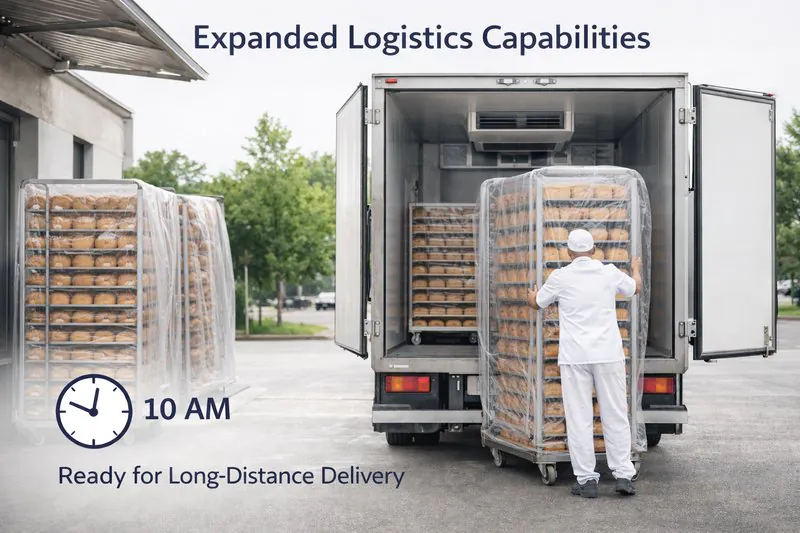
Yes. The 5-minute turnaround is a competitive weapon. It lets you accept rush orders your competitors can’t. It also extends your delivery radius by hours, opening up entirely new markets for daily fresh bread.
Opportunity Cost and Market Expansion
This part of the ROI calculator is about "Opportunity Cost." What money are you losing by being slow? Many business owners forget to calculate the cost of missed opportunities. The 5-minute cycle turns missed opportunities into new revenue streams.
1. The "Rush Order" Scenario
Imagine a hotel or a catering company calls you at 8:00 AM. Their regular supplier failed. They need 500 baguettes delivered by 11:00 AM for a lunch event.
- Without Vacuum: You bake (30 mins). You must cool the baguettes (at least 90 mins). Then you pack (30 mins). The total time is over 2.5 hours. You cannot meet the deadline. You have to say "No" and turn away the new customer.
- With a 5-Minute Cycle: You bake (25 mins). You cool the baguettes (5 mins). You pack (30 mins). The entire process takes one hour. The bread is on the truck at 9:00 AM. You easily say "Yes" and win a new, grateful client.
- The profit from capturing just one or two of these large, unexpected orders a month can often cover the entire monthly financing payment for the machine. This is how the machine starts paying for itself immediately.
2. Extending the Delivery Radius
Freshness is a ticking clock that starts the moment bread leaves the oven.
- If your bread takes 2 hours to cool before it’s ready for the delivery truck, that is 2 hours of precious shelf life lost. Your driver has a limited time to reach customers.
- With a 5-minute cycle, you gain back almost 2 full hours. Your delivery truck can leave 2 hours earlier. That means you can drive 2 hours further. This opens up new cities, new towns, and new supermarket chains that were previously "too far away" to service with fresh daily product. Expanding your market is the fastest way to grow your business, and this logistical speed is what makes it possible.
Conclusion
Add the verified annual benefits, subtract maintenance and ownership costs, and compare the result with the installed investment. Report a payback range only after the project’s inputs and utilisation assumptions are documented.
The decision should compare installed cost and operating risk with the verified value of the bottleneck removed.
Understanding ‘Dead Time’ can help you identify inefficiencies in your bakery workflow and improve productivity. ↩
Discover the risks of workplace injuries in bakeries and how to mitigate them for a safer environment. ↩
Find out how 5-minute vacuum cooling can enhance efficiency and reduce energy consumption in food production. ↩
Learn about VFD technology and its impact on energy efficiency and cost savings in machinery. ↩

Mila
You May Also Like

When Should You NOT Use Vacuum Cooling for Your Bakery?
Are you tired of waiting hours for your bread to cool down while your profits evaporate? You might think vacuum

Is Your Cooling Strategy Burning Your Profits? A Cost-Benefit Analysis of Vacuum vs. Conventional Cooling
As a bakery owner, you look at your balance sheet every month. You see the cost of ingredients, labor, and
Hybrid Cooling Solutions: Can Combining Vacuum and Traditional Methods Save Your Bakery?
Are you torn between the speed of new technology and the reliability of traditional freezing? Many bakery owners feel they
Blast Freezers vs Vacuum Coolers: Which Is the Right Choice for Your Bakery?
Are you tired of watching your freshly baked bread sit on racks for hours, taking up valuable space while you

Bakery Vacuum Cooling vs Spiral Cooling Systems: Which Is Better for Your Business?
Are you struggling with slow production lines because your bread takes forever to cool down? You are not alone. Cooling
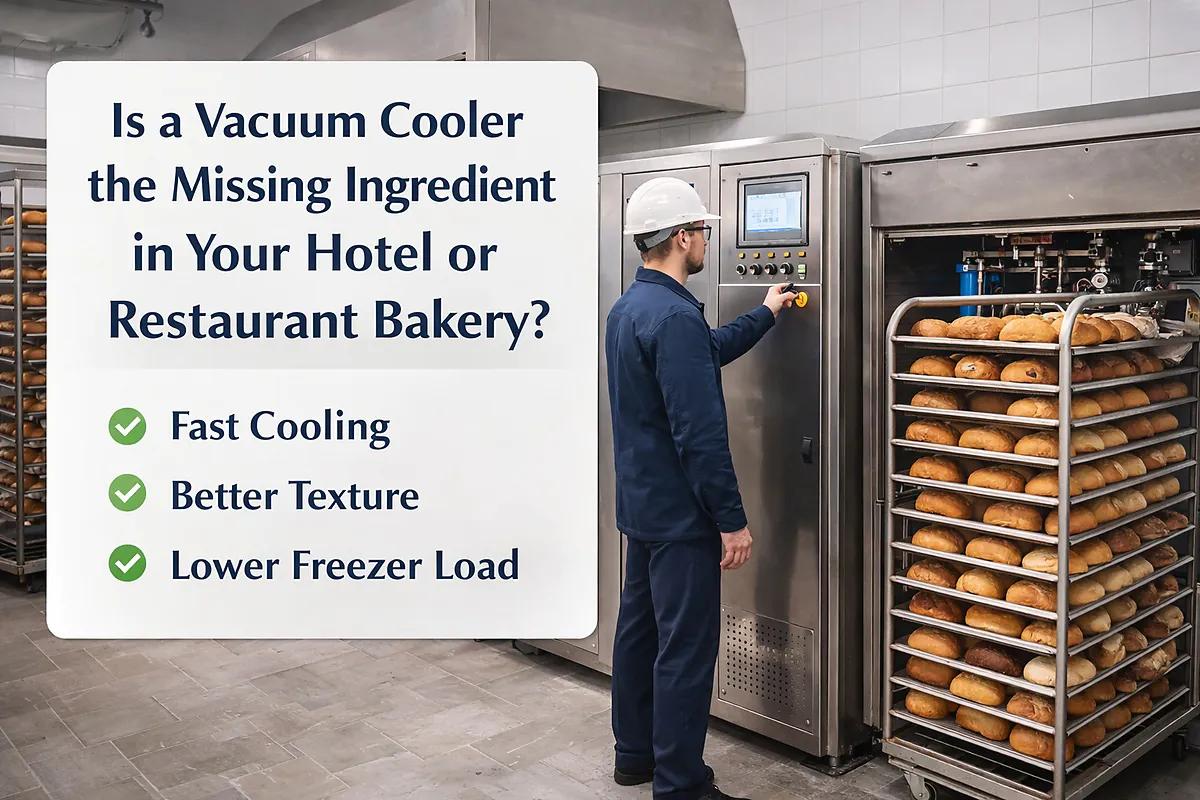
Is a Vacuum Cooler the Missing Ingredient in Your Hotel or Restaurant Bakery?
Imagine your kitchen is in full swing, and the freshly baked bread is finally out of the oven, but it
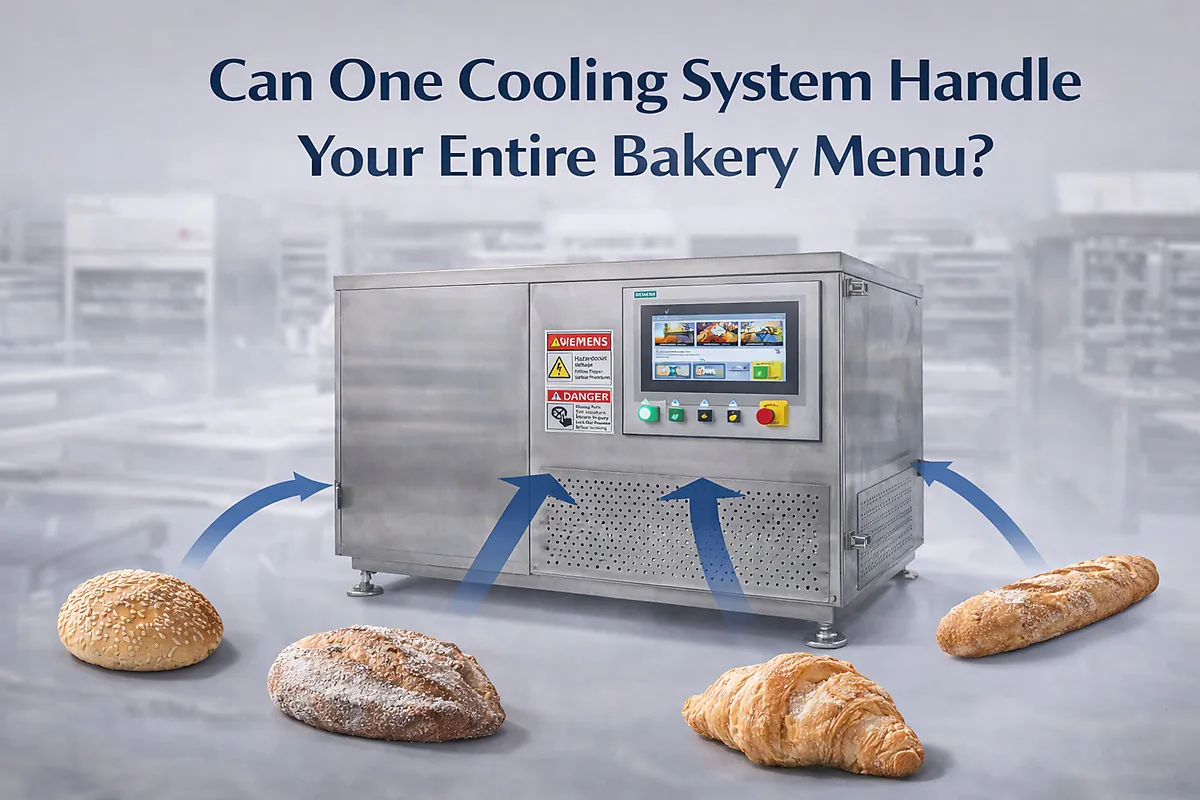
Can One Cooling System Handle Your Entire Bakery Menu?
You juggle sourdough, delicate pastries, and frozen dough lines daily. Yet, one cooling mistake ruins the texture of your artisan

Is Your Frozen Dough Production Losing Quality Before It Hits the Freezer?
You watch your energy bills climb month after month while your blast freezers work overtime. You see production bottlenecks form
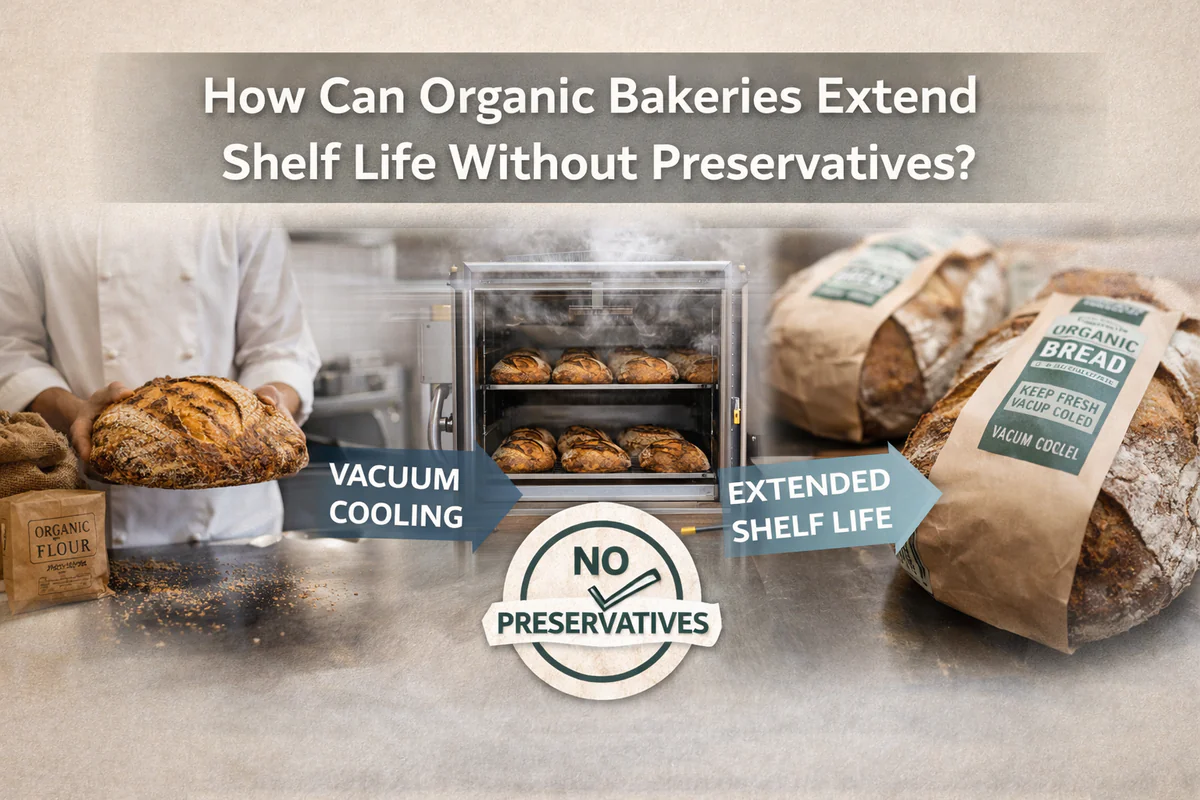
How Can Organic Bakeries Extend Shelf Life Without Preservatives?
You pour your heart into sourcing the finest organic flours and perfecting natural fermentation, only to watch your hard work

Can Vacuum Cooling Finally Fix the "Gummy" Texture in Gluten-Free Bread?
You watch your perfectly risen gluten-free loaves come out of the oven, only to see them sink or turn gummy