
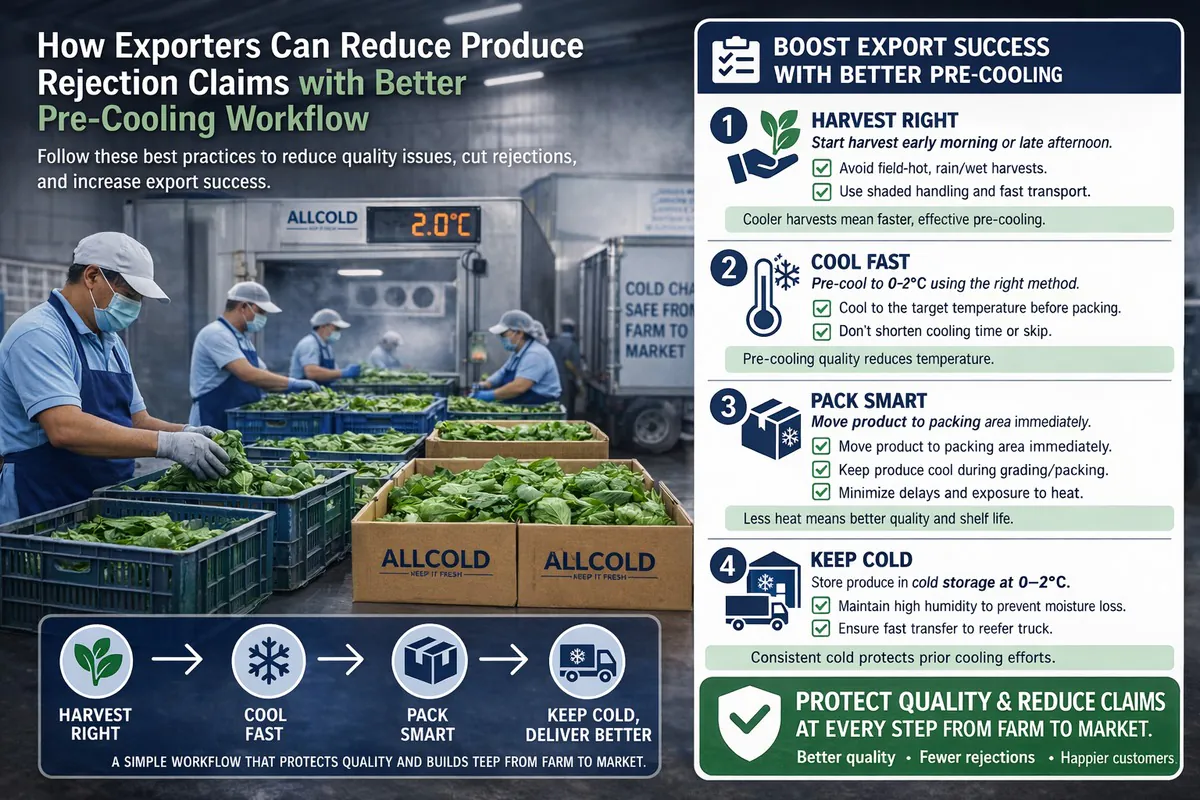
How Exporters Can Reduce Produce Rejection Claims with Better Pre-Cooling Workflow
Many exporters think rejection claims begin at destination. From our factory-side perspective, that is usually too late. By the time the buyer opens the load and raises the complaint, the shipment may have been carrying hidden risk for days.
In many fresh produce export projects, the real causes of rejection claims begin much earlier, often in the first hours after harvest. Product may still look acceptable when it is packed, palletized, and loaded, but the shipment is already carrying hidden risk because field heat was not removed quickly enough, pre-cooling was inconsistent, or the handoff between cooling, packing, and cold storage was poorly controlled. In other words, the load may still look sellable at origin while already losing the safety margin the buyer expects at destination.
That is why we do not see pre-cooling as a supporting detail. We see it as one of the first places where an exporter either protects the shipment or quietly weakens it.
In our experience, many exporters do not lose claims because they lacked a refrigerated truck or a cold room. They lose claims because the first part of the cold chain was too slow, too uneven, or too dependent on hope. Some exporters spend heavily on reefer logistics and cold storage, then still end up arguing about claims because the weakest part of the chain was never fixed.
Most Rejection Claims Start as Small Temperature-Control Mistakes Upstream
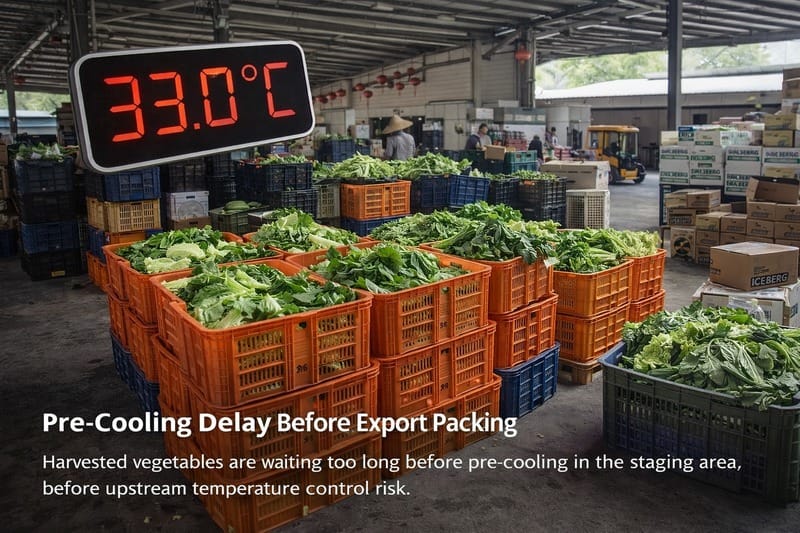
One of the biggest mistakes exporters make is assuming rejection claims are mainly a destination issue.
They are not. In many cases, the destination inspection is simply where the problem becomes visible, not where the problem begins.
From our side, many claims begin as small upstream mistakes that do not look dramatic at first:
- harvested product waits too long before pre-cooling
- pallets enter the cold room while still carrying too much field heat
- pre-cooling is uneven across the load
- product moves too slowly from cooling to packing
- packed cartons sit too long before stable cold storage
- loading windows compress the workflow and force rushed handling
These are the kinds of problems that may not create immediate visible damage at origin. But once the shipment moves into longer transport, tighter buyer expectations, and less margin for recovery, the consequences become more visible.
That is why we usually tell exporters this: the claim may arrive later, but the mistake often happened earlier. If the first-mile workflow is weak, you may be loading a claim into the container before the truck even leaves.
Exporters Should Treat Pre-Cooling as a Claim-Prevention Step, Not Just a Quality Step
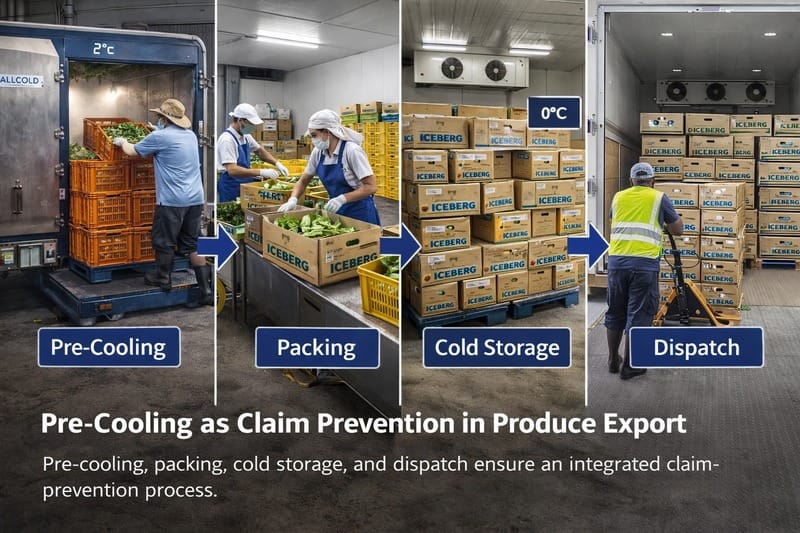
Image brief: Produce export workflow showing pre-cooling, packing, cold storage, and dispatch as an integrated claim-prevention process.
A lot of exporters already understand that pre-cooling helps product quality. That part is not new.
What is still underestimated is this: better pre-cooling workflow also helps reduce rejection risk by reducing instability before the shipment enters the part of the journey where recovery becomes difficult and expensive.
When pre-cooling is handled correctly, it can help exporters:
- remove field heat faster
- reduce temperature variation across the shipment
- improve stability before packing and storage
- lower the chance that weak product enters transport in a risky condition
- reduce the number of avoidable questions later about where the damage really started
From our factory-side perspective, this is a major commercial point. Good pre-cooling does not guarantee that no buyer will ever raise a claim. But it does make the shipment more defensible, more stable, and less exposed to preventable first-mile mistakes. That matters because once the load reaches destination, the exporter is no longer arguing only about temperature. The exporter is arguing about credibility, responsibility, and margin.
That is also why we believe exporters should not evaluate pre-cooling only by speed. They should evaluate it by whether it improves shipment control before the product enters the longer and less forgiving part of the export chain.
The Most Dangerous Period Is Often Between Harvest and Stable Cold Storage
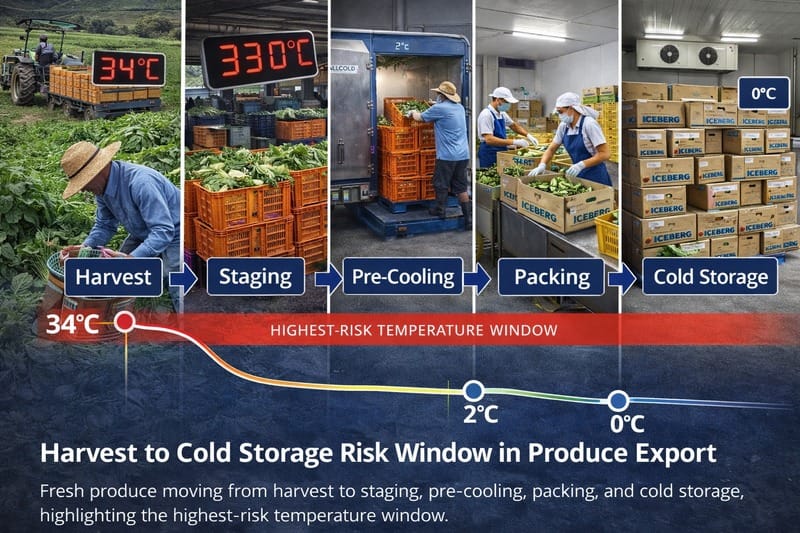
In many projects, the most dangerous period is not the ocean shipment itself. It is the earlier window between harvest and stable cold storage. That is where exporters most often lose control while still believing they have time to recover it later.
We often see exporters focus on the refrigerated container, the transport temperature, and the destination handling. Those things matter, of course. But if the product starts that journey in a weak condition, the later cold chain is often trying to protect a problem that already exists.
This is where the workflow usually needs closer review:
- how long does the product wait after harvest
- how much field heat is still present when it reaches pre-cooling
- whether pre-cooling starts quickly enough
- whether the cooled product moves fast into cold storage or packing
- whether the route between these steps stays disciplined during peak periods
From our side, this window is where many exporters unknowingly lose quality margin. The product may not yet be rejected. But it has already become less resilient, less defensible, and less able to survive the rest of the chain without complaint.
That is why buyers planning their site or process should also review what to check before installing a vacuum cooler, because weak installation logic often leads to weak first-mile workflow later.
Uneven Pre-Cooling Creates Hidden Claim Risk Across the Load
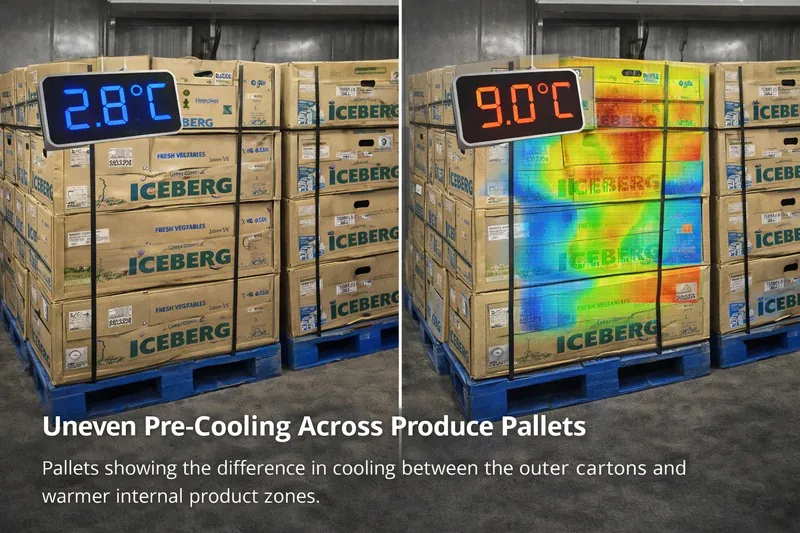
One of the most frustrating problems in export claims is unevenness.
A shipment may contain some product that arrives in acceptable condition and some product that does not. When that happens, exporters often end up in difficult conversations because the load was not fully stable in the first place.
Uneven pre-cooling can come from several workflow problems:
- overloaded batches
- poor airflow or product arrangement before cooling
- loading patterns that do not match the cooling method
- inconsistent handling discipline during busy hours
- moving product before the cooling step is complete enough for the actual export risk
From our factory-side perspective, unevenness is dangerous because it creates false confidence. The exporter sees some cartons looking fine and assumes the whole load is protected. But claims often grow from the weakest part of the shipment, not the strongest part. One weak zone in the load can damage the commercial value of the whole container.
That is why pre-cooling workflow should not be judged only by whether product feels colder than before. It should be judged by whether the process reduces unevenness across the real commercial load.
Packing and Pre-Cooling Should Be Managed as One Workflow, Not Two Departments
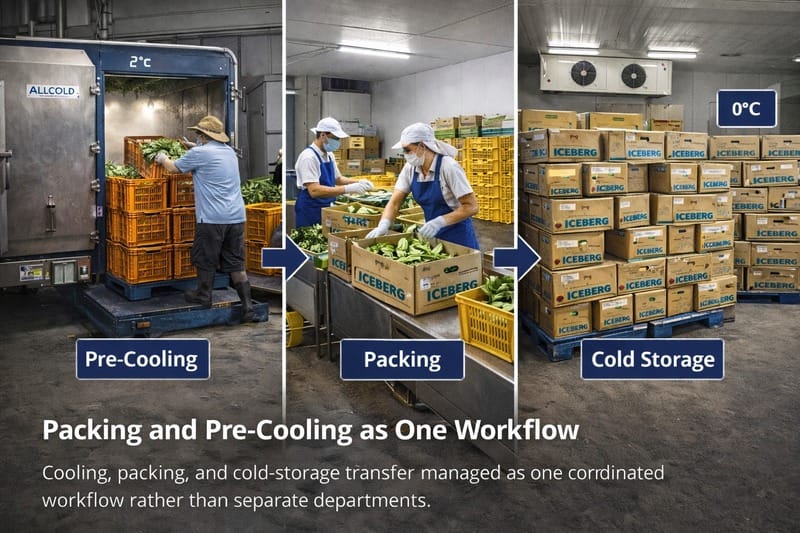
Many exporters organize these steps as separate teams: harvest, cooling, packing, cold storage, dispatch. That may be necessary operationally, but it becomes risky when each team optimizes its own step without protecting the full chain. That is how exporters end up with a shipment that was handled "correctly" in several departments and still arrives with claim risk built into it.
In our experience, this is where avoidable claim risk builds quietly:
- the cooling team finishes a batch, but packing is not ready
- packing accelerates, but the pre-cooling rhythm falls behind
- cooled product waits too long before the next protected step
- dispatch timing pressures the whole line into rushed decisions
From our side, this is why we say pre-cooling and packing should be managed as one workflow, not as two separate departments that happen to touch the same product.
A shipment becomes safer when the exporter can control:
- the timing between cooling and packing
- the route from cooling to cold storage
- the amount of waiting allowed after each step
- the peak-hour handoff between teams
If buyers want to think about project design more broadly, our article on how packing house layout affects vacuum cooling throughput is also relevant, because layout weaknesses often become claim risk during the busiest periods.
The Wrong Pre-Cooling Workflow Can Make Later Cold Chain Investment Less Effective
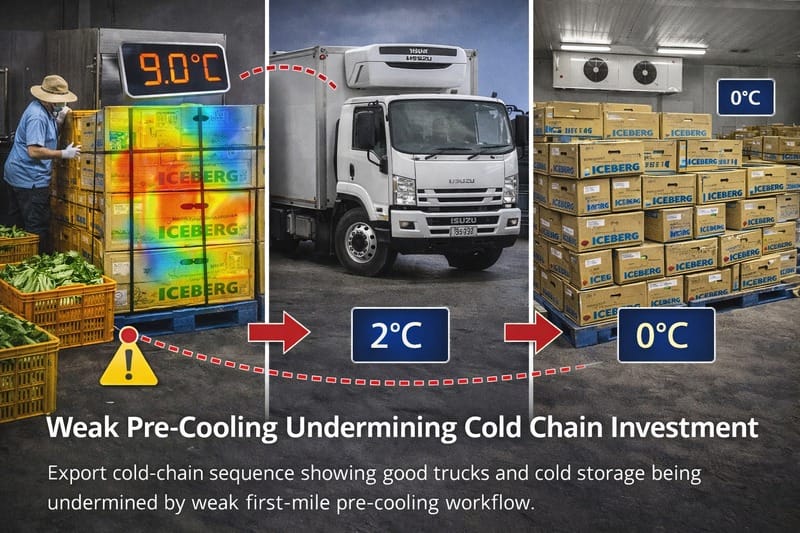
This is one of the harder truths in produce export.
An exporter can invest in better cold rooms, better containers, and better logistics, and still face claim pressure if the pre-cooling workflow remains weak. This is one of the most frustrating forms of loss because the exporter has spent money on the cold chain but left the most fragile part of it under-controlled.
Why? Because later cold chain investment is often trying to preserve what the first-mile workflow has already compromised.
From our perspective, the first-mile cooling step has a disproportionate impact on what happens next. If that step is slow, uneven, or badly timed, the rest of the cold chain is no longer protecting a strong shipment. It is protecting a weakened one, and weakened shipments are where expensive arguments begin.
That is why pre-cooling is not just a processing step. It is a leverage point.
And that is also why buyers comparing solutions should not think only about price. Our article on why detailed vacuum cooler quotations help buyers avoid project risk is relevant here, because the right pre-cooling project depends on whether the supplier has really understood the workflow conditions that drive claim risk.
Peak-Season Pressure Is Where Weak Workflow Usually Becomes Expensive
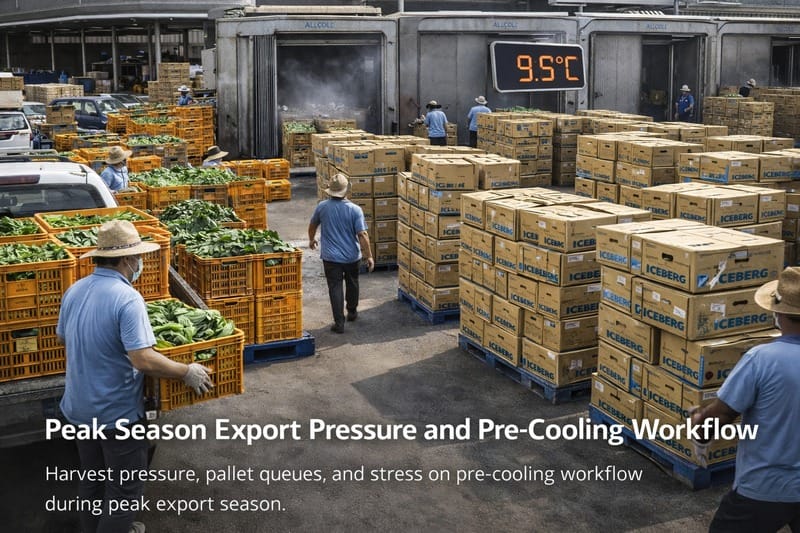
Many workflows look acceptable on a normal day. That is not the real test. Claims are not usually created on the easiest day in the season. They are created when pressure rises and discipline slips.
The real test is peak season, when harvest volume rises, loading windows tighten, and every delay becomes more expensive.
We usually ask exporters to review:
- what happens in the busiest harvest hour
- where product queues when volume spikes
- whether the cooling step still starts fast enough
- whether packing and cold storage can absorb the cooled load in time
- whether operators start making shortcuts when pressure rises
From our side, this is where many claim-prevention systems prove whether they are real or only theoretical. A workflow that works only when everything is calm is not a strong export workflow.
It has to work when the site is under pressure.
What Exporters Should Check If They Want Fewer Rejection Claims
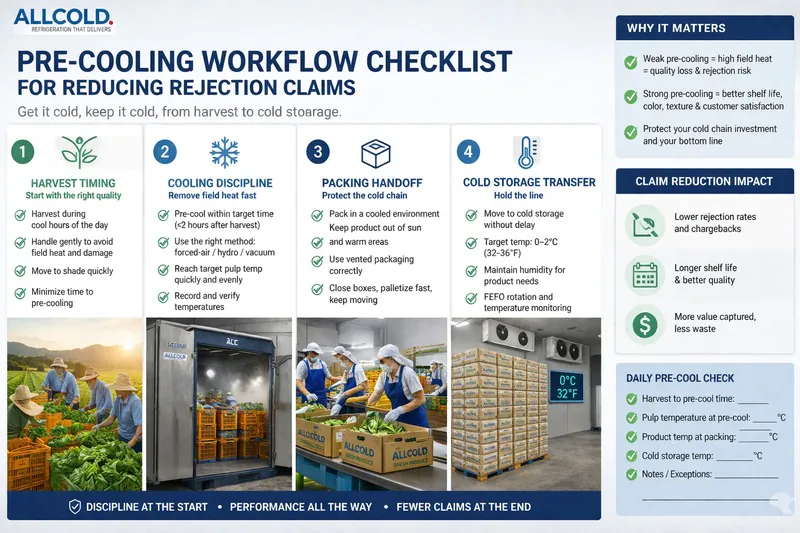
If exporters want to reduce preventable rejection claims, we usually recommend checking these points first:
Pre-Cooling Workflow Checklist for Claim Reduction
- harvest-to-cooling time is measured, not guessed
- field heat is removed quickly enough for the actual product and export route
- pre-cooling consistency across the load is reviewed
- packing does not create long waiting time after cooling
- cold storage transfer is fast and controlled
- peak-hour workflow is reviewed, not just average-day performance
- layout and handoff discipline support the cooling step
- site decisions are based on real operating pressure, not ideal assumptions
This checklist is not glamorous, but that is usually the point. Claims are often created by ordinary operational weaknesses, not dramatic technical failures. Exporters do not usually lose money because one catastrophic thing happened. They lose it because too many small weaknesses were allowed to travel with the load.
FAQ
Can better pre-cooling really reduce export rejection claims?
Yes, in many cases it can reduce avoidable claim risk because it helps remove field heat earlier, stabilize product condition, and reduce unevenness before the shipment enters longer transport.
Why do claims often show up later if the problem started earlier?
Because small first-mile temperature-control mistakes may not create obvious visible damage immediately. The problem becomes more visible later, after transport time, handling stress, and tighter buyer inspection at destination.
Is pre-cooling only about product quality?
No. It is also about shipment defensibility and workflow control. Better pre-cooling can help reduce avoidable instability before packing, storage, and loading.
What is the biggest workflow mistake exporters make?
From our perspective, the biggest mistake is treating harvest, cooling, packing, and cold storage as separate steps without controlling the timing between them. That is where hidden risk builds across the shipment.
Final Thoughts
If I had to reduce this article to one message, it would be this:
Most rejection claims do not begin where they are discovered. They begin where the pre-cooling workflow was too weak to protect the shipment early enough.
We have seen exporters focus too much on destination handling and not enough on the first-mile timing, consistency, and handoff discipline that shape claim risk much earlier.
From our factory-side perspective, the strongest export operations are not only the ones with more cold equipment. They are the ones with a better pre-cooling workflow. The painful truth is that many exporters do not lose the shipment when the claim is raised. They lose it much earlier, when a weak workflow quietly sends unstable product into a chain that can no longer fully save it.
If you send us your product type, harvest rhythm, packing sequence, and current pre-cooling process, we can help you review where your shipment may still be exposed before the claim ever reaches you.
Footnotes
Looking for the right vacuum cooler for your operation?
Allcold engineers work with packhouses and exporters to spec the right system for your product, volume, and site conditions.
Mila
You May Also Like
Used vs. New Vacuum Coolers: Is the Lower Price Worth It?
Buying a used vacuum cooler? Compare load fit, condition, relocation, installed cost and support with a new system before deciding if the saving is real.
Why Does Produce Sweat After Vacuum Cooling?
FRESH PRODUCE · POST-COOLING HANDLING The cooling cycle can finish correctly—and the load can still become wet on its way
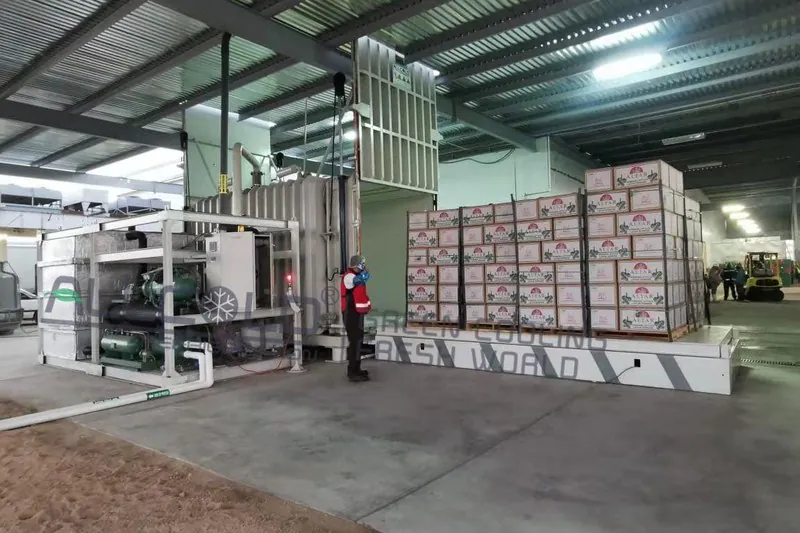
Vacuum Cooler Not Performing? Check Your Pallet Loading First
When a vacuum cooler produces inconsistent results—warm spots, longer cycle times, variable exit temperatures across the load—the machine is usually
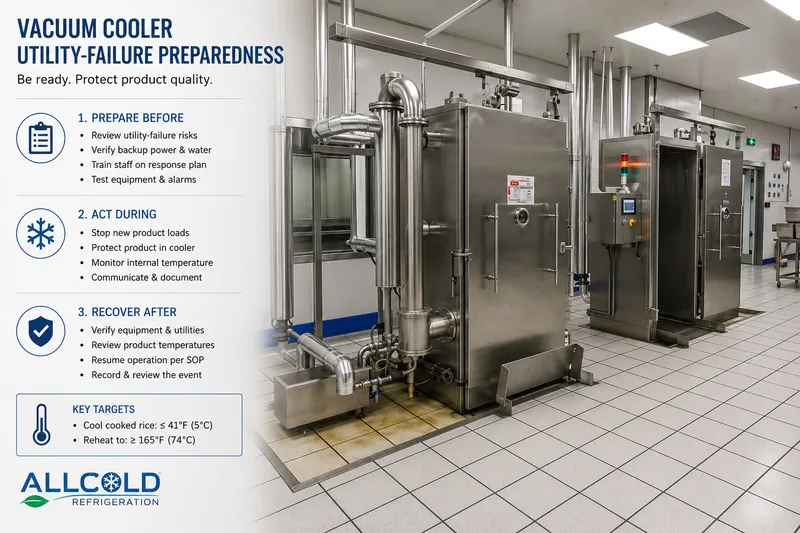
Why One Successful Cooked Rice Cooling Test Is Not Enough to Standardize a Central Kitchen Process
A cooked rice batch can pass a vacuum cooling test and still fail as a production process. That is the
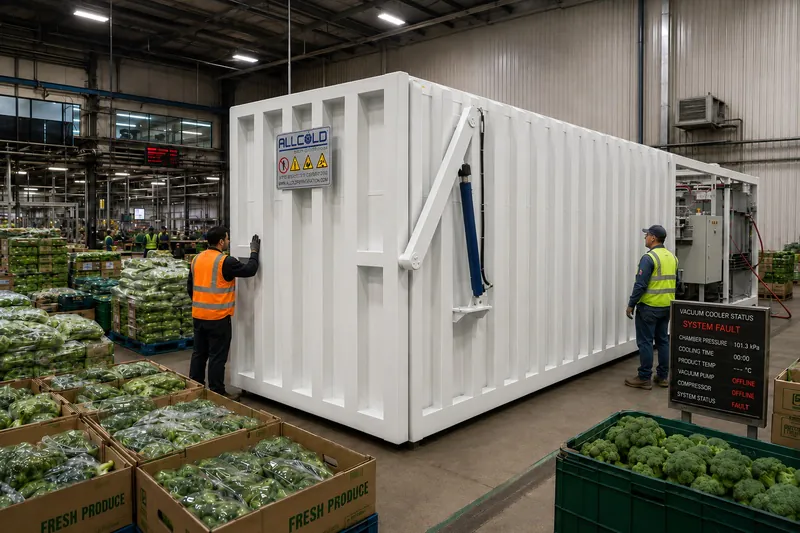
Why a Vacuum Cooler Utility Failure Becomes an Export Quality Problem Before It Becomes a Repair Problem
A vacuum cooler stoppage does not start as a maintenance problem. In a produce export operation, it becomes a quality
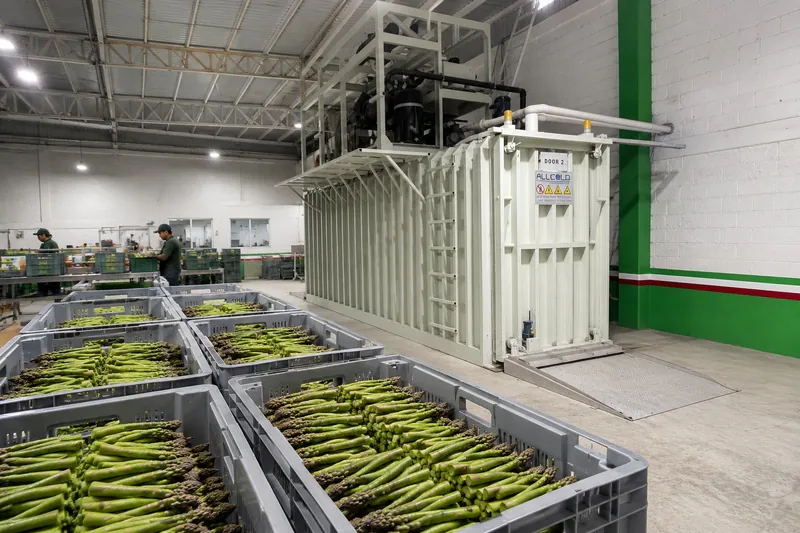
Why Asparagus Loses More Export Value in the First Two Hours After Cutting Than in the Entire Cold Chain That Follows
For fresh asparagus exporters, the most expensive quality loss often happens before the product even reaches the main cold chain.
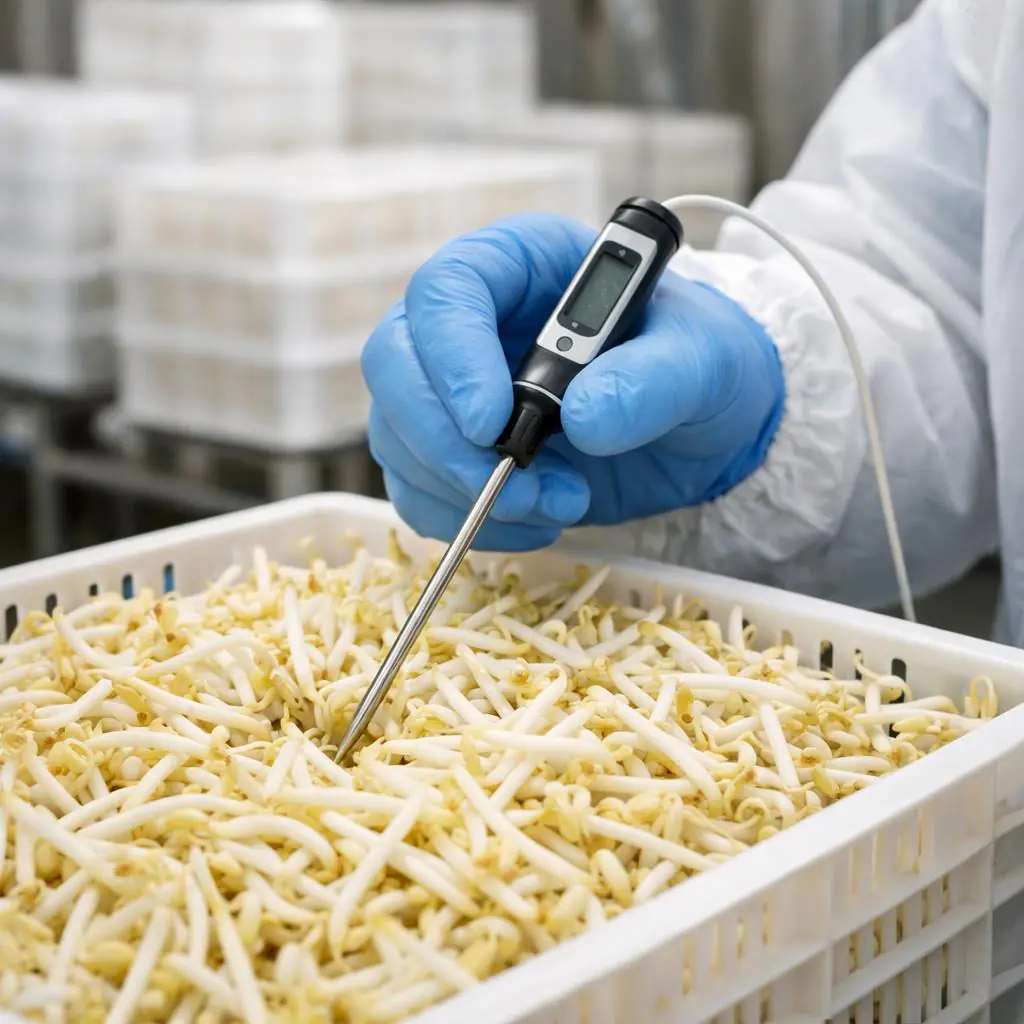
Why Bean Sprouts Are One of the Hardest Vegetables to Pre-Cool Correctly and What Exporters Get Wrong
Bean sprouts look simple. They are light, moist, and usually packed in bulk or retail bags. But from a pre-cooling
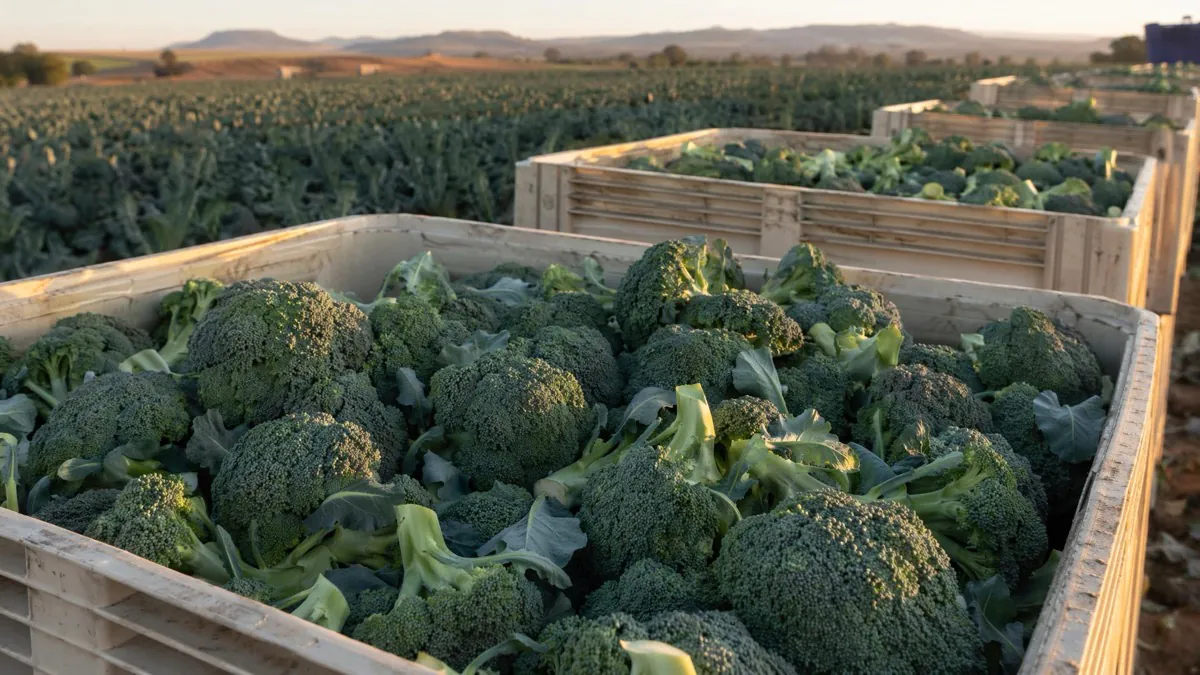
Why Broccoli Loses Export Quality Faster Than Any Temperature Log Will Show
The complaint comes in from the buyer: yellowing, premature flowering, weak texture on arrival. The exporter reviews the cold room
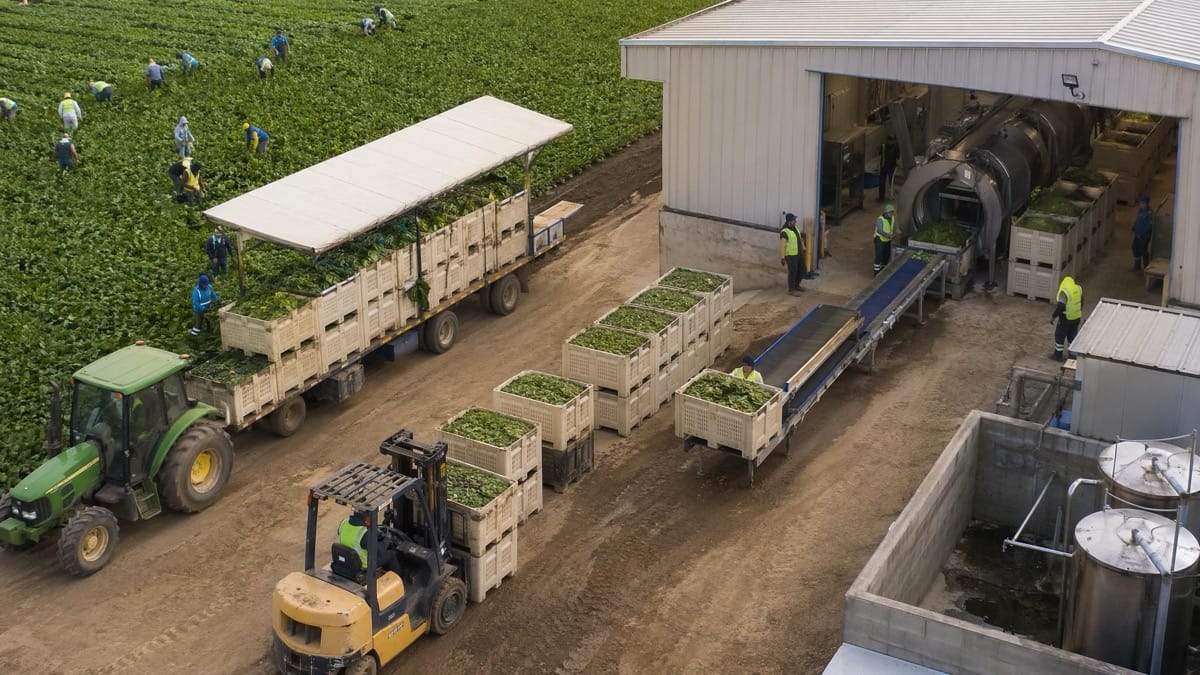
Why Spinach Shipments That Leave Looking Perfect Arrive Looking Wrong
The complaint lands differently with spinach than with most other export vegetables. The exporter packed dark green, crisp product. The
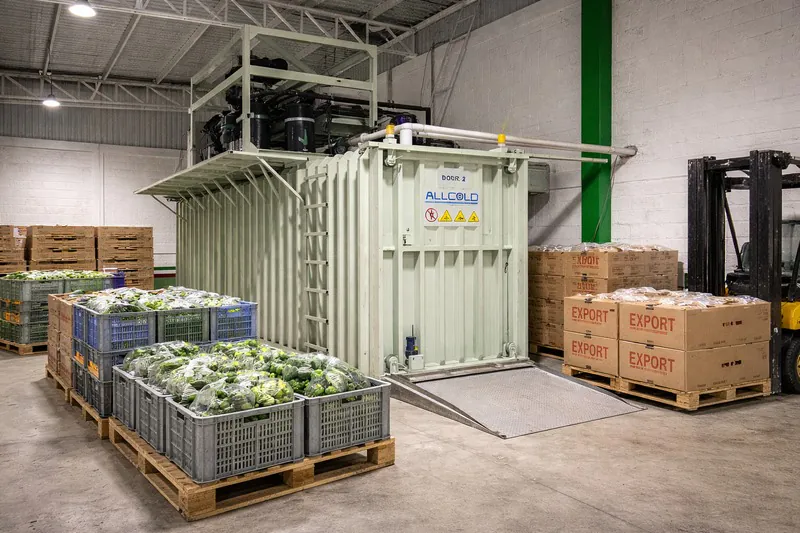
Buying a Vacuum Cooler for Fresh Produce Export? Avoid These Costly Procurement Mistakes
Buying a vacuum cooler for fresh produce export is not simply a machine purchase. It is a project decision that