
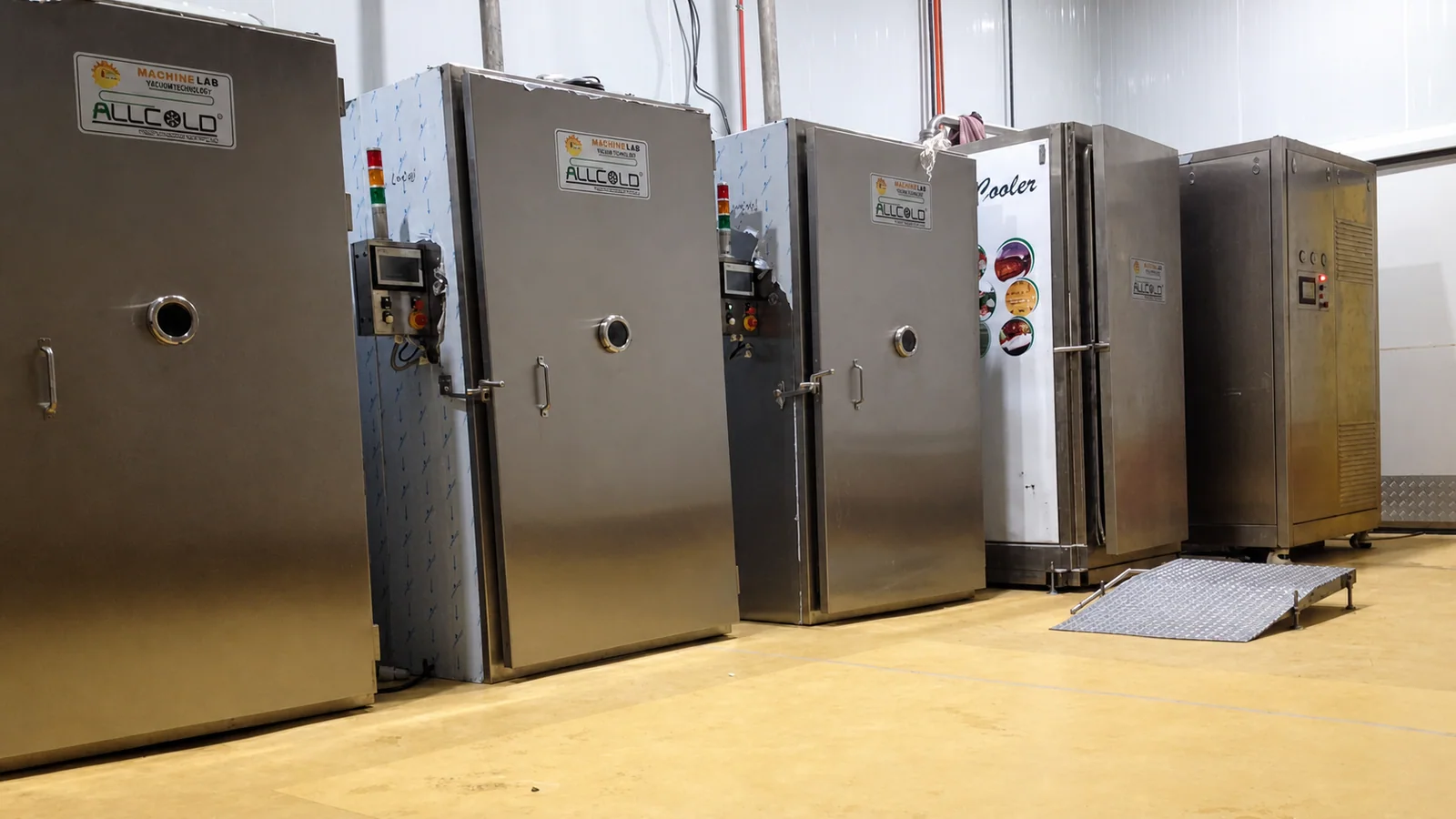
Vacuum Cooling Cooked Rice: A Validation Guide for Central Kitchens
Can cooked rice be vacuum cooled safely in a central kitchen?
Yes—but the process must be validated with the actual rice variety, recipe, batch mass, tray depth, trolley pattern, cook-to-cool delay, temperature limits, and vacuum program. A fast chamber cycle is not enough. The approved process must also protect yield and texture, reach the slowest-cooling point within the facility’s applicable food-safety limits, and remain repeatable during peak production.
Cooked rice creates an uncomfortable combination for a central kitchen: it is produced hot and in large batches, it can be packed densely, quality changes when moisture is removed, and it should not be left waiting at ambient temperature. A machine can pull down the temperature quickly while the commercial process still fails because the test used shallow trays, one temperature probe, or a batch smaller than normal production.
This guide is for central-kitchen operators, ready-meal manufacturers, QA teams, engineering managers, and project buyers evaluating vacuum cooling for cooked rice. It does not supply a universal cycle recipe. It explains how to build and document a product-specific validation protocol that a food-safety professional can review against the rules that apply to the facility.
Why Cooked Rice Needs Its Own Cooling Validation
Rice is not simply another hot product. Bacillus cereus spores can be present in uncooked rice and may survive cooking. If cooked rice is then held under unsuitable time-temperature conditions, cells can multiply and toxin can be produced. A documented CDC outbreak associated with fried rice found that the rice had been cooked the previous night and cooled at room temperature before refrigeration.[1]
That history does not mean vacuum cooling automatically makes rice safe. It means the cooling step has to be treated as a controlled process. The FDA’s cooling guidance for time/temperature control for safety food uses a two-stage framework: from 57°C (135°F) to 21°C (70°F) within two hours, then to 5°C (41°F) or below within a total of six hours.[2] Local requirements may be different or stricter, so the facility’s food-safety team must define the applicable limits before equipment trials begin.
Quality creates a second requirement. Vacuum cooling removes heat through evaporation. Research comparing cooling methods for cooked rice found that vacuum cooling was much faster but produced more weight loss than the other methods tested; operating conditions also changed cooling time, moisture, hardness, and adhesiveness.[3] A safe temperature curve can therefore coexist with unacceptable yield, dry surface grains, excessive clumping, or poor reheating quality.
The validation target is not “cold rice.” It is a repeatable intersection of:
- food safety: the slowest point meets the facility’s approved time-temperature limits;
- quality: moisture, texture, appearance, separation, and reheating performance remain acceptable;
- yield: cooling-related mass loss stays within the commercial specification;
- throughput: the complete loading-to-release cycle fits the production rhythm;
- control: operators can run, monitor, record, and correct the process consistently.
Define Acceptance Criteria Before the First Trial
A trial without written acceptance criteria tends to end with subjective comments such as “the rice cooled quickly” or “the texture looked fine.” Those observations are useful, but they do not define an approved production process.
Before testing, the QA, production, and engineering teams should agree on measurable acceptance criteria. The exact values belong to the facility, recipe, market, and regulatory framework, but the categories should include:
| Area | What to define | What to record |
|---|---|---|
| Safety | Applicable cooling limits and slowest-point target | Time-temperature curve at mapped probe locations |
| Yield | Maximum acceptable mass loss | Verified mass before and after cooling |
| Texture | Hardness, stickiness, separation, surface condition | Standard sensory or instrumental checks at defined times |
| Process | Maximum load, tray depth, trolley map, program | Batch mass, geometry, start delay, pressure and cycle data |
| Throughput | Required batches or kilograms per hour | Load, cool, vent, unload, clean, and release time |
FDA HACCP guidance distinguishes validation from routine monitoring. Validation asks whether the controls are scientifically and technically capable of controlling the identified hazard; monitoring checks whether the approved process is being followed.[5] For cooked rice, a temperature display on the machine is useful monitoring data, but it does not replace the initial mapped validation.
Lock the Product and Load Variables Before Adjusting the Machine
Many trials start by changing vacuum settings while the product itself keeps changing. That makes the result difficult to interpret. Freeze the main product and loading variables first.
Document at least:
- rice variety and supplier;
- rice-to-water ratio and cooking method;
- oil, seasoning, sauce, or other additions;
- temperature at cooking completion;
- time between cooking completion and chamber start;
- mass of rice per tray and total mass per trolley;
- tray material, dimensions, perforations, and lid status;
- rice-bed depth and whether the product is fluffed, compacted, or portioned;
- number and position of trays and trolleys;
- whether the product will be packed, chilled, frozen, or reheated after cooling.
These details are not paperwork around the test; they are the test. A 25 mm loose bed of long-grain rice is not equivalent to a deep, compact tray of sticky rice. A trolley loaded with alternating empty shelves is not equivalent to the production trolley. A program proven with 80 kg should not be assumed valid for 180 kg.
The same principle applies when evaluating other starch products. Allcold’s guide to vacuum cooling cooked noodles and pasta explains why recipe, surface condition, clumping, and moisture management must be validated rather than copied from a fresh-produce cycle. Rice has a different grain structure and handling pattern, but the discipline is the same.
Place Temperature Probes Where Failure Is Most Likely
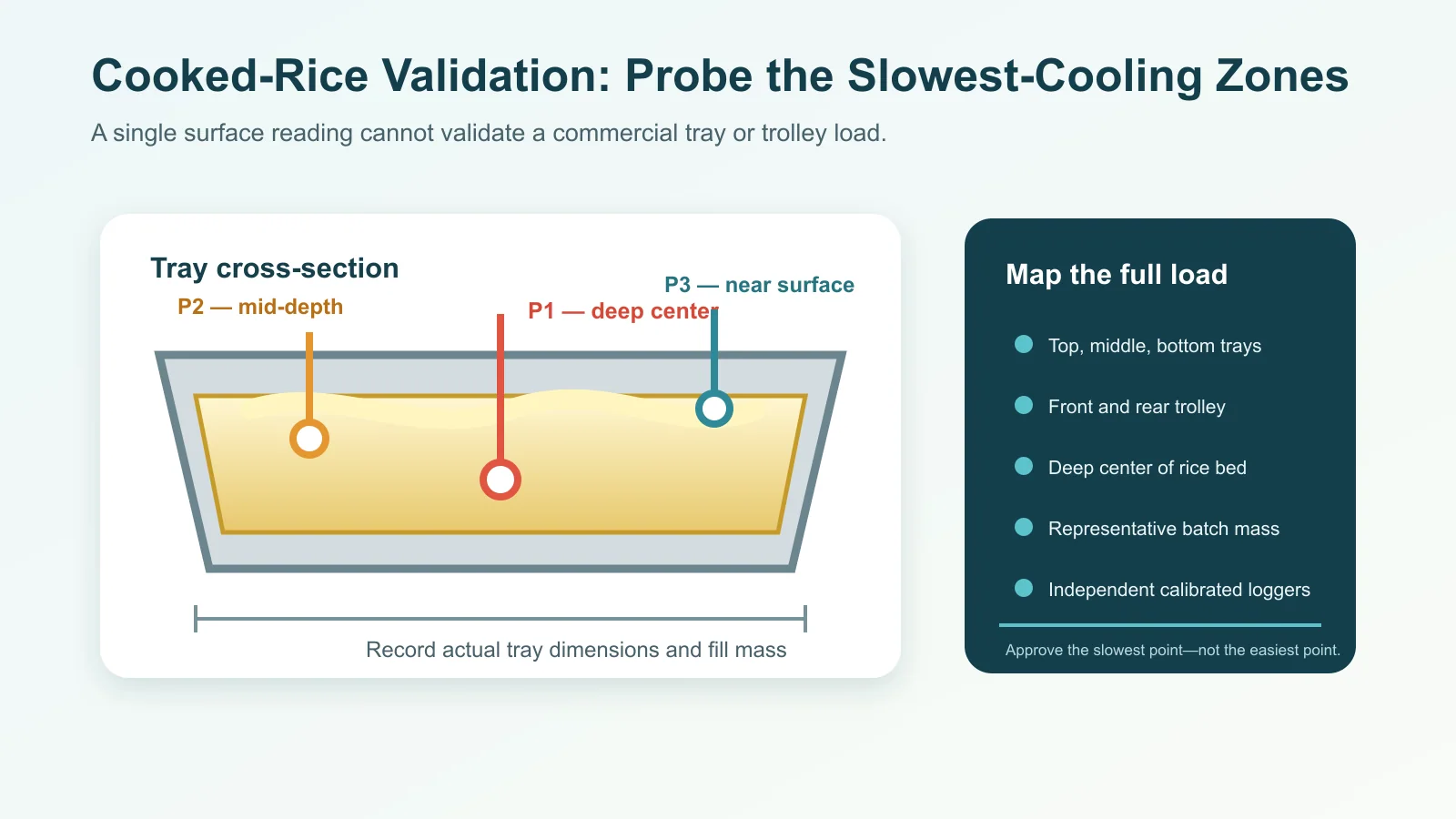
A single probe near the surface can make a weak process look successful. The validation must find the slowest-cooling zones in both the tray and the full trolley load.
Begin with independent, calibrated temperature loggers or probes suitable for the process. Map multiple trays at the top, middle, and bottom of the trolley, and include front and rear positions if the chamber holds more than one trolley. Inside each selected tray, measure the deep center of the rice bed as well as a shallower point for comparison.
The slowest location may change when tray depth, load mass, trolley position, recipe, or cycle program changes. That is why validation should use a map rather than one preferred probe location. The production control probe may later be simpler, but the relationship between that control point and the mapped slowest point must first be demonstrated.
Probe installation also matters. The sensor should remain at its intended depth throughout the cycle and should not rest against metal. Record probe IDs and calibration status. If the process relies on the Allcold control system’s product probe, compare it with the independent validation instruments rather than assuming the readings are interchangeable.
Build a Baseline Cycle Before Chasing the Fastest Cycle
The first useful cycle is not the shortest possible cycle. It is a stable baseline that shows how pressure, product temperature, and time interact with the commercial load.
For each trial, record:
- cooking completion time and temperature;
- cooler entry and cycle-start time;
- chamber pressure over time;
- temperature at every mapped location over time;
- program name or version;
- cycle end condition and final pressure;
- venting, door-open, unload, and cold-storage transfer times;
- mass and quality observations before and after cooling.
Research on tray-loaded rice and beef found that higher pumping speed or lower final pressure reduced cooling time, while those operating choices also affected weight loss; increasing the amount of rice lengthened cooling time.[4] This is why “pull a deeper vacuum” is not a complete process strategy. Speed, yield, texture, and equipment duty must be reviewed together.
Do not copy a pressure setpoint or cycle time from another rice line without product trials. Final conditions depend on the actual recipe, load, equipment, target temperature, and control logic. For a new project, the supplier should help configure the baseline, but the food business remains responsible for approving the process within its food-safety system.
Measure Moisture Loss as a Yield and Quality Variable
Because vacuum cooling uses evaporation, some moisture loss is inherent to the mechanism. The commercial question is whether the validated loss is acceptable and repeatable—not whether evaporation can be eliminated.
Weigh the same defined unit before and after cooling. For a large trolley, use a verified floor scale and subtract the known tare mass. Control transfer time so that evaporation between weighing and cycle start does not distort the result. Record drained liquid or handling loss separately where relevant.
Then connect mass data to product quality:
- Does the rice surface look dry while the center remains acceptable?
- Do grains separate more easily or become too firm?
- Does the result change after chilled holding?
- Does reheating restore the intended texture?
- Does sauce absorption or seasoning behavior change?
- Is yield variation larger on the first or last trolley of the shift?
The rice study cited above reported that water addition strategies influenced moisture, hardness, and adhesiveness, but some also prolonged cooling.[3] That finding supports controlled trials; it does not justify adding water automatically. Any water addition must be compatible with the recipe, hygienic design, potable-water controls, allergen plan, and validated process. “Add spray” should never be used as an undocumented correction for an aggressive cycle.
Evaluate Texture After Cooling, Holding, and Reheating
Rice that looks acceptable immediately after cooling may behave differently after six or twenty-four hours in chilled storage. Validation should follow the product through its intended use.
Create a simple quality panel with defined scoring language. Depending on the product, this can include grain separation, clumping, surface dryness, hardness, chew, broken-grain rate, color, aroma, sauce uptake, and reheated texture. Compare against the currently approved cooling method, not an imaginary perfect sample.
Run the comparison using the same cook batch whenever practical. Otherwise, recipe variation can be mistaken for a cooling effect. Keep sampling, holding, packaging, and reheating conditions consistent. If multiple rice varieties or menu recipes share the cooler, treat each materially different product family as a separate validation or justify why one represents the others.
Allcold’s broader page on ready-to-eat food preservation and cooling provides context on why rapid cooling must sit inside a larger food-handling plan. The vacuum cooler does not replace hygienic cooking, protected transfer, chilled storage, packaging control, or validated reheating.
Test the Complete Production Cycle, Not Only Pump-Down Time
A laboratory cycle can be technically successful and commercially too slow. Throughput must include every step that prevents the chamber from starting the next approved batch:
- moving the trolley from cooking to the cooling area;
- confirming batch identity and load condition;
- loading and door closure;
- vacuum cooling and controlled venting;
- unloading and moving product to the next controlled step;
- required inspection, cleaning, drainage, and reset;
- operator and trolley availability.
Use peak production, not only average daily output. If cooking releases three trolleys within twenty minutes and then pauses, the cooler must handle that arrival pattern without creating an unsafe or quality-damaging queue. A machine rated by kilograms per batch is not automatically matched to kilograms per hour.
For procurement, model at least three conditions: normal load, maximum approved load, and the heaviest expected peak sequence. Where the kitchen produces mixed foods, include changeover and cleaning time. Allcold’s cooked-food and bakery vacuum cooling systems are configured around the actual tray, trolley, batch, and workflow requirements rather than a fresh-produce pallet assumption.
Turn the Trial Into an Approved Operating Standard
A successful demonstration becomes a controlled process only when the acceptable conditions, monitoring records, and corrective actions are written down. FDA HACCP guidance identifies critical limits, monitoring, corrective actions, verification, and records as connected elements of control.[5]
The approved cooked-rice standard should identify:
- covered rice products and recipes;
- permitted tray, trolley, and batch configurations;
- maximum cook-to-cool delay;
- approved machine program and access control for changes;
- temperature measurement point and required limits;
- monitoring frequency and instrument calibration;
- yield or quality checks where required;
- release responsibility;
- predefined actions when time, temperature, load, or program limits are not met;
- conditions that trigger revalidation.
Record actual values, not only “pass.” A batch record that contains timestamps, temperatures, program ID, load identity, operator, and any deviation supports both daily control and later investigation. The FDA’s 2024 supplement also emphasizes that critical limits should be scientifically based and measurable, and it discusses specific controls for acidified rice; rice that has not been validated as a special process remains subject to time-temperature control.[6]
What Information Should a Buyer Send Before Requesting a Proposal?
A supplier can recommend a more realistic cooked-rice configuration when the inquiry contains production data rather than only “kg per day.” Send:
- rice varieties and representative recipes;
- cooking method, batch timing, and discharge temperature;
- required cooling limits and target product temperature;
- tray dimensions, material, fill depth, and mass;
- trolley dimensions and trays per trolley;
- normal and peak batches per hour;
- current cooling method and its problems;
- acceptable yield and quality criteria;
- facility layout, sanitation requirements, drainage, utilities, and local electrical supply;
- the market, food-safety standard, and documentation expectations.
Photos or drawings of the trolley route are useful. So are actual temperature curves and current yield records. If the project is still at concept stage, a discussion about the vacuum chamber, refrigeration, controls, and hygienic construction can help the buyer distinguish process requirements from generic component lists.
Commissioning Checklist for Cooked-Rice Vacuum Cooling
- The applicable cooling limits and process owner are identified.
- The test uses the actual commercial rice, recipe, trays, trolleys, and maximum approved load.
- Cook-to-cool delay is measured and controlled.
- Independent calibrated probes map the slowest tray and trolley positions.
- Time, pressure, and product-temperature curves are retained.
- Mass loss is measured with a consistent weighing method.
- Texture is checked after cooling, chilled holding, and reheating.
- Consecutive batches demonstrate repeatability.
- Peak-shift loading, unloading, transfer, cleaning, and reset time are tested.
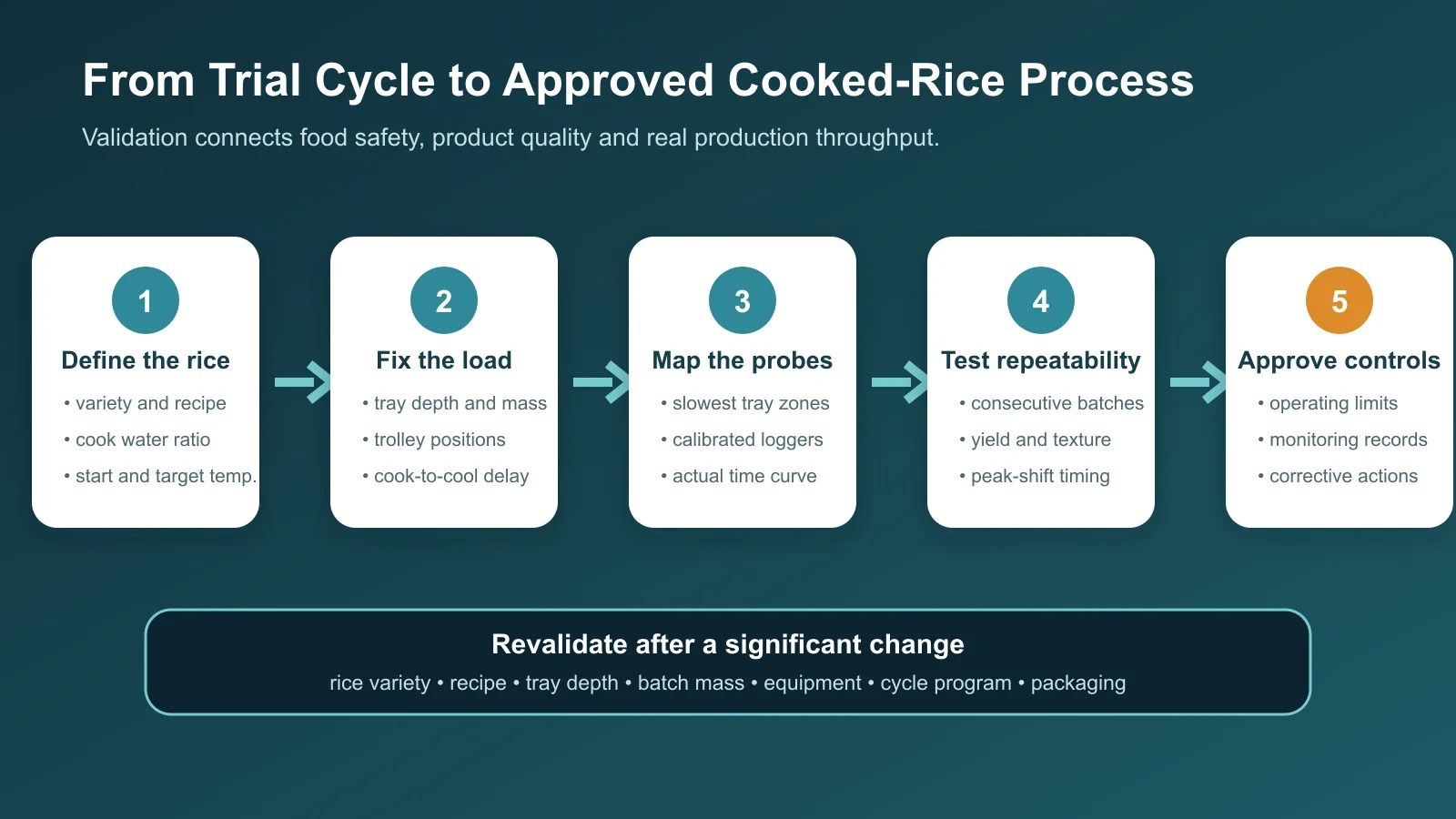
- Approved operating limits, monitoring, release, and corrective actions are documented.
- Operators and QA staff are trained on the approved standard.
- Recipe, load, equipment, and packaging changes have a revalidation rule.
Frequently Asked Questions
How long does vacuum cooling cooked rice take?
There is no responsible universal time. The result depends on start and target temperature, rice recipe, total mass, tray depth, load pattern, vacuum and refrigeration performance, and cycle program. Allcold commonly discusses cooked-food projects in a 15–25 minute range, but cooked rice must be proven with the actual commercial load and the facility’s approved limits.
Does vacuum cooling dry out cooked rice?
Vacuum cooling removes heat through evaporation, so mass loss must be expected and measured. Whether the result is acceptable depends on the recipe, cycle, load, and intended eating quality. The validation should connect measured mass loss to texture after chilled holding and reheating.
Can we validate with one tray and then scale to a full trolley?
A single tray is useful for early feasibility work, but it does not prove a full trolley. Commercial validation should include the approved maximum load and mapped positions likely to cool slowest.
Is the machine temperature probe enough for HACCP records?
It can become part of routine monitoring after its relationship to the slowest product point has been validated. Initial validation should use independent calibrated instruments at multiple mapped locations, with the final monitoring plan approved by the facility’s food-safety authority.
Should water be sprayed onto rice before vacuum cooling?
Do not make water addition an automatic rule. Research shows that water strategies can change moisture and texture, but they can also change cooling time. Any addition must be part of the approved recipe and hygienic process, use suitable water, and be validated for safety, yield, and eating quality.
When should the process be revalidated?
Revalidate when a significant change may affect the result—for example, rice variety, recipe, cook method, tray depth, batch mass, trolley arrangement, machine program, equipment, packaging, target temperature, or intended use. Also investigate and revalidate after an unexplained process failure.
Final Takeaway
Vacuum cooling can give a central kitchen a fast and controllable way to cool cooked rice, but the value comes from a validated process—not a headline cycle time. The strongest projects define the food-safety and quality targets first, test the actual commercial load, find the slowest point, measure yield and texture, and prove repeatability during real production pressure.
If you are planning a cooked-rice project, send Allcold your rice type, recipe, tray and trolley dimensions, batch mass, peak-hour output, starting temperature, target temperature, and site requirements. We can help you identify the main equipment and validation questions before you compare proposals. Final food-safety approval should be completed by your qualified process authority under the rules that apply to your operation.
References
- CDC — Bacillus cereus Food Poisoning Associated with Fried Rice at Two Child Day Care Centers.
- U.S. FDA — Cooling Cooked Time/Temperature Control for Safety Foods and the FDA Food Code.
- Zhang and Sun — Effects of Cooling Methods on the Cooling Efficiency and Quality of Cooked Rice, Journal of Food Engineering.
- Zhang and Sun — Effects of Operation Parameters on Cooling Time and Weight Loss During Vacuum Cooling of Cooked Rice and Cooked Diced Beef in Tray.
- U.S. FDA — HACCP Principles & Application Guidelines.
- U.S. FDA — Supplement to the 2022 Food Code, December 2024 Version.

Mila
You May Also Like
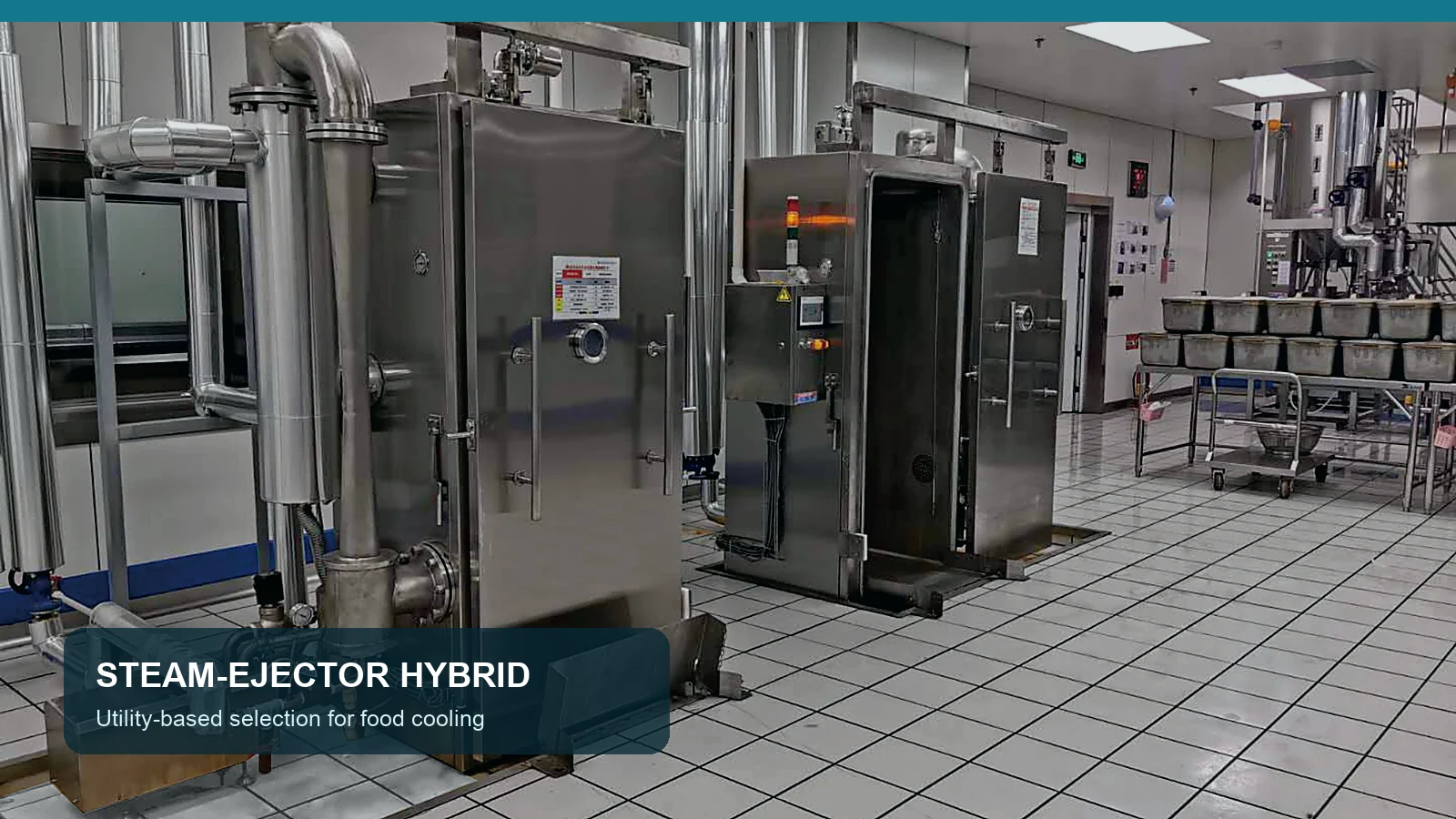
Steam Ejector or Vacuum Pump? Choosing the Right Vacuum System for Food Cooling
A utility-based guide to choosing between a mechanical vacuum package and a steam-ejector hybrid for bakery and cooked-food cooling projects.
Vacuum Cooling Soups and Sauces: Machine Selection, Foam Control, and Validation
Compare continuous vacuum cooling, micro rapid cooling with tap-water capability, and custom cook-cool systems for soups and sauces. Learn how to validate foam, pressure, viscosity, vapor handling, concentration, safety, and yield.
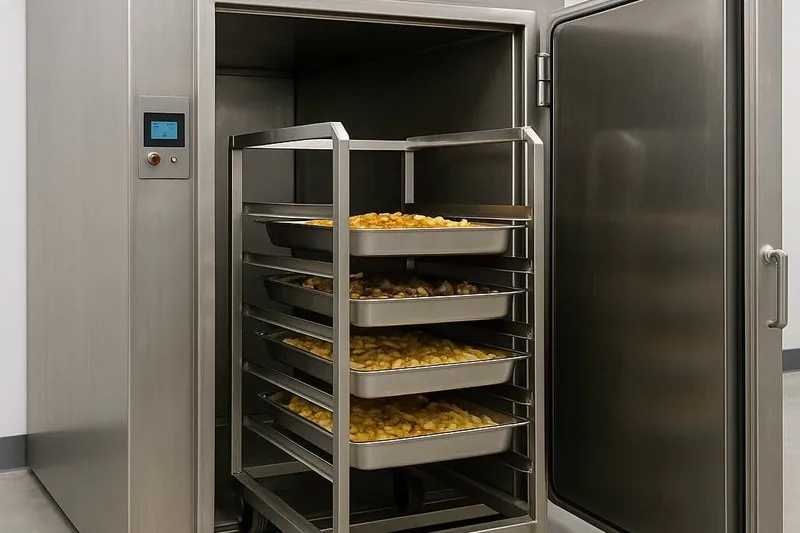
Vacuum Cooling Cooked Noodles and Pasta: A Validation Guide for Central Kitchens
Vacuum cooling cooked noodles and pasta sounds straightforward—it’s just cooling food, and vacuum cooling is a proven technology. In practice,
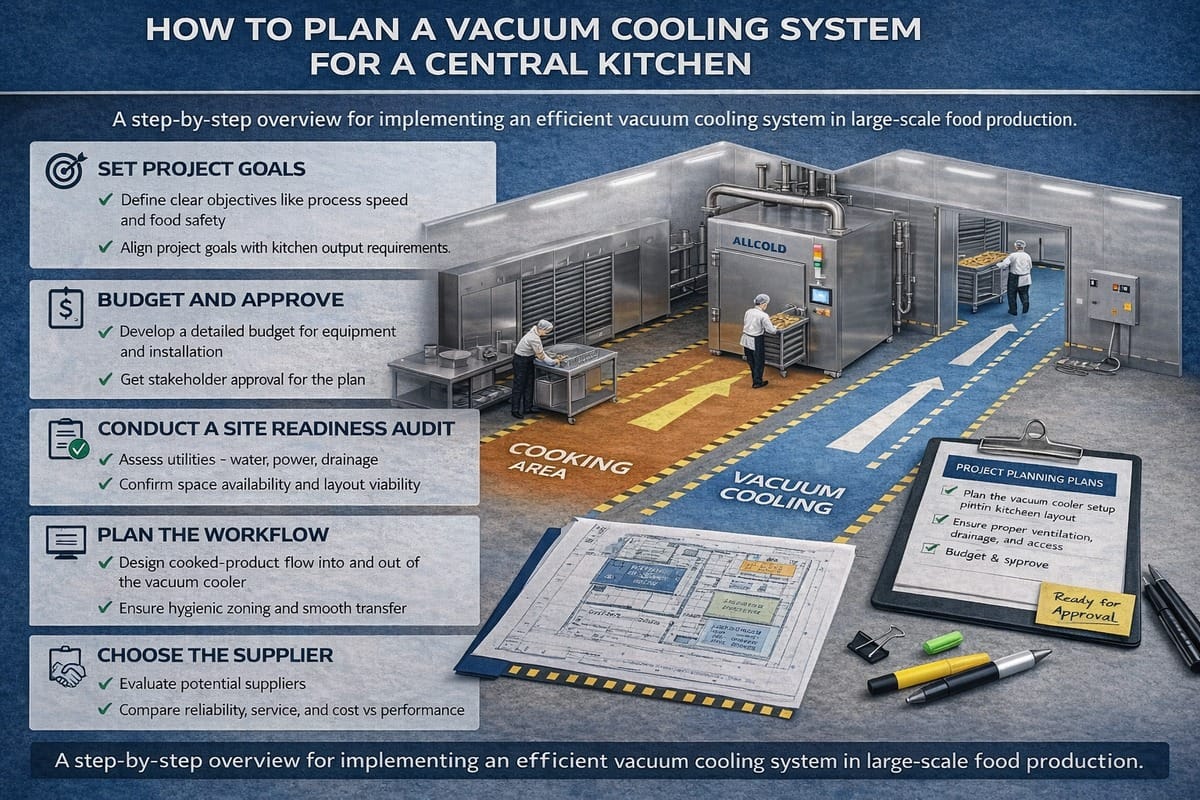
How to Plan a Vacuum Cooling System for a Central Kitchen
Learn how to plan a vacuum cooling system for a central kitchen with a practical factory-side view on throughput, workflow, hygiene zoning, utilities, and supplier evaluation.
Is Your Cooling Process Holding Back Your Ready-Meal Business?
Your kitchen produces delicious, complex ready-meals, but the slow cooling process introduces food safety risks and production delays. This critical
How Can Vacuum Cooling Revolutionize Meat and Poultry Processing?
You’ve cooked a thousand kilograms of chicken perfectly, but now it sits for hours, slowly passing through the temperature danger
What's Really Inside Your Vacuum Cooler that Makes it Work?
Ever wondered what makes a vacuum cooler tick, transforming warm produce into perfectly chilled goods in minutes? It’s not magic,
What Are the Preservation Techniques for Ready-to-Eat Foods?
As consumers increasingly prefer ready-to-eat (RTE) foods, extending their shelf life effectively becomes a critical challenge. Currently, the most effective