
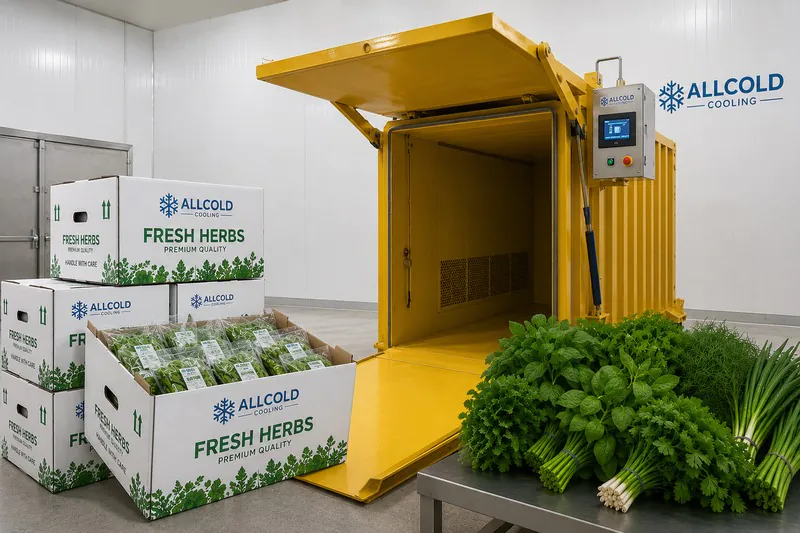
Why Fresh Herb Exporters Often Blame the Vacuum Cooler When the Real Problem Is Packaging
Many herb exporters believe they are testing a vacuum cooler. In reality, they are often testing whether their packaging allows the cooler to do its job. That difference matters. If the carton, liner, sleeve, or bunching format blocks heat and vapor movement, the vacuum cooler is not solving the real problem. It is only working against a decision already made at the packing table.
From our factory-side experience, this is where many herb projects become misleading. The quotation can look correct. The chamber size can look correct. The cooling cycle can even look reasonable during a controlled trial. But once real export packaging enters the process, the result changes. The product cools unevenly, the appearance becomes inconsistent, and the buyer starts asking whether the machine should be larger, colder, or slower.
That is often the wrong question. Fresh herbs are not bulk vegetables. They are bunched, sleeved, lined, packed into smaller cartons, and judged by visual freshness, aroma, turgidity, and dehydration marks. The package is not a passive container. It becomes part of the cooling system.
The core insight is simple: for fresh herbs, packaging can set the ceiling for cooling performance before the vacuum cooler cycle even starts. If the package is fighting the process, better machine settings may only hide the problem for a short time.
Why Herbs Become a Packaging Problem Faster Than Many Other Vegetables [1][2]
Fresh herbs are commercially sensitive because buyers judge them quickly on visual freshness, aroma, turgidity, and dehydration marks. That means packaging decisions can create visible quality problems very fast, even before a shipment shows a clear temperature problem.
Compared with heavier vegetables, herbs often have:
- lower product mass per package
- higher exposed leaf surface area
- more delicate stems and leaves
- tighter tolerance for wilting or condensation marks
- more frequent use of sleeves, liners, and retail-ready packs
Those traits matter because the package is shaping the cooling environment around the product. If the package slows vapor release, traps moisture, or makes airflow and handling less disciplined, the exporter can lose quality margin during the exact period when the herbs should be stabilizing.
From our side, this is why herb cooling projects need a stronger packaging review than many generic vegetable projects do. The machine may still be correct, but the product presentation format can quietly become the main operational risk.
Which Packaging Elements Most Often Interfere with Vacuum Cooling Performance [3]
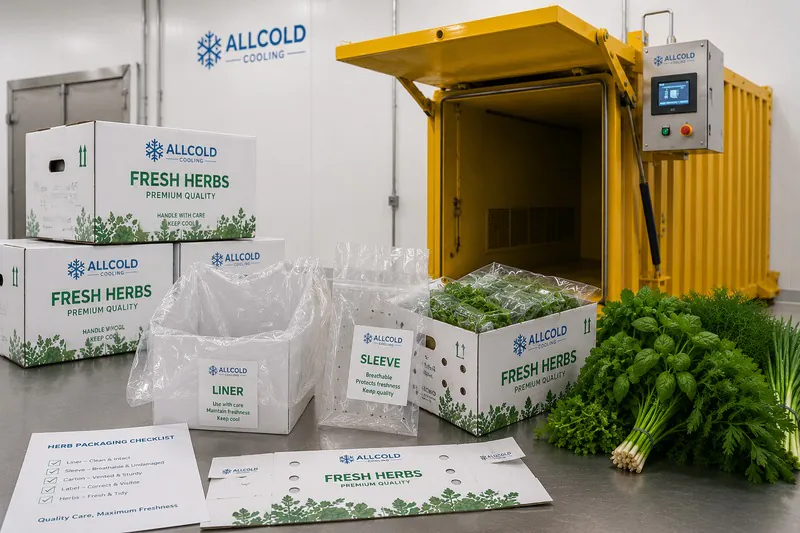
When herb exporters say the product cooled inconsistently, we usually do not start by blaming the chamber. We start by asking what the product looked like inside the package.
The most common packaging-related risk points are these:
| Packaging decision | What buyers often think | What actually decides the result | Stronger factory-side judgement |
|---|---|---|---|
| Carton vent area | “The box is standard.” | Whether heat and vapor can leave the load consistently. | A standard carton is not automatically a cooling-compatible carton. |
| Plastic liner | “The liner protects freshness.” | Whether it controls moisture or traps it at the wrong stage. | A liner can protect shelf life or quietly create condensation risk. |
| Sleeve or retail wrap | “Presentation comes first.” | Whether the wrap changes surface moisture and cooling uniformity. | Retail presentation should not be approved before cooling behavior is tested. |
| Bunch density | “More product per carton improves freight cost.” | Whether dense bunches create warm zones and uneven pull-down. | Freight efficiency can become quality loss if density blocks cooling. |
| Mixed SKU packout | “One cycle can handle similar herbs.” | Whether different herbs and pack styles respond the same way. | Mixed herb loads should earn one recipe through testing, not assumption. |
In our experience, the highest-risk situation is not always a dramatic packaging error. It is usually a series of small packaging decisions that make the load less predictable. The exporter then tries to solve that variability with longer cooling time, colder storage, or extra handling, which can create different problems later.
A practical packaging review should ask:
- does vapor leave the package consistently across the load
- are bunches packed too tightly for even cooling
- do liners and sleeves match the intended cooling sequence
- is one carton design being used for products with very different moisture behavior
- does the package still support stable handling after cooling finishes
Exporters Should Validate the Packaging-and-Cooling Sequence, Not Only the Package Itself [4]
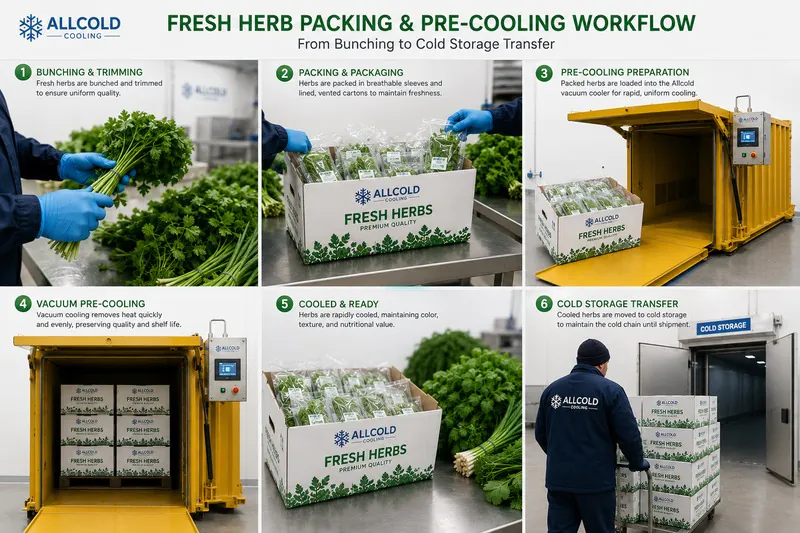
A packaging format that looks acceptable on the packing table may still fail in the real workflow. That is because the cooling result is shaped by sequence as much as by materials.
We usually recommend looking at the entire packaging-and-cooling path: 1. harvest and field collection 2. bunching or trimming 3. sleeving or liner insertion 4. carton loading 5. waiting time before chamber loading 6. vacuum cooling cycle 7. transfer into cold storage 8. staging before dispatch
If one step introduces delay or inconsistency, the package can become much less forgiving. For example, a lined herb carton may perform acceptably when loaded quickly but create condensation and visual complaints when packed early and left waiting too long. In that case, the packaging is not wrong by itself. The process is wrong for that package.
This is why we often tell buyers not to approve herb packaging after a static sample review alone. They need a sequence validation test under realistic operating rhythm.
Packaging-and-cooling validation checklist
- test the real export carton, not a simplified sample crate
- test the real herb variety mix, not only the easiest SKU
- record waiting time before chamber loading
- compare results for lined versus unlined or differently vented cartons
- inspect visual quality again after cold storage transfer, not only after chamber discharge
- review whether downstream handling adds condensation or compression risk
For handling and packhouse logic, FAO’s packhouse guidance remains relevant:
How to Compare Packaging Options Without Turning the Season into a Trial Run [5]
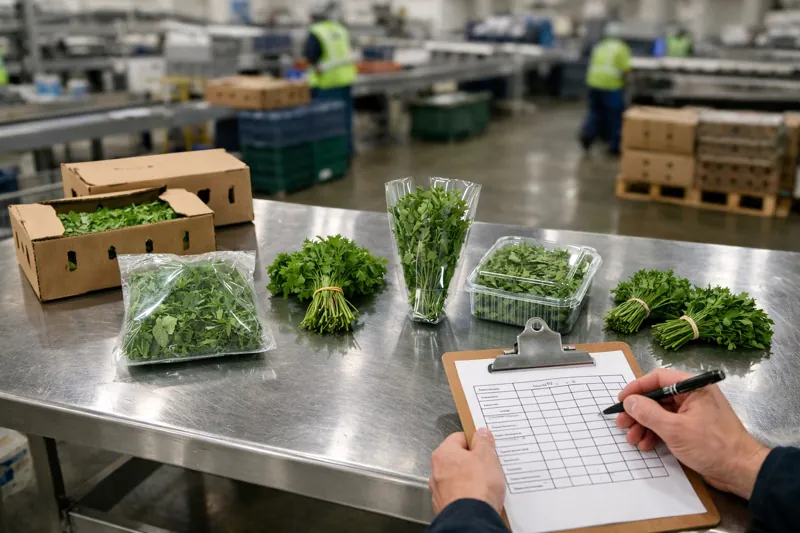
Exporters do not need a perfect laboratory study before they make a packaging decision. But they do need a structured comparison that reflects commercial reality.
We usually suggest a decision table like this before standardizing the pack format:
| Evaluation point | Option A | Option B | What matters commercially |
|---|---|---|---|
| Cooling uniformity | Does one format leave fewer warm spots across cartons? | ||
| Visual freshness after 24 hours | Which format better protects appearance after storage and re-handling? | ||
| Water loss tolerance | Can the exporter accept the expected weight or freshness loss? | ||
| Condensation risk | Which format creates fewer surface marks or wet-package complaints? | ||
| Loading discipline | Which format is easier to handle consistently during peak hours? | ||
| Freight efficiency | Does packing density create savings that are later lost in claims or shrink? |
The point is not to choose the package that looks best on the line for five minutes. The point is to choose the package that protects export condition through cooling, storage, and shipping preparation.
In many herb projects, the wrong decision comes from comparing packaging by material cost alone. From our side, the better question is whether the cheaper package creates higher instability cost later. If it does, it was never the cheaper package.
Additional context on refrigeration planning and reference standards:
When Packaging Should Be Changed Before the Machine Specification Is Changed [6]
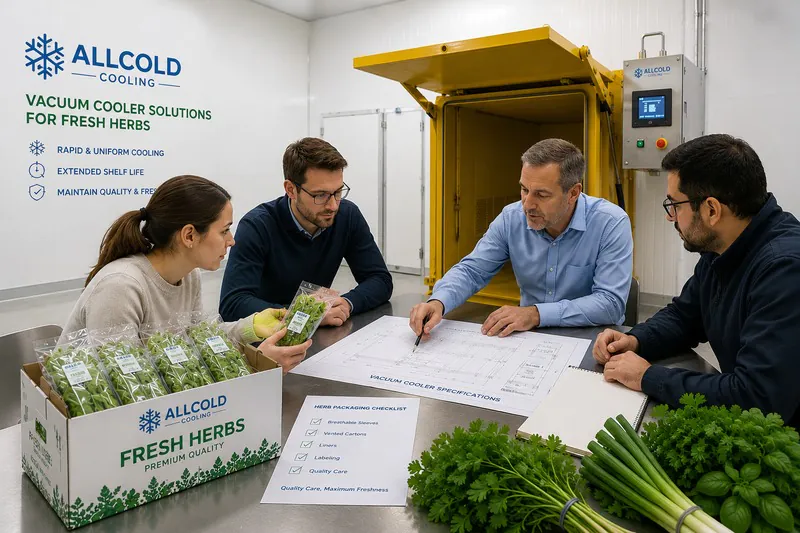
One expensive mistake is changing the machine specification before the team has proven the packaging path is workable. That can push the buyer toward unnecessary equipment cost while leaving the original process weakness untouched.
We would usually review packaging first if any of these warning signs appear:
- herbs cool unevenly across cartons or pallet positions
- appearance complaints are concentrated in one pack style
- liners, sleeves, or carton designs vary by customer but one cooling recipe is used for all
- the chamber performance looks acceptable on simple tests but unstable in production
- longer cooling cycles improve temperature readings but worsen appearance or water-loss complaints
In those cases, the machine may not be the first thing to change. The package, loading pattern, or timing discipline may be the real control point.
That is especially important for exporters because packaging choices are often copied from customer requirements, freight habits, or existing packhouse routines. Those are not always wrong, but they are not automatically compatible with rapid vacuum cooling either.
A Practical Decision Framework for Herb Exporters
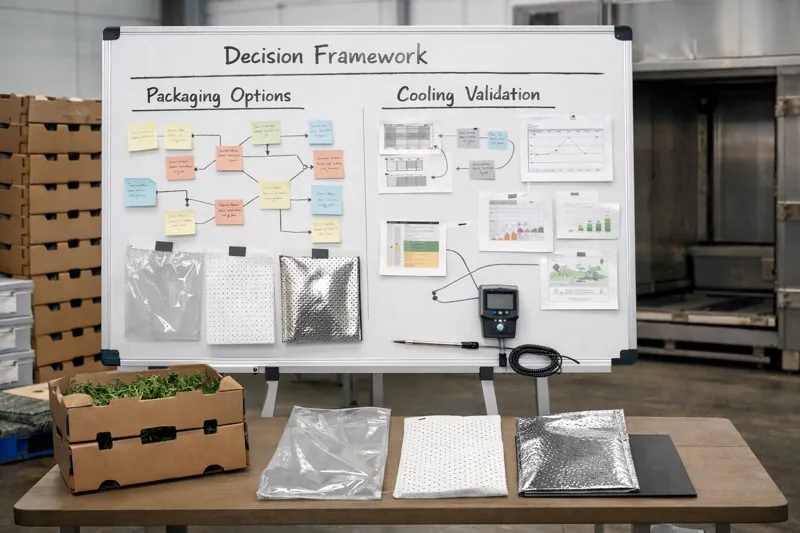
Before approving one packaging format for the season, we suggest asking these four questions:
1. Does the package allow stable and repeatable cooling? If not, do not assume cycle changes alone will solve it. 2. Does the herb still look commercially right after cooling and transfer? If not, the package may be protecting the wrong thing. 3. Can the packhouse repeat the sequence under peak-hour pressure? If not, the package may be too process-sensitive for real operation. 4. Does the package reduce total export risk, not just material cost? If not, the comparison is incomplete.
The strongest packaging choice is not the one that looks neat on the packing table or saves the most carton cost. It is the one that survives the cooling process without stealing shelf life, appearance, or claim margin.
This is the point many herb exporters miss: if the package blocks the cooling pathway, the vacuum cooler becomes a compensating tool instead of a quality-protection tool. Longer cycles, colder rooms, or larger chambers may reduce symptoms, but they do not fix a package that is incompatible with rapid pre-cooling.
Before scaling a herb export project, we would not ask only “Which vacuum cooler capacity do you need?” We would ask: “Which packaging format allows the cooling system to protect the product under real peak-hour pressure?”
If you are preparing a herb export project, send us your herb type, bunching format, carton design, liner or sleeve setup, and peak-hour handling flow. We can help you review where packaging may be weakening the pre-cooling result before you compare equipment or finalize the process.
Conclusion
Packaging is not a secondary decision for herb exporters. It is a pre-cooling decision that sets the ceiling for everything the machine can do. Exporters who review packaging compatibility before evaluating machine capacity protect more shelf life, manage fewer downstream claims, and spend less time adjusting a process that was never correctly designed. The goal is not a faster or larger cooler. It is a package format that allows the cooler to do its job consistently under real peak-hour conditions.
References
1. FAO manual on preparation and sale of fruits and vegetables
2. FAO training manual on prevention of post-harvest food losses
3. NC State Extension: Introduction to Postharvest Engineering for Fresh Fruits and Vegetables
4. UC Davis Postharvest Technology Center
5. University of Wisconsin Extension: Postharvest Handling of Fresh Market Vegetables
6. USDA Agricultural Marketing Service
Looking for the right vacuum cooler for your operation?
Allcold engineers work with packhouses and exporters to spec the right system for your product, volume, and site conditions.

Mila
You May Also Like
Why Vacuum Cooling Herbs and Baby Leaves Requires a Different Approach Than Standard Vegetable Pre-Cooling
Herbs and baby leaves are often treated as “small lettuce” in pre-cooling discussions. That assumption causes real problems. The product