
How Fast Will a Bakery Vacuum Cooler Pay for Itself?
You hesitate to buy a vacuum cooler because the initial price tag looks high. You worry that this investment will take years to recover, draining your cash flow instead of helping it.
Most commercial bakeries see a full return on investment (ROI) within 12 to 18 months. By combining energy savings, reduced labor costs, and extended shelf life, the machine generates daily cash savings that pay for the equipment faster than almost any other upgrade in your factory.
Simple payback compares the installed investment with annual net operating benefit. As an illustration, $50,000 divided by $4,000 per month is 12.5 months before financing, tax and other adjustments. This is a calculation example, not an Allcold customer result or a promise of return.
Will the Electricity Bill Savings Really Impact Your ROI?
You might think that running a powerful vacuum pump will increase your utility bill. You assume that "heavy machinery" equals "heavy costs," and you fear trading one expense for another.
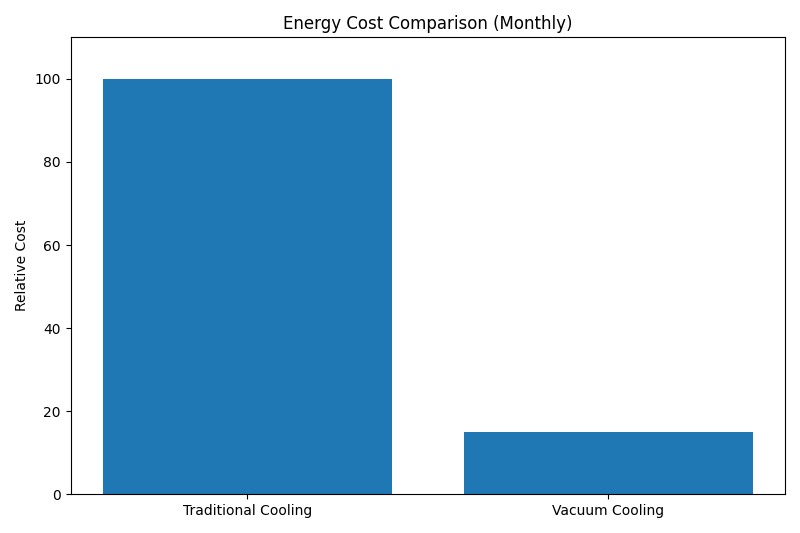
Actually, vacuum cooling is about 60% cheaper to run than traditional air conditioning cooling. Because the cycle is so fast (minutes instead of hours), your total energy consumption drops drastically, putting thousands of dollars back into your pocket every year.
The Mathematics of Energy Reduction
The following numbers are hypothetical inputs for understanding the calculation. Use measured consumption for comparable products, loads and endpoints before applying the method to your own bakery.
For illustration, a process averaging 40 kW over two hours would consume 80 kWh per batch. Neither the duration nor the power is a standard requirement for conventional cooling.
- Traditional Math: 40kW x 2 hours = 80 kWh per batch.
- Cost: If electricity is $0.15 per kWh, that batch costs you $12.00.
An alternative stage averaging 60 kW for 0.15 hours, or nine minutes, would consume 9 kWh. This is not an Allcold machine rating or measured cycle; include the complete system when gathering your own data.
- Vacuum Math: 60kW x 0.15 hours = 9 kWh per batch.
- Cost: At $0.15 per kWh, that batch costs you $1.35.
With those illustrative inputs and an electricity rate of $0.15/kWh, the difference is $10.65 per batch. At ten batches on each of 300 days, the arithmetic gives $31,950 per year. That result is only as valid as the assumed consumption, workload and tariff.
Check where both systems reject heat and whether either changes the building’s cooling demand. Include any verified HVAC effect in the comparison, but do not assume it disappears or produces a fixed percentage return.
| Illustrative input | Existing scenario | Alternative scenario |
|---|---|---|
| Average power and operating time | 40 kW × 2 h | 60 kW × 0.15 h (9 min) |
| Calculated energy | 80 kWh | 9 kWh |
| Cost at $0.15/kWh | $12.00 | $1.35 |
| Difference at 3,000 batches/year | Hypothetical inputs only | $31,950 before other costs |
Can Reducing Labor Hours Shorten Your Payback Period?
You are paying staff to stand around waiting for bread to cool. You see the overtime hours on your payroll report, and you know that inefficiency is draining your bank account.
Shorter cooling may reduce waiting or overtime when cooling is the actual bottleneck. Measure the paid work affected rather than assuming a fixed number of labor hours saved each day.
The Cost of Waiting
Labor savings should reflect paid hours actually removed, overtime avoided or staff reassigned to useful work. Shorter cooling time does not automatically produce the same reduction in paid labor.
In a standard bakery, the packaging team is held hostage by the cooling time.
If the last batch comes out of the oven at 2:00 PM, the packaging team cannot touch it until 4:00 PM. They have to stay until 5:00 PM to slice and pack it.
That gap—from 2:00 PM to 4:00 PM—is often "dead time" or low-productivity time. Yet, you are paying for it.
Illustrative scheduling scenario: if an approved cooling process enables packing to finish earlier, check whether the same staff can actually leave earlier or perform other productive work. Elapsed time saved is not automatically paid labor saved.
Let’s do the math on the payback:
- Imagine you have a team of 4 people in packaging.
- You pay them $20 per hour (including taxes and insurance).
- You save 2 hours per person, per day.
- Calculation: 4 people x 2 hours x $20 = $160 saved per day.
- Annual Calculation: $160 x 300 days = $48,000 saved per year.
The illustrative energy and labor inputs total $79,950 per year before additional costs. They are independent assumptions, not verified benefits from an Allcold installation. Use conservative utilization and actual operating costs before calculating payback.
| Labor input | What to measure | Valuation |
|---|---|---|
| Paid hours | Hours actually removed or reassigned | Use the relevant loaded labor rate |
| Overtime | Overtime demonstrably avoided | Use actual overtime cost |
| Handling changes | Any additional tasks | Deduct their cost |
| Annual use | Realistic operating days and batches | Do not assume full utilization |
Does Extended Shelf Life Convert to Real Cash?
You throw away bread that goes moldy too quickly. Or, you lose potential sales because you cannot ship your products to distant cities due to short shelf life. This is lost revenue that should be in your pocket.
Any shelf-life or returns benefit must be established with the actual product, packaging and distribution conditions. Use measured changes and avoid double-counting additional sales and reduced returns.

Turning Waste into Profit
Product returns can matter financially, but a cooling change alone does not establish a longer shelf life. Compare representative batches under the actual packaging and distribution conditions.
Check the evidence for each proposed quality benefit before including it in the investment model.
- Vacuum cooling is not a microbial kill step and does not make bread sterile. Maintain the approved hygiene and handling process.
- Measure product yield, texture and any shelf-life effect under comparable recipe, packaging and distribution conditions.
If a documented trial supports a change in product life or returns, translate that into the appropriate net financial effect rather than treating the whole sales value as profit.
- Measure any change in returns under comparable product and distribution conditions.
- Value recovered saleable product using the appropriate net contribution and avoid double-counting the same benefit.
Combine only independently supported benefits and deduct additional operating costs. The examples above are calculation methods, not a forecast for your project.
- Energy: $31,950
- Labor: $48,000
- Total Year 1 Benefit: ~$110,000.
Calculate simple payback from installed cost and annual net benefit, then assess financing, seasonality and uncertainty separately. Do not treat an illustrative seven- or nine-month result as a supplier commitment.
| Product benefit | Evidence required | Financial treatment |
|---|---|---|
| Fewer returns | Comparable return records | Use avoided loss or net contribution |
| Longer selling window | Product and distribution evidence | Do not assume extra sales |
| Additional output | Demand and downstream capacity | Use incremental contribution |
| Recipe changes | Separately validated product changes | Do not infer preservative reductions |
Can You Monetize the Space You Save?
You think you need to rent a bigger factory to grow. You are looking at expensive real estate contracts, not realizing that you already have the space you need—it is just filled with cooling racks.
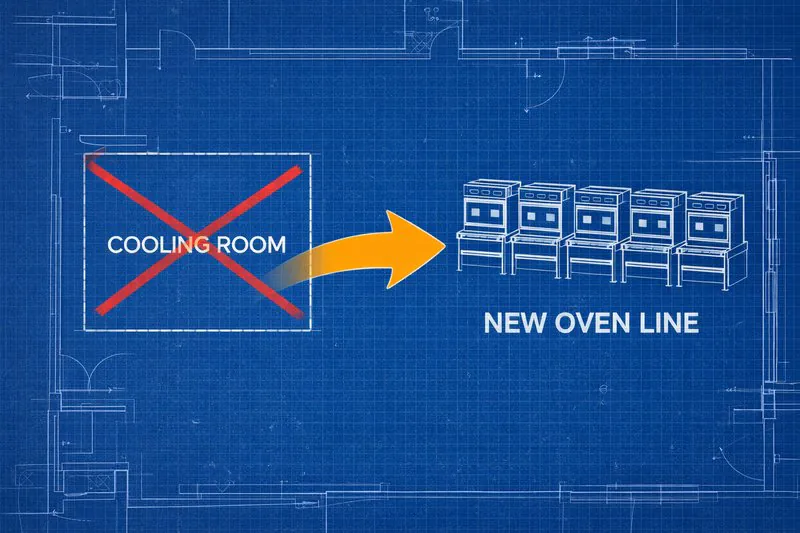
Allcold can discuss bakery chamber sizing around your trolley footprint and production requirement. For an investment appraisal, request the complete installed layout rather than using a generic machine footprint. Count space as a financial benefit only if it can actually be reused or released. This turns the customization discussion into a measurable layout input for your own payback calculation.
A compact cooling stage may release space, but use the complete installed layout to quantify it. Include loading, service access and auxiliary equipment before valuing any area as available for another use.
The Real Estate Calculation
Real estate is expensive. This is true for Sophia in Singapore (where land is gold) and for Carlos in Mexico (where building a new facility is a headache).
Space has a dollar value. You are paying rent (or mortgage) on every square meter of your factory.
Let’s analyze the "Phantom Rent" you are paying for cooling.
- Obtain the complete installed layout for each alternative.
- Include loading, access and utilities; calculate value only for space that can actually be reused or released.
How does this pay back the machine?
Method 1: Avoided Construction Costs.
If you were planning to build an extension to fit a new oven, that might cost $200,000.
By installing a vacuum cooler, you can put the new oven in the old cooling room.
You just saved $200,000 in construction. The machine paid for itself instantly—on Day 1.
Method 2: Increased Revenue per Square Meter.
If you use that reclaimed 85 square meters to install a second production line, you might double your output.
If your profit margin is $0.10 per loaf, and the new line produces 5,000 loaves a day, that is $500 of extra profit daily.
$500 x 300 days = $150,000 per year.
This is the "Opportunity Cost" payback.
Many business owners forget this. They only look at the electricity bill. But the ability to double your production without moving to a new factory is often the biggest financial win of all. It makes the payback period calculation look almost too good to be true, but the math is solid. You are trading low-value storage space for high-value production space.
| Space input | Required basis | Financial treatment |
|---|---|---|
| Installed footprint | Machine, loading and service layout | Compare complete alternatives |
| Released area | Usable and accessible space | Value only if it can be reused |
| Avoided expansion | Actual alternative investment | Include only demonstrably avoided costs |
| Site work | Connections and installation | Include in project investment |
Conclusion
The payback period for a bakery vacuum cooler is rarely longer than 18 months, and for high-volume bakeries, it can be as short as 6 months. When you add up the electricity savings, the labor reduction, the lowered waste, and the reclaimed floor space, the numbers are undeniable. It is an investment that stops your factory from leaking money.
Learn about the role of cooling rooms in food production and how they impact efficiency and product quality. ↩
Explore the advantages of the Allcold vacuum cooler for energy efficiency and cost savings in cooling processes. ↩
Understand the concept of Heat Load and its implications for energy consumption and cooling efficiency. ↩
Discover strategies and technologies that can help businesses significantly reduce energy costs in their cooling systems. ↩
Explore how vacuum cooling can revolutionize your bakery’s efficiency and reduce labor costs significantly. ↩
Discover innovative strategies that bakeries can implement to maximize labor savings and improve profitability. ↩
Explore this link to understand how vacuum cooling can extend shelf life and reduce waste in food products. ↩
Learn effective strategies to enhance bread shelf life, which can significantly boost your business profitability. ↩
Discover the financial benefits and ROI of vacuum cooling technology for food businesses. ↩

Mila
You May Also Like

When Should You NOT Use Vacuum Cooling for Your Bakery?
Are you tired of waiting hours for your bread to cool down while your profits evaporate? You might think vacuum

Is Your Cooling Strategy Burning Your Profits? A Cost-Benefit Analysis of Vacuum vs. Conventional Cooling
As a bakery owner, you look at your balance sheet every month. You see the cost of ingredients, labor, and
Hybrid Cooling Solutions: Can Combining Vacuum and Traditional Methods Save Your Bakery?
Are you torn between the speed of new technology and the reliability of traditional freezing? Many bakery owners feel they
Blast Freezers vs Vacuum Coolers: Which Is the Right Choice for Your Bakery?
Are you tired of watching your freshly baked bread sit on racks for hours, taking up valuable space while you

Bakery Vacuum Cooling vs Spiral Cooling Systems: Which Is Better for Your Business?
Are you struggling with slow production lines because your bread takes forever to cool down? You are not alone. Cooling
Is a Vacuum Cooler the Missing Ingredient in Your Hotel or Restaurant Bakery?
Imagine your kitchen is in full swing, and the freshly baked bread is finally out of the oven, but it
Can One Cooling System Handle Your Entire Bakery Menu?
You juggle sourdough, delicate pastries, and frozen dough lines daily. Yet, one cooling mistake ruins the texture of your artisan

Is Your Frozen Dough Production Losing Quality Before It Hits the Freezer?
You watch your energy bills climb month after month while your blast freezers work overtime. You see production bottlenecks form
How Can Organic Bakeries Extend Shelf Life Without Preservatives?
You pour your heart into sourcing the finest organic flours and perfecting natural fermentation, only to watch your hard work

Can Vacuum Cooling Finally Fix the "Gummy" Texture in Gluten-Free Bread?
You watch your perfectly risen gluten-free loaves come out of the oven, only to see them sink or turn gummy