
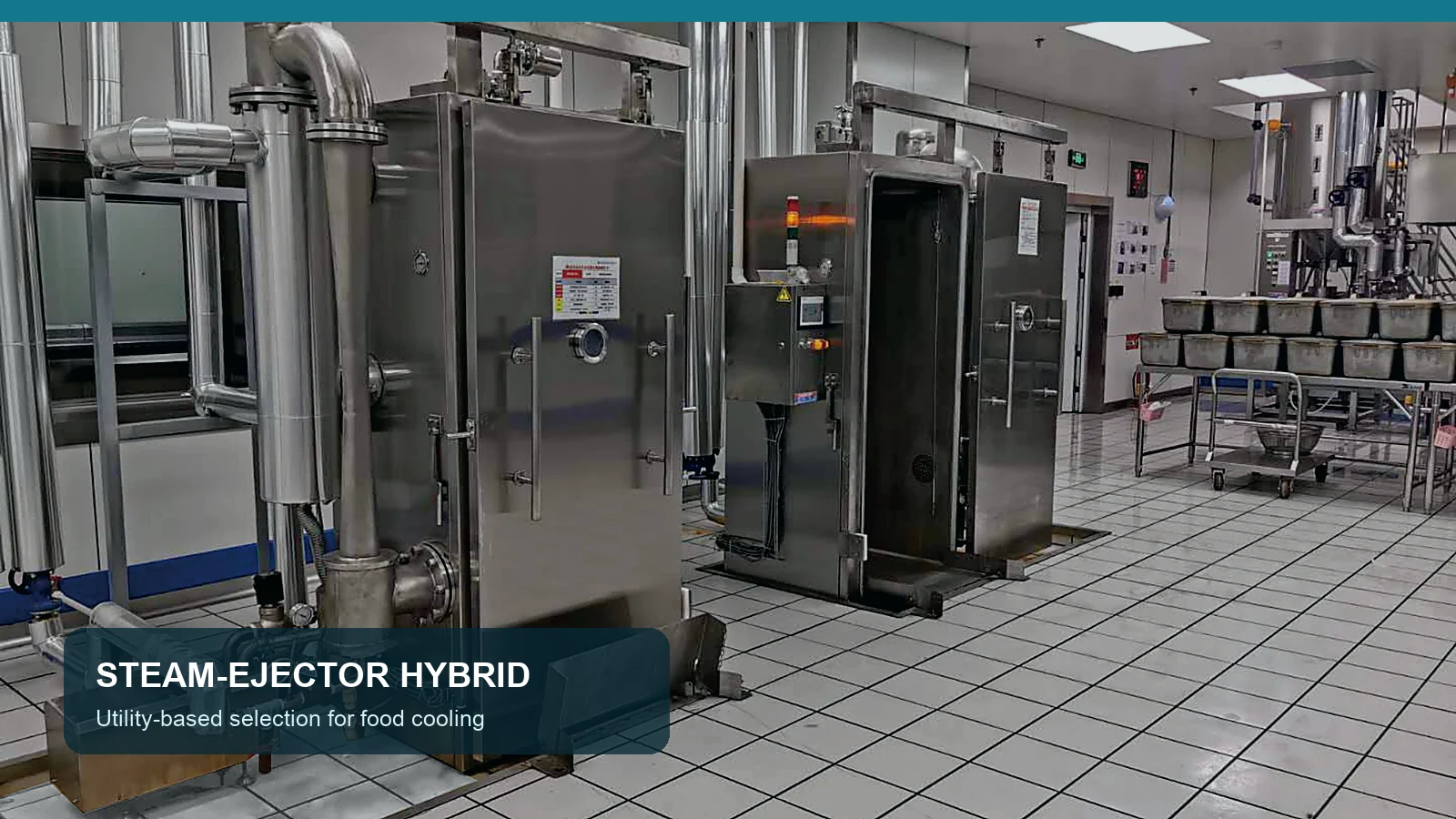
Steam Ejector or Vacuum Pump? Choosing the Right Vacuum System for Food Cooling
Should a food vacuum cooler use a steam ejector or a mechanical vacuum pump?
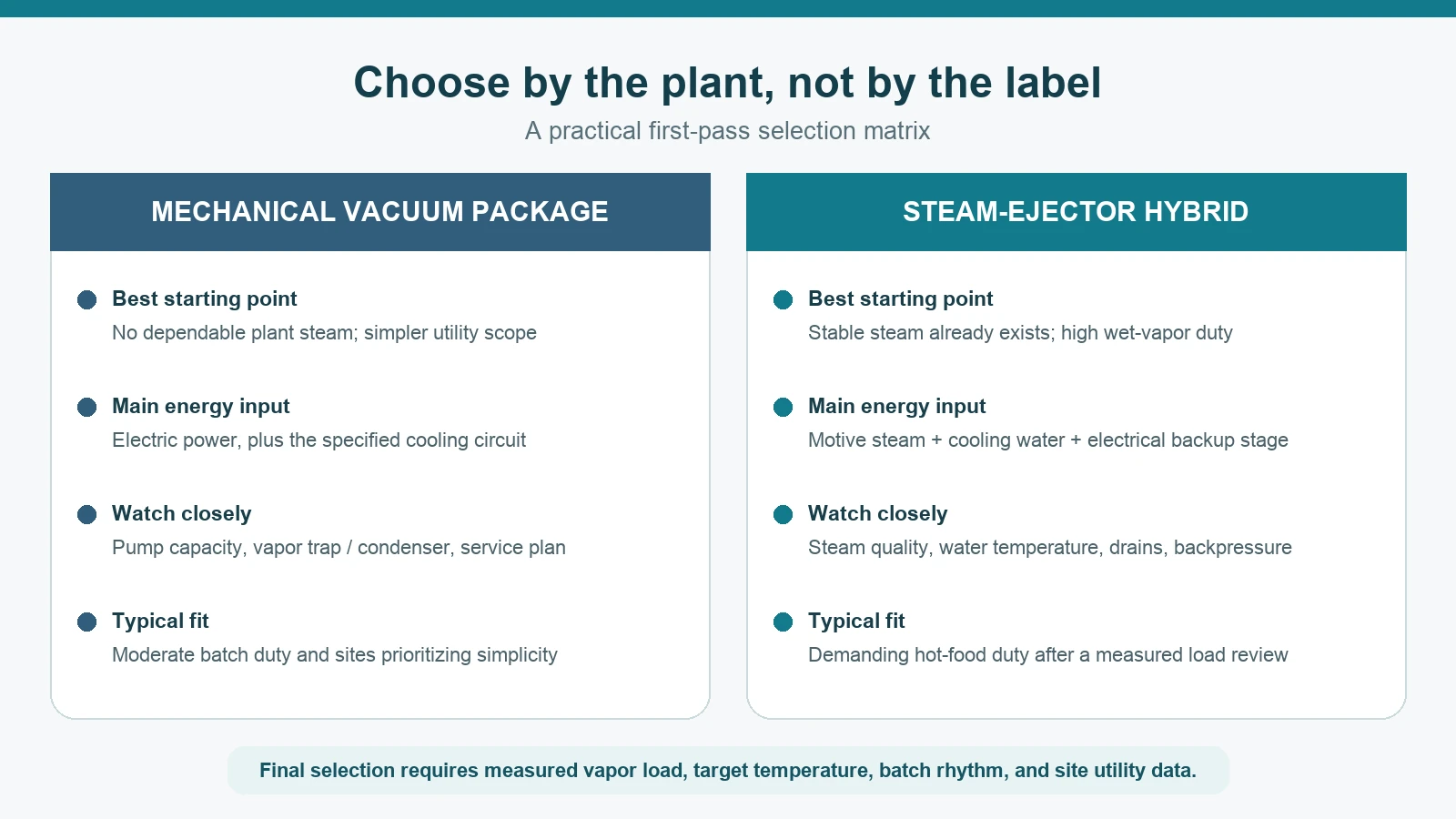
Choose from the plant utilities and vapor load, not from the technology name. A mechanical package is usually the simpler starting point when dependable steam is unavailable. A steam-ejector hybrid can be valuable for demanding hot, wet loads when the site already has stable motive steam, suitable cooling water, drainage, and operators who can control those utilities. The correct answer requires the product mass, start and target temperatures, cycle frequency, moisture released, and real site conditions.
Two vacuum coolers can have the same chamber size and still need very different vacuum systems. One may cool bread on trolleys in short batches. Another may handle cooked food near boiling temperature, releasing a much larger pulse of water vapor. Comparing only motor kilowatts or advertised pump capacity misses the engineering problem.
The useful question is not “Which vacuum technology is better?” It is “Which package can remove air and process vapor at the required pressure, on the required cycle, with the utilities this factory can supply every day?” This guide gives bakery managers, central kitchens, food processors, and project engineers a practical way to answer that question before requesting a quotation.
What a Steam Ejector Changes – and What It Does Not
A steam ejector uses high-pressure motive steam passing through a nozzle to entrain lower-pressure gas and vapor. The mixed stream then recovers pressure through the diffuser. The ejector itself has no rotating parts. GEA describes jet vacuum pumps as devices that can be combined with mechanical vacuum pumps, while Nash explains that hybrid systems combine the high-vacuum capability of an ejector with the stability of a liquid-ring pump.[1][2]
In a food vacuum cooler, the ejector does not directly “make the food cold.” Product cooling still comes from water evaporating at reduced pressure. The vacuum package must remove non-condensable air and manage the large volume of vapor created by that evaporation. Condensers collapse much of the vapor back into liquid; the ejector and backing pump maintain the required pressure through the cycle.
This distinction matters because adding an ejector cannot compensate for every process problem. It will not correct an overloaded chamber, blocked vapor path, wrong recipe, poor probe placement, insufficient condenser duty, or unstable cooling water.
Why Hot Food Creates a Different Vacuum Duty
At the start of a cycle, the system first removes chamber air. As pressure approaches the saturation condition associated with product temperature, evaporation accelerates. A hot, moisture-rich load can then release a very large vapor volume in a short period. Batch mass, initial temperature, exposed surface, product structure, tray depth, free water, pressure ramp, and target temperature all change that load.
This is why “200 kg per cycle” is not a complete vacuum specification. Two hundred kilograms of bread, cooked rice, sauce, and packaged ready meals do not generate the same vapor profile. Even the same product can change when recipe hydration, tray depth, start temperature, or batch rhythm changes.
Liquid foods add further variables such as viscosity, foam expansion, carry-over risk, and freeboard. Those process issues are covered separately in Allcold’s soup and sauce vacuum-cooling validation guide; they should be defined before the vacuum package is sized.
The sizing sequence should therefore be:
- Define the actual product and worst approved batch.
- Measure or estimate the heat and vapor load across the intended pressure profile.
- Define target temperature, allowed cycle time, and cycles per hour.
- Check condenser and vacuum capacity across the full cycle, not only at final pressure.
- Match the package to available steam, cooling water, power, drainage, and service capability.
For food safety, equipment capacity must also support the site’s validated cooling plan. The U.S. FDA Food Code uses a two-stage benchmark for cooked time/temperature control for safety food: 57°C to 21°C (135°F to 70°F) within two hours, then to 5°C (41°F) or below within a total of six hours.[3] That is a regulatory model, not a universal machine guarantee; the applicable national rules, product hazard analysis, probe method, and post-cooling handling still control the project.
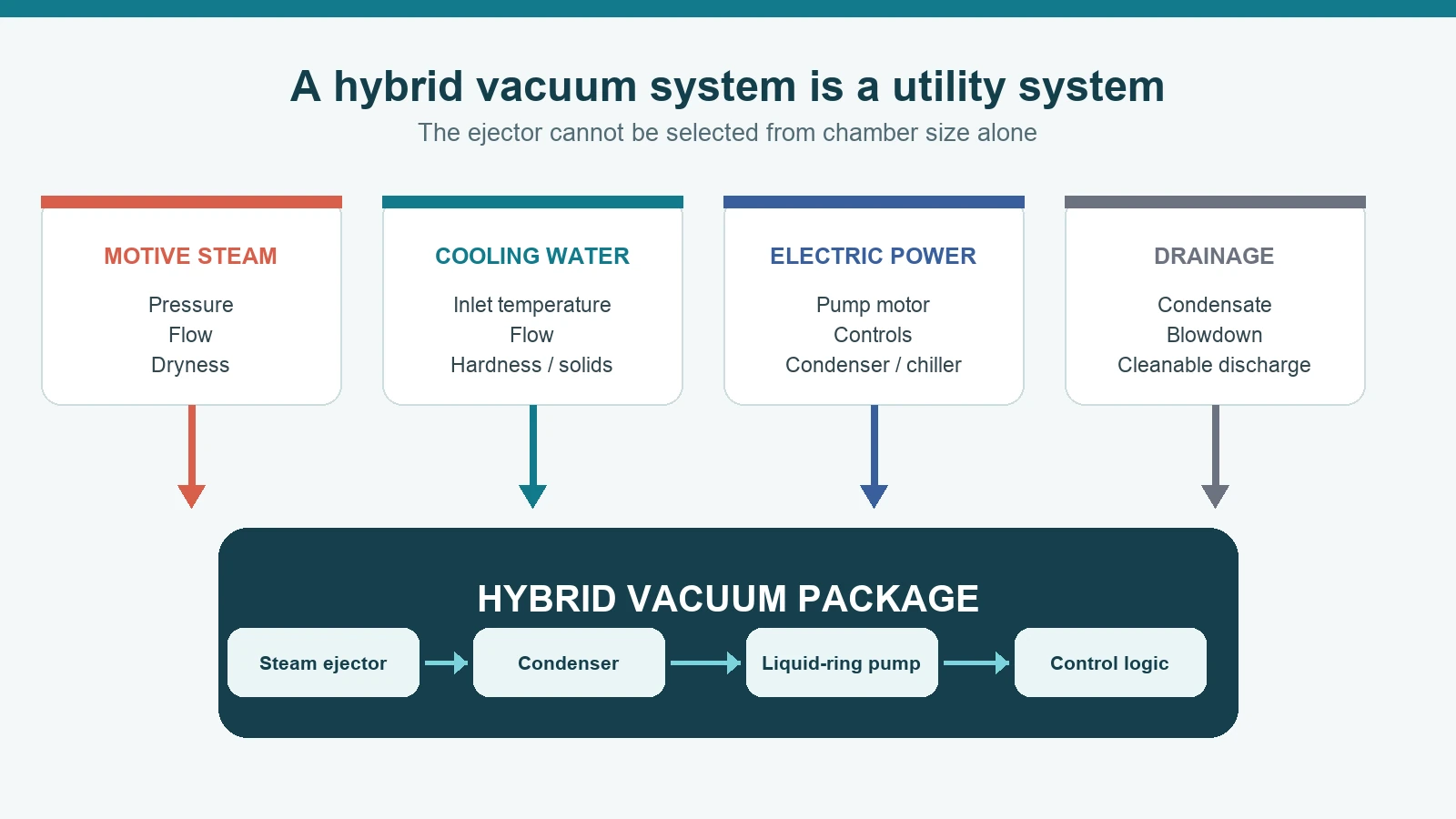
The Four Utilities That Decide Whether a Hybrid System Fits
1. Motive Steam: Pressure Alone Is Not Enough
The proposal must state required steam pressure and flow at the machine connection while the plant is operating at peak demand. Boiler nameplate capacity is not proof that the ejector will receive stable steam. Pipe size, distance, pressure drop, separator and trap arrangement, steam dryness, and simultaneous users all matter.
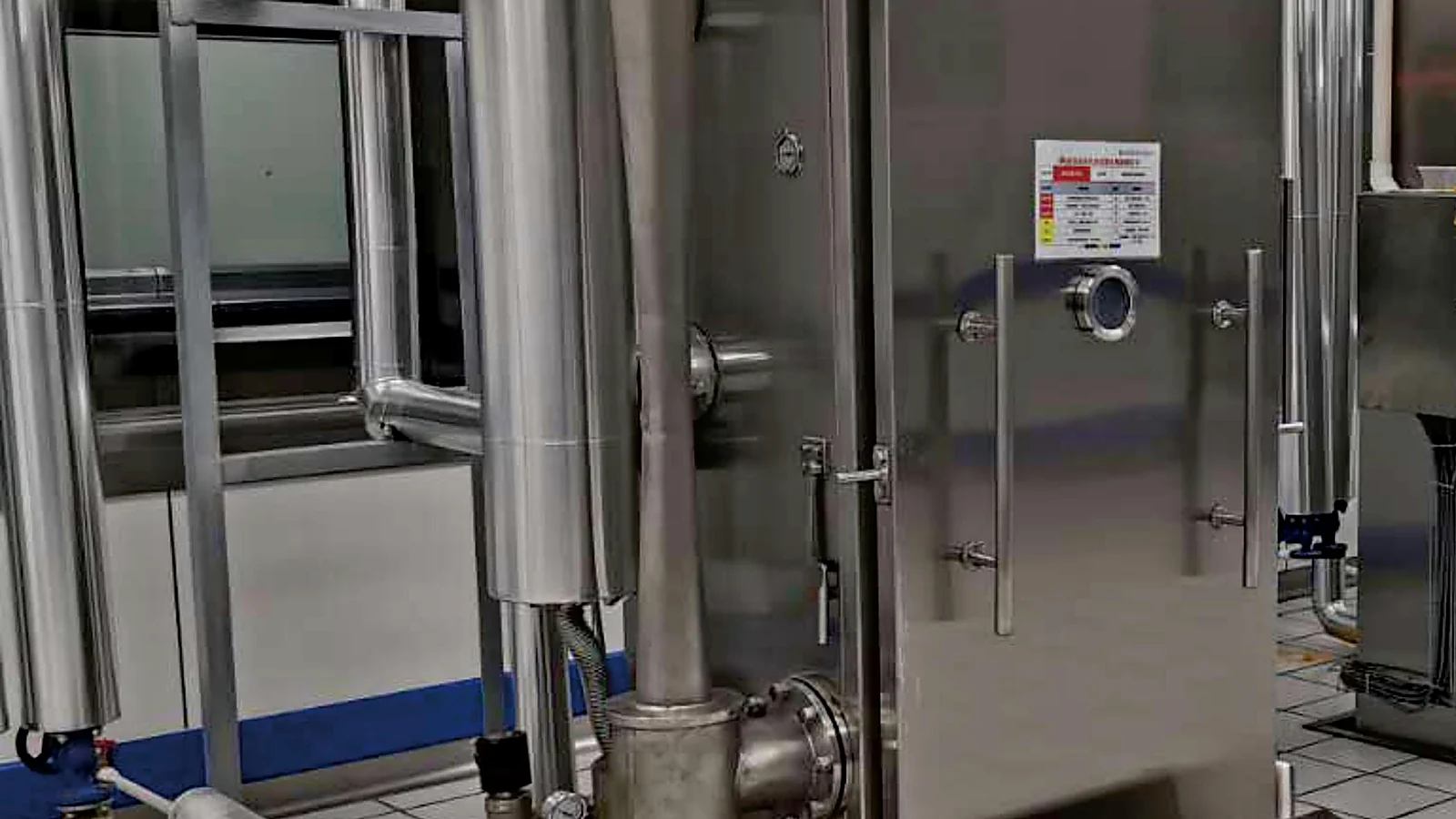
One Allcold AVCF-200 project configuration with a steam ejector specified client-supplied boiler steam in the 0.3-0.5 MPa range. That is a project example, not a standard value for every model. A final quotation must state the actual pressure, consumption, connection, and responsibility boundary for the selected duty.
2. Cooling Water: Normal Tap Water May Be Acceptable, but Temperature Still Sets a Boundary
An Allcold system does not automatically require purified or chilled water simply because it includes an ejector. Normal municipal tap water can be acceptable when its inlet temperature, flow, pressure, cleanliness, and chemistry meet the design. The important word is when.
Warm seasonal water reduces condensing margin. Low flow or unstable pressure changes performance. Hardness, suspended solids, and biological fouling can create an insulating layer or restrict passages. The U.S. Geological Survey notes that heated hard water can form calcium-carbonate deposits, while U.S. Department of Energy guidance explains that scaling and fouling on heat-exchanger surfaces increase the energy required to remove heat.[4][5]
Do not buy unnecessary water treatment by default. Instead, send a recent water analysis and the highest expected inlet temperature. Engineering can then determine whether a strainer, filtration, softening, closed loop, chiller, or cleaning plan is justified.
3. Electrical Power: Hybrid Does Not Mean Electricity-Free
A hybrid package may still include a liquid-ring pump, water pump, condenser fans or chiller, PLC, valves, sensors, and chamber auxiliaries. Steam can reduce or redistribute the mechanical vacuum duty, but the full connected and operating load must remain on the utility list. Ask for normal running demand, maximum connected load, start-up behavior, voltage and frequency, and which items are supplied by the buyer.
4. Drainage and Backpressure: The Forgotten Design Limit
Condensed vapor, cooling-water discharge, cleaning water, and other liquid streams need a defined route. Poor drainage can flood a condenser or create unwanted backpressure. Nash’s technical guidance specifically notes that ejector installations must be arranged to drain correctly and that condenser drain legs need sufficient conditions to avoid flooding.[2]
Before layout approval, define drain elevation, line size, slope, hot-well or receiver arrangement, maximum discharge pressure, cleanability, odor control, and whether any stream requires treatment. “Drain available” is not an engineering specification.
Mechanical Package vs Steam-Ejector Hybrid
| Decision factor | Mechanical vacuum package | Steam-ejector hybrid |
|---|---|---|
| Plant steam | Not required for vacuum generation | Stable pressure, flow, and quality are essential |
| Wet-vapor duty | Package and condenser must be sized for the peak | Can be attractive for demanding vapor loads after calculation |
| Utility simplicity | Usually simpler where electricity and cooling circuit are already available | Adds steam and tighter water/drain responsibility |
| Maintenance focus | Rotating equipment, seals, service liquid, condenser cleanliness | Ejector nozzle, steam condition, condenser, backing pump, drains |
| Operating-cost model | Electricity, water, maintenance, downtime | Steam, water, electricity, boiler losses, treatment, maintenance |
Neither column is automatically cheaper. A factory with surplus process steam and existing water treatment may reach a different conclusion from a small bakery that would need a new boiler, larger water system, and extra drainage solely for the cooler. Total cost should be calculated per accepted batch or per kilogram at the required production schedule, not from one utility tariff.
What an Allcold Project Example Actually Proves
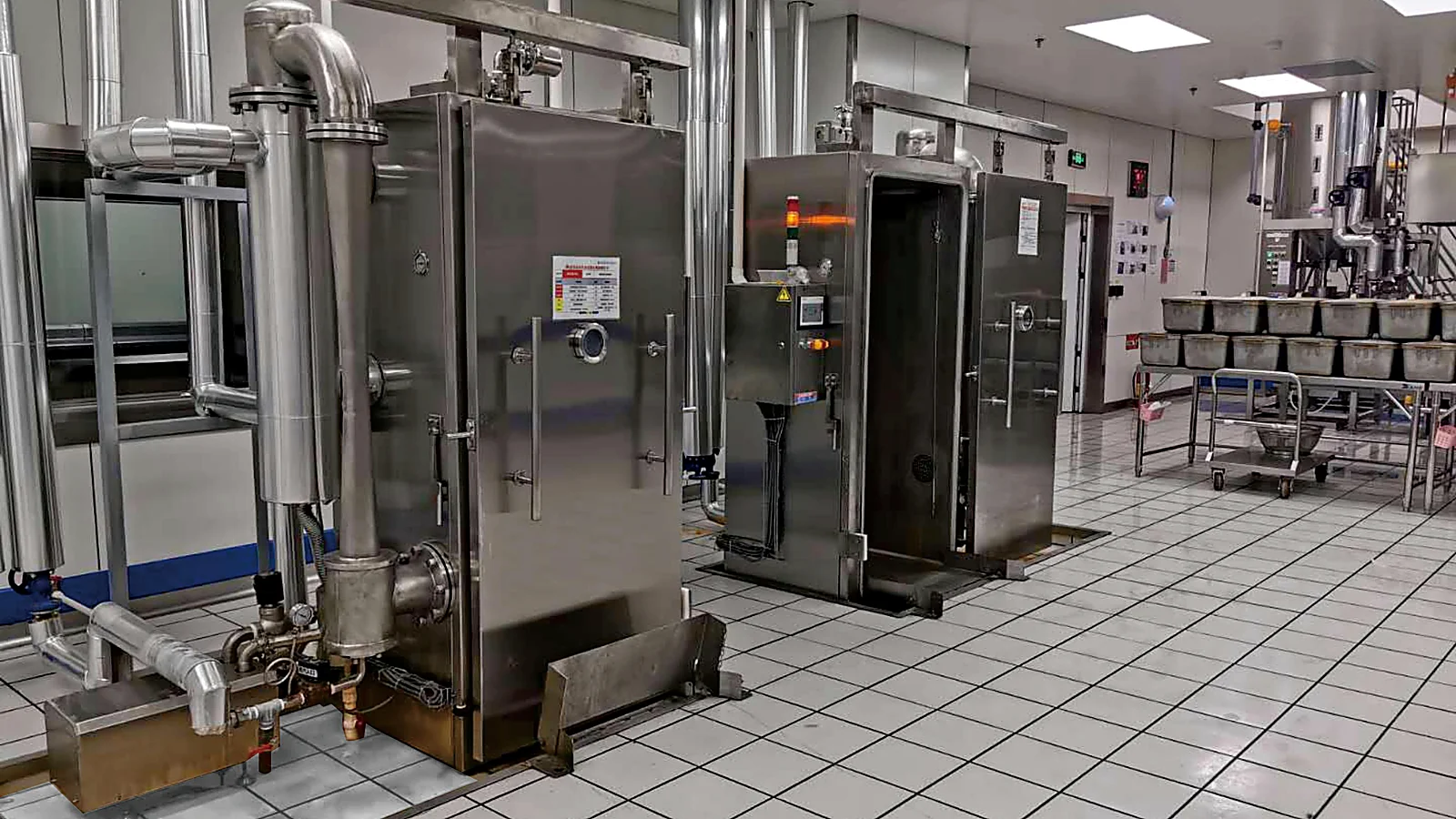
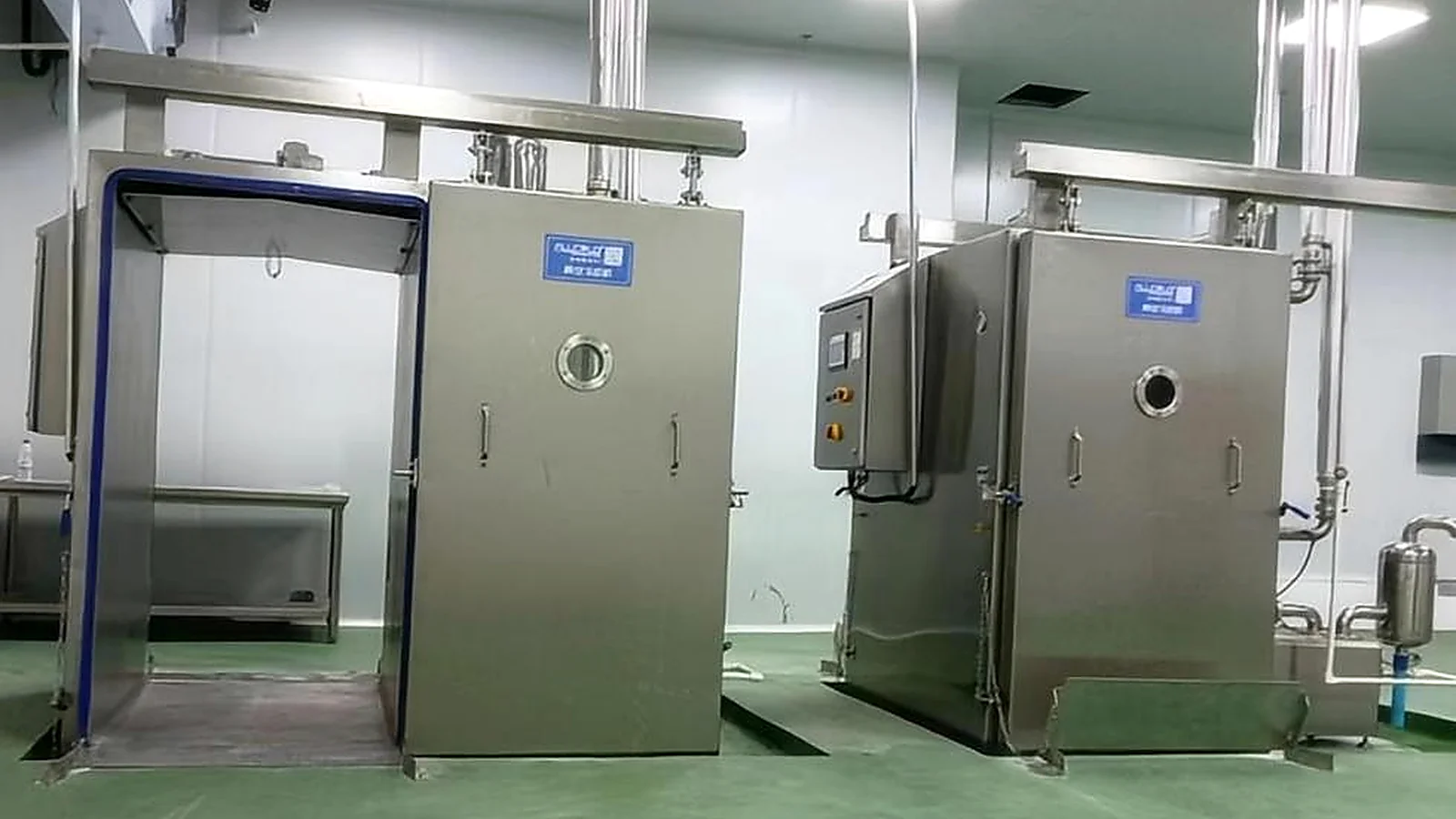
Allcold has supplied food vacuum-cooling configurations that combine a steam ejector, condenser/heat-exchange components, and a liquid-ring vacuum pump. In one quoted AVCF-200 trolley project, the design basis listed approximately 200 kg per cycle, hot food starting around 95-100°C, a target below 30°C, and a cycle around 15 minutes. It also listed client-side steam and water conditions.
Those values prove that a hybrid arrangement is an available engineered route. They do not prove that every 200 kg product will follow the same curve. The quoted load, recipe, tray geometry, actual fill, product evaporation behavior, probe position, utility conditions, and acceptance method still need confirmation in a sample test and commissioning protocol.
Ask for a Utility Guarantee, Not a Components List
A proposal that lists “steam ejector + vacuum pump + condenser” is still incomplete. The useful commercial schedule should state:
- design product, batch mass, start temperature, target temperature, and expected cycle;
- peak vapor-load basis and whether the guarantee applies to a specific recipe or a product family;
- required motive-steam pressure, consumption, quality, and connection at full plant load;
- cooling-water inlet temperature range, flow, pressure, quality, and return condition;
- electrical supply, connected load, normal demand, and start-up requirement;
- drainage, condensate, exhaust, receiver, and backpressure limits;
- which pumps, heat exchangers, tanks, strainers, valves, and controls are in the vendor scope;
- instrumentation and data required for acceptance testing;
- cleaning, inspection, spare-parts, and preventive-maintenance responsibilities.
This is consistent with Allcold’s broader guidance on using detailed quotations to avoid project risk. A component brand can support reliability, but it cannot replace a defined operating envelope.
How to Compare Operating Cost Correctly
Build the comparison from a common production case. For each option, calculate annual steam, electricity, cooling or make-up water, water treatment, boiler fuel and losses, cleaning chemicals, planned service, expected wear parts, and downtime exposure. Then divide by accepted product output at the real batch schedule.
Also model off-design operation. A system sized for the worst load may spend much of the year on smaller batches. A steam system may look efficient at stable high throughput but less attractive when it starts and stops around a variable production plan. Conversely, a mechanical package that looks simple may be oversized or slow if the peak wet-vapor load was understated.
The relevant Allcold bakery and cooked-food vacuum cooling systems are configured around actual trays, trolleys, batches, products, and workflow. The vacuum-system choice belongs inside that application review, not outside it.
Frequently Asked Questions
Does a steam ejector replace the vacuum pump?
Not necessarily. Many industrial packages are hybrid systems in which an ejector works with a condenser and a liquid-ring or other backing pump. The final arrangement depends on required pressure, vapor load, utility limits, and operating cost.
Can an Allcold steam-ejector system use tap water?
Normal municipal tap water can often be used when its temperature, pressure, flow, hardness, suspended solids, and hygiene status meet the project specification. Special purified water is not an automatic requirement, but unusually warm, hard, dirty, or unstable water may require filtration, treatment, a closed loop, or a chiller.
Is a steam ejector always faster?
No. Cycle time depends on the whole system and product. An ejector cannot overcome inadequate condenser duty, an incorrect pressure ramp, excessive batch mass, poor loading, restricted vapor flow, or utilities outside the design condition.
Is a steam ejector suitable for a small bakery?
It may be, but a site without dependable process steam will usually need to justify the added boiler and utility infrastructure. A mechanically driven package may offer a simpler total project for small or intermittent production.
What should we send before asking for a recommendation?
Send product and recipe family, batch mass, initial and target temperatures, tray/trolley details, cycle frequency, daily output, room layout, electrical supply, available steam pressure and capacity, seasonal water temperature and analysis, drainage conditions, and the required acceptance method. Allcold can review those details through the vacuum cooling project assessment form.
The Best Vacuum System Is the One the Factory Can Support
A steam-ejector hybrid can be a strong solution for demanding food-cooling duty, especially where high vapor loads and existing plant steam make the configuration practical. A mechanical vacuum package can be the better system where utility simplicity, intermittent operation, or the absence of steam dominates the project.
Do not select either from the chamber capacity, final pressure, or component list alone. Define the product load, map the cycle, verify the utilities at peak factory demand, and write the acceptance boundary into the quotation. That turns a technology comparison into an operable food-cooling project.
References
- GEA, Vacuum Ejector – Function and Applications, including the use of jet vacuum pumps with mechanical vacuum pumps.
- Nash, Steam Jet Ejectors & Hybrid Vacuum Systems, operating principles, hybrid arrangements, utilities, and installation considerations.
- U.S. Food and Drug Administration, Cooling Cooked Time/Temperature Control for Safety Foods and the FDA Food Code, July 2024.
- U.S. Geological Survey, Hardness of Water, hardness classification and scale formation.
- U.S. Department of Energy, Federal Energy Management Program, Side Stream Filtration for Cooling Towers, fouling, scaling, heat-transfer efficiency, and maintenance effects.

Mila
You May Also Like
Vacuum Cooling Soups and Sauces: Machine Selection, Foam Control, and Validation
Compare continuous vacuum cooling, micro rapid cooling with tap-water capability, and custom cook-cool systems for soups and sauces. Learn how to validate foam, pressure, viscosity, vapor handling, concentration, safety, and yield.
Vacuum Cooling Cooked Rice: A Validation Guide for Central Kitchens
Cooked rice can be vacuum cooled rapidly, but the process must be validated with the actual recipe, tray depth, batch mass, temperature map, yield target, and production rhythm. This guide shows central kitchens what to test, record, and approve.
Vacuum Cooling Cooked Noodles and Pasta: A Validation Guide for Central Kitchens
Vacuum cooling cooked noodles and pasta sounds straightforward—it’s just cooling food, and vacuum cooling is a proven technology. In practice,
How to Plan a Vacuum Cooling System for a Central Kitchen
Learn how to plan a vacuum cooling system for a central kitchen with a practical factory-side view on throughput, workflow, hygiene zoning, utilities, and supplier evaluation.
Is Your Cooling Process Holding Back Your Ready-Meal Business?
Your kitchen produces delicious, complex ready-meals, but the slow cooling process introduces food safety risks and production delays. This critical

How Can Vacuum Cooling Revolutionize Meat and Poultry Processing?
You’ve cooked a thousand kilograms of chicken perfectly, but now it sits for hours, slowly passing through the temperature danger
What's Really Inside Your Vacuum Cooler that Makes it Work?
Ever wondered what makes a vacuum cooler tick, transforming warm produce into perfectly chilled goods in minutes? It’s not magic,
What Are the Preservation Techniques for Ready-to-Eat Foods?
As consumers increasingly prefer ready-to-eat (RTE) foods, extending their shelf life effectively becomes a critical challenge. Currently, the most effective