
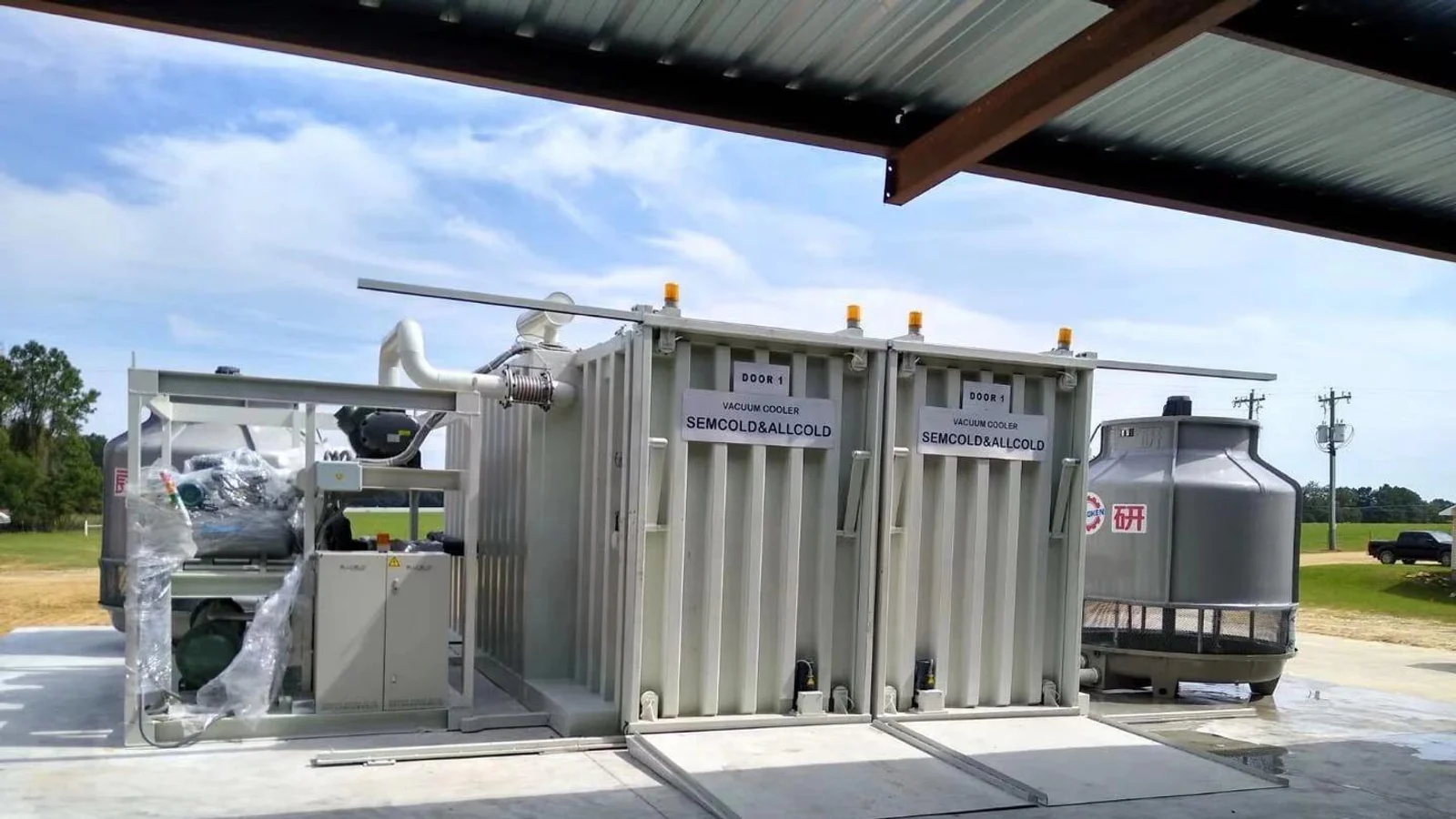
Why Vacuum Coolers Can Slow Down in Summer: Cooling-Water Temperature, Condenser Capacity, and Cycle Time
Why can a vacuum cooler run well in winter but slow down in summer?
The most common seasonal reason is that warmer cooling water reduces heat-transfer and condensation margin, while warmer seal water raises the vapor-pressure limit of a liquid-ring pump. The chamber may still be airtight and the pump may still run, but the system can stall at a higher pressure during the peak vapor load. Diagnose it by comparing inlet and outlet water temperature, water flow or pressure, chamber-pressure curves, and product-temperature curves against a known good cycle. Do not assume that “tap water is acceptable” means any tap-water temperature is acceptable.
A vacuum cooler is a heat-removal system, not only a vacuum pump connected to a chamber. When product water evaporates under reduced pressure, the released vapor and latent heat must go somewhere. Depending on the design, a condenser, refrigeration circuit, cooling-water loop, liquid-ring pump, steam ejector, or a combination of these components has to absorb and reject that load.
This is why a machine can pass a cool-season trial and then miss its cycle target during a hot, humid production week. The pump model has not changed. The thermal boundary around it has.
Where Cooling Water Enters the Vacuum-Cooling Process
During a cycle, the vacuum system first removes chamber air. As pressure falls toward the saturation pressure associated with product temperature, water begins to evaporate rapidly. That evaporation cools the product, but it also creates a large vapor volume. Condensing much of that vapor before it reaches the final vacuum stage reduces the gas volume that pumps or ejectors must handle.
GEA’s jet-vacuum guidance explains that condensable compounds are commonly condensed between stages and that condensation pressure depends on cooling-medium temperature. Its example places water-vapor condensation at about 60 mbar with 25°C cooling water; this is an ejector example, not a universal vacuum-cooler operating point.[1]
Warmer water changes the system in several possible places:
- Water-cooled condenser: a smaller temperature difference reduces the available heat-transfer margin, so more vapor may pass downstream or the condenser may operate at a higher pressure.
- Liquid-ring vacuum pump: warmer seal liquid has a higher vapor pressure, which reduces the pump’s practical vacuum margin and can increase the vapor handled inside the pump.
- Steam-ejector hybrid: higher condenser pressure can increase ejector backpressure and disturb stage performance.
- Chilled-water package: higher ambient or condenser-water temperature can increase chiller load and power, or expose insufficient chiller capacity.
- Cooling tower: the leaving-water temperature is constrained by ambient wet-bulb temperature plus the tower’s approach.
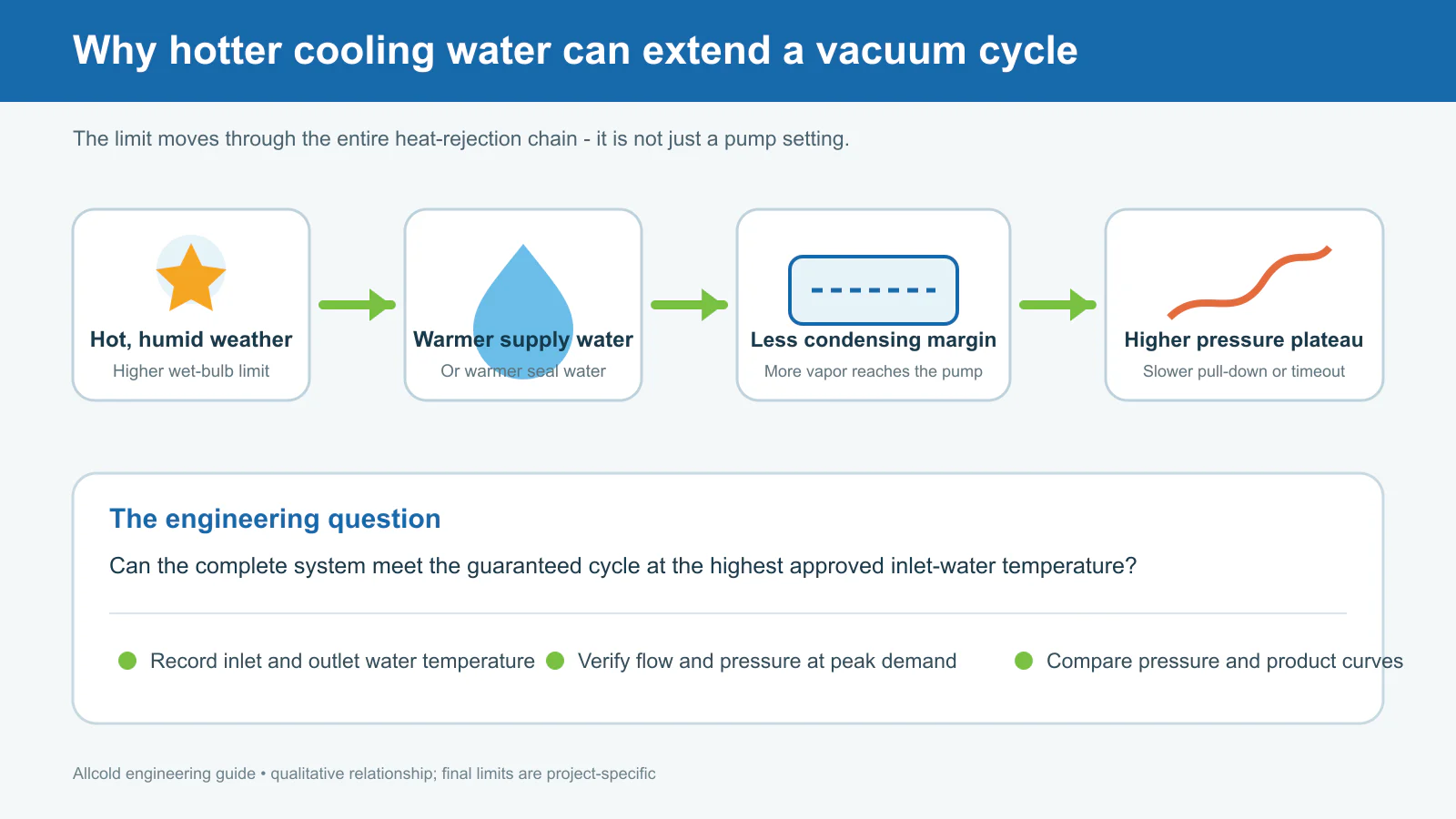
Why a Few Degrees Can Matter
Water vapor pressure rises nonlinearly with temperature. NIST’s thermodynamic tables, based on the IAPWS formulation, show the saturation relationship used in engineering calculations.[2] Around typical utility temperatures, saturation pressure is approximately 1.7 kPa at 15°C, 3.2 kPa at 25°C, 4.2 kPa at 30°C, and 5.6 kPa at 35°C.
Those values do not mean that a vacuum cooler must stop at those chamber pressures. They explain why liquid temperature matters inside a liquid-ring pump and why a condenser needs sufficient temperature difference. Actual attainable pressure depends on pump design, seal-liquid handling, gas load, condenser arrangement, refrigeration duty, air leakage, and the full operating curve.
NASH similarly advises operators to record seasonal heat-exchanger and seal-water temperatures because higher water temperature affects vapor pressure and vacuum performance. Its maintenance guidance also points to scale, restricted flow, and temperature differences as useful diagnostic evidence.[3]
“Normal Tap Water” Is a Water-Quality Statement and a Temperature Condition
Allcold systems do not automatically require purified water. Normal municipal water can be acceptable when temperature, flow, pressure, cleanliness, hardness, and hygiene status fall inside the selected system’s design envelope. The phrase “use tap water” should never be interpreted as “performance is unchanged at any seasonal temperature.”
For example, one current Allcold catalogue table for several compact fresh-food models lists a normal-water condition of no more than 25°C and separately lists an optional 3-15°C chiller range. These are catalogue conditions for that model group, not a universal limit for every Allcold vacuum cooler. A project quotation should state the actual maximum inlet temperature and minimum flow at the machine connection.
For open cooling towers, the U.S. Department of Energy notes that leaving water can approach but cannot be colder than the ambient wet-bulb temperature. The difference is the tower “approach,” which changes with water flow, entering-water temperature, wet-bulb temperature, fan speed, and tower design.[4] A buyer who submits only the annual average air temperature may therefore hide the worst summer water condition.
How Summer Problems Look in Cycle Data
A seasonal water problem does not always produce a clear alarm. The first sign may be a cycle that is two or three minutes longer, a product probe that cools normally at first and then tails, or a pressure curve that stops following the approved reference during the highest vapor-load section.
Compare today’s cycle with a known-good vacuum-cooling pressure and temperature curve. Use the same product, batch mass, start temperature, packaging, loading pattern, target, and recipe. Without those controls, a warmer or wetter product can be mistaken for a utility fault.
Record at least:
- cooling-water inlet temperature at the machine while the cycle is running;
- cooling-water outlet temperature;
- water flow, line pressure, or validated pump differential pressure;
- liquid-ring seal-water temperature where applicable;
- chamber absolute pressure versus time;
- product core temperature versus time;
- refrigeration suction/discharge data or chiller status where supplied;
- ambient dry-bulb and wet-bulb condition for tower- or air-cooled systems.
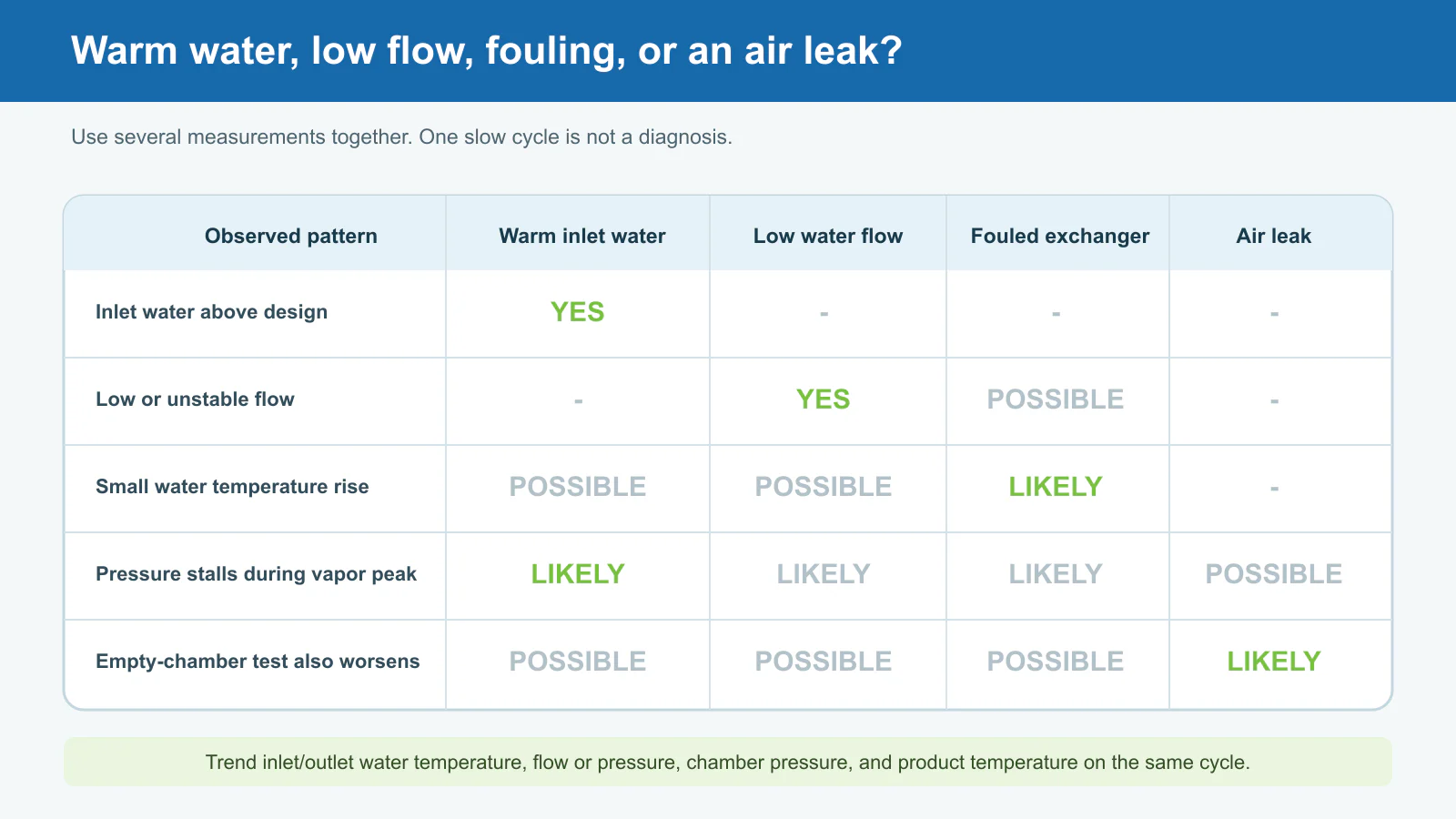
Warm Water, Low Flow, Fouling, and Air Leaks Are Not the Same Fault
| Possible cause | Evidence that supports it | First action | Do not assume |
|---|---|---|---|
| High inlet-water temperature | Flow is normal, but inlet temperature exceeds the approved condition and pressure performance tracks the seasonal change | Confirm the design limit and evaluate chiller, tower, storage, larger exchanger, or seasonal derating | More flow will always restore design performance |
| Low or unstable water flow | Low line pressure, large temperature rise, pump cycling, blocked strainer, undersized pipe, or competing users | Restore specified flow and pressure; check valves, strainers, pump curve, pipe loss, and simultaneous demand | The condenser is undersized |
| Scale or biological fouling | Flow may appear available, but heat transfer deteriorates; pressure drop, inspection, or cleaning history supports the diagnosis | Inspect and clean using the approved method; verify water treatment and filtration | Raising pump speed fixes a dirty heat-transfer surface |
| Air leak or valve problem | Empty-chamber performance worsens, leak-rate evidence changes, or the fault is not correlated with water condition | Run the approved empty-chamber and isolation checks; inspect seals, valves, probes, and penetrations | Every summer slowdown is a cooling-water problem |
A loaded pressure plateau can be caused by water, product vapor load, or both. An empty chamber contains almost no product vapor, so it helps separate a basic leak or evacuation fault from a condensing limit that appears only under a wet load. For loading-related warm spots or variable cycles, also check Allcold’s guide on pallet loading before blaming the machine.
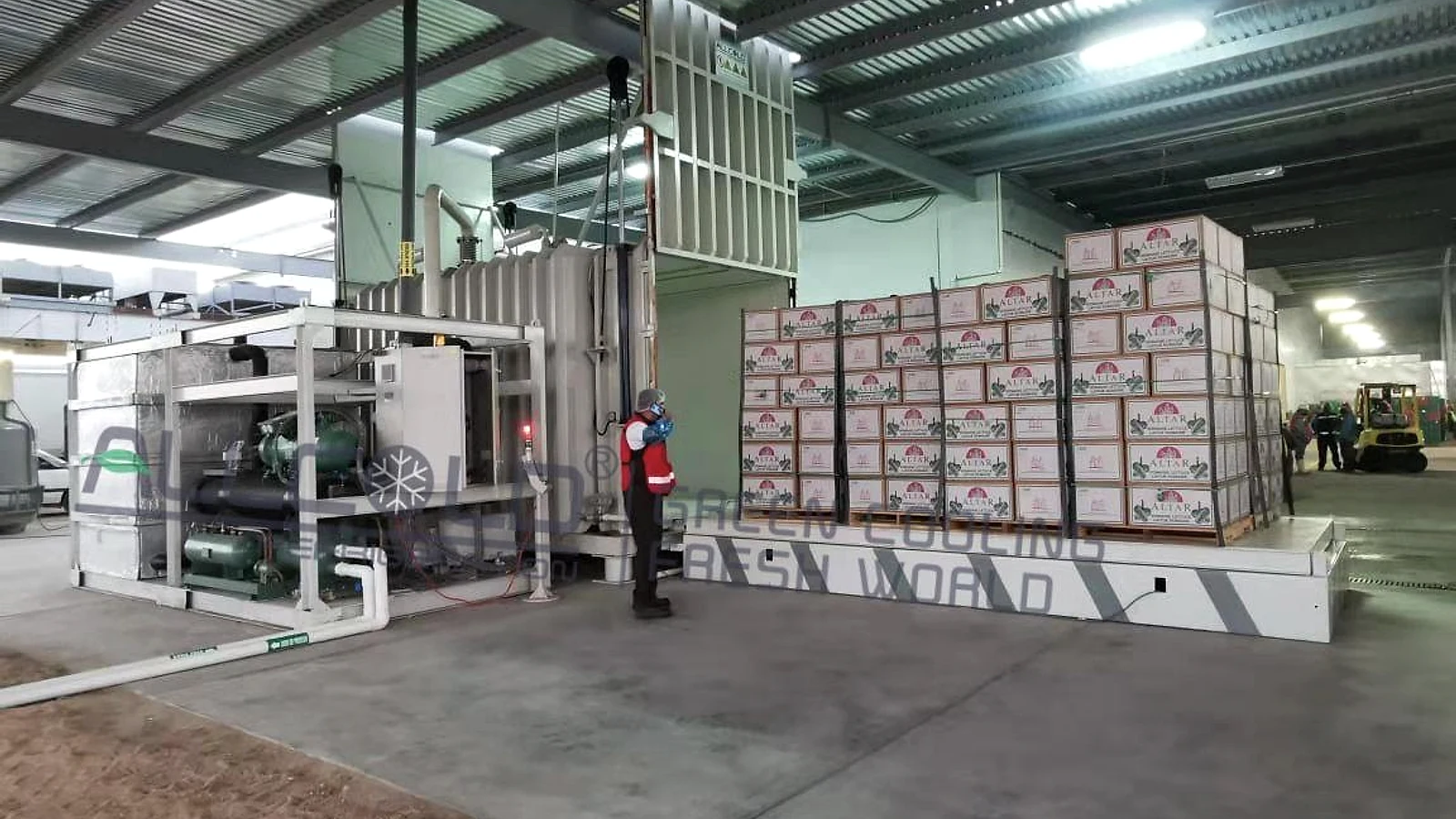
Why Simply Increasing Water Flow May Not Solve It
Increasing flow can help when actual flow is below design. It is not a universal response to warm water. The exchanger may already be near its allowed pressure drop, the pipe may be undersized, the pump may move off its efficient region, or the condenser may lack surface area for the new duty. Excessive velocity can also create erosion, vibration, or control problems.
For ejector-condenser systems, Graham documents a case where cooling water at 85°F instead of the 80°F design condition contributed to a higher intercondenser pressure and a sharp loss of ejector-system performance.[5] The lesson is not that five degrees always causes failure. It is that a system designed close to a backpressure boundary may have little tolerance once water temperature, steam condition, fouling, and vapor load move together.
The correct engineering choices may include one or more of the following:
- restore specified flow and remove restrictions;
- clean or replace a fouled heat exchanger;
- increase heat-transfer surface or add another condenser stage;
- provide a closed loop, buffer tank, or dedicated cooling-water pump;
- install or resize a chiller for the declared summer condition;
- use tower capacity and control selected for the site wet-bulb design point;
- reduce batch mass or cycles per hour under a written seasonal derating rule;
- revise the vacuum package if peak vapor load was understated.
What Buyers Should Put in the Quotation
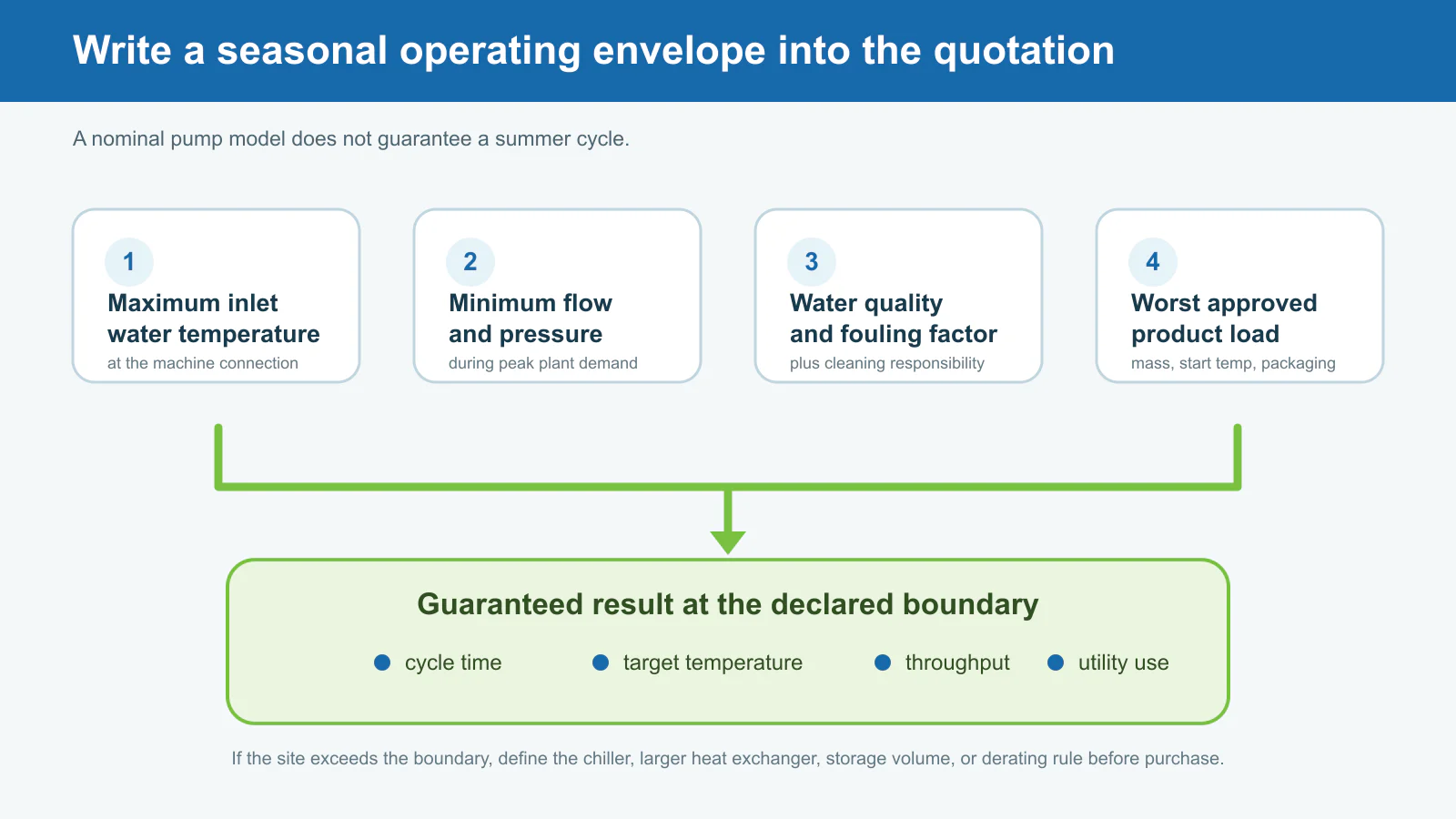
A quotation that states only “tap water required” or lists a pump brand leaves a major performance boundary undefined. Ask the supplier to state the conditions at which cycle time, target temperature, and throughput apply. This extends the responsibility-boundary approach in Allcold’s guide to detailed vacuum-cooler quotations.
The utility schedule should include:
- maximum cooling-water inlet temperature at the machine connection;
- minimum and maximum water flow and pressure;
- permitted outlet temperature or required return condition;
- water chemistry, suspended solids, filtration, treatment, and cleaning basis;
- ambient dry-bulb and wet-bulb design conditions;
- chiller entering/leaving temperature and capacity at the stated ambient;
- concurrent machine or factory loads that share the utility;
- worst approved product, batch mass, starting temperature, and packaging;
- guaranteed cycle, target product temperature, and cycles per hour;
- what happens outside the envelope: alarm, derating, longer cycle, or no guarantee.
How to Commission a System Before the Hottest Month
If commissioning occurs in cool weather, the team may not be able to reproduce the highest annual inlet-water temperature naturally. Do not accept a vague promise that the summer result will be the same. Agree on one of these methods:
- test at the worst approved water condition using controlled water temperature;
- obtain a supplier correction curve or calculated derating across the specified range;
- verify condenser, chiller, tower, and pump selections at the stated peak condition;
- repeat a loaded performance check during the first hot season;
- define the temporary production response if the utility exceeds its boundary.
For outdoor projects, combine this seasonal utility review with Allcold’s outdoor vacuum-cooler site-planning checklist. Shade, airflow, enclosure protection, drainage, service access, and cooling-water design solve different risks and should all be addressed.
Frequently Asked Questions
Can an Allcold vacuum cooler use normal tap water?
Often yes, when the water temperature, flow, pressure, cleanliness, and chemistry match the project specification. “Tap water” describes the source; it does not remove the need to state a maximum temperature and minimum flow.
At what cooling-water temperature will a vacuum cooler stop working?
There is no universal cutoff. The limit depends on condenser size, vacuum-pump or ejector design, seal-water arrangement, refrigeration capacity, vapor load, target pressure, and allowed cycle time. Use the project data sheet, not a generic internet number.
Does every hot-climate vacuum cooler need a chiller?
No. Some sites can meet duty with stable municipal water, a properly selected cooling tower, a larger exchanger, or another engineered loop. A chiller is justified when the required inlet condition cannot be maintained reliably by the available water system.
Why does the machine reach pressure when empty but struggle when loaded?
An empty test mainly checks air removal and leakage. A loaded cycle adds the product’s vapor and heat load. If the problem appears only during peak evaporation, investigate water temperature, flow, condenser duty, refrigeration capacity, and product loading before concluding that the chamber leaks.
What information should be sent for a summer-performance review?
Send machine model, product and batch mass, start and target temperature, recipe, pressure and product-temperature trends, water inlet/outlet temperature, water pressure or flow, ambient condition, photos of the utility arrangement, recent cleaning history, and a known-good comparison cycle. Allcold can review these through the vacuum-cooling project and service form.
Design for the Hottest Approved Condition, Not the Average Day
A vacuum cooler that slows in summer is not automatically defective, but seasonal slowdown should never be dismissed as unavoidable. It is evidence that one or more operating conditions have moved away from the validated envelope.
Measure before replacing parts. Compare water temperature and flow with pressure and product curves. Separate a warm-water limit from low flow, fouling, an air leak, and a larger product vapor load. For a new project, write the maximum water temperature, minimum flow, worst product load, and guaranteed result into the quotation. That is how a buyer turns a good cool-season demonstration into dependable year-round production.
References
- GEA, Steam Jet Vacuum Pumps, cooling-medium temperature, condensation pressure, staging, and condenser design inputs.
- National Institute of Standards and Technology, NISTIR 5078: Thermodynamic Properties of Water, saturation temperature and pressure tables based on IAPWS-95.
- NASH, Monitoring Heat Exchanger Temperatures, seasonal seal-water temperature, vacuum performance, flow restriction, and scale diagnostics.
- U.S. Department of Energy, Federal Energy Management Program, Measurement and Verification Guidelines, Data Center Addendum, cooling-tower wet-bulb limit, approach temperature, and peak design conditions.
- Graham Corporation, How to Improve Ejector System Performance, case evidence on warm cooling water, condenser pressure, ejector backpressure, and performance breakdown.
Mila
You May Also Like
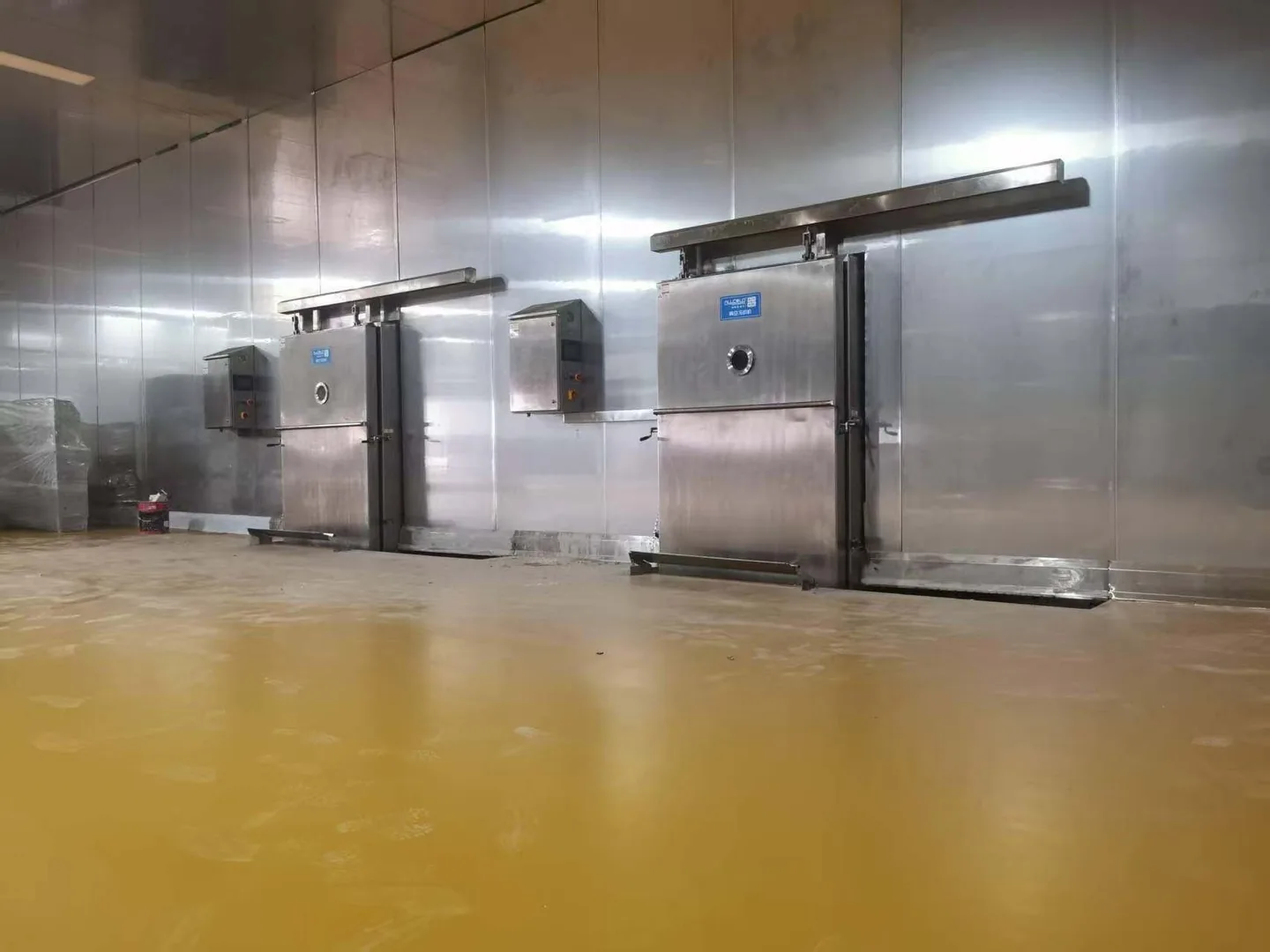
Can a Vacuum Cooler’s Chamber, Pump and Chiller Go in Different Rooms?
Keep the chamber convenient for production without assuming the machinery must sit beside it. A practical guide to reviewing a split vacuum cooling installation.
Vacuum Cooling Sweet Corn: Look Beyond Cooling Speed
Can sweet corn be vacuum cooled? Compare moisture control, husk and pack formats, hydrocooling alternatives, and the product checks to agree before buying.
Vacuum Cooling Celery: Is It the Right Choice for Your Packing Line?
Can celery be vacuum cooled? Compare vacuum, hydro and forced-air cooling, then assess packaging, temperature, weight loss and real packing-line throughput.
Does a Bigger Vacuum Pump Mean Faster Vacuum Cooling?
Does a larger vacuum pump cool produce faster? Compare m³/h ratings, loaded cooling time and complete batch throughput before buying a vacuum cooler.
Which Refrigerant Should Your Vacuum Cooler Use?
Choosing a vacuum cooler refrigerant? Check local service support, destination rules, system performance and quotation details before ordering.
Can Your Floor Support a Vacuum Cooler? Look Beyond Tonnes per Square Metre
Check vacuum cooler floor loading before you buy: operating weight, support reactions, forklift wheel loads, ramps and the site data your engineer needs.
Buying a Vacuum Cooler Near the Coast? Specify More Than Paint
Coastal protection is more than chamber paint. Use this component-by-component checklist to compare vacuum cooler quotations, test evidence and maintenance scope.
50 Hz or 60 Hz? How to Confirm a Vacuum Cooler Will Work at Your Site
Buying a vacuum cooler for 50 Hz or 60 Hz power? Check whole-machine compatibility, auxiliaries, conversion scope and quoted performance before ordering.
Can You Move a Vacuum Cooler Between Farms for Different Harvest Seasons?
ALLCOLD · MULTI-SITE COOLING & EQUIPMENT PLANNING Sharing one cooler across two growing regions can look efficient on an annual
How Loud Is a Vacuum Cooler? Plan for Noise Before You Buy
ALLCOLD · EQUIPMENT SELECTION & SITE PLANNING A cooler can fit the available space and still be in the wrong