
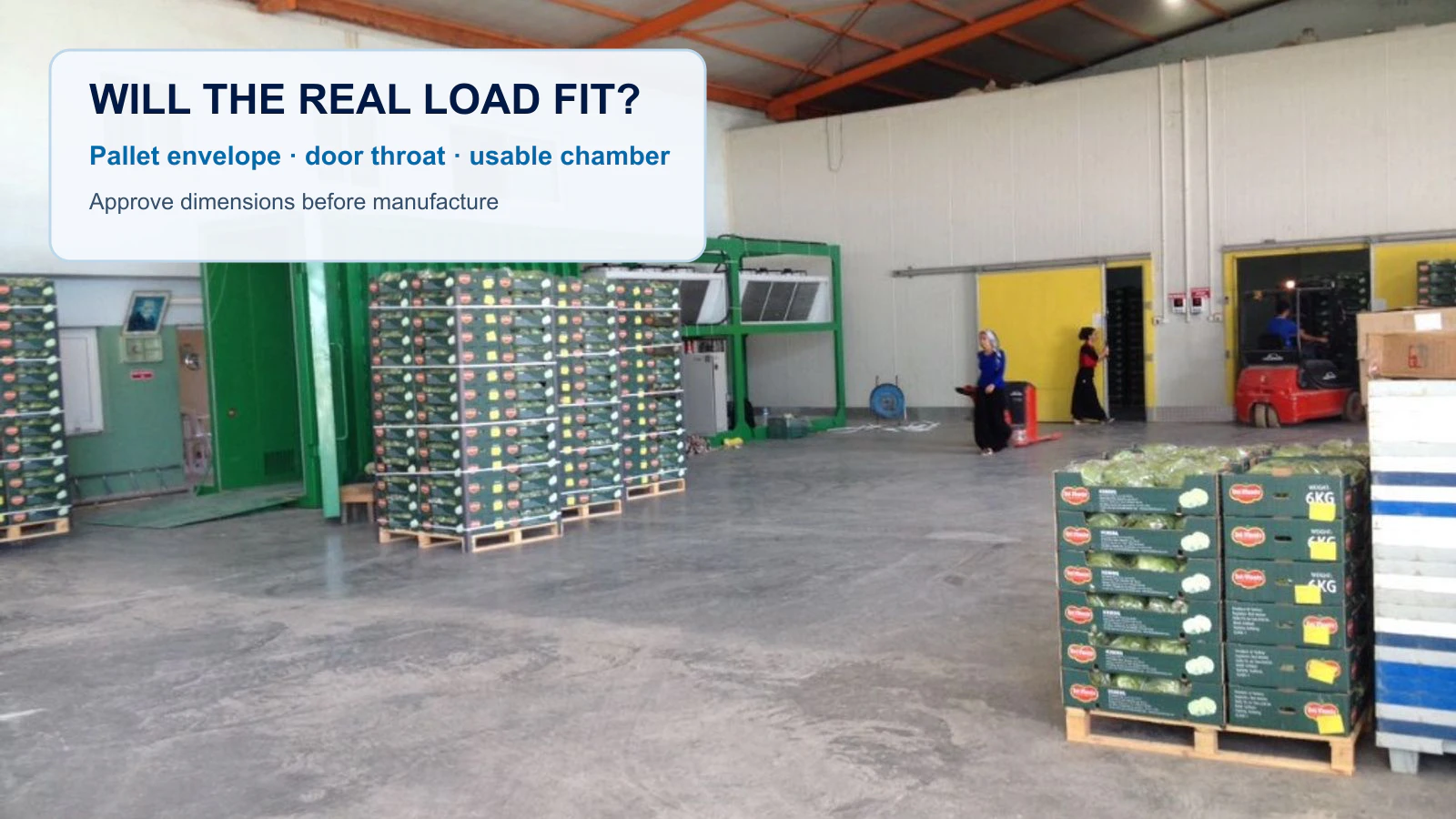
Will Your Pallets Actually Fit? How to Specify the Usable Chamber Size of a Vacuum Cooler
Direct answer: do not buy a vacuum cooler from “four pallets” or “eight pallets” alone. Give the supplier the maximum loaded width, depth, height and mass of every pallet format, then require the quotation drawing to show the door clear opening, usable chamber envelope, pallet positions, movement path and planned gaps. The smallest dimension governs. A nominal pallet may fit on paper while bulging cartons, leaning crates, stretch film, a raised load or the loading direction prevents the production load from entering safely.
A vacuum cooler is usually discussed by pallet capacity because that is convenient for early conversations. But “one pallet” is not a controlled engineering unit. Pallet standards cover different base sizes, and the load on top may extend beyond the deck or vary from shift to shift. The machine also has more than one relevant dimension: outside chamber dimensions, inside wall dimensions, the door opening and the genuinely usable space are not interchangeable.
This guide gives growers, packhouses and produce exporters a practical way to turn their actual pallets into an approvable machine layout. It complements Allcold’s articles on getting the machine through the site, choosing the chamber-door motion and avoiding loading arrangements that restrict cooling. Those articles deal with the route outside the chamber, the way the door moves and the performance of the load. Here the question is narrower: will every approved production load fit through the opening and occupy the intended position inside?
Why “Four Pallets” Is Not a Complete Size Specification
Flat pallets are not one universal size. ISO 6780 covers principal dimensions and tolerances for flat pallets used in intercontinental materials handling.[1] EPAL’s own product range illustrates the practical variation: its published load-carrier overview includes 800 × 1,200 mm, 1,200 × 1,000 mm, 1,000 × 1,200 mm and several other footprints.[2] Even when two buyers both say “Euro pallet,” the machine supplier still needs to know which side faces the chamber and how the product is stacked.
The base is only the first layer of the dimensional problem. The operating load can be larger because:
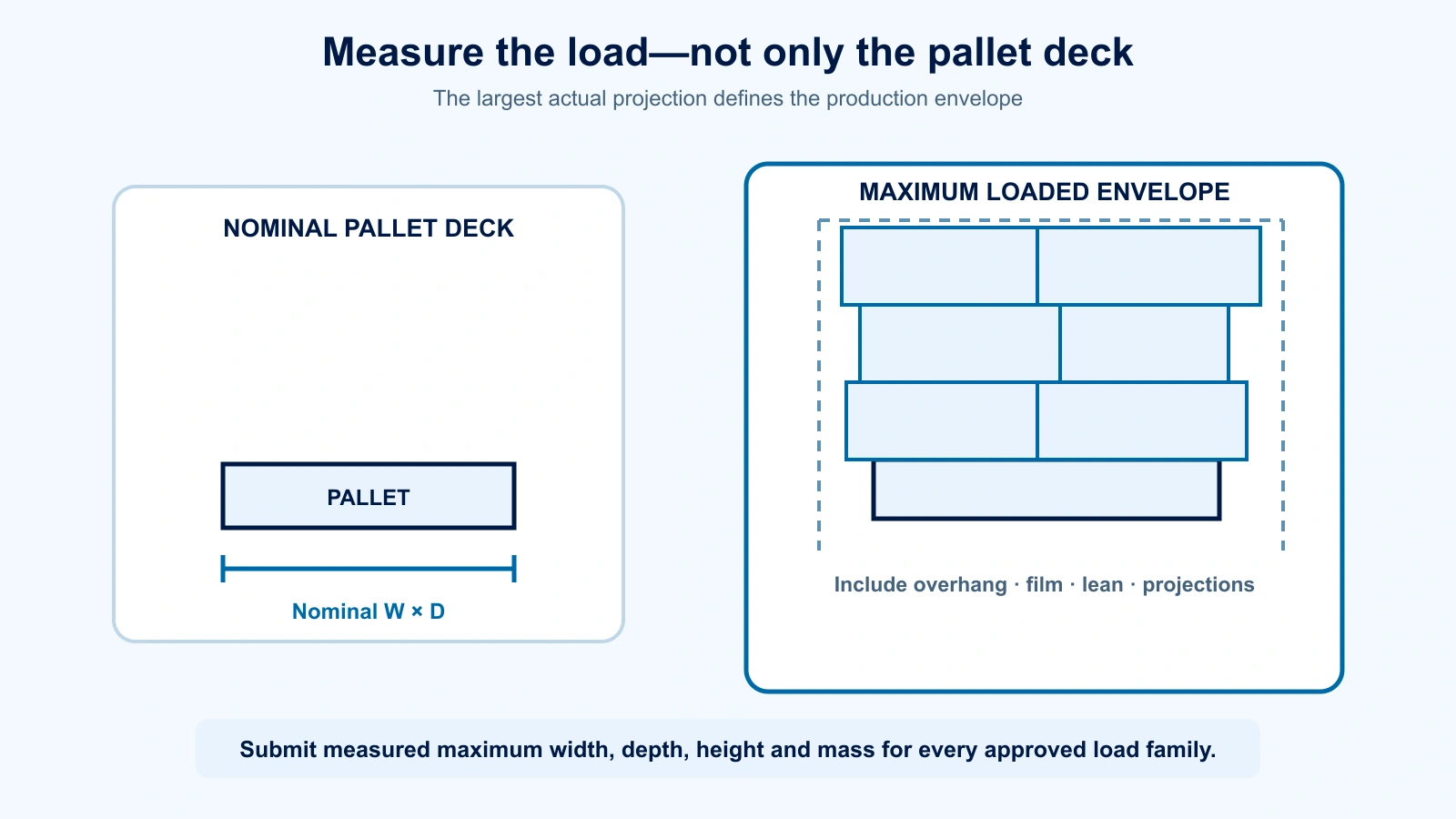
- cartons, returnable plastic crates or corner boards overhang the deck;
- stretch film, straps or netting stand proud of the nominal footprint;
- soft cartons bulge after washing, humidity or stacking;
- the top layer is not aligned with the bottom layer;
- the pallet is damaged, repaired or not square;
- a temperature probe, label, liner or protective cap projects from the load;
- the tallest approved crop uses a different carton count or stacking pattern.
A proposal may state an internal chamber size that looks generous, yet the limiting point may be the clear door opening, the loaded trolley width, a floor guide, a threshold or the turning approach. For this reason, the buyer should ask for a dimensioned loading arrangement—not infer fit from a model name.
The Five Envelopes That Must Agree
A reliable review separates five related envelopes. Combining them into one “machine size” hides the exact point that can cause a fit problem.
| Envelope | What it includes | Why the buyer needs it |
|---|---|---|
| 1. Pallet-deck envelope | Nominal base length, width and height; entry direction; runner or fork-pocket arrangement | Establishes the logistics format but does not prove the loaded product will fit |
| 2. Loaded-product envelope | Maximum actual width, depth, height and mass, including overhang and restraints | Defines the object that must pass through the door and stand inside the chamber |
| 3. Handling envelope | Pallet truck, forklift, trolley, fork tips, mast, wheels, operator position and withdrawal path | Shows whether the load can be placed and the handling device removed |
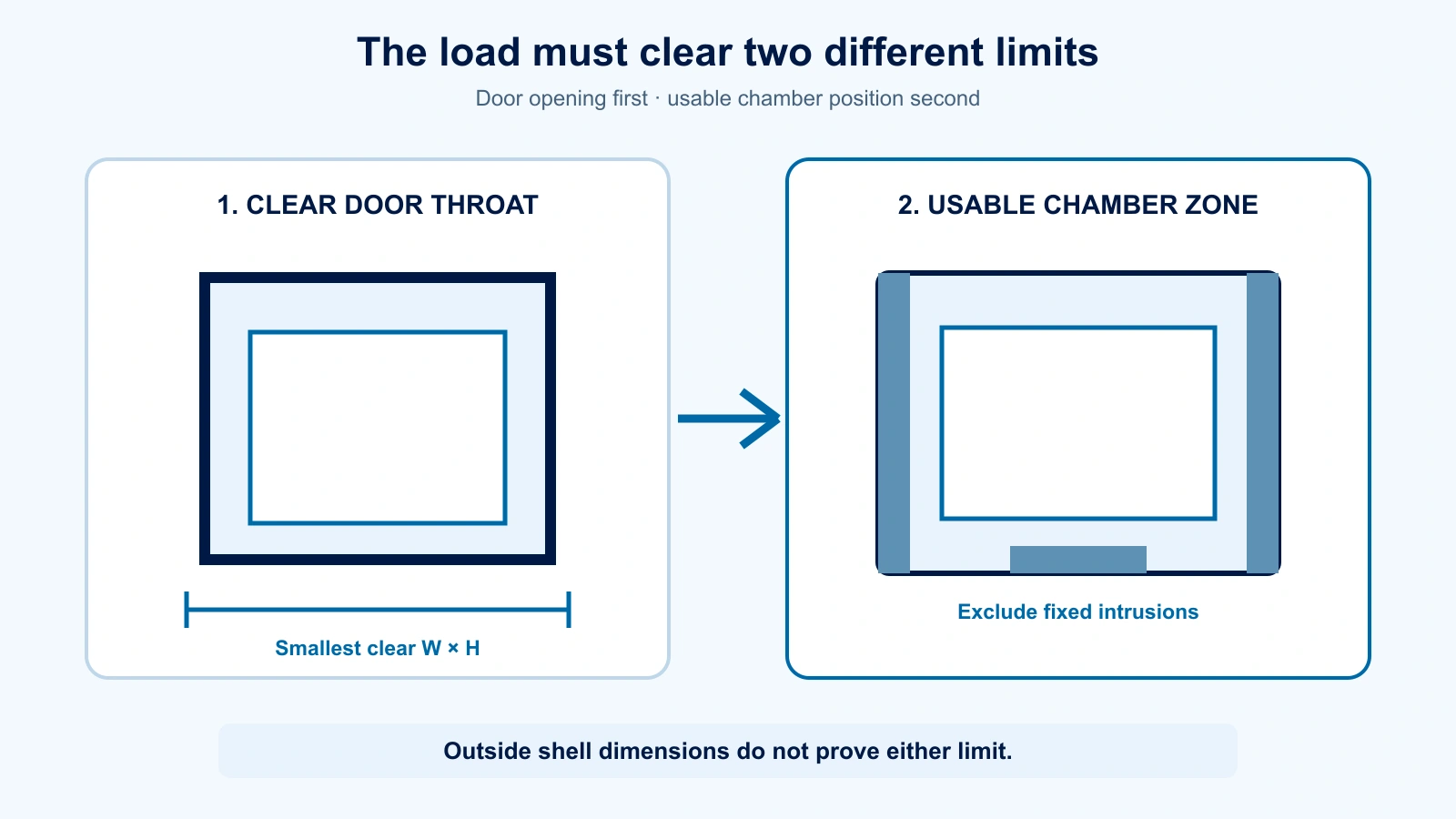
| 4. Door-throat envelope | Clear—not nominal—opening width and height in the fully open, locked position | Often becomes the first dimensional bottleneck |
| 5. Usable chamber envelope | Space available after excluding walls, seals, guides, rails, thresholds, sensors and other fixed intrusions | Defines where loads can actually stand without contact or obstruction |
Outside dimensions still matter for delivery, foundations and service access, but they cannot answer the fit question. Likewise, a chamber’s widest internal point does not prove that the same width exists at the doorway or at floor level. Ask the supplier to label every dimension on the same general-arrangement drawing and to state whether each figure is nominal, clear or usable.
How to Measure the Real Production Load
Use representative commercial loads, not a new empty pallet and not a carefully restacked demonstration load. Measure the largest approved configuration that production is reasonably expected to send to the cooler. If several crops, carton systems or customers use the same machine, record each one separately.
For every load family, collect:
- pallet or trolley type and the side that faces the chamber;
- maximum loaded width, depth and height at the widest points;
- gross mass and the method used to establish it;
- carton or crate dimensions, layer pattern and number of layers;
- typical and credible worst-case overhang;
- film, strap, net, corner-board, liner and label details;
- forklift or pallet-truck type and required withdrawal movement;
- photographs from the front, side and top where practical;
- any future format already planned by sales or production.
Do not add an arbitrary universal clearance to the measured load. The necessary allowance depends on the chamber configuration, door motion, handling method, floor accuracy, load stability, operator visibility and the space needed between adjacent loads. The supplier should show the proposed allowances on the project drawing, and the buyer should check them against normal production variation.

Build a Pallet–Machine Compatibility Matrix
A single “maximum pallet” can hide incompatible combinations. One SKU may be widest, another tallest and a third heaviest. Build a matrix so the supplier can check every limiting case against the proposed layout.
| Load family | Loaded W × D × H | Gross mass | Entry orientation | Handling method | Special projection or risk |
|---|---|---|---|---|---|
| Crop / package A | Measured maximum | Measured maximum | Short or long side first | Forklift / pallet truck | Film tail, overhang, lean |
| Crop / package B | Measured maximum | Measured maximum | Short or long side first | Forklift / pallet truck | Corner boards or tall top layer |
| Future format | Proposed design value | Expected maximum | Planned orientation | Planned equipment | Identify what is not yet verified |
Then require the supplier to mark each row as compatible, incompatible or conditional. A conditional result must say what changes: reduce stack height, change orientation, use a different load position, modify the door opening or select another chamber. This is far clearer than a general statement that “standard pallets fit.”
The matrix should also be connected to capacity. If one pallet format fits only in one orientation or reduces the number of loads per batch, the throughput model must use that arrangement. Allcold’s guide to comparing one large unit with two smaller units explains why chamber count, occupied-cycle time and peak-window arrivals have to be reviewed together.
Why “It Fits” Is Not Enough
A load that barely clears the door can still be a poor production arrangement. Dimensional review should protect four things at once:
Repeatable handling
Operators need to enter, position and withdraw without scraping the seal, striking the frame or stopping to rebuild every imperfect pallet. OSHA’s general material-handling rule requires sufficient safe clearances where mechanical equipment travels through aisles, doorways and turns, and requires clearance limits to be marked.[3] The detailed legal requirements depend on the installation jurisdiction; the practical project lesson is to assess the complete handling path, not only the stationary pallet.
Protected chamber components
Loads should not contact door seals, instruments, pipework, guides or walls. Repeated small impacts can damage packaging or equipment and make door closing less predictable. The approved drawing should show fixed intrusions and protective stops where used.
Consistent cooling access
Packaging and load arrangement still have to support vapour movement. FAO guidance notes that packaging used in refrigerated produce distribution should have ventilation arrangements appropriate to the cooling method, and that misaligned or blocked openings can impede cooling.[4] Vacuum cooling does not rely on the same forced-air path as air cooling, but blocked or highly compact load structures can still make product conditions less uniform. Fit and process performance therefore require separate checks.
Cleaning and inspection
The layout should not create inaccessible pockets filled by packaging debris or make routine chamber inspection impractical. For food applications, the equipment and the site sanitation plan need a separate hygienic review. Dimensional fit alone is not hygienic validation.
What to Approve on the General-Arrangement Drawing
The signed drawing is the bridge between measurements and manufacture. It should show the load in plan view and elevation, not only list a chamber size in a specification table.
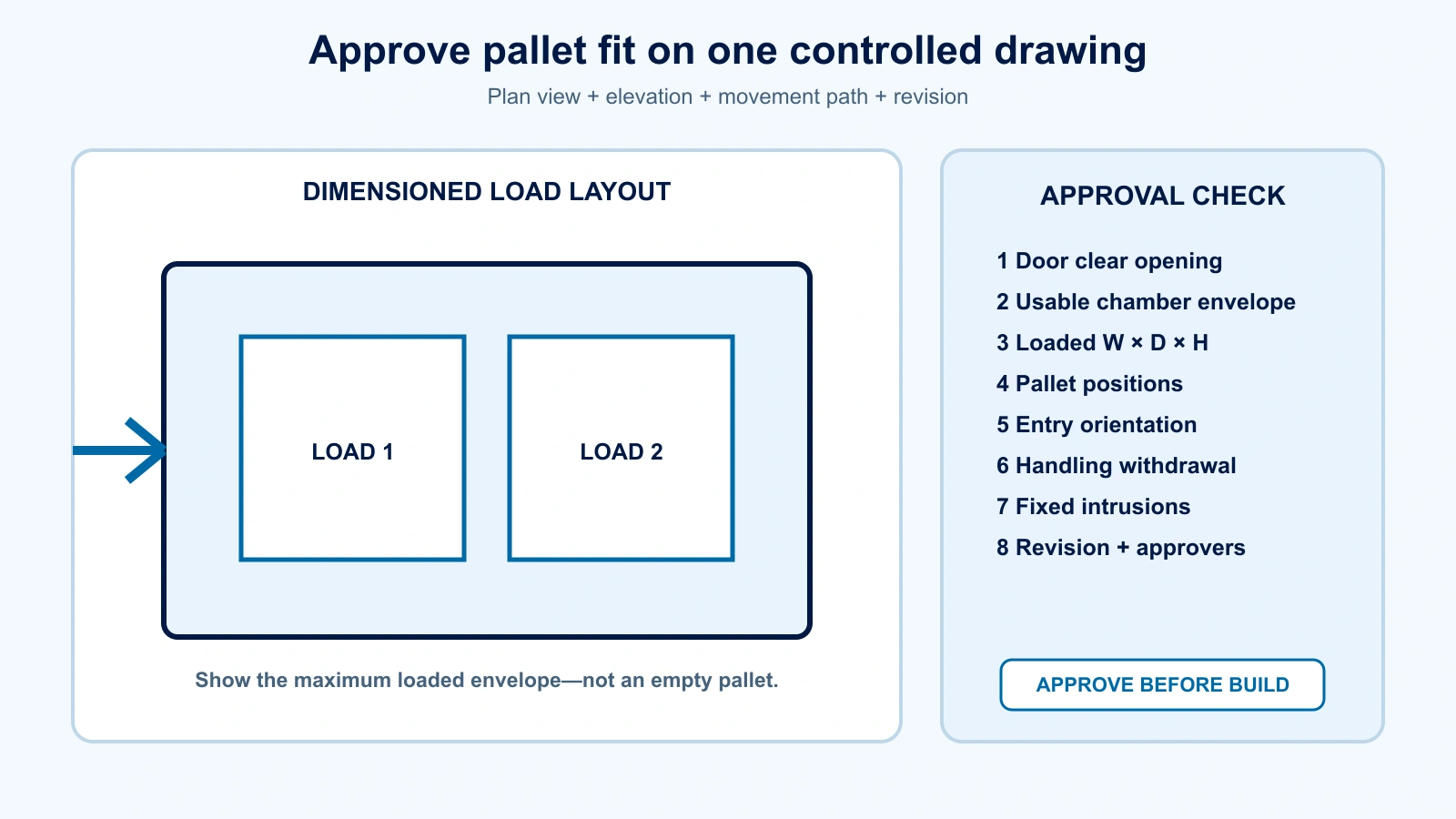
Ask for these items:
- door clear opening width and height;
- usable chamber width, depth and height;
- numbered pallet or trolley positions;
- loaded envelope drawn at the approved maximum;
- entry orientation and movement arrows;
- planned gaps between loads and fixed surfaces;
- threshold, ramp, rail, guide and floor details;
- location of seals, sensors and other vulnerable intrusions;
- maximum load mass and the chamber-floor design condition;
- revision number, date and named approvers.
If the unit has two doors, show both loading faces and the full pass-through path. If it uses a sliding or vertical-lift door, confirm the opening available in the normal locked-open position. Door motion, loading direction and chamber capacity are related decisions but not the same decision.
Run a Physical Fit Trial Before Final Sign-Off
Where practical, reproduce the maximum load with the actual pallet, crates, packaging restraints and handling equipment. A factory or site dry run can reveal details that two-dimensional drawings miss:
- fork tips or pallet-jack wheels crossing a threshold poorly;
- the mast or load backrest approaching the door frame;
- film catching on hardware;
- insufficient sight lines for final positioning;
- the load fitting straight but not during a correction movement;
- the operator being unable to withdraw the handling device cleanly;
- the planned gap disappearing when cartons bulge.
Record the test object, dimensions, mass, photographs, drawing revision and result. “We tried a pallet” is not traceable acceptance evidence. If the final production packaging is unavailable, identify the trial as provisional and define what must be rechecked before shipment.
Put These Questions in the RFQ
- What pallet and trolley footprints were used to define the quoted capacity?
- Does the stated capacity use nominal pallet bases or maximum loaded envelopes?
- What is the clear door opening in the normal operating position?
- What is the usable—not merely internal—chamber envelope?
- Which fixed components reduce the available space?
- Which load orientation was used in the layout?
- What gaps and handling allowances are shown, and which party approves them?
- Can every load in the compatibility matrix be processed at the quoted batch capacity?
- What floor load and maximum batch mass were used for design?
- What physical loading trial, drawing or measurement record will be supplied before dispatch?
These questions also belong in the commercial package. Our article on detailed vacuum-cooler quotations explains why assumptions, inclusions and acceptance evidence should be visible before the purchase order.
Send the Load Data Before Choosing the Chamber
For a project-specific pallet-fit review, send Allcold the pallet or trolley types, maximum loaded dimensions and mass, photographs, product and packaging list, entry orientation, handling equipment, target batch capacity and site layout. We can compare those loads with the door opening, usable chamber envelope and proposed pallet positions before the design is frozen.
Discuss your pallet and chamber requirements View fresh-produce systems
Frequently Asked Questions
Is the nominal pallet size enough to select a vacuum cooler?
No. It establishes the base format, but the supplier also needs maximum loaded width, depth, height and mass, entry orientation, packaging projections and handling method.
Are internal chamber dimensions the same as usable dimensions?
Not necessarily. The door throat, seals, guides, rails, thresholds, sensors or other fixed details may reduce the space that a load can pass through or occupy. Ask for both clear opening and usable envelope dimensions.
Should the load be packed tightly to maximize batch capacity?
Do not assume that the tightest geometric arrangement is the best operating arrangement. The supplier should define the planned gaps and positions using the actual product, packaging and process requirements.
Can one approved pallet represent every crop?
Only if every approved crop, package and stacking pattern stays within that same loaded envelope and operating condition. Otherwise, use a compatibility matrix and check each limiting case.
When should pallet fit be approved?
Before chamber manufacture and again when the final general-arrangement drawing is issued. Recheck if the pallet, packaging, load height, handling equipment or capacity plan changes.
References
- International Organization for Standardization. ISO 6780:2003 — Flat pallets for intercontinental materials handling: principal dimensions and tolerances. Accessed 1 September 2026.
- European Pallet Association e.V. Load carriers overview. Accessed 1 September 2026.
- U.S. Occupational Safety and Health Administration. 29 CFR 1910.176 — Handling materials: general. Accessed 1 September 2026.
- Food and Agriculture Organization of the United Nations. Recommended International Code of Practice for Packaging and Transport of Fresh Fruit and Vegetables. Accessed 1 September 2026.

Mila
You May Also Like
50 Hz or 60 Hz? How to Confirm a Vacuum Cooler Will Work at Your Site
Buying a vacuum cooler for 50 Hz or 60 Hz power? Check whole-machine compatibility, auxiliaries, conversion scope and quoted performance before ordering.
Can You Move a Vacuum Cooler Between Farms for Different Harvest Seasons?
ALLCOLD · MULTI-SITE COOLING & EQUIPMENT PLANNING Sharing one cooler across two growing regions can look efficient on an annual
How Loud Is a Vacuum Cooler? Plan for Noise Before You Buy
ALLCOLD · EQUIPMENT SELECTION & SITE PLANNING A cooler can fit the available space and still be in the wrong
Air-Cooled, Water-Cooled or Evaporative: Which Vacuum Cooler Fits Your Site?
VACUUM COOLER BUYER’S GUIDE · SITE UTILITIES Three heat-rejection arrangements can mean very different utilities, maintenance and installed costs. Compare
Vacuum Cooling vs. Vacuum Packaging: Which Machine Do You Need?
ALLCOLD · EQUIPMENT SELECTION Two machines can both use a vacuum chamber and still solve completely different production problems. Before
Should You Buy a Vacuum Cooler or Use a Third-Party Cooling Service?
FARM INVESTMENT · OWNERSHIP VS. OUTSOURCING The cooling fee is easy to see. The cost of getting your harvest cooled
Can a Vacuum Cooler Work at High Altitude? A Buyer’s Guide for Farms
Buying a vacuum cooler for a high-altitude farm? Learn how altitude affects pressure readings, equipment selection and the site details your supplier needs.
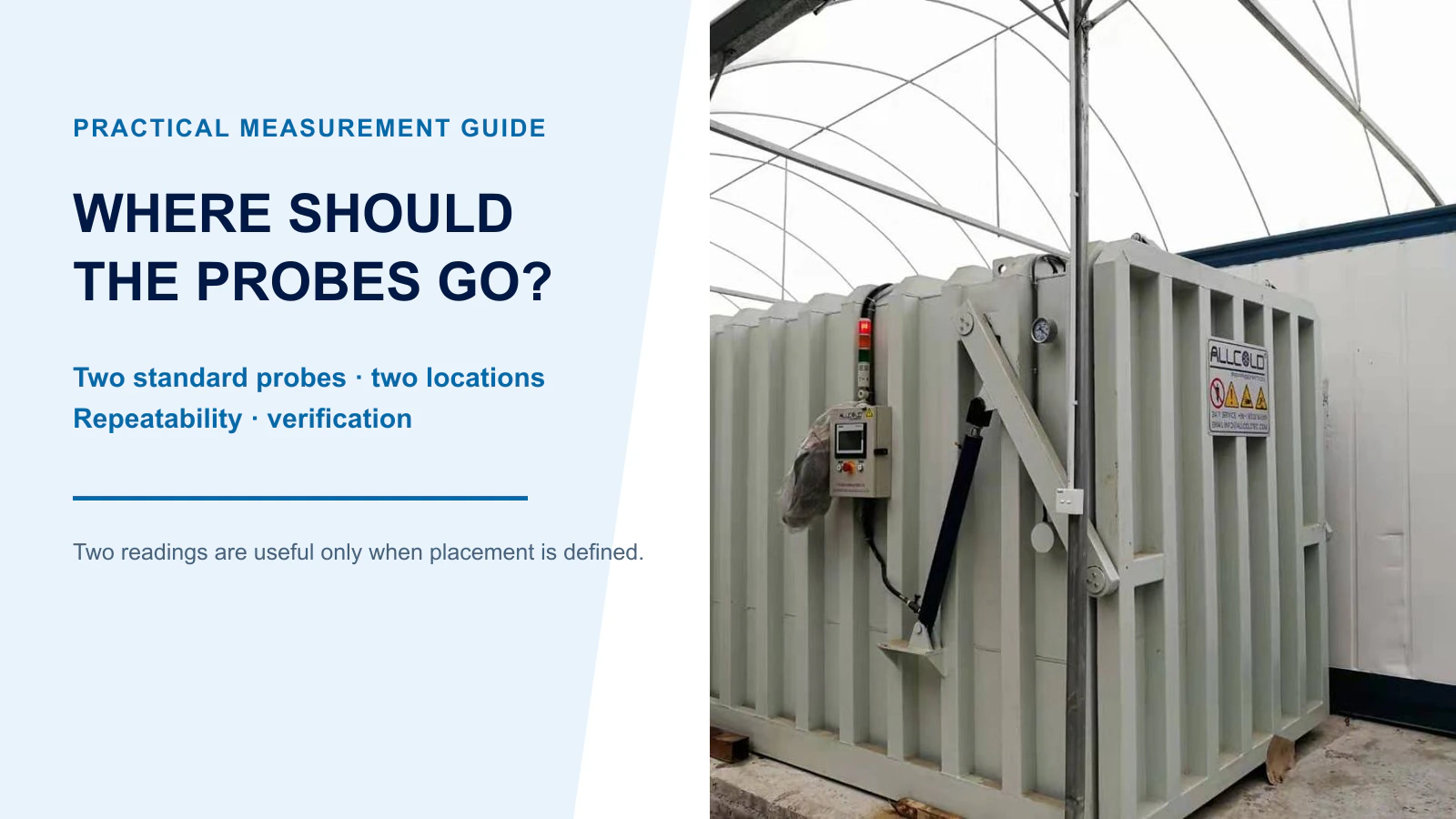
Where Should Two Product Temperature Probes Go in a Vacuum Cooler?
Learn how to place a vacuum cooler’s two standard product temperature probes, avoid false cold readings and define repeatable production locations.
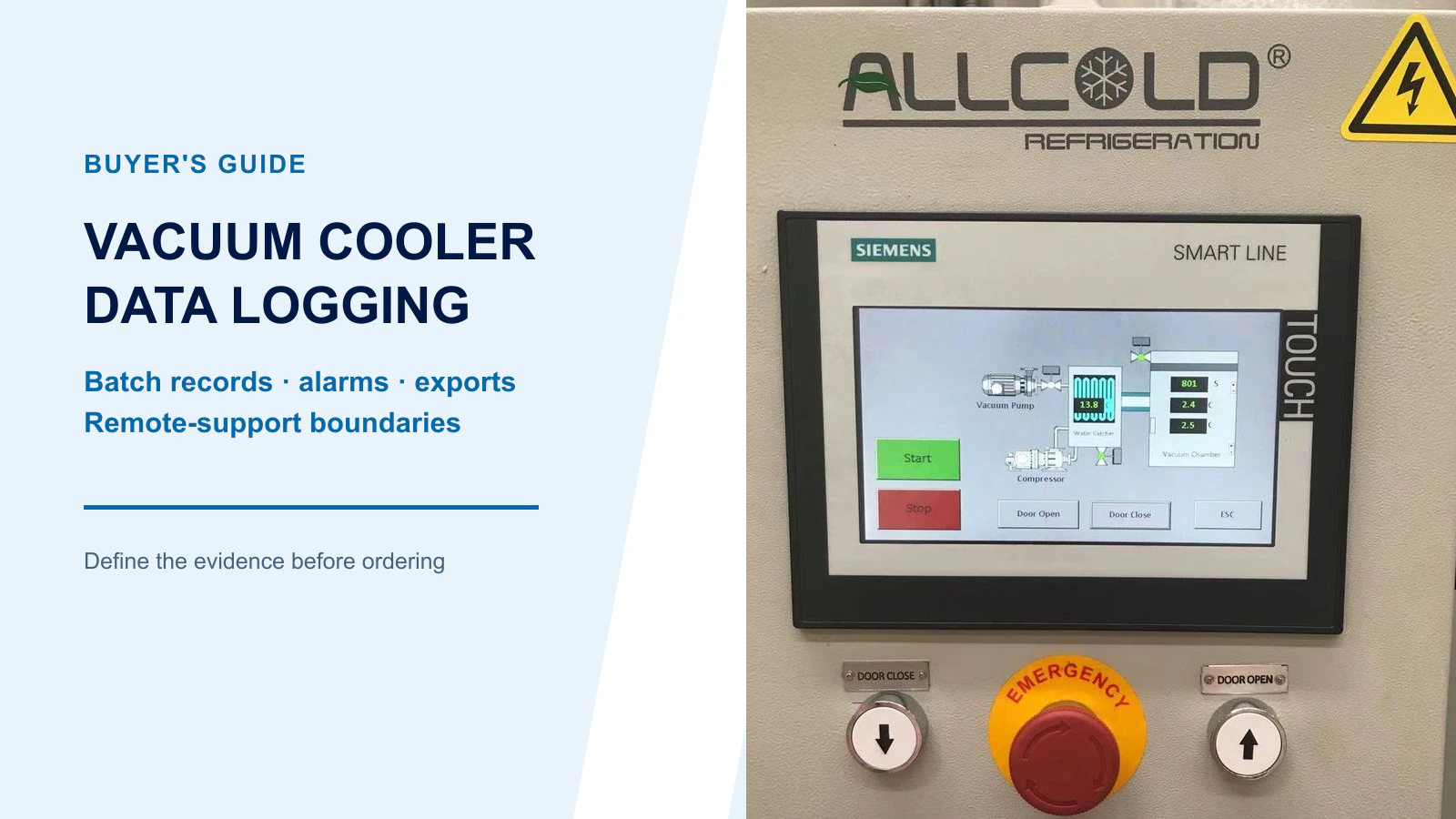
What Should a Vacuum Cooler Record? A Buyer’s Guide to Batch Data, Alarms, and Remote Support
A practical buyer’s guide to specifying vacuum cooler batch records, sensor data, alarm history, exports, backups and controlled remote support.
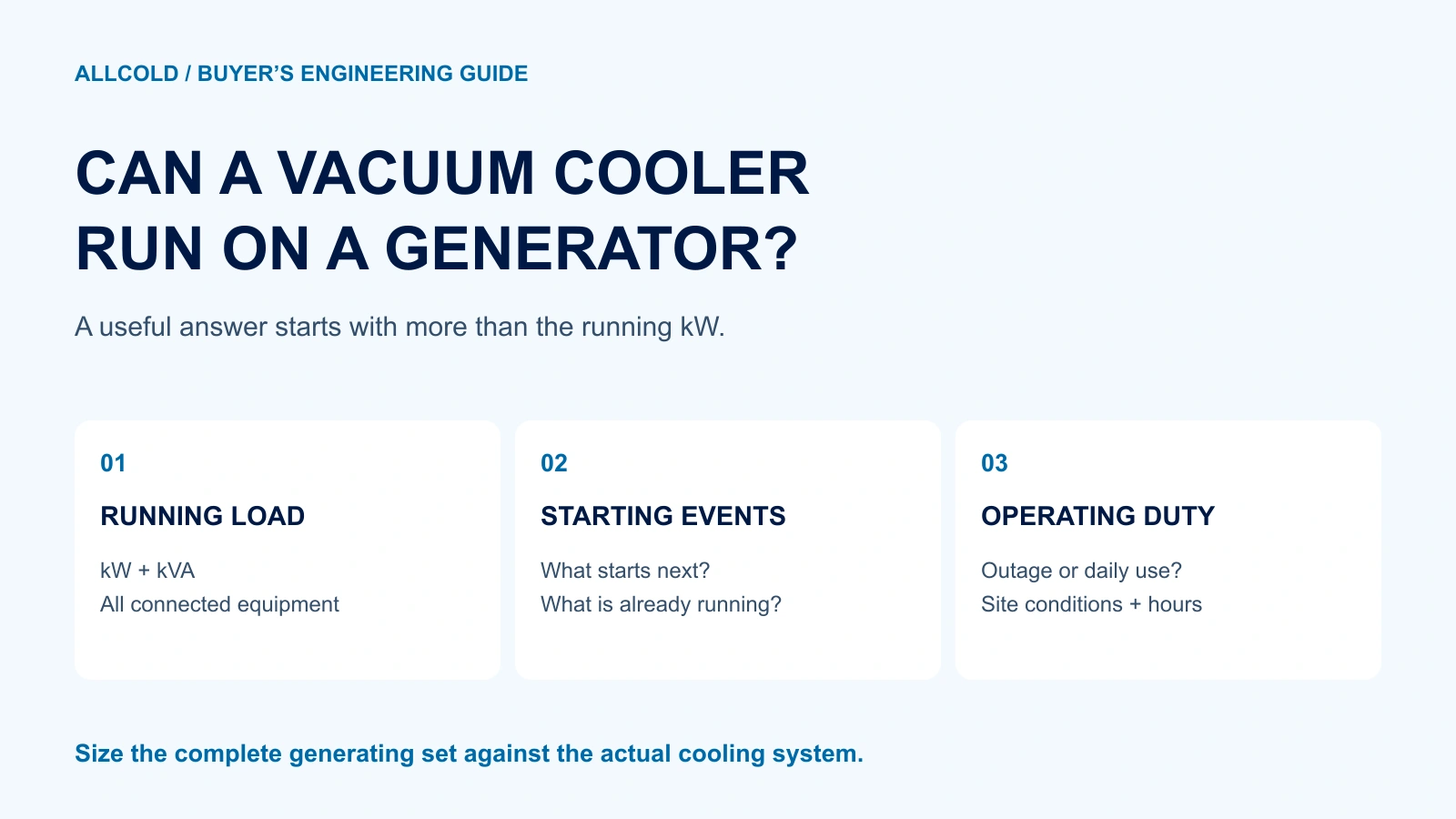
Can a Vacuum Cooler Run on a Generator? A Buyer's Guide to Sizing Beyond Running kW
A generator can have enough running power and still struggle when a vacuum cooler starts. Learn how to define the operating duty, starting events, supporting utilities and supplier responsibilities before selecting the generator set.