
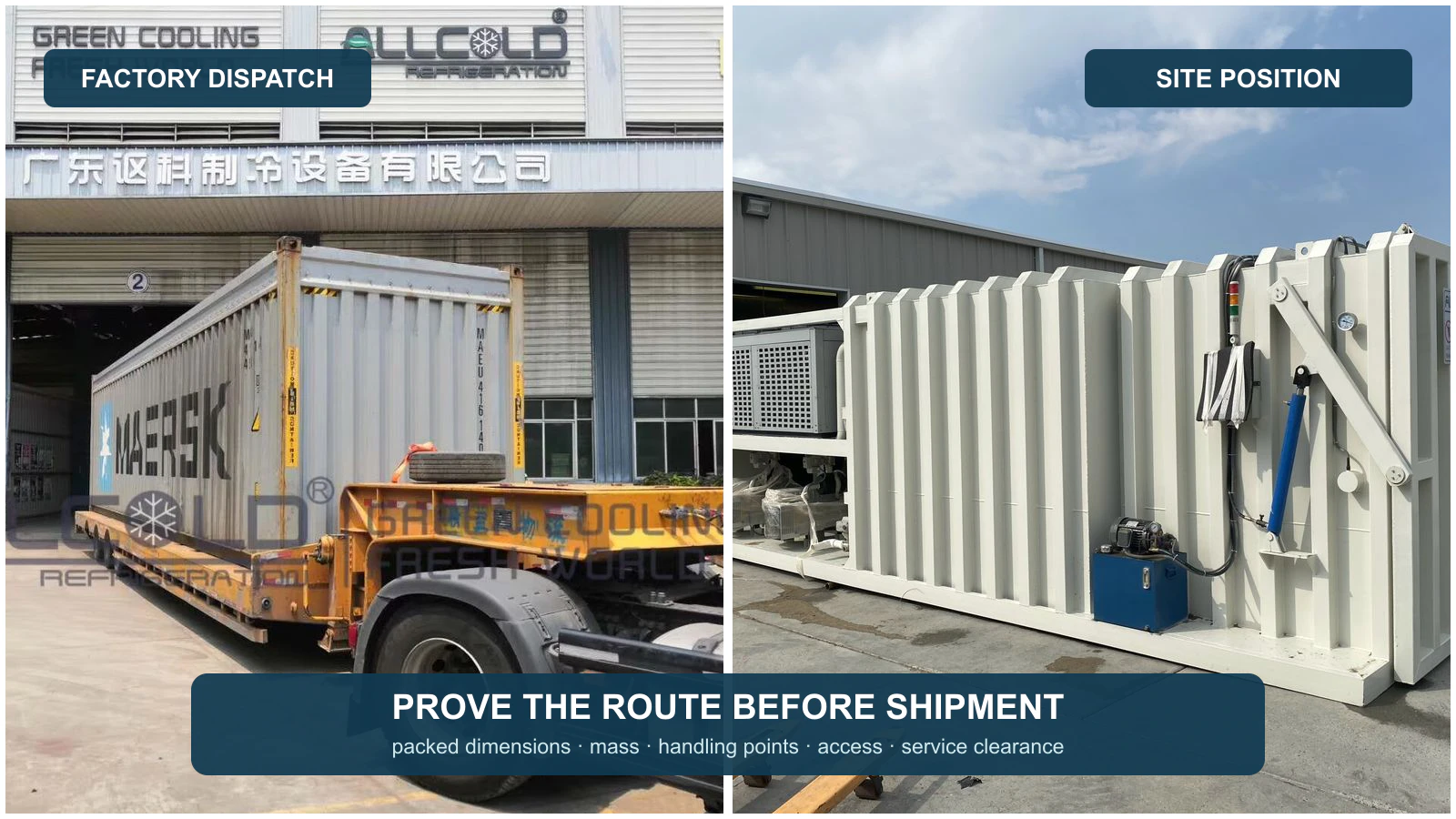
Can Your Vacuum Cooler Reach Its Final Position? A Delivery, Rigging and Installation-Access Checklist
Direct answer: confirm the delivery route before the vacuum cooler enters production—not after it reaches the destination port. The supplier should issue the shipping dimensions, gross and net mass of every module, centre-of-gravity information, approved lifting or handling points, packing arrangement and reassembly scope. The buyer should verify the unloading zone, crane or forklift capacity, gates, overhead clearances, door openings, corners, floor loading, final foundation and maintenance space. A machine that fits the process can still fail the project if its transport, rigging or service envelope does not fit the site.
Vacuum-cooler procurement often concentrates on pallets per cycle, target temperature, vacuum-system capacity and utilities. Those questions are essential, but they describe the machine after it is in position. Delivery is a separate engineering stage. A one-piece skid, a chamber shipped without its external equipment frame and a system divided into several containers can all describe the same final process capacity, yet they create completely different unloading, access, reassembly and commissioning work.
This guide is deliberately narrower than our general article on vacuum-cooler installation requirements. It focuses on the physical path between the factory and the final equipment pad. The objective is not to tell a site team how to perform a lift. That work requires a competent local planner using the actual machine data, lifting equipment, ground conditions and local rules. The objective is to make sure the planner receives usable information early enough to avoid emergency changes.
Approve Three Different Envelopes, Not One Overall Dimension
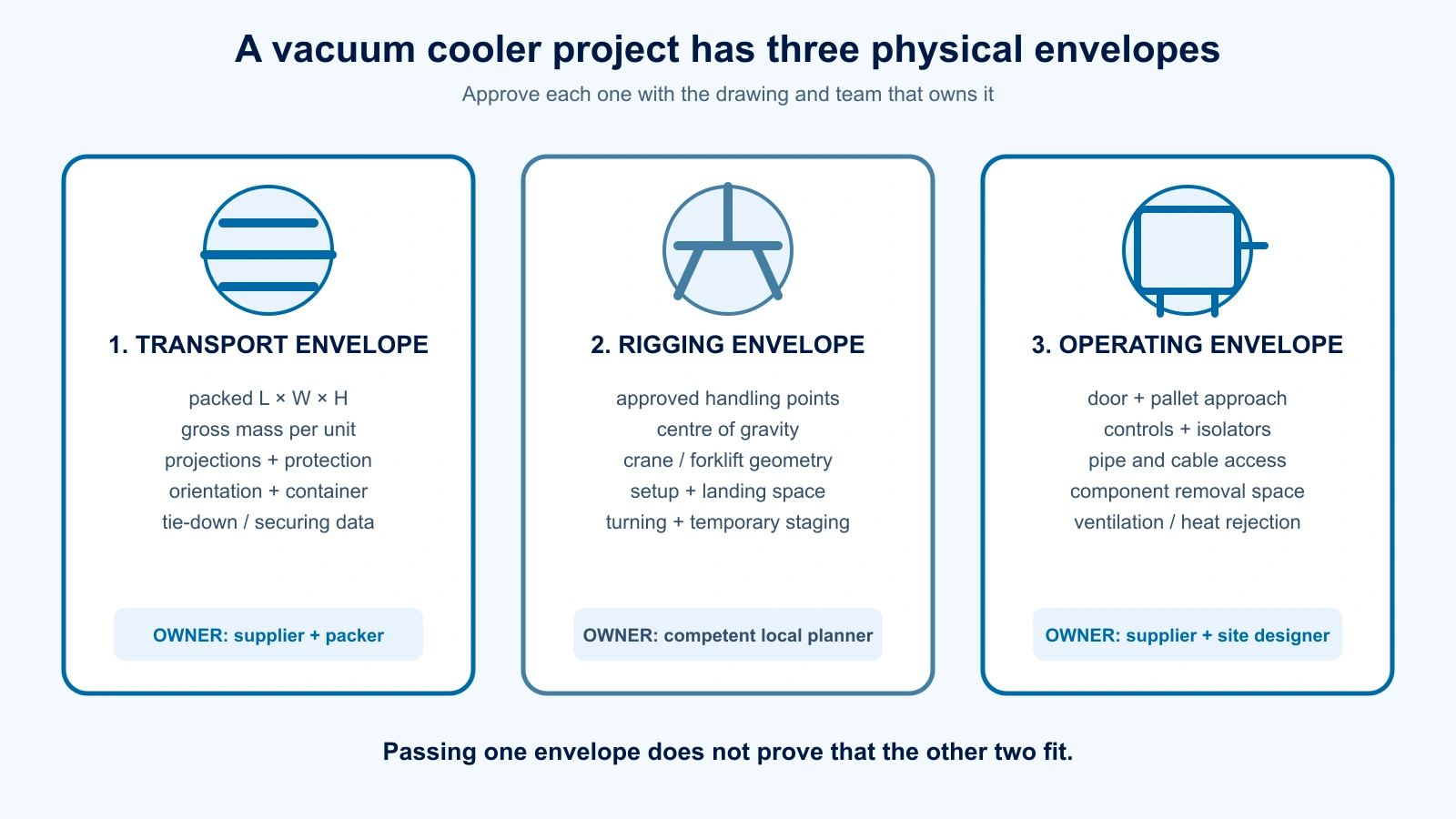
A general-arrangement drawing usually gives the final machine length, width and height. That is not enough for delivery planning. Buyers should approve three related but different envelopes:
- Transport envelope: the outside dimensions and mass of each packed shipping unit, including frames, crates, protective covers and projections that remain fitted during transport.
- Rigging envelope: the space needed to unload, lift, rotate, lower and temporarily stage each module. It depends on the selected handling method, equipment geometry and the location of verified lifting or handling points.
- Operating and service envelope: the installed machine plus door movement, pallet approach, control-panel access, removable components, pipe connections, ventilation or heat-rejection clearances and safe maintenance access.
The distinction matters when selecting machine architecture. Two smaller units may pass through a restricted access route more easily than one large chamber, but they can require more unloading operations, doors, pipe runs and service zones. Our guide comparing one large vacuum cooler with two smaller units covers the throughput and redundancy side of that decision. The delivery survey should test the physical consequences of the same alternatives.
Lock the Shipping Configuration Before the Purchase Order Is Frozen
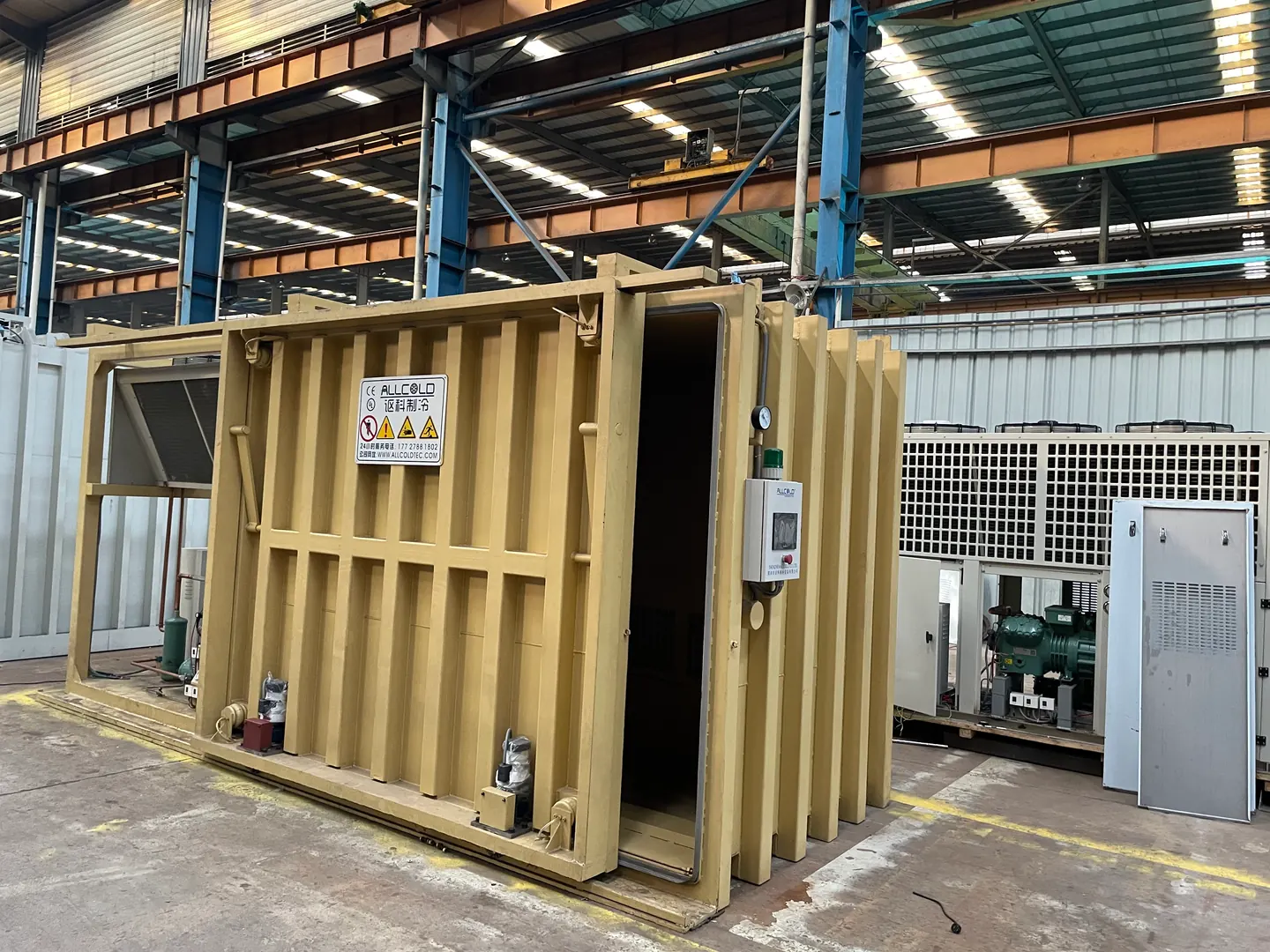
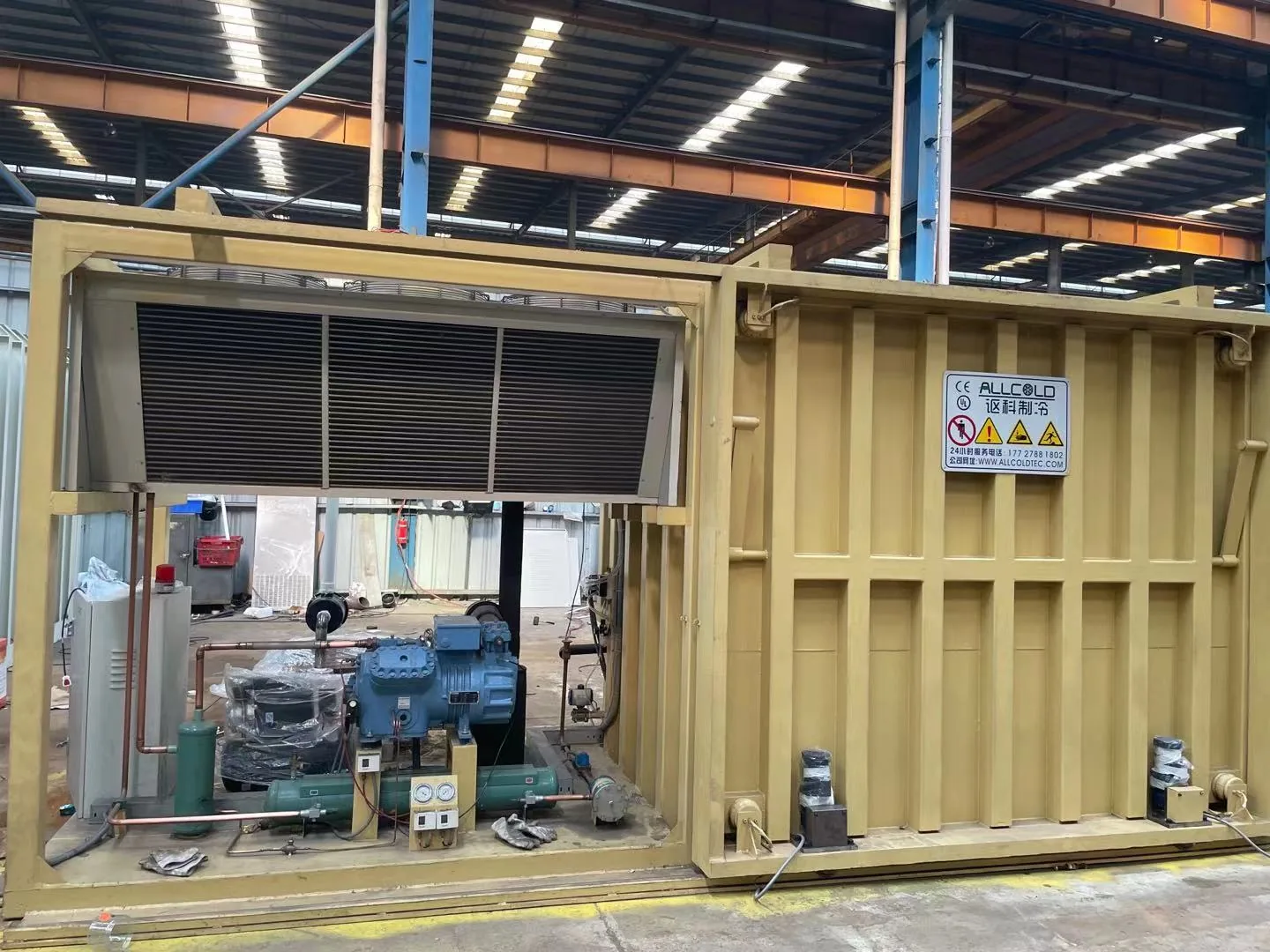
Do not assume that the dimensions shown on a sales brochure are shipping dimensions. Ask the supplier to identify every transport unit and state what is removed, protected or shipped separately. Depending on the design, the shipment may include the chamber, vacuum or refrigeration skid, condenser or heat-rejection equipment, control cabinet, loading rails, ramps, platforms, pipe assemblies and loose installation items.
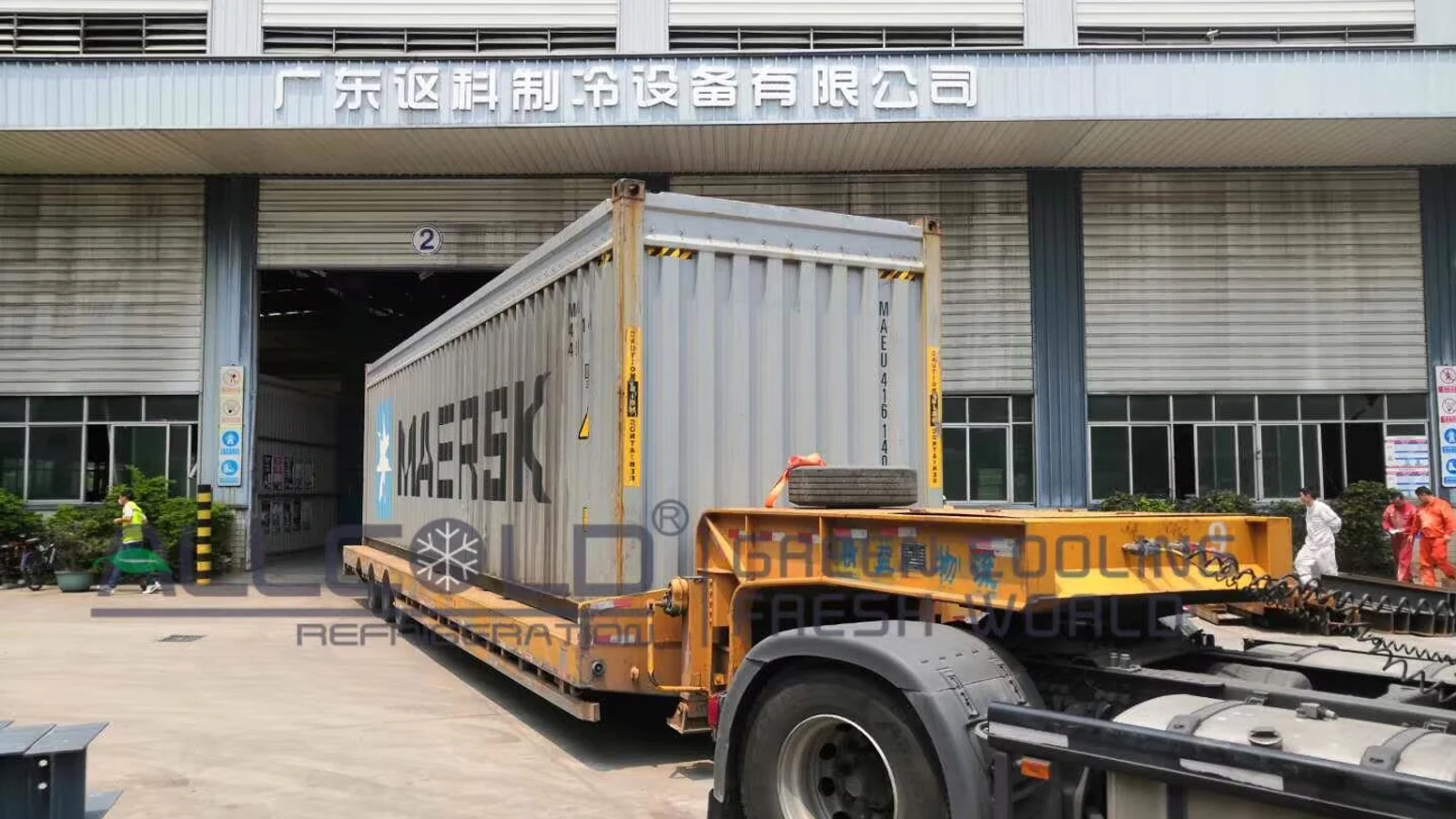
The IMO/ILO/UNECE CTU Code is a global, non-mandatory code of practice for packing and securing cargo transport units used by sea and land.1 It does not replace the supplier’s engineering drawings or the carrier’s rules, but it reinforces a useful procurement principle: packing and securing are planned activities with defined information and responsibilities, not a last-minute warehouse task.
Request a shipping schedule with at least these fields for every item:
| Required field | Why the site team needs it | Common ambiguity to remove |
|---|---|---|
| Packed length × width × height | Checks container selection, road restrictions, gates, openings and turning space | Final installed size is mistaken for shipping size |
| Net and gross mass | Supports carrier documentation and preliminary lifting-equipment selection | Machine mass excludes crate, skid, fluids or loose assemblies |
| Centre of gravity | Allows the appointed lifting planner to evaluate stability and rigging geometry | A geometric centre is assumed to be the load centre |
| Approved handling points | Separates designed lift or fork locations from visually convenient steelwork | Fork pockets, lifting lugs and tie-down points are treated as interchangeable |
| Orientation limits | Prevents a module being tilted or stored in a way not approved by the supplier | “Keep upright” is missing from drawings and package marks |
| Removed items | Defines reassembly, alignment, wiring, piping and leak-test work at site | Loose parts appear on a packing list without installation ownership |
For sea freight, the packed container’s verified gross mass is a formal shipping requirement under SOLAS. The IMO explains that the shipper is responsible for providing the verified mass in the shipping document before loading.2 The commercial contract should therefore state who supplies item weights, who packs the container, who determines the verified gross mass and who submits it to the carrier.
Survey the Route from the Truck Position to the Equipment Pad
A site survey should follow the actual delivery path in sequence. Do not stop at the factory gate or receiving door. Measure the place where the truck can stand, the unloading and crane setup zone, every gate and canopy, the narrowest door, the sharpest corner, any ramp or floor transition and the exact route to the final pad.
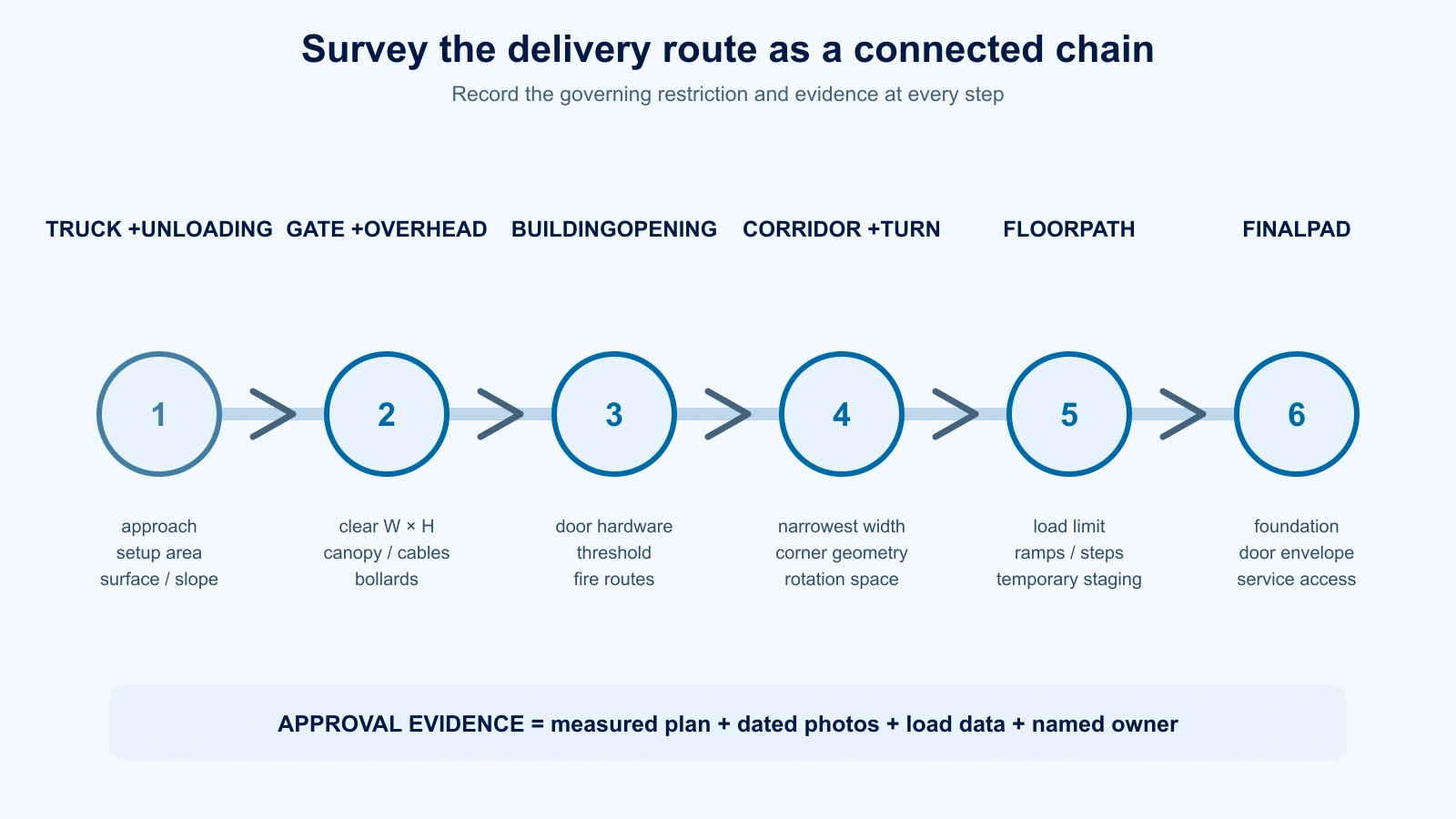
The route record should combine dimensions with dated photographs and a marked site plan. Include:
- truck type, approach direction, reversing space and any time or axle restrictions;
- unloading-zone length, width, slope, surface condition and underground services;
- gate width and height after hinges, guards, bollards and door hardware are considered;
- overhead cables, canopies, sprinklers, pipes, lighting, beams and temporary structures;
- corridor width, corner geometry and whether the load must rotate;
- floor steps, dock plates, ramps, thresholds and permitted floor loading;
- temporary staging space for modules that cannot move directly to the final position;
- escape routes, production traffic and areas that cannot be blocked during delivery.
A clearance calculation should use the packed transport unit—not the final chamber—and include a project-specific handling allowance set by the delivery planner. There is no universal “add 100 mm” rule. The required margin changes with load length, handling method, steering geometry, sight lines, surface quality and the consequence of contact.
Route acceptance is a chain:
truck access → unloading setup → gate → external obstructions → building opening → internal turns → floor path → final pad
If one link is unverified, the delivery route is not yet approved.
For projects where the machine will remain outside, the route check should connect directly to drainage, weather protection, heat rejection and utility routing. See our separate outdoor vacuum-cooler site-planning guide for those installed-condition issues.
Match the Unloading Method to the Actual Load and Load Centre
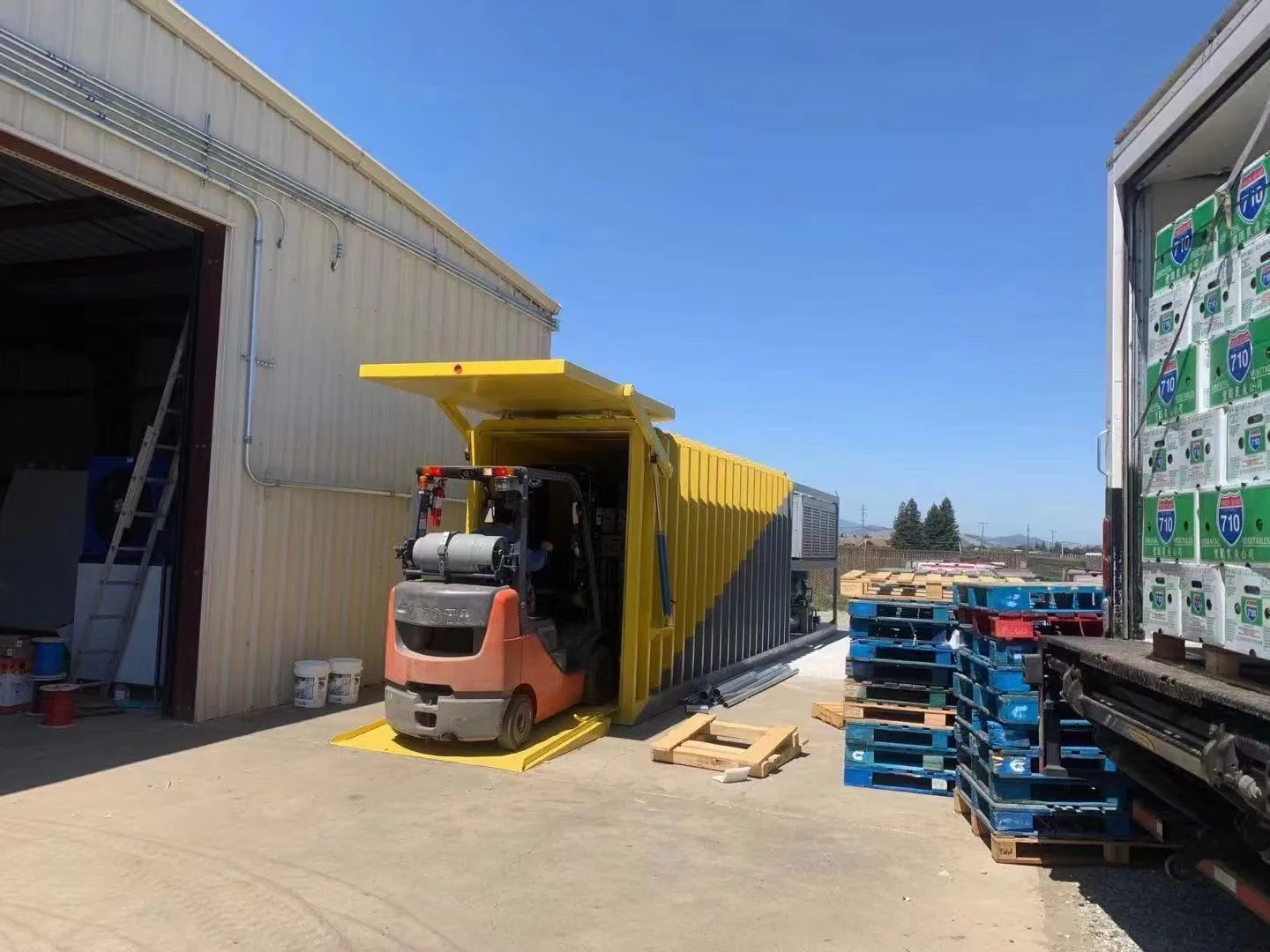
“A forklift is available” is not an unloading plan. Forklift capacity depends on the machine’s rated configuration and the real load centre. A long vacuum-cooler module may place its centre of gravity much farther from the fork face than the capacity plate’s reference load centre. Attachments, fork extensions, uneven ground and restricted visibility can change the evaluation again.
OSHA’s powered-industrial-truck rule states that only loads within the truck’s rated capacity may be handled, and its stability appendix explains why unusual or long loads require attention to the actual load moment.3 Those US requirements are not universal project law, but the engineering lesson travels well: never approve a forklift from tonnage alone. Give the local material-handling specialist the gross mass, load dimensions, centre of gravity and intended pick position.
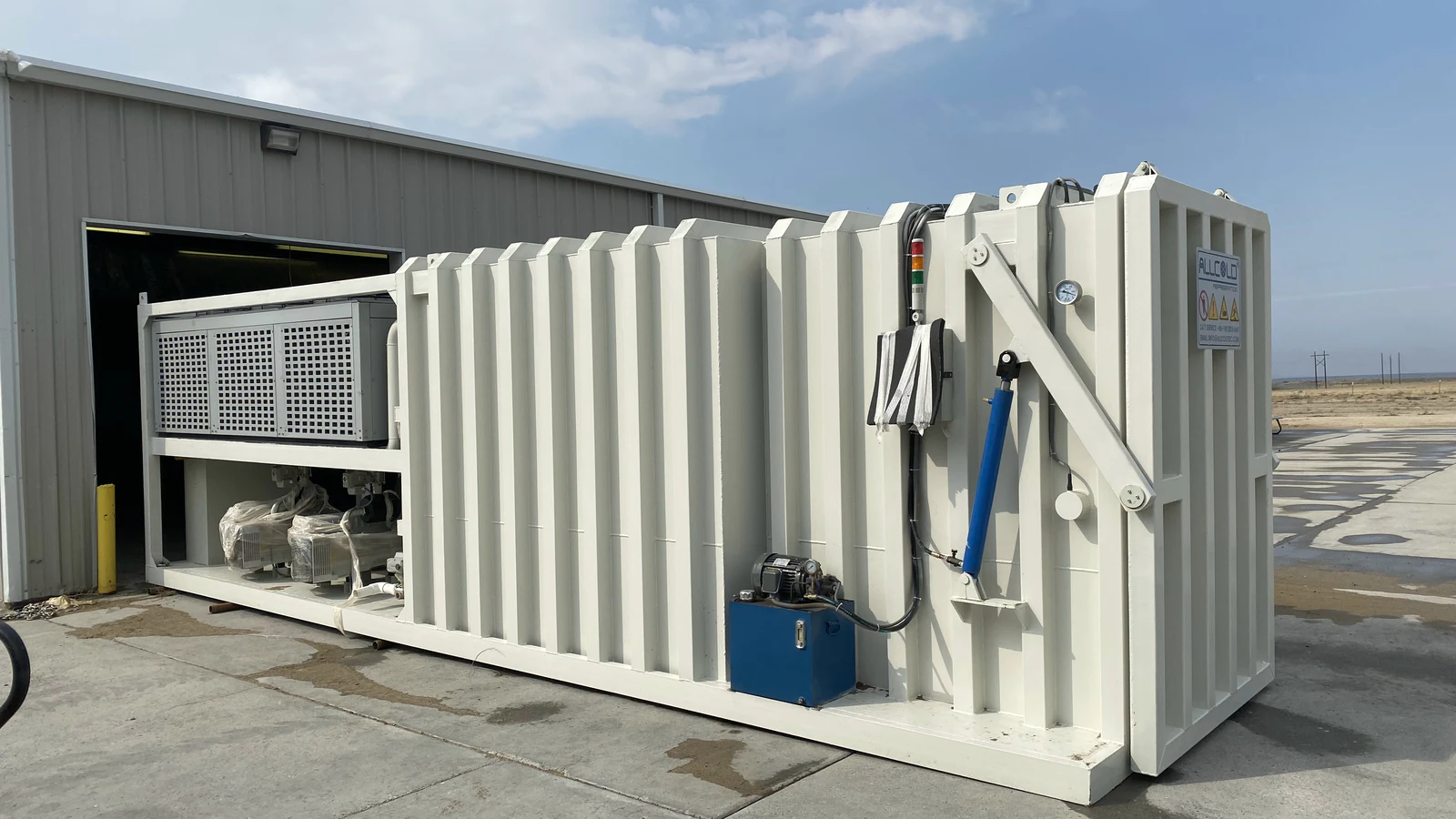
Crane selection likewise depends on more than the load mass. The planner needs the working radius, boom configuration, setup area, ground support, overhead hazards, wind limits and the path from the landing point to the foundation. The UK’s HSE states that lifting operations should be properly planned by a competent person, appropriately supervised and carried out safely; the level of planning should reflect the complexity of the operation.4
The supplier should identify approved lifting or handling points and provide their purpose. The local lift planner then selects the lifting equipment and rigging arrangement. OSHA’s sling rule, for example, requires slings to remain within rated capacity, be securely attached and be protected from sharp load edges.5 A machine drawing cannot replace the planner’s lift plan, and a lift plan cannot invent lifting points that the manufacturer has not approved.
Do Not Trade Delivery Clearance for Operating Problems
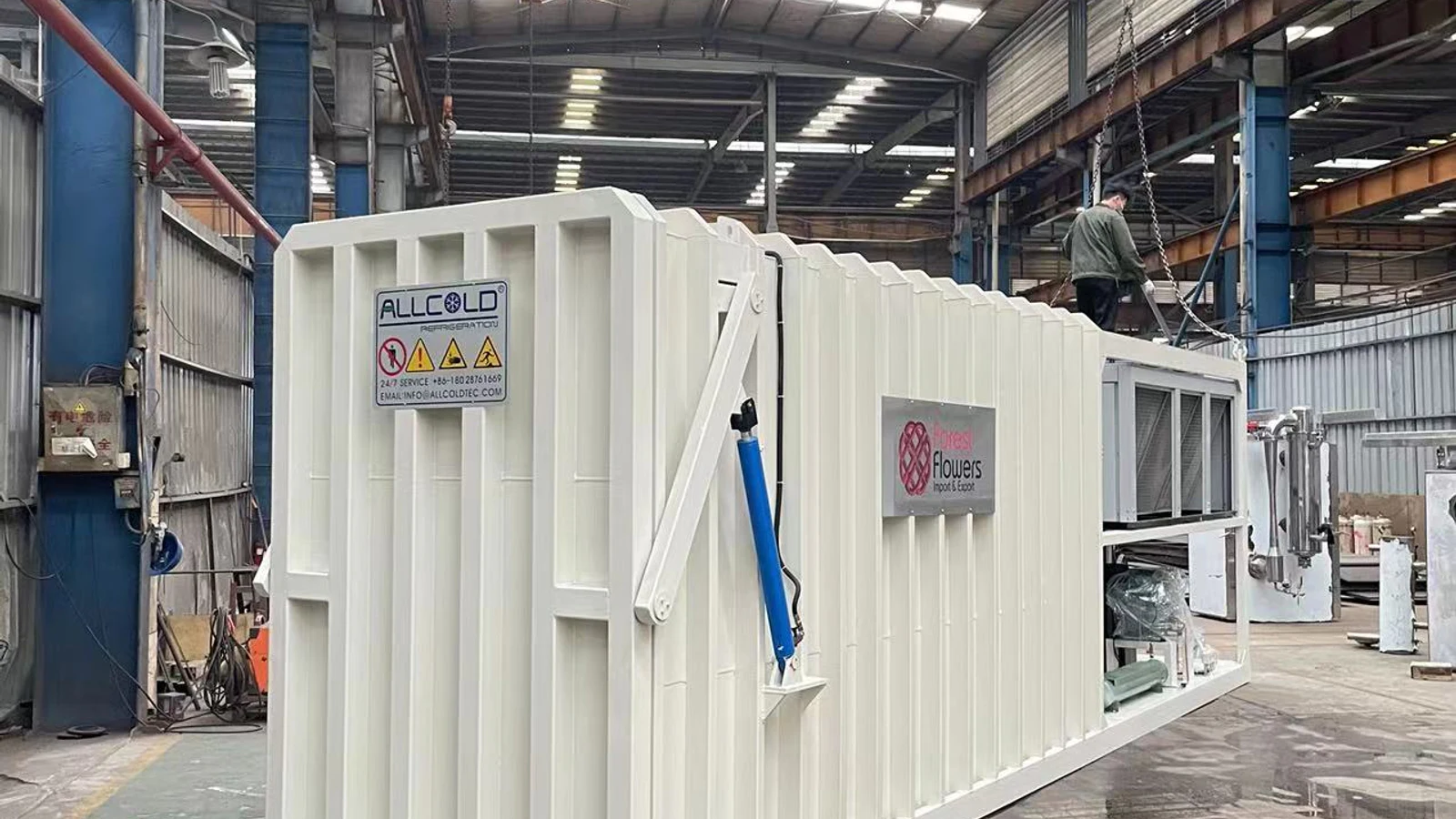
Moving the chamber through the door is not the finish line. A site team under delivery pressure may be tempted to place the equipment wherever it physically lands. That can block pallet traffic, reduce door clearance, prevent component removal or force technicians to work in an impractical space.
Overlay the final general-arrangement drawing on the real room and check:
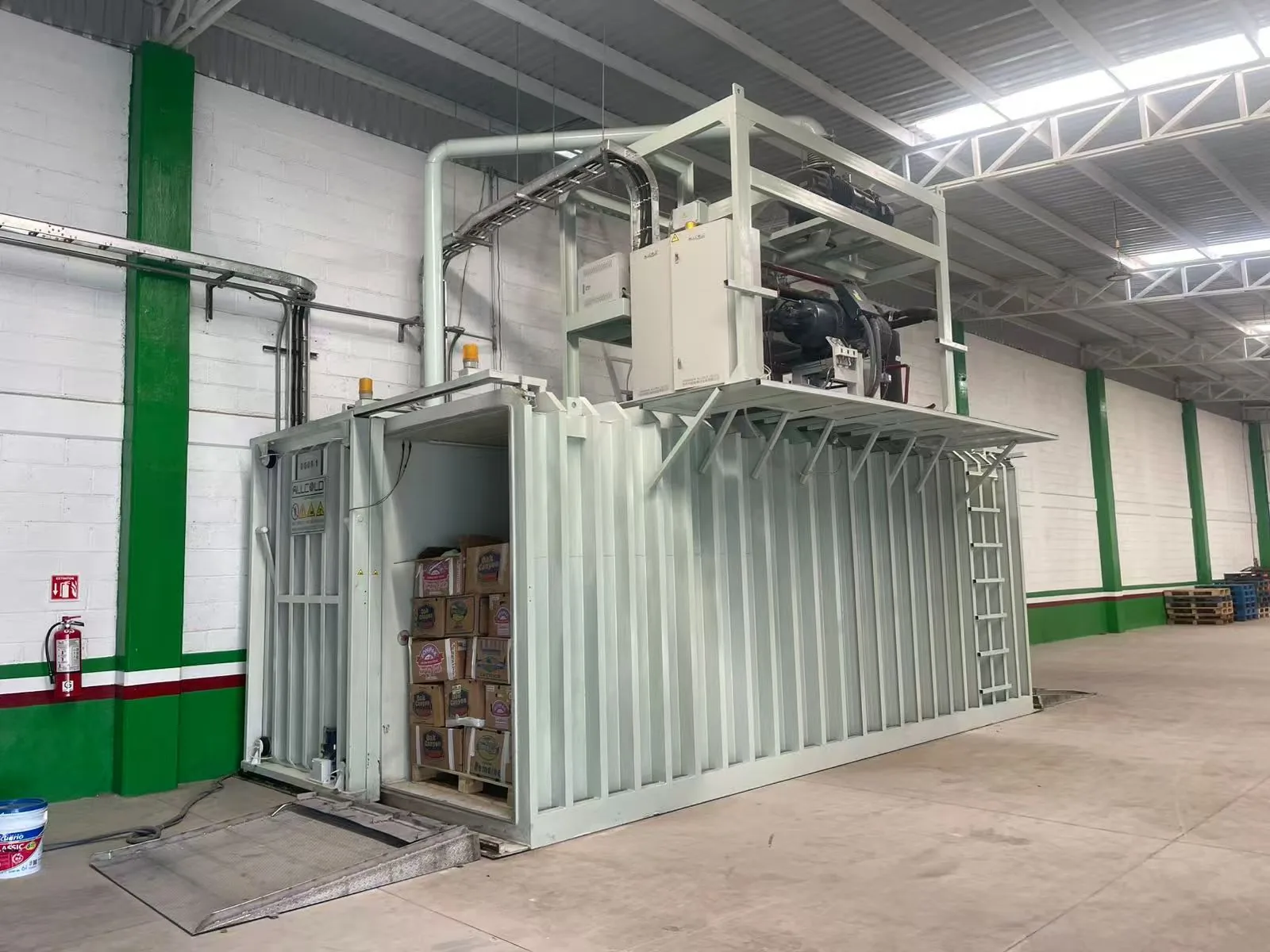
- door motion and pallet approach: an outward-opening hydraulic door, horizontal sliding door and vertical-lift door create different swept and parked envelopes; see the vacuum-cooler door selection guide;
- loading rails and ramps: confirm level differences, forklift turning, pallet staging and pass-through direction;
- control access: doors, isolators and emergency controls should remain visible and reachable in the installed layout;
- service extraction: reserve the space required to remove motors, pumps, heat exchangers, valve assemblies or filters using the supplier’s maintenance method;
- pipe and cable routes: keep utility connections from crossing access lanes or occupying the component-removal path;
- heat rejection and ventilation: installed clearances should follow the project design and equipment documentation, not a generic distance copied from another machine.
The vacuum cooler is part of a wider material-flow system. A technically correct final position can still create queues if warm pallets, cooled pallets and forklifts cross each other. Review the packing-house layout and throughput guide before approving the pad location.
Create One Delivery Responsibility Matrix
Many delivery disputes are not caused by missing equipment; they are caused by two parties assuming the other party owns the same task. Put the boundary in writing before dispatch.
| Deliverable or task | Typical information owner | Acceptance evidence |
|---|---|---|
| Module drawings, mass, centre of gravity and approved handling points | Vacuum-cooler supplier | Controlled shipping drawing with revision |
| Packing method and container loading plan | Supplier / nominated packer | Packing list, package marks and loading records |
| Carrier equipment and transport restrictions | Freight forwarder / carrier | Booking details and route or permit confirmation where required |
| Destination route survey and final pad readiness | Buyer / site contractor | Measured route plan, photographs and signed site-readiness check |
| Local lifting and unloading plan | Competent local lifting contractor | Approved plan using actual load and site data |
| Reassembly, connection and alignment | Defined in contract | Method statement and completion record |
| Post-positioning inspection | Supplier and buyer roles defined | Damage, level, alignment and completeness checklist |
Incoterms or a freight quotation may allocate cost and risk, but they do not automatically provide a technical unloading method or prove that the equipment can reach its pad. The detailed quotation should name technical deliverables as well as commercial boundaries. Our article on detailed vacuum-cooler quotations explains how to make those assumptions visible.
Delivery Questions to Put in the RFQ
Ask every bidder to answer the same questions so the comparison includes site work rather than hiding it:
- Will the machine ship as one skid, several modules or a partly disassembled system?
- What are the packed dimensions, net mass and gross mass of every shipping unit?
- Which drawing marks the centre of gravity and approved lifting, fork-handling and tie-down points?
- What container or transport arrangement is assumed, and who owns packing and cargo securing?
- Which components are removed for shipment, and what reassembly, wiring, piping, charging, insulation or testing is required at site?
- What final operating clearances, door envelopes and maintenance-removal spaces must the buyer reserve?
- What foundation, anchoring, levelness and floor-loading information will be issued before site work begins?
- Who performs the destination route survey, unloading plan, lift plan and final positioning?
- What site-readiness evidence must be approved before dispatch?
- How will transport damage, missing parts and deviations be recorded on arrival?
Practical approval gate: do not release shipment only because the machine passed factory checks. Release it when the packing list, shipping drawings, site route, unloading plan, foundation readiness and responsibility matrix refer to the same equipment revision.
Frequently Asked Questions
Can the supplier choose the crane or forklift for the buyer?
The supplier can provide the machine data and may recommend handling concepts, but the destination equipment should be selected by a competent local planner who knows the real site, ground, reach, access and legal requirements.
Is overall machine weight enough to select a forklift?
No. The packed dimensions, actual load centre, centre of gravity, pick position, attachment, travel surface and the truck’s rated configuration all matter. Long loads can create a larger overturning moment than a compact load of the same mass.
Should the machine be shipped in one piece?
Not automatically. One-piece shipment can reduce field assembly, but it may require heavier handling equipment or a larger route. Modular shipment can improve access while increasing site connections, alignment and testing. Compare total project risk, not only container count.
How much clearance should be added around the packed machine?
There is no universal allowance. The delivery planner should set it from the handling method, load geometry, turning requirement, sight lines, surface and consequences of contact. The supplier should provide exact packed dimensions; the site team should not estimate the machine envelope from a photograph.
What should be checked immediately after positioning?
Record visible transport damage, package and loose-item completeness, skid level and location, door and frame condition, protected pipe or cable ends, removed shipping braces and any deviation from the approved arrangement. Connection and commissioning work should follow the agreed project procedure.
References
- UNECE — IMO/ILO/UNECE Code of Practice for Packing of Cargo Transport Units. Global non-mandatory guidance for packing and securing cargo transport units. Accessed 26 August 2026.
- International Maritime Organization — Verification of the Gross Mass of a Packed Container. SOLAS verified-gross-mass requirements and shipper responsibility. Accessed 26 August 2026.
- US OSHA 29 CFR 1910.178 — Powered Industrial Trucks and Appendix A — Stability of Powered Industrial Trucks. Rated capacity, training and load-centre considerations. Accessed 26 August 2026.
- UK Health and Safety Executive — Lifting Operations and Lifting Equipment Regulations and Planning and Organising Lifting Operations. Competence, planning and supervision principles. Accessed 26 August 2026.
- US OSHA 29 CFR 1910.184 — Slings. Rated capacity, secure attachment, protection and inspection requirements. Accessed 26 August 2026.
Regulatory sources above illustrate widely useful planning principles but do not replace the laws, carrier rules, engineering review or lifting plan applicable at the project location.
Send the Site Route Before the Machine Is Packed
Allcold can use your pallet format, required capacity, site plan, access photographs and destination constraints to discuss a practical vacuum-cooler arrangement. Early route information helps align chamber configuration, shipping split and site responsibilities before dispatch.

Mila
You May Also Like
50 Hz or 60 Hz? How to Confirm a Vacuum Cooler Will Work at Your Site
Buying a vacuum cooler for 50 Hz or 60 Hz power? Check whole-machine compatibility, auxiliaries, conversion scope and quoted performance before ordering.
Can You Move a Vacuum Cooler Between Farms for Different Harvest Seasons?
ALLCOLD · MULTI-SITE COOLING & EQUIPMENT PLANNING Sharing one cooler across two growing regions can look efficient on an annual
How Loud Is a Vacuum Cooler? Plan for Noise Before You Buy
ALLCOLD · EQUIPMENT SELECTION & SITE PLANNING A cooler can fit the available space and still be in the wrong
Air-Cooled, Water-Cooled or Evaporative: Which Vacuum Cooler Fits Your Site?
VACUUM COOLER BUYER’S GUIDE · SITE UTILITIES Three heat-rejection arrangements can mean very different utilities, maintenance and installed costs. Compare
Vacuum Cooling vs. Vacuum Packaging: Which Machine Do You Need?
ALLCOLD · EQUIPMENT SELECTION Two machines can both use a vacuum chamber and still solve completely different production problems. Before
Should You Buy a Vacuum Cooler or Use a Third-Party Cooling Service?
FARM INVESTMENT · OWNERSHIP VS. OUTSOURCING The cooling fee is easy to see. The cost of getting your harvest cooled
Can a Vacuum Cooler Work at High Altitude? A Buyer’s Guide for Farms
Buying a vacuum cooler for a high-altitude farm? Learn how altitude affects pressure readings, equipment selection and the site details your supplier needs.
Where Should Two Product Temperature Probes Go in a Vacuum Cooler?
Learn how to place a vacuum cooler’s two standard product temperature probes, avoid false cold readings and define repeatable production locations.
What Should a Vacuum Cooler Record? A Buyer’s Guide to Batch Data, Alarms, and Remote Support
A practical buyer’s guide to specifying vacuum cooler batch records, sensor data, alarm history, exports, backups and controlled remote support.
Will Your Pallets Actually Fit? How to Specify the Usable Chamber Size of a Vacuum Cooler
A pallet count does not prove the real production load will fit. Learn how to define the loaded-pallet envelope, door throat, usable chamber space, handling path and drawing-approval evidence before ordering a vacuum cooler.