
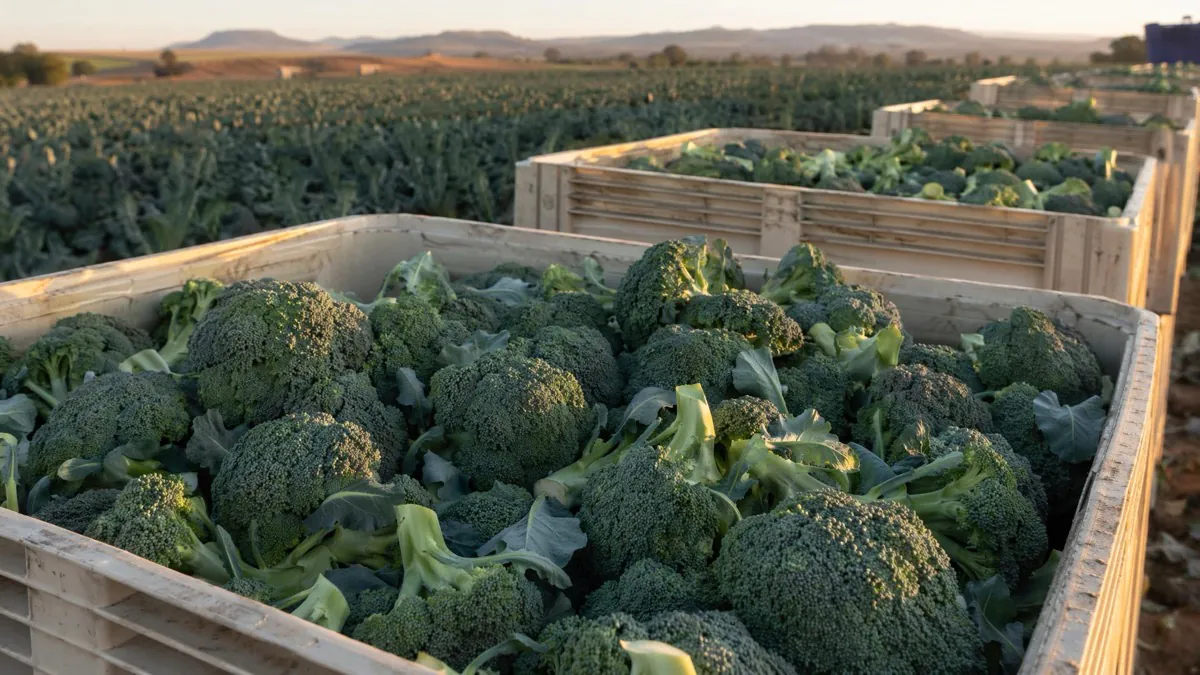
Why Broccoli Loses Export Quality Faster Than Any Temperature Log Will Show
The complaint comes in from the buyer: yellowing, premature flowering, weak texture on arrival. The exporter reviews the cold room records, checks the transport temperature log, and finds nothing obviously wrong. The numbers looked fine the whole way. The broccoli still failed.
This is one of the most frustrating patterns in fresh broccoli export, and it has a consistent cause that most temperature logs are structurally unable to capture: the broccoli was generating its own heat long before any measurement was taken, and the cold room was never going to overcome it.
Broccoli is not passive cargo. It is a living product with one of the highest respiration rates of any commercial vegetable. After harvest, it produces heat continuously — not from the outside environment, but from inside the florets and stem. A pallet of broccoli that has not been adequately pre-cooled is not simply a pallet that is too warm. It is a pallet that is actively heating itself from within, and will continue to do so inside your cold room, inside your refrigerated truck, and across the entire export journey.
That is the insight most broccoli export operations learn only after several seasons of complaints they could not explain: the cold chain does not fail broccoli. Broccoli fails the cold chain — when it arrives at the cold room still carrying the field heat and respiratory heat it should have lost before it got there.
Broccoli Generates More Heat Per Kilogram Than Almost Any Vegetable You Export
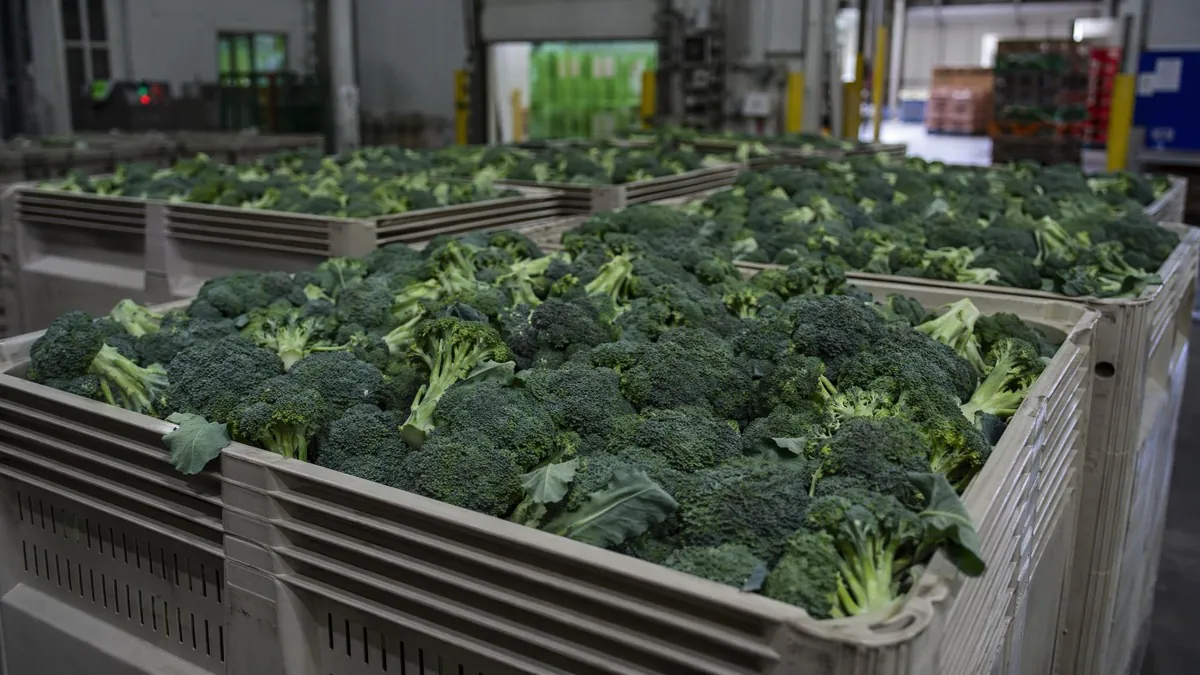
Most exporters understand that broccoli needs to be kept cold. Fewer understand how actively broccoli works against that goal from the moment it is harvested.
The respiration rate of broccoli at typical harvest temperatures sits among the highest of any commercially exported vegetable. At 20°C, broccoli respires at a rate roughly 10 to 20 times higher than it does at 0°C. That respiration process generates heat. The product is not just absorbing ambient temperature — it is producing thermal energy from within, and that production does not stop simply because a cold room door closes.[^1]
In practical terms, a pallet of freshly harvested broccoli that has not been pre-cooled will continue warming its immediate environment even after entering cold storage. The cold room must first overcome the product’s own heat output before it can begin actually reducing the product temperature. For a small quantity of product in a large cold room, this may be manageable. For a full cold room loaded with warm broccoli, it can mean that the product temperature barely falls — or even rises — for the first hours after loading.
This is not a cold room malfunction. It is physics. And it is why the temperature log that shows “cold room maintained at 2°C” can be entirely accurate while the broccoli inside was never close to 2°C for most of the time it appears on that record.
The Temperature Log Shows the Air. It Does Not Show What the Floret Was Doing.
This is where most broccoli export quality investigations go wrong.
When a destination complaint arrives, the exporter pulls the cold room log, the reefer data, the transit record. The numbers are in range. The conclusion is that the product must have been damaged after the exporter’s responsibility ended, or that the buyer’s cold chain failed, or that this was an unusual transit event.
In many cases, that conclusion is wrong — not because the logs were falsified, but because the logs measured the wrong thing.
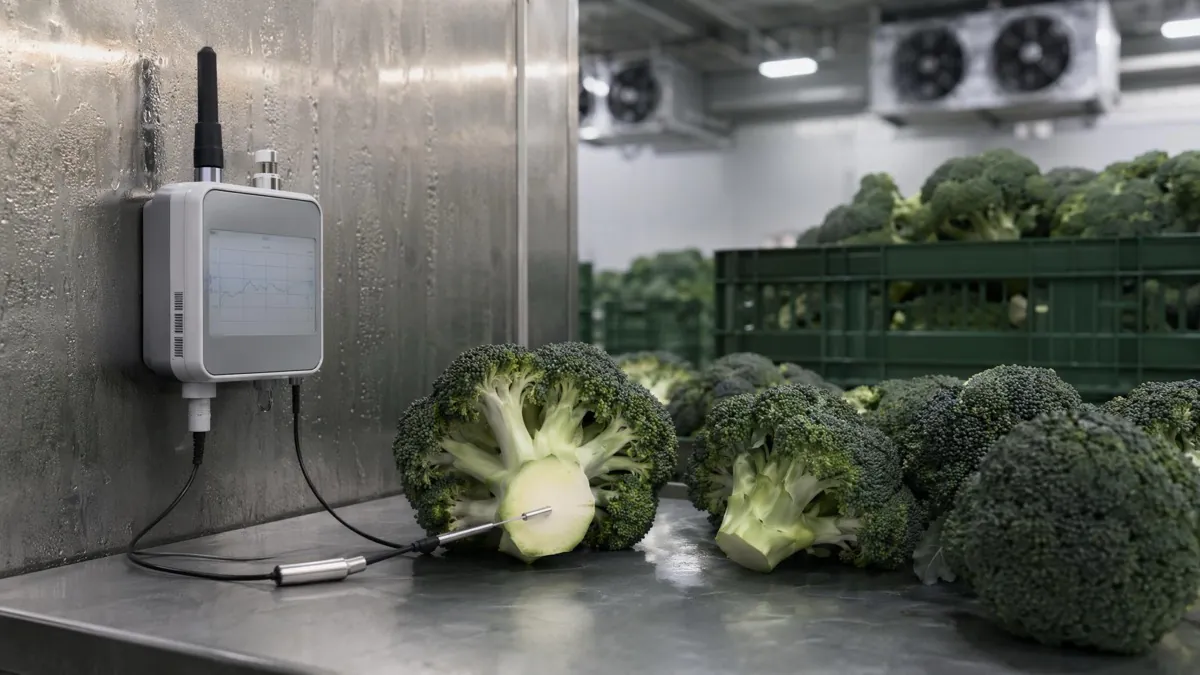
Cold room and reefer temperature loggers typically measure air temperature, not product core temperature. For low-respiration produce that is adequately pre-cooled, air temperature is a reasonable proxy for product temperature. For broccoli that was loaded warm, the two measurements can diverge significantly for many hours after loading.
The air can be at 2°C. The core of a warm broccoli crown in the middle of a dense pallet can be substantially higher — and staying there, because the surrounding crowns are also generating heat, creating a microenvironment that the cold room’s air circulation cannot easily penetrate.[^2]
By the time the product core finally equilibrates with the air temperature, if it ever does during transport, hours have passed at elevated internal temperature. Respiratory activity has continued. Chlorophyll breakdown — the process that produces yellowing — has been running at a rate the temperature log never recorded.
The log looked fine because the log was not measuring the problem.
The First Two Hours After Harvest Determine More Than the Next 48 Hours in Cold Storage
If there is one rule for broccoli export that our factory-side experience consistently supports, it is this: what happens in the two hours after harvest does more damage — or more protection — than almost anything that happens in the following 48 hours of cold storage and transport combined.
That sounds like an exaggeration. It is not.
At harvest temperature, broccoli is respiring at maximum rate. The chlorophyll degradation that produces yellowing, the cellular changes that produce softening, the glucosinolate breakdown that affects flavor and odor — all of these are enzymatic and temperature-dependent processes running at their fastest in the window immediately after harvest. Every 10 minutes of delay at harvest temperature is not equivalent to 10 minutes of delay at 2°C. The damage rate is orders of magnitude higher in the warm window.[^3]
This means that a broccoli pallet that was harvested at 7:00 AM and entered a vacuum cooler at 7:20 AM is in a fundamentally different commercial condition than one that entered at 9:30 AM — even if both pallets spent the next 48 hours in identical cold storage and transport conditions. The second pallet has already spent two hours consuming its export quality margin at the fastest possible rate. The cold chain it enters at 9:30 AM cannot recover that.
Yet in most operations, the 7:20 AM pallet and the 9:30 AM pallet are treated identically once they are inside the cold room. The log shows both at 2°C. The dispatch team sees two pallets of acceptable-looking broccoli. The destination result will be different, and the operation will have no data to explain why.
“Still Looks Green” Is the Most Dangerous Quality Check in Broccoli Export
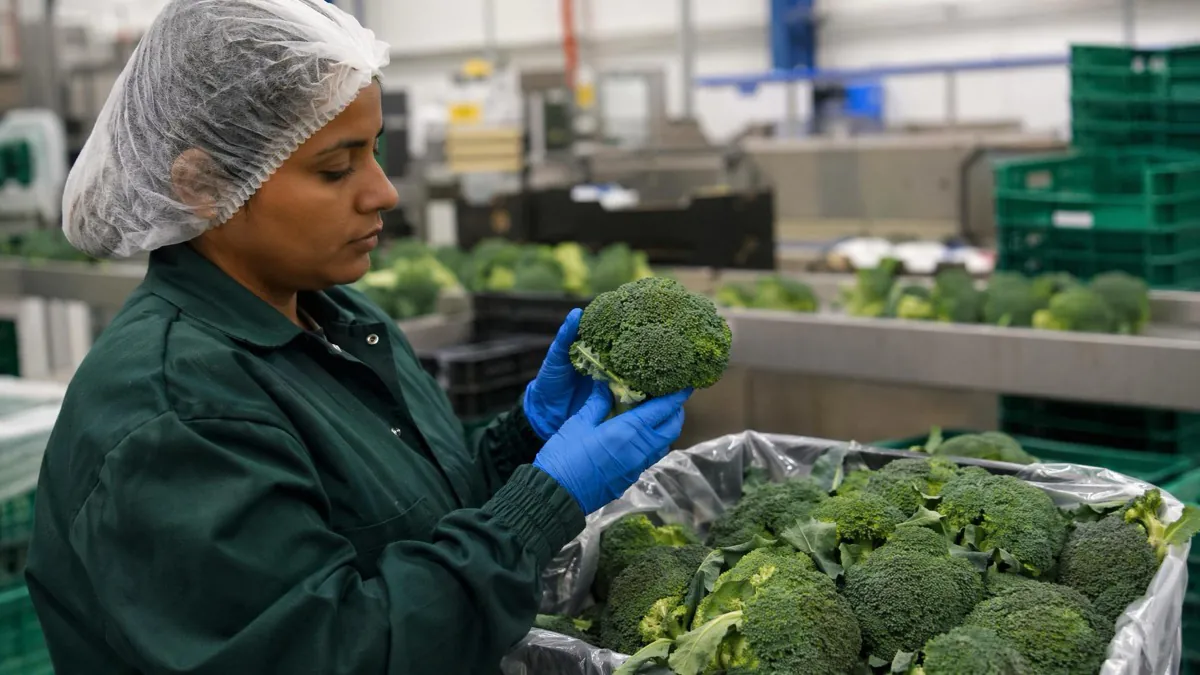
Broccoli is a particularly dangerous product for visual quality assessment because it does not show early-stage damage on its surface the way many other vegetables do. Soft spots, wilting, and color change in broccoli are relatively late-stage indicators. By the time a crown looks visibly compromised, it has already been declining for some time.
This creates a consistent trap in broccoli export dispatch:
The packing team checks the crowns. They look green. The load goes. At destination, two to four days later, the buyer sees yellowing that was not present at dispatch and cannot be explained by the recorded transit conditions.
The gap is not fabricated. It is a consequence of the fact that the relevant biological processes — chlorophyll breakdown, respiration-driven cellular change — were progressing throughout the journey at a rate that the visual check at dispatch was not designed to detect, and that the temperature log was not measuring in the right place.[^4]
This is why we say “still looks green” is the most dangerous quality check in broccoli export. It is not wrong, exactly. It just answers the wrong question. The relevant question is not “does it look green now?” It is “how much margin does this crown still have for transport, wholesale handling, and retail display?” And that question cannot be answered by looking at the surface.
Dense Pallet Loading Compounds the Pre-Cooling Problem for Every Batch After the First
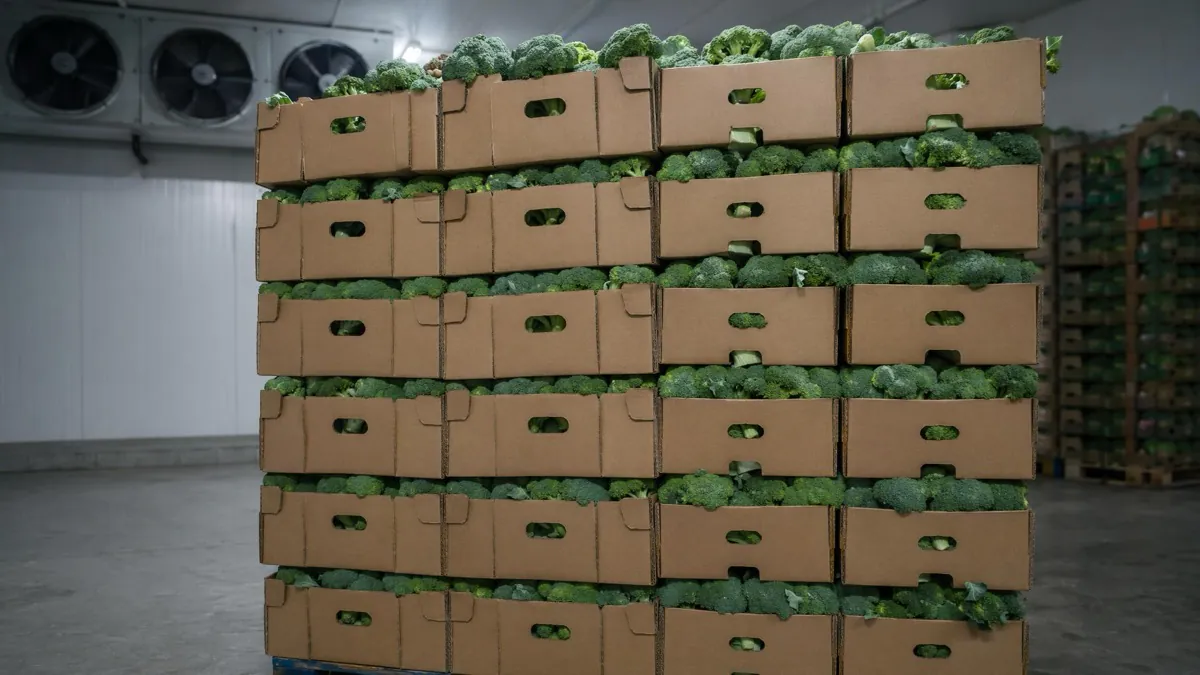
Even when pre-cooling is happening, pallet loading density creates a consistent secondary problem in broccoli export: the outer crowns cool, and the inner crowns do not.
For produce with moderate respiration rates, this unevenness may be acceptable. For broccoli, where the difference in damage rate between 2°C and 10°C is so large, a crown in the warm interior of a dense pallet during a 30-minute cooling cycle is in a meaningfully different condition than one on the outer edge.
Vacuum cooling addresses this more effectively than surface-driven methods because it reduces pressure across the whole load simultaneously, drawing heat from moisture throughout the product rather than relying on air circulation to reach the interior. But the benefit only materializes fully when the cycle time, pallet format, and loading density are matched correctly to the product being cooled.[^5]
Operations that have tested vacuum cooling with a poorly matched configuration — too short a cycle for their pallet weight, too dense a loading pattern for the chamber size — often conclude that vacuum cooling did not work for their product. In most cases, the system was capable of the result they needed. The configuration was not designed around the pallet format they were actually running.
This is why pallet format and loading density are not secondary details in a broccoli cooling project. They are primary variables in whether the cooling step reaches the crowns that need it most.
What Exporters Should Be Measuring Instead of Just Logging Cold Room Temperature
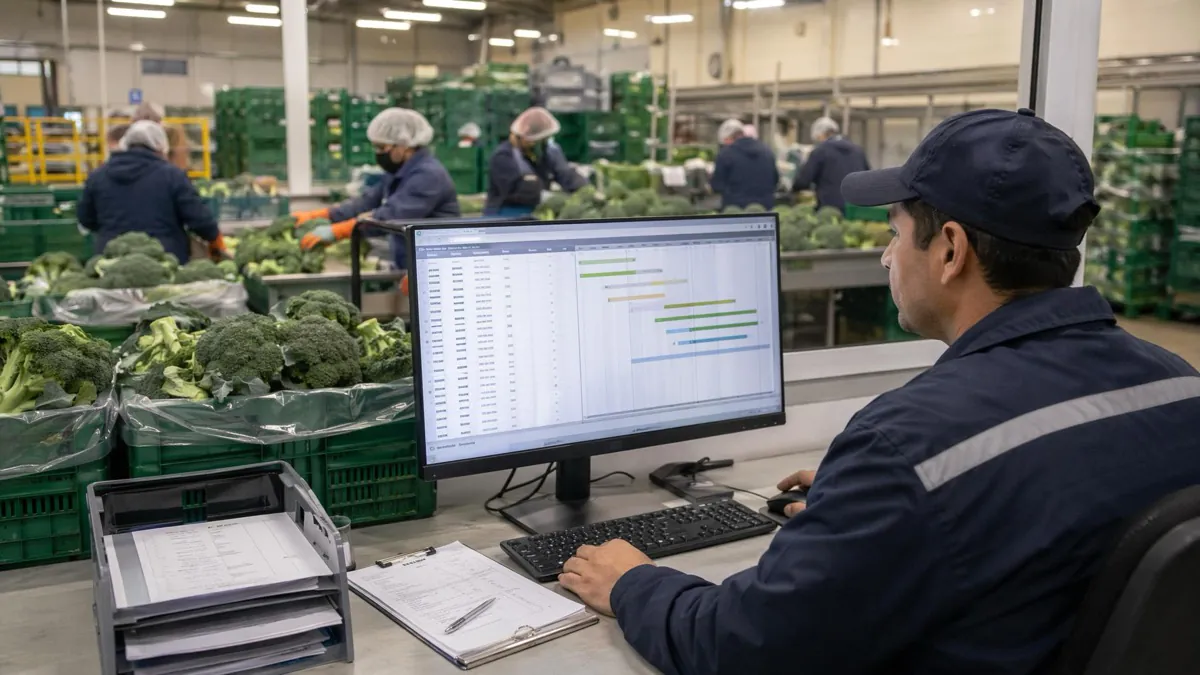
If you are still diagnosing broccoli export complaints using cold room logs and transport temperature records alone, you are looking at the output of a process you are not fully measuring.
The most useful data points in broccoli export quality are often the ones nobody is currently recording:
- Harvest-to-cooler interval per batch — how long between cutting and the start of pre-cooling, measured per batch, not estimated per day
- Product core temperature after cooling — not air temperature in the chamber, but actual product temperature at the crown interior before loading
- Pallet position in the cold room — whether stacking patterns are creating warm zones in the load that the room sensor does not detect
- Batch-to-destination correlation — when a complaint arrives, can you link it to a specific harvest day, harvest time, and pre-cooling interval? If not, you cannot improve the process systematically
Operations that build even a basic version of this tracking usually discover two things. First, their harvest-to-cooler intervals are longer than they thought. Second, their worst destination results correlate with their longest pre-cooling delays — not with the transit records that were previously the focus of every complaint investigation.
Broccoli Export Pre-Cooling Quality Checklist
- harvest-to-cooler interval is measured per batch, not assumed from schedule
- product core temperature is confirmed after cooling, not only air temperature
- pallet loading density is reviewed against the cooling system’s specification for broccoli
- vacuum cooling cycle time is matched to the actual pallet weight and crown size being run
- peak-harvest volume is reviewed against cooling throughput capacity before the season
- destination quality feedback is actively collected and linked to upstream batch data
- dispatch visual checks are supplemented by at least periodic product core temperature confirmation
FAQ
Why does broccoli turn yellow even when the cold room temperature log shows everything was in range?
Because cold room temperature logs measure air temperature, not product core temperature. Broccoli that was loaded warm generates its own heat and can stay significantly above air temperature for hours after cold room entry. The yellowing process — chlorophyll breakdown — runs at a rate determined by the actual product temperature, not the air temperature the logger recorded.
How much does a two-hour delay before pre-cooling actually affect broccoli shelf life?
The effect is not linear. Broccoli at 20°C is respiring at a rate roughly 10 to 20 times higher than at 0°C. Two hours at harvest temperature does not equal two hours of equivalent cold storage. In practical export terms, a two-hour pre-cooling delay can compress the usable destination shelf life by a margin that is disproportionate to what the time difference suggests on paper.
Is vacuum cooling significantly better than cold room pre-cooling for broccoli?
For broccoli specifically, the speed of temperature pull-down matters more than for lower-respiration products. Vacuum cooling typically achieves pre-cooling in minutes rather than hours, and it reaches the interior of the product more uniformly than cold room air circulation. For export operations with tight dispatch windows and dense pallet formats, that difference is commercially meaningful.
What should exporters do if they cannot implement vacuum cooling immediately?
At minimum, shorten the harvest-to-cold room interval as much as possible, ensure cold rooms are not loaded with warm broccoli alongside already-cooled product, and begin tracking product core temperature after cooling rather than relying on air temperature logs. These steps will not match the result of a vacuum cooling setup, but they will reduce the worst of the avoidable pre-cooling damage and provide the data needed to make a more informed investment decision.
Final Thoughts
Broccoli does not fail in the cold room. It fails in the two hours before it gets there.
The cold chain your exporter built, the transport your logistics team arranged, the cold room your buyer confirmed — all of that infrastructure is working to protect a margin that was already being spent the moment the crown was cut and left in warm conditions. Every minute of warm pre-cooling delay is not time your cold chain can recover later. It is damage running at the highest rate it will ever run in the whole post-harvest sequence.
From our factory-side perspective, the broccoli exporters who consistently receive fewer destination complaints are not the ones with the best cold rooms or the most sophisticated transit monitoring. They are the ones who treated the two hours after harvest as the most commercially critical window in the whole operation — and who built a workflow, a measurement habit, and a cooling setup designed specifically around that fact.
If you want to review your current harvest-to-cooler interval, pallet format, and cooling configuration against your destination quality record, send us the details. We can help you find where the gap is before the next season’s complaints arrive.
Footnotes
[^1]: UC Davis Postharvest Technology Center — broccoli commodity fact sheet including respiration rates and temperature recommendations: https://postharvest.ucdavis.edu/commodity-resources/commodity-fact-sheets/
[^2]: FAO guidance on post-harvest handling and the role of rapid pre-cooling in quality preservation for high-respiration vegetables: https://www.fao.org/3/x5055e/x5055e00.htm
[^3]: ASHRAE Refrigeration Handbook — pre-cooling methods and the relationship between product temperature and quality loss rates for fresh produce: https://www.ashrae.org/technical-resources/bookstore/refrigeration-handbook
[^4]: Postharvest Biology and Technology reference — chlorophyll breakdown and senescence in broccoli as a function of temperature: https://www.sciencedirect.com/journal/postharvest-biology-and-technology
[^5]: UC Davis Postharvest Technology — vacuum cooling principles and application for high-respiration produce: https://postharvest.ucdavis.edu/
Looking for the right vacuum cooler for your operation?
Allcold engineers work with packhouses and exporters to spec the right system for your product, volume, and site conditions.

Mila
You May Also Like
Used vs. New Vacuum Coolers: Is the Lower Price Worth It?
Buying a used vacuum cooler? Compare load fit, condition, relocation, installed cost and support with a new system before deciding if the saving is real.
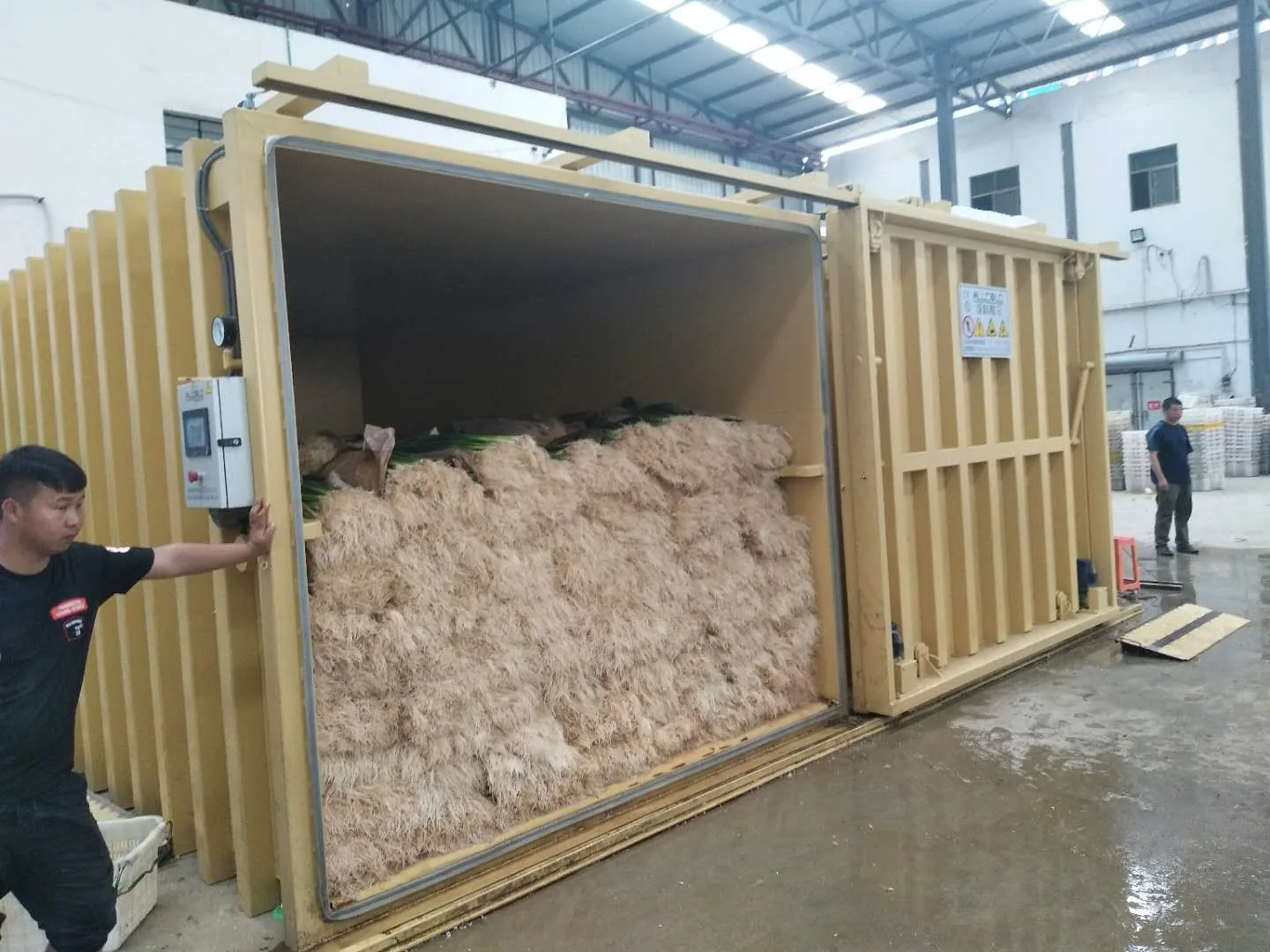
Why Does Produce Sweat After Vacuum Cooling?
FRESH PRODUCE · POST-COOLING HANDLING The cooling cycle can finish correctly—and the load can still become wet on its way
Vacuum Cooler Not Performing? Check Your Pallet Loading First
When a vacuum cooler produces inconsistent results—warm spots, longer cycle times, variable exit temperatures across the load—the machine is usually
Why One Successful Cooked Rice Cooling Test Is Not Enough to Standardize a Central Kitchen Process
A cooked rice batch can pass a vacuum cooling test and still fail as a production process. That is the
Why a Vacuum Cooler Utility Failure Becomes an Export Quality Problem Before It Becomes a Repair Problem
A vacuum cooler stoppage does not start as a maintenance problem. In a produce export operation, it becomes a quality
Why Asparagus Loses More Export Value in the First Two Hours After Cutting Than in the Entire Cold Chain That Follows
For fresh asparagus exporters, the most expensive quality loss often happens before the product even reaches the main cold chain.
Why Bean Sprouts Are One of the Hardest Vegetables to Pre-Cool Correctly and What Exporters Get Wrong
Bean sprouts look simple. They are light, moist, and usually packed in bulk or retail bags. But from a pre-cooling
Why Spinach Shipments That Leave Looking Perfect Arrive Looking Wrong
The complaint lands differently with spinach than with most other export vegetables. The exporter packed dark green, crisp product. The
How Exporters Can Reduce Produce Rejection Claims with Better Pre-Cooling Workflow
Learn how exporters can reduce produce rejection claims by improving pre-cooling workflow, timing control, packing handoff, and first-mile cold chain stability.
Buying a Vacuum Cooler for Fresh Produce Export? Avoid These Costly Procurement Mistakes
Buying a vacuum cooler for fresh produce export is not simply a machine purchase. It is a project decision that