
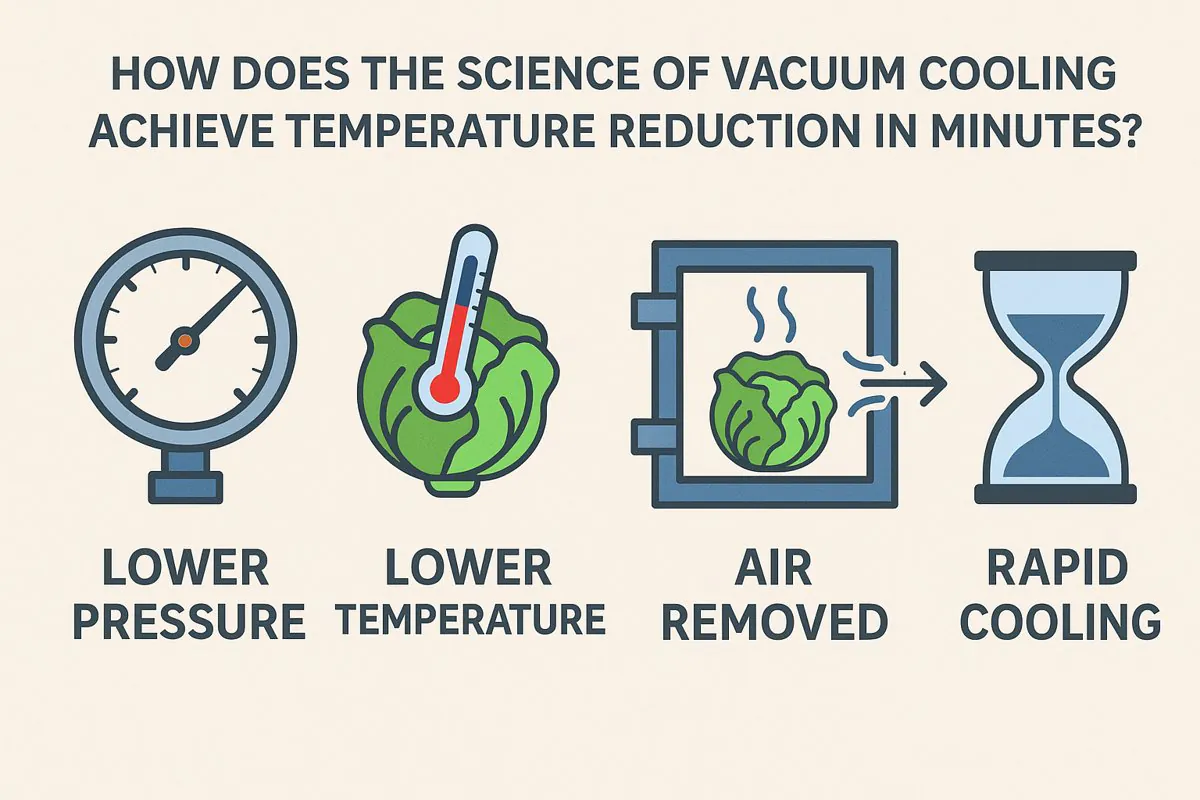
How Does the Science of Vacuum Cooling Achieve Temperature Reduction in Minutes?
You know that field heat is the enemy of fresh produce, but traditional cooling methods take hours to fight it, slowly draining the life and value from your harvest.
The science is based on a simple principle: lowering air pressure reduces the boiling point of water. This forces a tiny amount of moisture in the produce to evaporate, rapidly drawing heat from the core and cooling it down in just minutes.
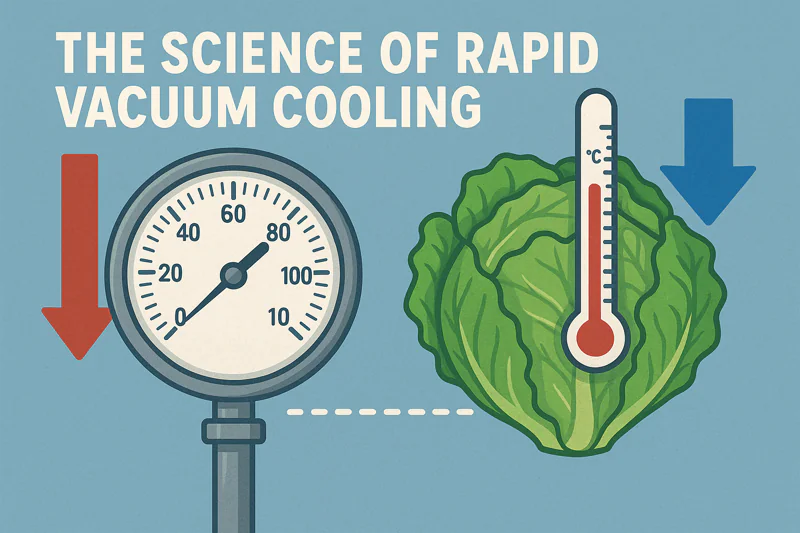
I often get asked how it’s possible to chill an entire pallet of vegetables so fast. It’s not magic; it’s pure physics. This article will walk you through the science of how this process works so effectively to protect your hard work.
How can reducing pressure make things cold?
It seems counterintuitive. You normally associate pressure with heat, not cold. The idea that removing air can rapidly chill your vegetables seems like something from a science fiction movie.
By lowering the chamber’s atmospheric pressure, we lower the boiling point of water. The water in the vegetables boils at a very low temperature (around 3°C), and this evaporation rapidly pulls heat from the produce.
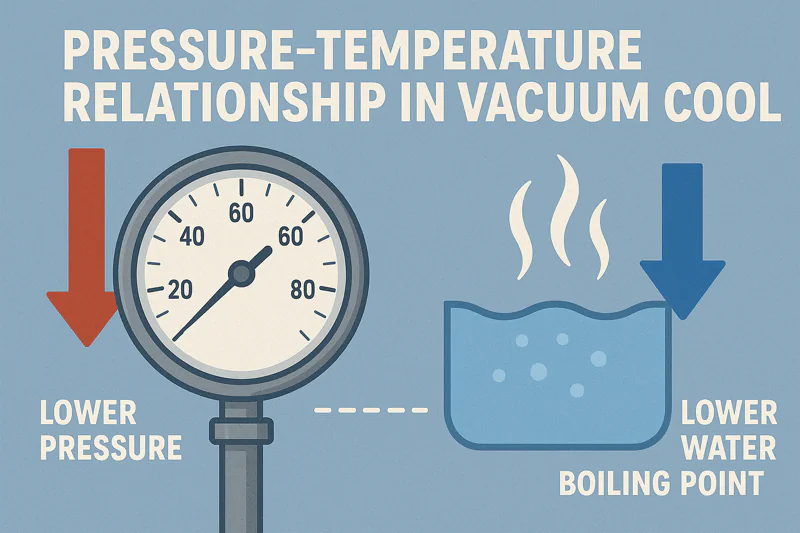
Evaporation: Nature’s Refrigerator
Evaporation removes heat from the product as moisture changes to vapor. Lowering chamber pressure allows that process to occur at lower temperatures. Cooling rate and temperature spread still depend on the commodity, package and load; pressure equalization does not prove identical product temperatures.
| Feature | Vacuum Cooling Physics | Traditional Cooling Physics |
|---|---|---|
| Energy Transfer | Phase Change (Evaporation) | Convection (Air Movement) |
| Heat Removal | From the core outwards | From the surface inwards |
| Primary Medium | Product’s own moisture | Cold air |
| Efficiency | Extremely high and rapid | Slow and gradual |
What happens inside the chamber during a typical cycle?
You press the start button, the door seals, and you hear the pumps turn on. But what is actually happening inside that steel chamber to cool your produce so quickly?
The cycle is a controlled sequence: first, the pressure drops steadily. Then, as the boiling point is reached, the temperature begins to fall rapidly. The process stops automatically when the target temperature is hit.
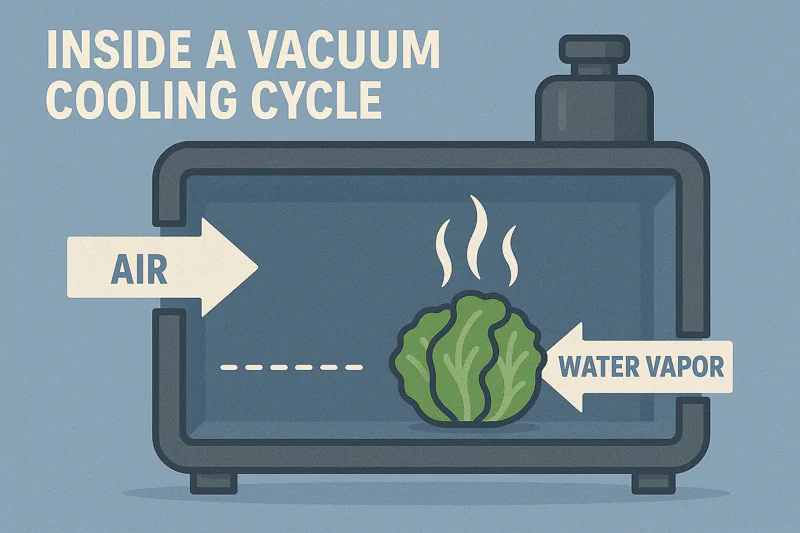
A Precisely Controlled Process
The PLC/HMI coordinates the supplied sequence and shows operating information. The following cycle is illustrative; confirm durations, functions and the endpoint for the actual machine and product.
First, during Minutes 0-15, the vacuum pumps are working hard. The main goal here is to remove air from the chamber. During this phase, you see the inside pressure drop quickly on the gauge, but the product temperature doesn’t change much yet. The machine is creating the right environment for cooling.
Second, from Minutes 15-25, we reach the critical point. The pressure is now low enough for the water in the vegetables to begin evaporating. This is when the rapid cooling happens. Both the pressure and the product temperature start to fall together, quickly and uniformly.
Finally, After 25 minutes, the system reaches its goal. Once the pre-set target temperature is achieved, the refrigeration compressor and condenser fans shut off automatically to save power. The machine then allows air back into the chamber. The vacuum pumps might keep running for a short period to clear any moisture from the pump oil. Once the pressure is balanced, the door can be opened, and the perfectly cooled produce is ready.
| Cycle Stage | Time Elapsed | Chamber Pressure | Product Temperature |
|---|---|---|---|
| Pump Down | 0 – 15 minutes | Decreasing (↘) | Stable (→) |
| Evaporative Cooling4 | 15 – 25 minutes | Decreasing (↘) | Decreasing (↘) 4 |
| Cycle End | After 25 minutes | Stabilizing (→) | Reached Target (✓) |
Why is this rapid cooling process so uniform?
Speed is great, but consistency is what makes you money. If a pallet of lettuce is cold on the outside but warm in the middle, you still have a big problem with shelf life.
Allcold’s fresh-produce vacuum cooling equipment combines configurable chamber loading with PLC/HMI operation and product-temperature measurement. That connects the physics to the actual crop and pallet arrangement. Ask for the expected duty at your starting temperature and batch size, then verify the product result instead of treating pressure uniformity as proof of temperature uniformity.
Assess uniformity using representative product measurements. Holds or staged pressure changes may be useful for a particular product, but their availability and settings must be confirmed for the selected configuration.
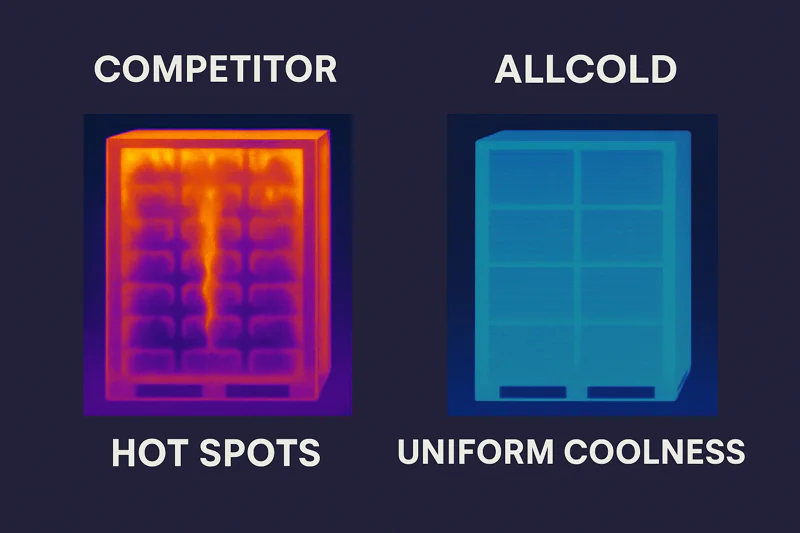
Smart Technology for a Perfect Result
Product structure, packing and moisture release can cause positions within a load to cool differently. Agree the pressure profile and probe placement using representative trials. Do not assume an automatic product-detection function or a guaranteed temperature spread from a general control description.
What technology ensures this science is reliable every day?
Advanced science is only useful if it’s reliable day in and day out, especially during the peak of harvest season. You need to know the machine will work every time you press start.
Reliability depends on suitable system design, component selection and maintenance. Check the component schedule of the actual proposal rather than assuming one pump or compressor brand is standard.
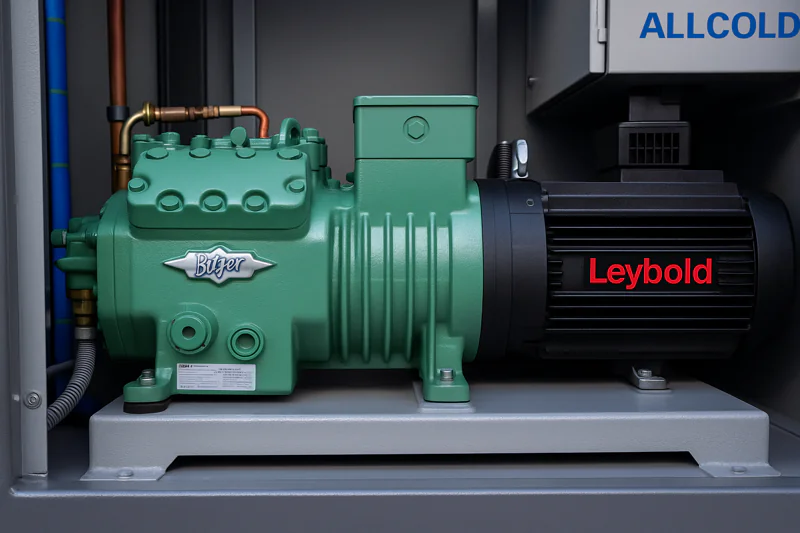
Engineering You Can Trust
Ask for the specified pump, compressor, controls and protective devices, together with the design duty and service requirements. Confirm warranty and support terms in the project documents. Recognizable brands alone do not establish performance or local parts availability.
| Component | Brand | Country of Origin | Role in the System |
|---|---|---|---|
| Compressor | Bitzer | Germany | Powers the refrigeration system |
| Vacuum Pump | Leybold | Germany | Removes air to lower pressure |
| Touch Screen | Siemens | Germany | Provides simple operator control |
| AC Contactor | Schneider | Germany / France | Manages electrical power safely |
Conclusion
The science of vacuum cooling uses the simple physics of evaporation under low pressure. It delivers incredibly fast, uniform temperature reduction that preserves the peak freshness and value of your harvest.
Understanding evaporative cooling can enhance your knowledge of energy-efficient cooling methods and their applications. ↩
Exploring vacuum coolers will reveal their advantages in food preservation and energy efficiency, crucial for modern cooling solutions. ↩
Explore how Siemens electronics enhance efficiency and reliability in cooling systems, ensuring optimal performance. ↩
Learn about the principles of evaporative cooling and its advantages in refrigeration processes for better energy efficiency. ↩
Understanding uneven cooling can help improve food quality and reduce waste in storage. ↩
Learn about the workings of refrigeration units to appreciate their design and functionality in various applications. ↩
Explore this link to understand how quality engineering enhances product reliability and efficiency in manufacturing. ↩
Looking for the right vacuum cooler for your operation?

Mila
You May Also Like
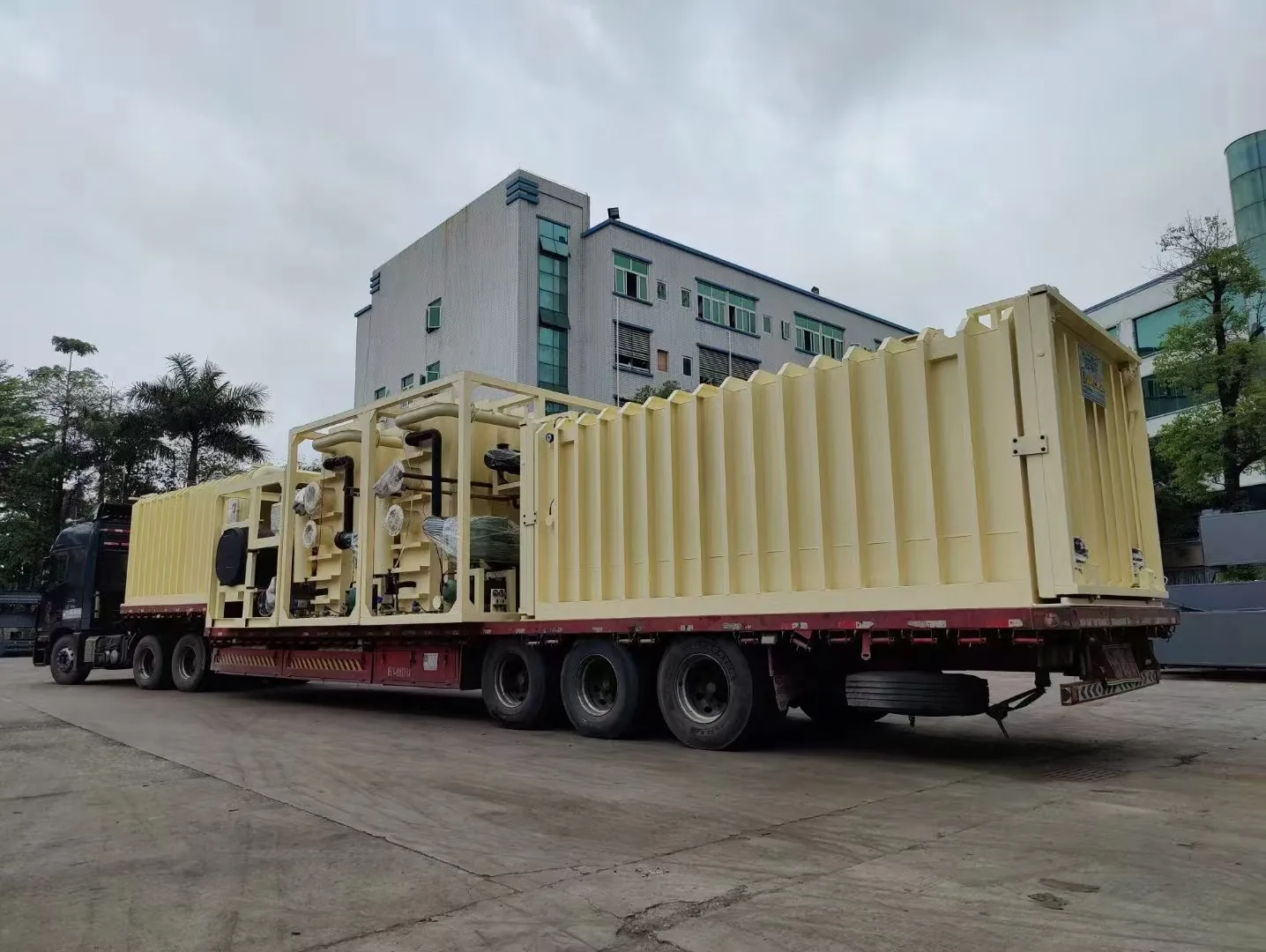
Used vs. New Vacuum Coolers: Is the Lower Price Worth It?
Buying a used vacuum cooler? Compare load fit, condition, relocation, installed cost and support with a new system before deciding if the saving is real.
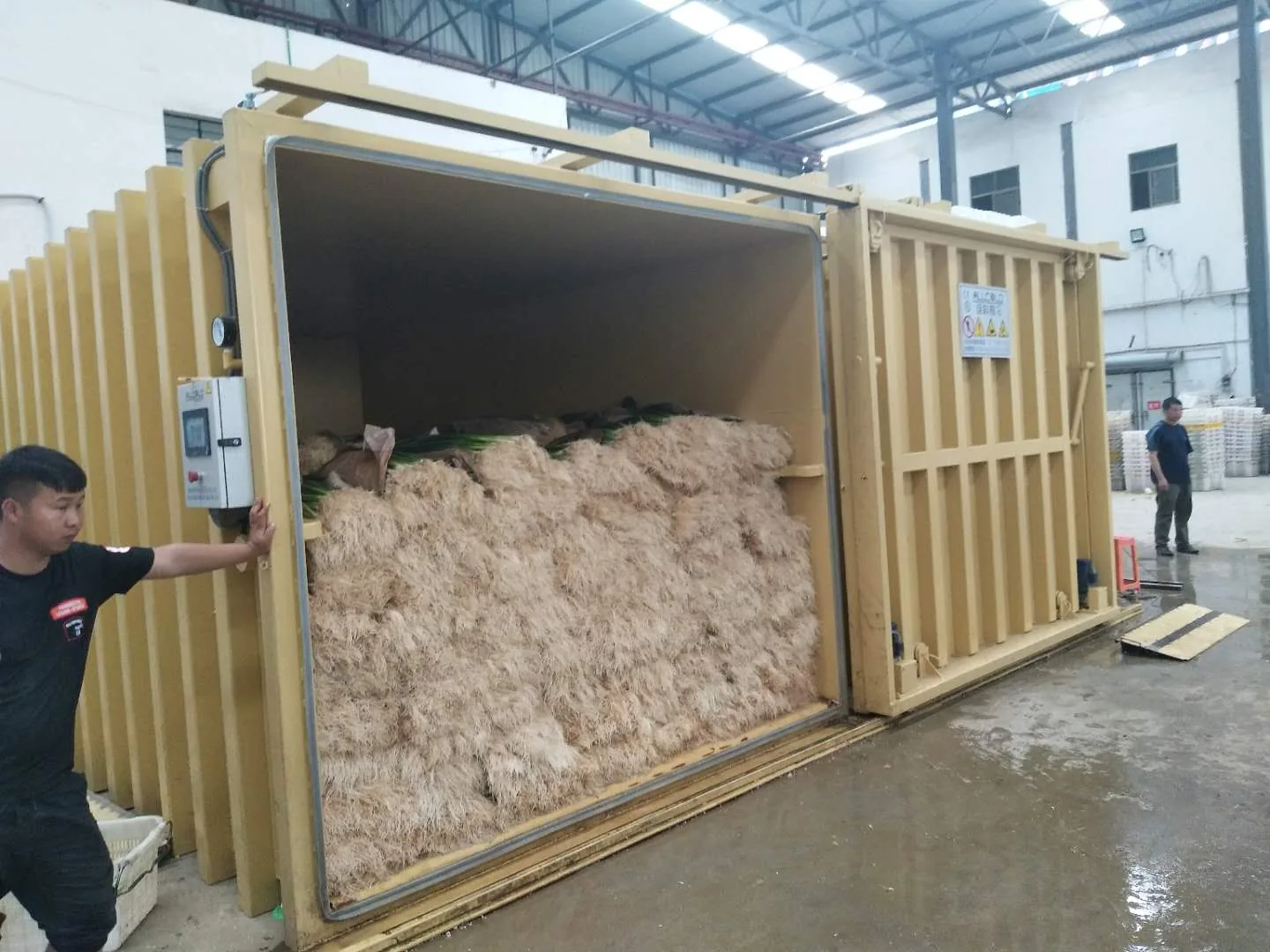
Why Does Produce Sweat After Vacuum Cooling?
FRESH PRODUCE · POST-COOLING HANDLING The cooling cycle can finish correctly—and the load can still become wet on its way
Vacuum Cooler Not Performing? Check Your Pallet Loading First
When a vacuum cooler produces inconsistent results—warm spots, longer cycle times, variable exit temperatures across the load—the machine is usually
Why One Successful Cooked Rice Cooling Test Is Not Enough to Standardize a Central Kitchen Process
A cooked rice batch can pass a vacuum cooling test and still fail as a production process. That is the
Why a Vacuum Cooler Utility Failure Becomes an Export Quality Problem Before It Becomes a Repair Problem
A vacuum cooler stoppage does not start as a maintenance problem. In a produce export operation, it becomes a quality
Why Asparagus Loses More Export Value in the First Two Hours After Cutting Than in the Entire Cold Chain That Follows
For fresh asparagus exporters, the most expensive quality loss often happens before the product even reaches the main cold chain.
Why Bean Sprouts Are One of the Hardest Vegetables to Pre-Cool Correctly and What Exporters Get Wrong
Bean sprouts look simple. They are light, moist, and usually packed in bulk or retail bags. But from a pre-cooling
Why Broccoli Loses Export Quality Faster Than Any Temperature Log Will Show
The complaint comes in from the buyer: yellowing, premature flowering, weak texture on arrival. The exporter reviews the cold room
Why Spinach Shipments That Leave Looking Perfect Arrive Looking Wrong
The complaint lands differently with spinach than with most other export vegetables. The exporter packed dark green, crisp product. The
How Exporters Can Reduce Produce Rejection Claims with Better Pre-Cooling Workflow
Learn how exporters can reduce produce rejection claims by improving pre-cooling workflow, timing control, packing handoff, and first-mile cold chain stability.