
Can a Vacuum Cooler Be Installed Outdoors? A Site-Planning Guide for Produce Packhouses
Can a vacuum cooler be installed outdoors?
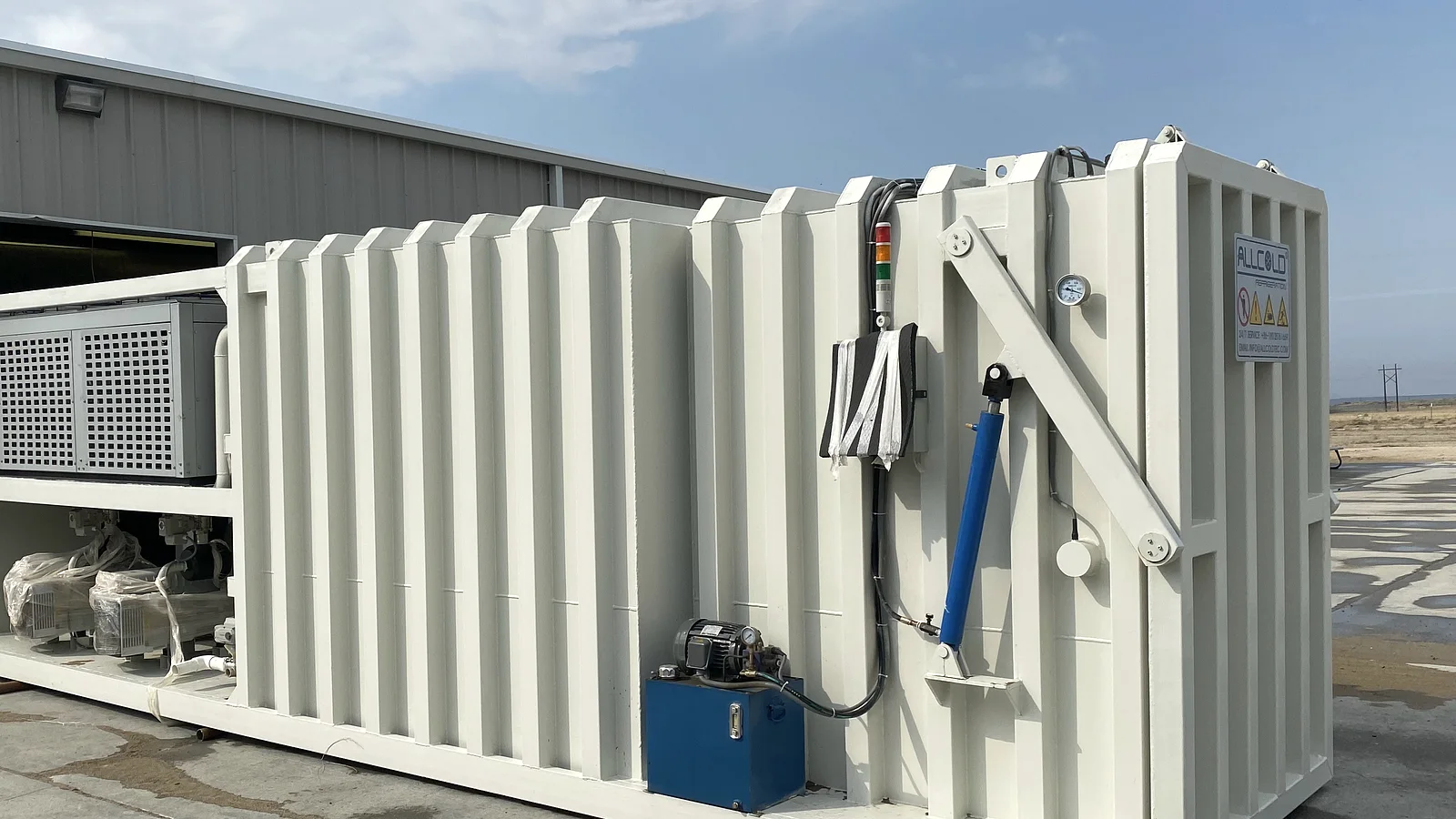
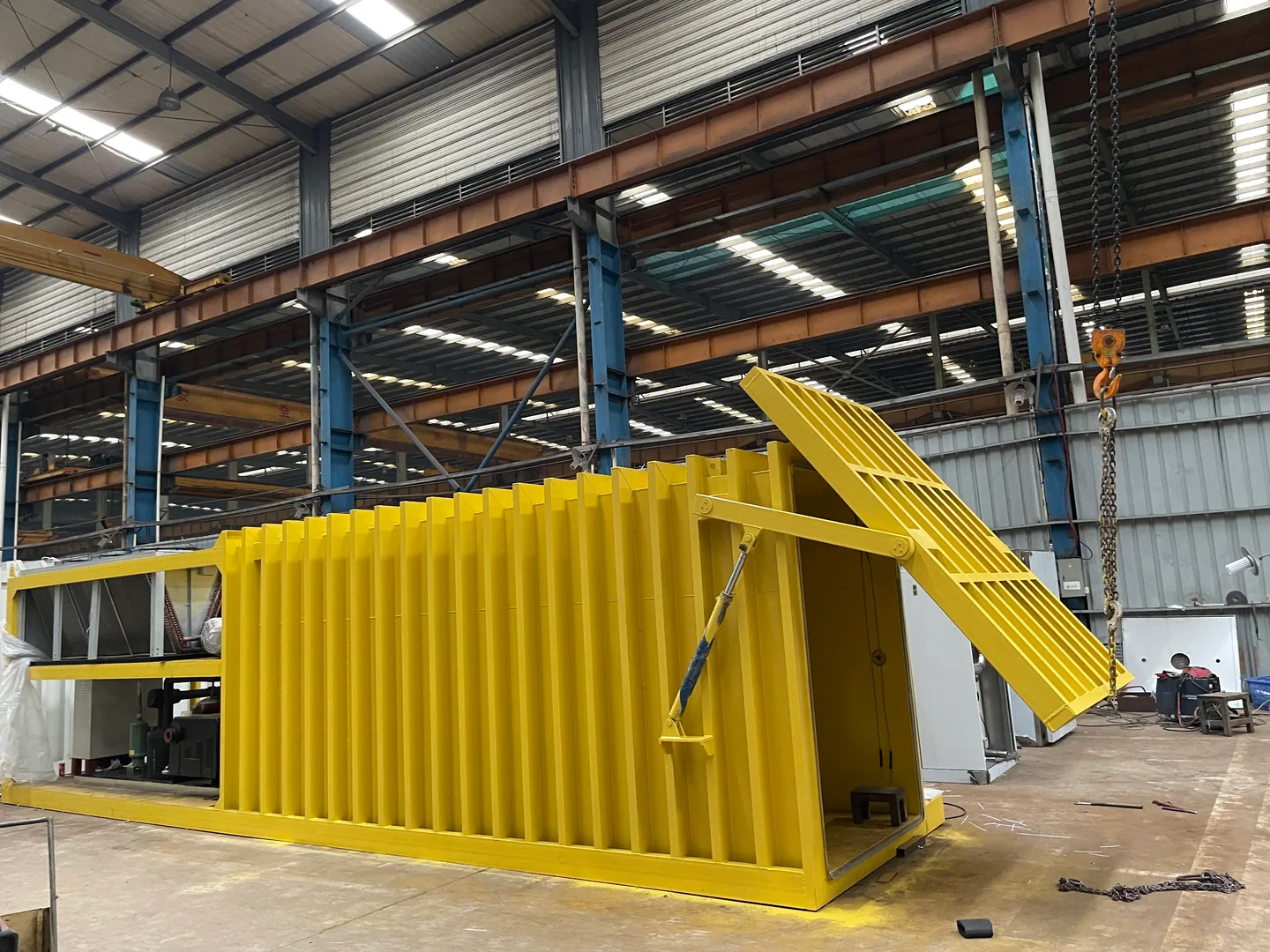
Yes—an industrial vacuum cooler can be installed outdoors when the machine configuration and site are designed for the actual climate, electrical environment, drainage, wind or flood exposure, condenser airflow, service access, and product-handling route. “Outdoor” should be specified before manufacture. It should not mean placing a standard indoor configuration on an open slab and adding a roof later.
Outdoor installation can be a practical way to save indoor floor space, connect the chamber directly to a packing-house wall, and simplify pallet movement. It can also create avoidable problems when weather protection is treated as the only design question.
The machine may tolerate rain while the loading area still exposes cartons to sun. A canopy may protect operators while trapping hot condenser discharge air. A concrete pad may look strong while directing storm water toward the electrical side. Outdoor suitability is therefore a system decision, not a yes-or-no feature printed on a brochure.
This guide explains what produce growers, exporters, packhouse managers, and project engineers should decide before ordering an outdoor vacuum cooler. Exact clearances, enclosure ratings, anchoring, loads, and utility requirements must come from the project-specific Allcold drawing, equipment documentation, qualified local contractors, and applicable local codes.
Outdoor Installation Is a Configuration Decision, Not Just a Location
The first question is not simply, “Can this model stand outside?” The better question is, “What environmental conditions must this specific machine and site handle for its full working life?”
An outdoor project can expose the equipment to:
- direct and wind-driven rain;
- strong sunlight and high surface temperatures;
- dust, soil, crop debris, insects, and airborne fibers;
- salt air or corrosive agricultural atmospheres;
- freezing weather, snow, ice, or large daily temperature swings;
- high wind, seismic loads, or vehicle impact;
- storm-water accumulation or flooding;
- unauthorized access outside normal operating hours.
Those exposures affect materials, coatings, electrical enclosures, cable entries, ventilation, heaters or anti-condensation measures, anchoring, and maintenance frequency. They should be disclosed before the machine is manufactured—not discovered after delivery.
NEMA explains that enclosure types provide different degrees of protection against rain, sleet, windblown dust, hose-directed water, and corrosion.[1] That does not mean every outdoor vacuum cooler needs the same designation. It means the electrical protection must be selected for the actual site and installed as a complete system, including glands, fittings, isolators, sensors, and field wiring.
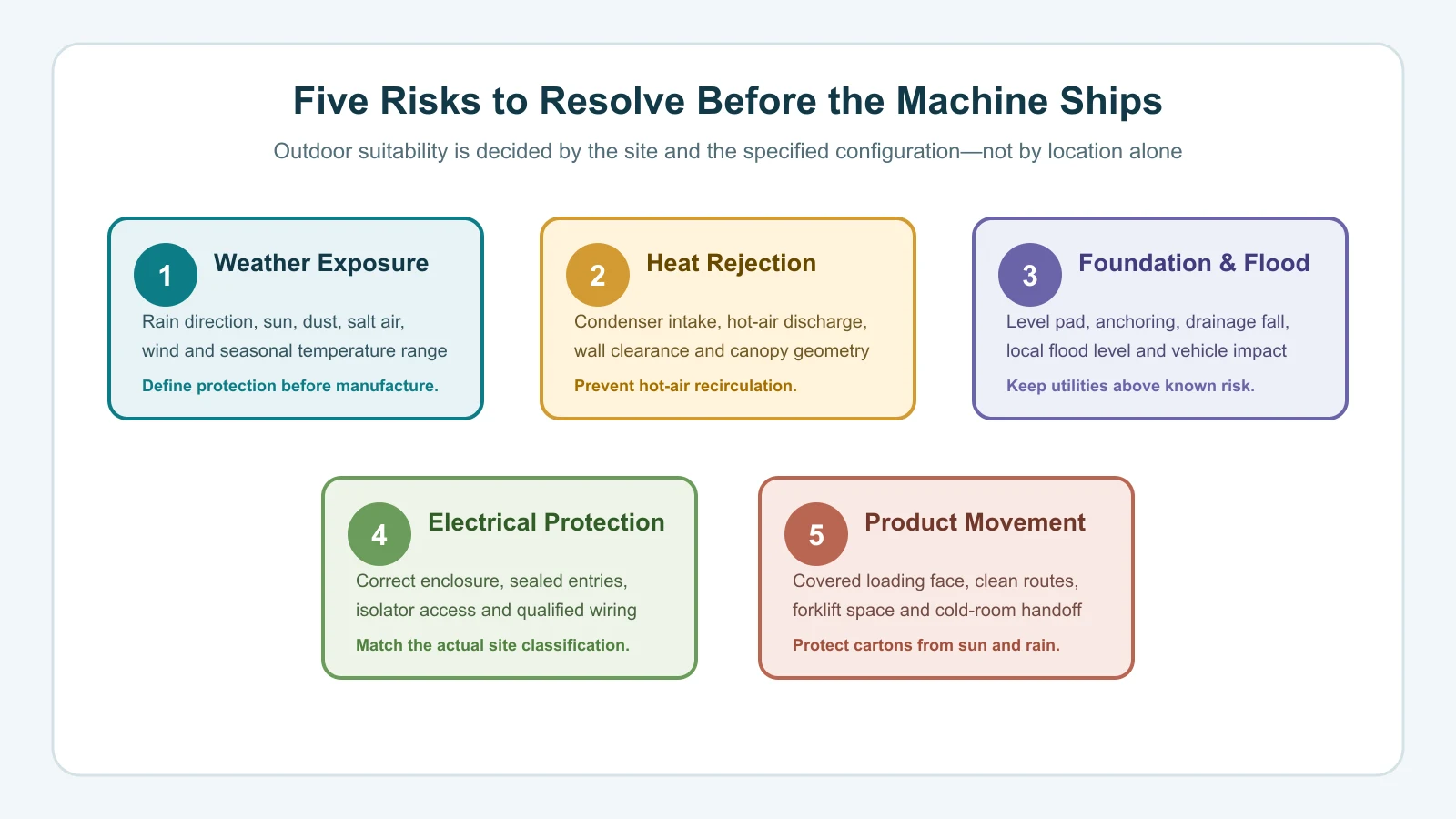
When Does an Outdoor Vacuum Cooler Make Sense?
Outdoor placement is often attractive when the packing house has limited internal space, when a pallet-size chamber is too large for an existing building, or when the cooler can connect directly to a wide wall opening. It may also simplify crane access, delivery, and maintenance of large modular systems.
A good outdoor arrangement usually has four characteristics:
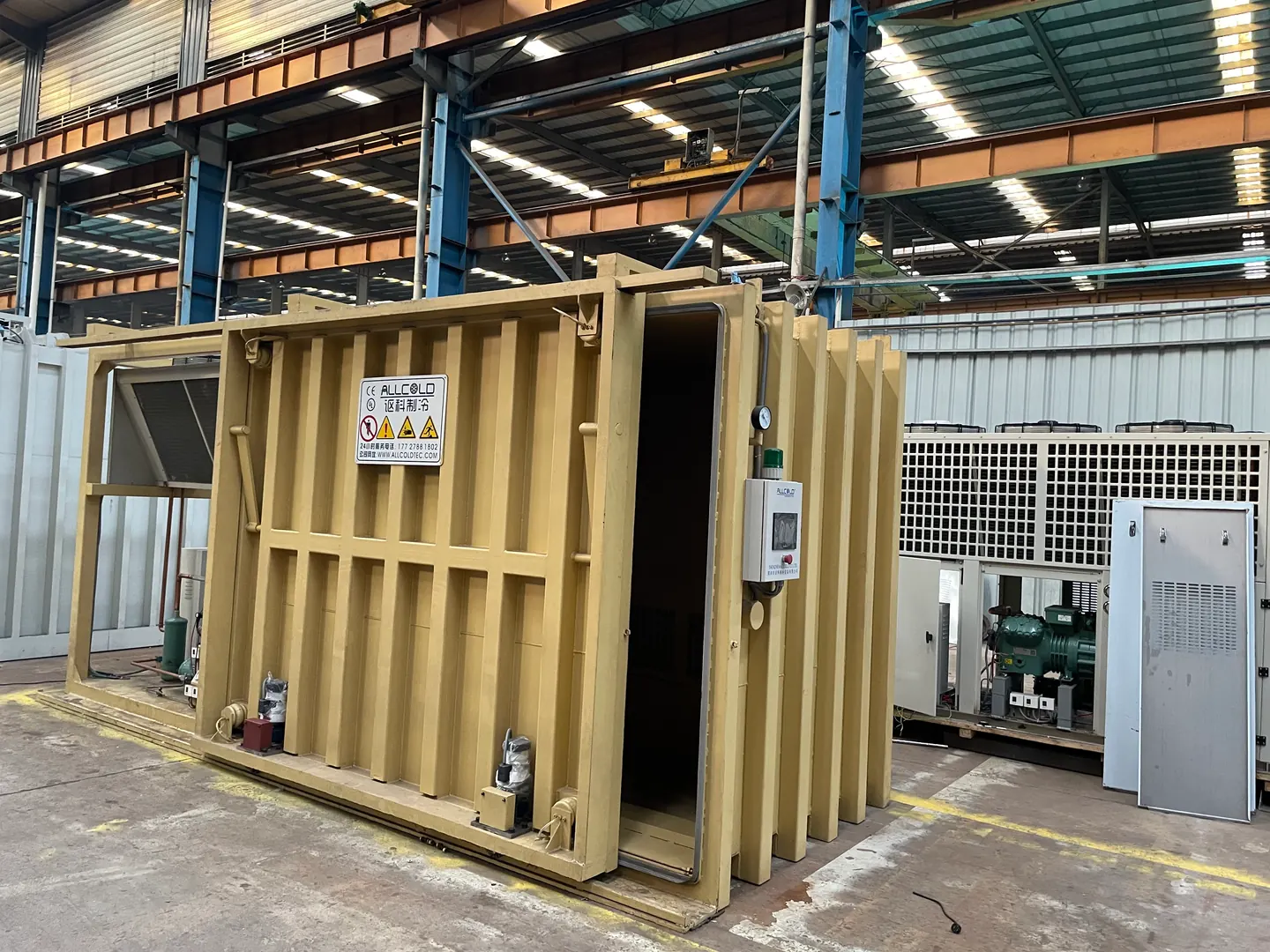
- The loading face is integrated with the building. Product and operators can move between the packing area and chamber without an uncontrolled outdoor queue.
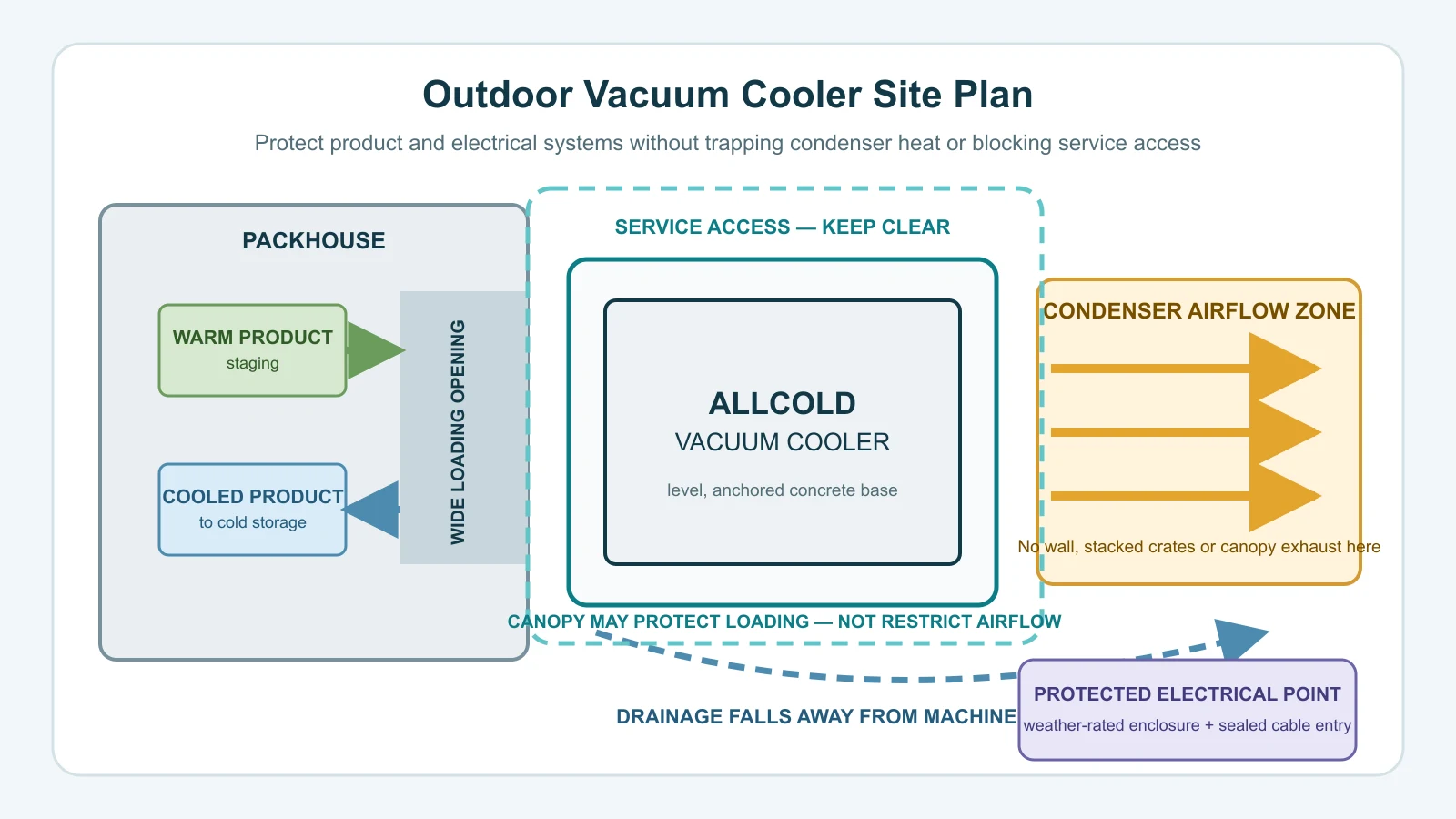
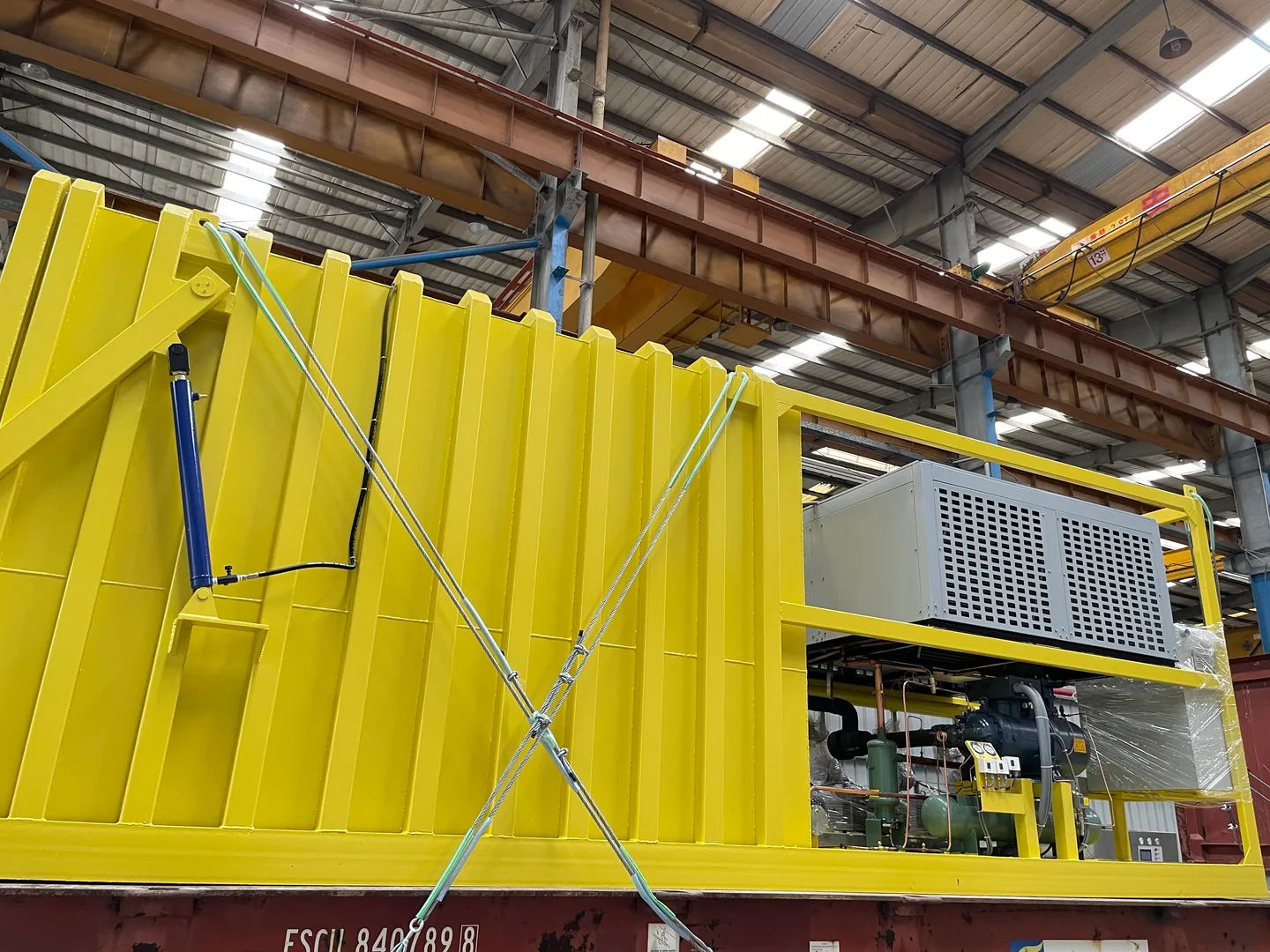
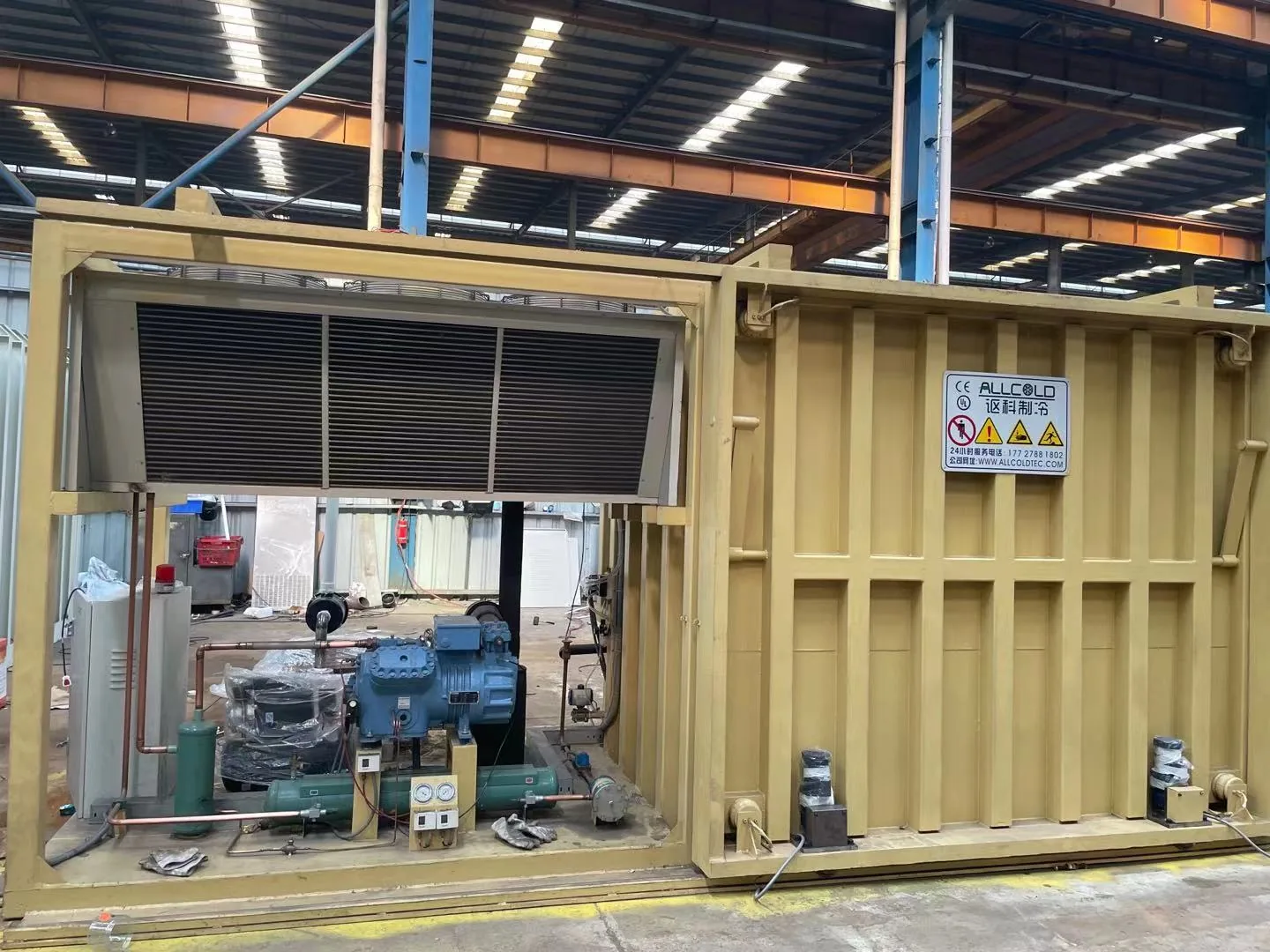
- The equipment side has open airflow and service space. Heat can leave the condenser area, and technicians can safely reach pumps, compressors, valves, filters, and panels.
- The foundation and drainage are engineered. The machine is level, anchored, and protected from settlement, runoff, and known flood risk.
- The supplied configuration matches the climate. Electrical protection, materials, coatings, sealing, and low- or high-temperature provisions are agreed before production.
Outdoor placement is less attractive when the site cannot protect the product route, when flood exposure is unresolved, when salt or chemical corrosion is severe, or when nearby walls and roofs leave no reliable heat-rejection path. In those cases, an indoor installation or a purpose-designed equipment enclosure may be the better project.
Start With the Product Route, Not the Empty Space
Many outdoor projects begin with a photograph of unused land beside the packing house. That is not enough. The machine position must support the actual sequence of warm-product staging, loading, cooling, unloading, and transfer to cold storage.
FAO packing-house guidance emphasizes weather protection, ventilation, hard level floors, drainage, and unrestricted movement of workers and produce.[5] For a vacuum-cooling project, those principles translate into several practical questions:
- Can a forklift or pallet jack approach the chamber in a straight, repeatable path?
- Can the next load be prepared without blocking the load being discharged?
- Are warm and cooled pallets clearly separated?
- Will cartons remain protected from direct sun, rain, and roof runoff?
- How quickly can cooled product reach the cold room or refrigerated dispatch area?
- Does the operator remain protected without the canopy blocking equipment airflow?
This is different from asking whether a forklift can pass once. Our article on how packing-house layout affects vacuum-cooling throughput explains why repeated loading and unloading time belongs in the capacity calculation. Outdoor installation adds weather and site exposure to that same workflow.
What Foundation Does an Outdoor Vacuum Cooler Need?
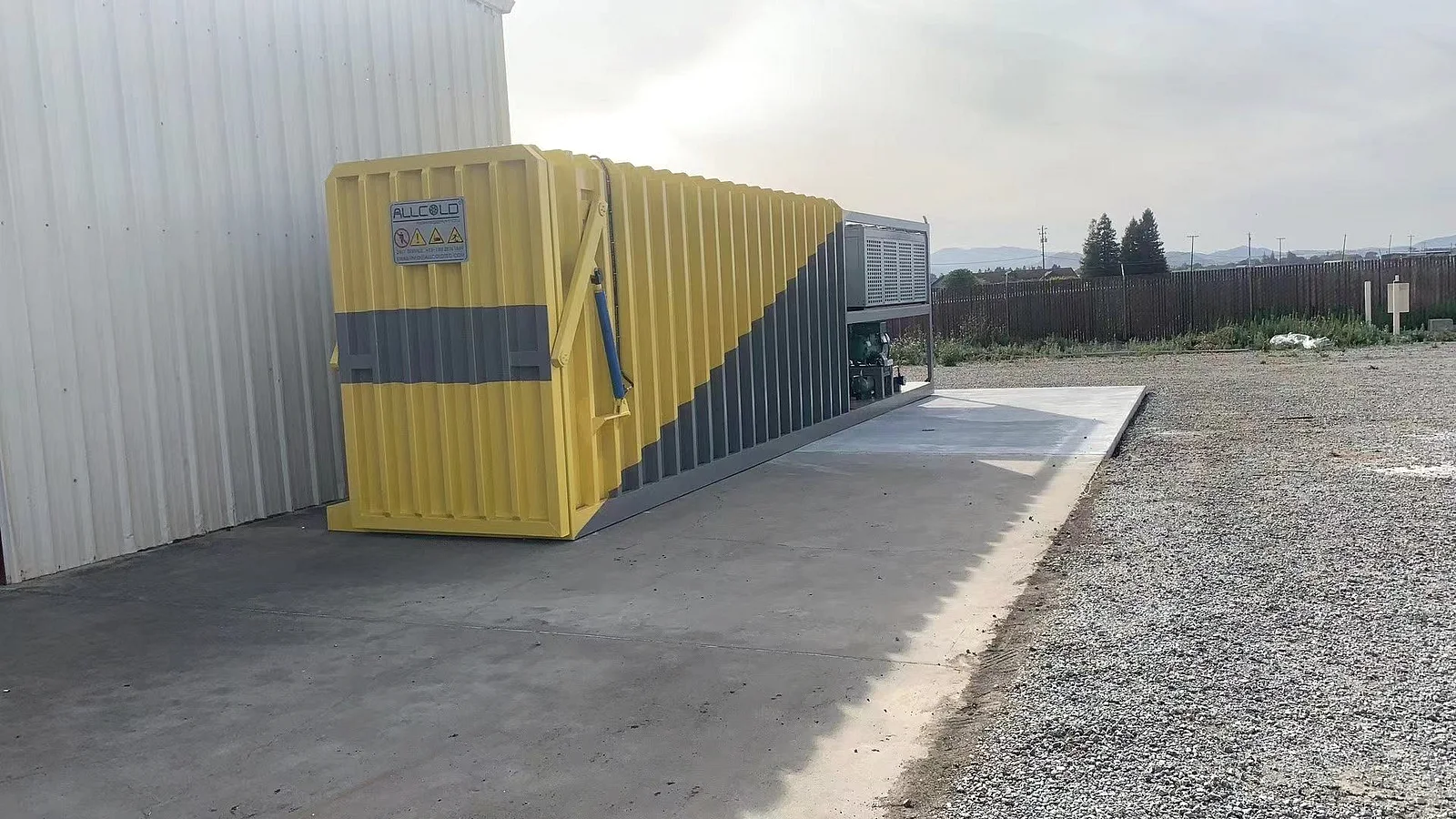
The foundation must carry the operating mass of the complete system and loads, remain level, accept the specified anchors, and resist local wind, seismic, frost, soil, and vehicle conditions. A thin yard slab should not be assumed suitable because it already supports forklifts.
The project drawing should identify the equipment footprint, support points, operating mass, anchor locations, service loads, and required clearances. A qualified local civil or structural professional should use that information to design the pad and anchoring for the site.
Important details include:
- a stable, level equipment-bearing surface;
- adequate edge distance around anchor points;
- no uncontrolled joint or drain channel beneath critical supports;
- protection from forklift, truck, or pallet impact;
- a planned route for water and cleaning runoff;
- access for unloading, lifting, positioning, and future major service.
The machine base should not become a dam. The surrounding surface must direct rain and wash water away without creating a pond at the door, electrical panel, cable entry, or service side.
Rain Protection Is Not the Same as Flood Protection
A roof can reduce direct rain, but it does not solve rising water, wind-driven rain, blocked site drains, or runoff from a larger roof area. Outdoor planning should distinguish three separate risks:
- Water falling onto the equipment: addressed through the specified equipment configuration, enclosure, sealing, and canopy design.
- Water flowing across the site: addressed through levels, drainage routes, curbs, channels, and site grading.
- Water rising during a flood: addressed through flood assessment, elevation, relocation, or engineered flood protection.
FEMA guidance treats elevation or floodproofing of utility systems as a core way to reduce flood damage.[4] The correct elevation is a local engineering and regulatory decision; it should not be guessed from the highest puddle seen last season.
Do not place a raised machine on a platform without checking loading access, anchoring, wind exposure, ramp gradients, guardrails, and service lifting. Solving one risk must not create another.
Why Condenser Airflow Can Decide Outdoor Performance
Outdoor air does not guarantee good condenser airflow. Problems appear when the unit is placed close to a wall, inside a three-sided shelter, beneath a low canopy, or next to stacked cartons and vegetation. Hot discharge air can recirculate into the intake instead of leaving the site.
ASHRAE notes that unimpeded airflow through an air-cooled condensing unit is important to delivered cooling capacity and that required clearances should come from the equipment installation instructions.[3] For a vacuum cooler, poor heat rejection can appear as higher refrigeration pressure, longer or unstable cycles, alarms, and greater stress during the hottest part of the day.
Before approving the position, review:
- where outdoor air enters the condenser section;
- where hot air leaves;
- whether a wall, fence, roof, or adjacent machine can redirect that air;
- whether leaves, dust, crop fibers, or packaging waste can accumulate at the intake;
- whether technicians can clean and inspect the heat-rejection components;
- the highest realistic ambient temperature, not only the annual average.
A shade canopy can be useful, but only when its height, sides, and discharge path respect the approved airflow arrangement. “More enclosure” is not automatically “more protection.”
How Should Outdoor Electrical Protection Be Planned?
Outdoor electrical work is not finished when the main cabinet has a weather-resistant label. The complete installed system includes field cable entries, conduit, junction boxes, isolators, plugs, sensors, local controls, and any openings added after delivery.
OSHA requires cabinets, boxes, fittings, and panelboard enclosures in damp or wet locations to prevent moisture from entering and accumulating; wet-location enclosures must be weatherproof.[2] Local electrical codes and site classifications may impose different or additional requirements.
The project team should confirm:
- the required enclosure and corrosion protection for the site;
- the direction and sealing method for field cable entry;
- how condensation inside enclosures will be controlled;
- safe, visible access to the main isolator;
- earthing, surge, lightning, and supply-protection requirements;
- who is authorized to perform and certify the field connection.
Do not drill an outdoor cabinet or reroute cables without approval. NEMA notes that an installed assembly is limited by its weakest component.[1] A correctly rated cabinet can lose effective protection through an unsuitable gland, open conduit, damaged seal, or poorly placed field opening.
Protect the Product Even When the Machine Is Outdoor-Ready
The equipment and the product do not have the same exposure tolerance. A vacuum cooler may be configured for outdoor use while cardboard cartons, labels, leafy produce, and operators still need a protected loading face.
FAO guidance recommends protecting packed produce from sun and rain and keeping the handling area ventilated.[5] Outdoor loading design should therefore prevent:
- direct solar heating while pallets wait for the next cycle;
- wet or weakened cardboard packaging;
- roof runoff falling across the loading route;
- mud, standing water, and pest activity near the chamber;
- mixing of cooled and uncooled product;
- long outdoor transfer after the cooling cycle.
FDA produce guidance also emphasizes facility sanitation, adequate surface drainage, cleanable equipment, and grounds maintained to reduce contamination risks.[6] The outdoor area around the cooler should be included in the site’s cleaning, pest-control, inspection, and drainage program—not treated as empty yard space.
What Changes in Coastal, Dusty, Hot, or Freezing Sites?
Outdoor projects should be reviewed by climate type rather than using one generic “weatherproof” specification.
| Site condition | Main risk | Questions to resolve before manufacture |
|---|---|---|
| Hot, high-sun site | High enclosure and condensing temperatures | Peak ambient, solar exposure, shade geometry, airflow and control-cabinet temperature |
| Coastal or corrosive site | Accelerated corrosion of coils, fasteners, panels and connections | Distance from coast, salt exposure, materials, coatings and wash/inspection plan |
| Dusty agricultural site | Blocked airflow and contaminated service areas | Prevailing wind, unsealed soil, harvest dust, intake orientation and cleaning access |
| Freezing climate | Frozen water paths, ice, condensation and cold-start limits | Minimum temperature, shutdown duration, drain-down, trace heating or enclosure needs |
| High-wind or seismic site | Structural and anchoring loads | Local design criteria, anchors, canopy loads and qualified structural review |
These conditions do not automatically rule out outdoor installation. They change the specification and maintenance plan. The earlier they are disclosed, the easier they are to address correctly.
Service Access Must Survive the Final Site Layout
A machine can fit on the pad and still be impossible to maintain. Fences, pipe racks, drains, walls, canopies, and later storage often consume the space originally shown as “clear.”
Keep the approved service zones available for routine inspection and for removal of major components. Confirm door swing or sliding travel, filter access, coil cleaning direction, panel opening, safe working position, and any lifting path needed for pumps or motors.
Outdoor maintenance frequency may be different from an indoor site because dust, insects, leaves, salt, ultraviolet exposure, and temperature cycling add new inspection points. The operator should incorporate the actual environment into the vacuum cooler maintenance routine.
What Information Should the Buyer Send Before Site Approval?
A useful outdoor-installation review needs more than a pin on a plan. Send the manufacturer and local project team:
- site address, altitude, and climate data;
- highest and lowest expected operating temperatures;
- rain, snow, wind, dust, salt, corrosion, and flood exposure;
- dimensioned site plan and photos in every direction;
- packing-house wall opening, roof, canopy, fence, and nearby equipment;
- warm-product and cooled-product movement routes;
- foundation and drainage concept;
- power supply, field cable route, earthing, and local electrical requirements;
- available unloading equipment and delivery access;
- required service and future expansion space.
This does not make the machine difficult to install. It prevents the simple plug-in-ready concept from being undermined by an unsuitable site. For the general delivery, foundation, utility, and first-start sequence, see our vacuum cooler installation guide.
Common Outdoor Installation Mistakes
Ordering an Indoor Configuration and Deciding the Location Later
This reverses the correct sequence. The environment can affect enclosures, materials, cable entry, protection, heaters, coatings, and layout. State the intended location before the technical offer is finalized.
Building the Canopy Before Reviewing Airflow
A roof and side walls may create a hot-air pocket. Review the condenser intake and discharge direction on the project drawing before fixing the canopy geometry.
Using the Existing Yard Slope as the Drainage Design
Water follows the finished site, not the drawing’s intention. Check actual levels, roof discharge, storm drains, cleaning flow, and the effect of blocked drains.
Protecting the Machine but Leaving Product in the Weather
The loading face, warm-product queue, and cooled-product exit need their own protection. Outdoor-ready equipment does not make wet cartons or sun-heated pallets acceptable.
Filling Service Clearances With Storage
Mark service zones on the final site plan and keep them operationally controlled. Temporary pallet storage has a habit of becoming permanent.
Treating Every Outdoor Site as the Same
A dry inland site, a tropical coastal packhouse, and a freezing location do not create the same specification. “Outdoor use” is the beginning of the site description, not the end.
Frequently Asked Questions
Does every outdoor vacuum cooler need a full building?
No. Some projects use an outdoor-configured machine with the loading face connected to the packhouse and a correctly designed canopy. Others need a larger shelter or equipment room. The answer depends on climate, product movement, airflow, electrical protection, hygiene, and service needs.
Can a canopy be added after installation?
It can be possible, but the canopy should be reviewed before construction. A poorly positioned roof or side wall can redirect hot air, block maintenance, dump rainwater onto the loading route, or increase wind loads.
Can the machine sit directly on an existing concrete yard?
Only after the slab, levels, drainage, anchors, support locations, loads, and local structural conditions are confirmed. Visible concrete is not evidence that the foundation is suitable.
Should the loading door face the prevailing wind?
Not automatically. Door direction should consider wind-driven rain and dust, building connection, pallet flow, sun exposure, and safe operation. Review the complete route instead of using one weather variable.
Is an outdoor installation harder to maintain?
Not necessarily. A well-planned outdoor equipment side can provide excellent access. Maintenance becomes harder when dust, salt, water, vegetation, fencing, or stored materials are not included in the plan.
Can an outdoor vacuum cooler use normal tap water?
For Allcold projects, normal tap-water supply is generally sufficient unless the project specification states otherwise. The required connection, pressure, flow, drainage, freeze protection, and local conditions should still be confirmed for the selected model. Outdoor installation does not automatically require a special water-treatment system.
Final Takeaway
An outdoor vacuum cooler can be simple to install and easy to operate when the location is decided early. The correct process is to combine the machine drawing with the real climate, foundation, drainage, airflow, electrical work, service access, and pallet route before production begins.
The best outdoor site does three things at once: it protects the equipment, keeps the condenser and service areas open, and moves product between the packing house, chamber, and cold room without exposing it to weather or delay.
If you are planning an outdoor fresh-produce vacuum cooling system, send Allcold your site photos, layout, climate, product, pallet size, batch volume, and utility information. We can review the equipment configuration and site interface together before the foundation or canopy is built.
Planning an outdoor vacuum cooler installation?
Share your site photos, climate, loading route, foundation concept, power supply, product and required throughput before construction begins.
References
- National Electrical Manufacturers Association: NEMA Enclosure Types — degrees of protection for indoor and outdoor electrical enclosures, including rain, dust, hose-directed water, and corrosion.
- U.S. Occupational Safety and Health Administration: 29 CFR 1910.305 — requirements for cabinets, boxes, fittings, wiring, and enclosures in damp or wet locations.
- ASHRAE: Installation Precautions for Air-Cooled Condensing Units — airflow, hot-air recirculation, obstruction, and manufacturer-specified clearances.
- U.S. Federal Emergency Management Agency: Reducing Flood Risk — elevation and floodproofing principles for outdoor utility equipment.
- FAO: Packing Houses and Equipment — weather protection, ventilation, flooring, product movement, and protection of packed produce from sun and rain.
- U.S. FDA: Guide to Minimize Microbial Food Safety Hazards for Fresh Fruits and Vegetables — packing-facility sanitation, grounds, drainage, and cleanable equipment.

Mila
You May Also Like
50 Hz or 60 Hz? How to Confirm a Vacuum Cooler Will Work at Your Site
Buying a vacuum cooler for 50 Hz or 60 Hz power? Check whole-machine compatibility, auxiliaries, conversion scope and quoted performance before ordering.
Can You Move a Vacuum Cooler Between Farms for Different Harvest Seasons?
ALLCOLD · MULTI-SITE COOLING & EQUIPMENT PLANNING Sharing one cooler across two growing regions can look efficient on an annual
How Loud Is a Vacuum Cooler? Plan for Noise Before You Buy
ALLCOLD · EQUIPMENT SELECTION & SITE PLANNING A cooler can fit the available space and still be in the wrong
Air-Cooled, Water-Cooled or Evaporative: Which Vacuum Cooler Fits Your Site?
VACUUM COOLER BUYER’S GUIDE · SITE UTILITIES Three heat-rejection arrangements can mean very different utilities, maintenance and installed costs. Compare
Vacuum Cooling vs. Vacuum Packaging: Which Machine Do You Need?
ALLCOLD · EQUIPMENT SELECTION Two machines can both use a vacuum chamber and still solve completely different production problems. Before
Should You Buy a Vacuum Cooler or Use a Third-Party Cooling Service?
FARM INVESTMENT · OWNERSHIP VS. OUTSOURCING The cooling fee is easy to see. The cost of getting your harvest cooled
Can a Vacuum Cooler Work at High Altitude? A Buyer’s Guide for Farms
Buying a vacuum cooler for a high-altitude farm? Learn how altitude affects pressure readings, equipment selection and the site details your supplier needs.
Where Should Two Product Temperature Probes Go in a Vacuum Cooler?
Learn how to place a vacuum cooler’s two standard product temperature probes, avoid false cold readings and define repeatable production locations.
What Should a Vacuum Cooler Record? A Buyer’s Guide to Batch Data, Alarms, and Remote Support
A practical buyer’s guide to specifying vacuum cooler batch records, sensor data, alarm history, exports, backups and controlled remote support.
Will Your Pallets Actually Fit? How to Specify the Usable Chamber Size of a Vacuum Cooler
A pallet count does not prove the real production load will fit. Learn how to define the loaded-pallet envelope, door throat, usable chamber space, handling path and drawing-approval evidence before ordering a vacuum cooler.