VACUUM COOLER BUYER’S GUIDE · SITE UTILITIES
Three heat-rejection arrangements can mean very different utilities, maintenance and installed costs. Compare the complete system—not just the chamber or condenser price.
Vacuum coolers with the same pallet capacity can need very different installations. An air-cooled condenser needs a clear hot-air discharge route. A water-cooled condenser needs a suitable water circuit. An evaporative condenser uses airflow and recirculating spray water around a refrigerant coil. Choosing between them changes what the site must supply and maintain.
The useful buying question is not simply “Which cooling method is best?” It is: Which complete system can maintain the agreed cooling duty at this site, with utilities and maintenance we can reliably provide?
The short answer: Start with air-cooled heat rejection where condenser-water provision is impractical and adequate airflow is available. Compare water-cooled equipment where a suitable water circuit exists or is justified. Include evaporative condensers where water availability, wet-bulb conditions and maintenance support make them a practical option. No category automatically guarantees the fastest cycle, lowest water use or lowest total cost.
Before requesting a price, settle these four points
- Same cooling task: product, mass per batch, packaging, starting and target temperatures, and required batches per shift.
- Peak operating conditions: entering-air temperature for dry air cooling, available water conditions for water cooling, and design wet-bulb conditions for evaporative equipment—not annual averages.
- Complete installation: identify the condenser type and who supplies any tower, dry cooler, spray system, pumps, piping, water treatment and controls.
- Operating ownership: decide who will maintain the heat-rejection equipment and what happens when its utility is unavailable.
First, separate product cooling from heat rejection
In a vegetable vacuum-cooling process, reduced pressure allows moisture to evaporate from the product and remove heat. Here, all three categories describe refrigeration heat rejection, not different ways to cool the produce. “Air-cooled” does not mean blowing cold air through the pallets, and “evaporative condenser” does not mean spraying water on the vegetables.
For a refrigeration-based package, an air-cooled refrigerant condenser transfers heat to air; a water-cooled condenser transfers it into a water circuit. ASHRAE distinguishes once-through water systems from recirculating arrangements.[1]
In an evaporative condenser, refrigerant condenses inside a coil while water wets its outside and air moves through the equipment. Part of the spray water evaporates, carrying heat away. The refrigerant and spray water remain separate.[2]
This is not the same arrangement as a water-cooled condenser plus a separate cooling tower. That system transfers heat into an intermediate condenser-water circuit before the tower rejects it. Both can use evaporation, but their equipment and piping are different. Ask what flows inside the heat-exchanger coil rather than identifying the system only by its external appearance.
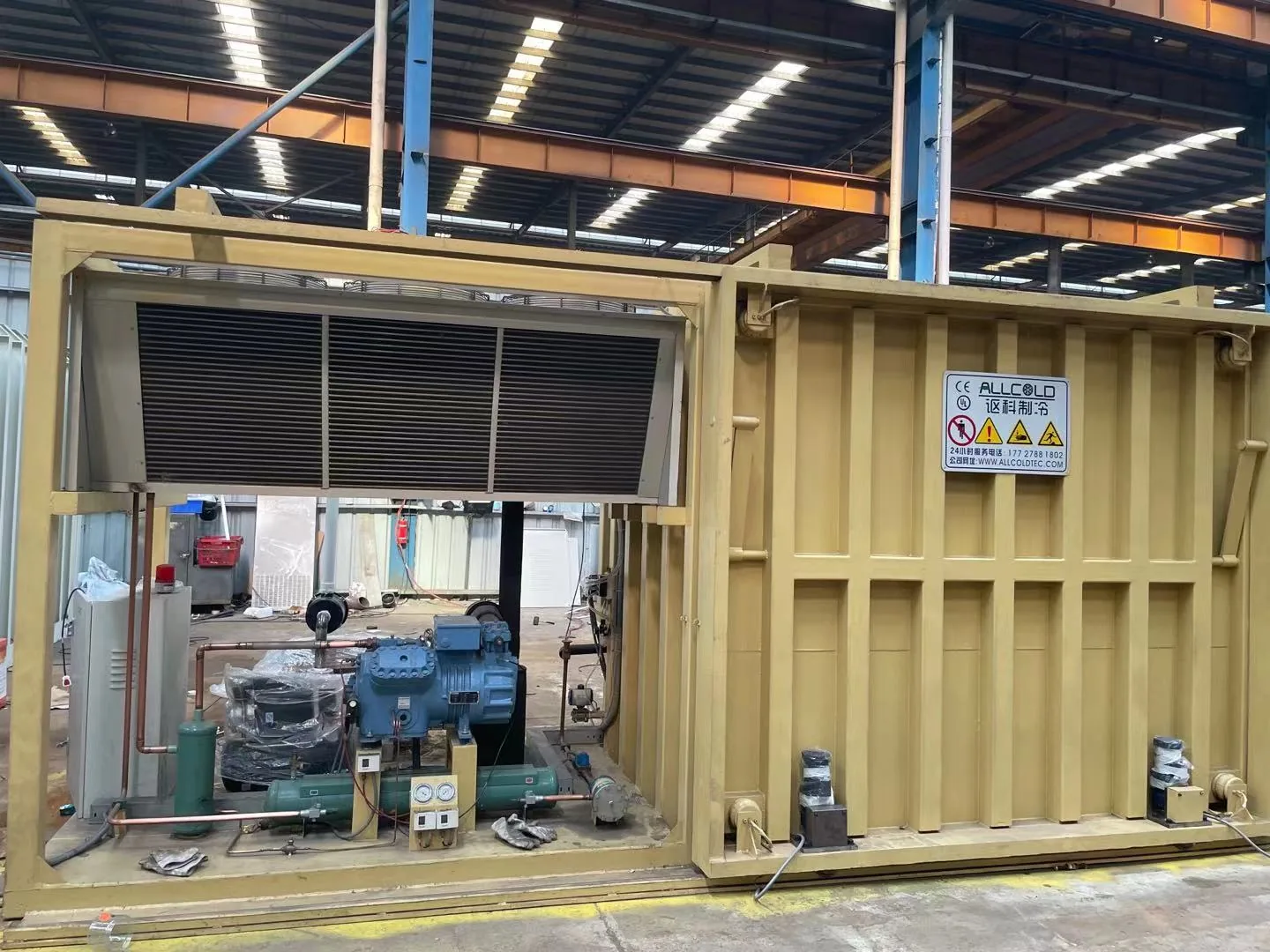
Ask the supplier to identify the refrigerant condenser, the product-vapor condenser or cold trap, and any external water equipment on a simple system drawing. Those are different functions. Food-cooling, steam-ejector and other configurations may use a different arrangement; this comparison is not a universal diagram for every vacuum cooler.
Compare site conditions, not just the equipment labels
| Decision | Air-cooled | Water-cooled | Evaporative condenser |
|---|---|---|---|
| Heat-rejection route | Refrigerant → coil → air. | Refrigerant → condenser water → tower or another approved heat sink. | Refrigerant → wetted coil → spray water and air. |
| Critical site condition | Actual entering-air temperature and unobstructed airflow. | Available water temperature and flow; tower performance where used. | Design wet-bulb condition, airflow and reliable make-up water. |
| Scope to include | Condenser, supports, electrical work and any approved remote installation. | Condenser plus the required water-side plant, piping and connections. | Condenser, spray pump, fans, water-management provisions and connections. |
| Maintenance focus | Coils, fans and airflow. | Water circuit, exchangers and associated heat-rejection equipment. | Coil exterior, spray distribution, basin, fans and water quality. |
| Unresolved reason to pause | No workable airflow route. | No confirmed water-side duty. | No practical water-management or service plan. |
Air-cooled: check the air at the machine, not the weather app
A condenser beside a wall, beneath a low canopy or facing another unit’s hot exhaust may receive warmer air than the weather report suggests. Daikin’s installation guidance explains that inadequate airflow and warm-air recirculation can raise condensing pressure and reduce refrigeration capacity and efficiency.[3]
Before fixing the location, send the supplier photographs and a dimensioned sketch showing walls, roof height, neighboring equipment and discharge direction. Use the selected unit’s approved clearances. A generic one-meter gap is not a substitute for its installation requirements.
Where space is tight, ask whether an engineered remote-condenser arrangement is available for that model. Do not assume that ducting the fans or extending refrigerant lines is an acceptable site modification. The outdoor installation guide covers the surrounding layout decisions.
Water-cooled: a hot climate is not a complete specification
A system with an evaporative cooling tower depends on wet-bulb conditions and tower performance. Wet-bulb temperature reflects both heat and humidity; it is not the ordinary air-temperature reading. A water-cooled refrigerant condenser can operate at a lower condensing temperature than an air-cooled one under suitable conditions. Trane explains this potential compressor-efficiency advantage.[4]
That does not establish a universal winner. Request selections for the actual harvest-season conditions and production schedule. A claim such as “suitable for hot countries” tells you less than a stated design condition and an agreed loaded-cycle duty.
Evaporative condensing: compare the benefit and the operating commitment
Include an evaporative-condenser proposal when the site can support its water and maintenance requirements. Request its heat-rejection duty at the local design wet-bulb temperature and proposed refrigerant condensing temperature. Do not apply an air-cooled rating condition to it or assume that a supplier’s general energy-saving percentage will hold for your vacuum-cooling cycle.
A typical evaporative condenser combines refrigerant condensation and evaporative heat rejection in one unit, avoiding the separate condenser-water loop of a conventional water-cooled condenser/tower arrangement. It still needs spray circulation, fans and water management. Less external piping does not mean no auxiliary equipment.
- Operating cost: include spray-pump and fan electricity, make-up water, treatment and maintenance—not only compressor power.
- Service access: check access to the coil, spray distribution, basin and drift eliminators; ask who will perform the specified cleaning and water-management tasks.
- Site approval: confirm discharge-air placement and the required water-management provisions; include freeze protection where seasonal conditions require it.
EVAPCO’s operating guidance treats spray-water distribution, water chemistry and cold-weather protection as maintenance responsibilities, not optional afterthoughts.[5]
Request estimated water use for the same duty as the alternatives. Evaporative condensing is not automatically the lowest-water option, and a lower compressor demand alone does not prove the lowest whole-system cost.
Circulating water and consumed water are different figures
Trace the water circuit before accepting the quotation. A connection size alone does not explain whether the water is discharged, recirculated through a tower, or returned through another engineered cooling loop.
- Once-through supply: establish source reliability, required flow, discharge arrangements and whether the local utility permits the proposed use.
- Evaporative cooling tower: include make-up water, blowdown management, treatment and maintenance in the operating plan.
- Closed loop with another heat-rejection device: identify that device and its summer capability. A water-cooled condenser can be connected to an engineered dry-cooler loop; it does not automatically require an open tower.
A recirculating evaporative tower is not water-free. The U.S. Department of Energy identifies evaporation, blowdown and drift as water losses that require replacement, and explains why mineral concentration must be controlled.[6] Ask for two separate figures: circulating flow and expected make-up consumption. For an evaporative condenser, request these for its spray-water system rather than assuming the figures for a separate cooling-tower loop apply.
If a packhouse already has a tower, ask its designer to confirm spare heat-rejection capacity at coincident peak demand. “We already have cooling water” is not evidence that another loaded vacuum-cooling cycle can be added without affecting existing users.
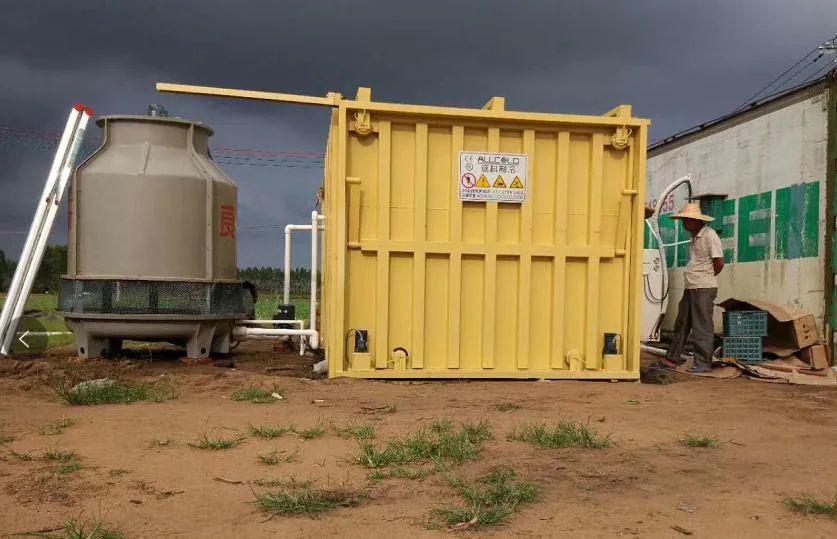
Compare the complete system on the same cooling duty
Do not compare an air-cooled package price with a water-cooled machine price that excludes the tower and pumps, or an evaporative-condenser price that omits installation and water management. Likewise, do not compare compressor power alone when options use different auxiliary equipment.
For each proposal, request the same product load, initial and final temperatures, packaging and operating conditions. Then separate three questions:
- Installed cost: what must be purchased, connected and commissioned before production can start?
- Operating cost: what electricity, water, treatment and scheduled maintenance does the complete arrangement require?
- Delivered production: how many comparable batches can it complete within the working shift?
Keep rated kW distinct from measured or estimated kWh per batch. Include external fans and pumps and state how shared-plant consumption is allocated. Otherwise, moving power consumption outside the machine can make a quotation look more efficient without reducing site energy use.
A simple break-even check
Illustrative arithmetic only—not Allcold pricing or a predicted saving. Suppose one complete arrangement costs $6,000 more to install but saves $1.50 per comparable batch after electricity, water and treatment. If its additional fixed annual maintenance is $600, then at 2,000 batches per year the net annual saving is:
(2,000 × $1.50) − $600 = $2,400 per year
Simple payback is $6,000 ÷ $2,400 = 2.5 years. At only 600 batches, the saving falls to $300 per year and the same calculation becomes 20 years. This excludes financing, replacements and production disruption. Replace every assumption with the project’s actual figures before using the result.
The point is not that any one cooling method pays back faster. It is that annual utilization can change the answer. For an existing machine with deteriorating performance, investigate the cause first using the summer cooling-water and cycle-time guide; poor performance alone does not prove the original system type was wrong.
Send one clear brief to every supplier
Use the following request alongside your vacuum-cooler quotation checklist:
“Please evaluate suitable air-cooled, water-cooled and evaporative-condenser arrangements for our product, batch mass, packaging, temperature change and daily schedule. Identify the proposed condenser type, design air/water conditions, all auxiliary equipment, utility demand and excluded work. State the cooling duty at those conditions, maintenance responsibilities and any site data needed before final selection.”
Attach a layout, operating-season climate information, available electrical supply and any existing water-system data. If flow or temperature is unknown, mark it “to be confirmed” rather than entering an optimistic estimate. Ask for the missing measurement to be resolved before the equipment selection is finalized.
Frequently asked questions
Does air-cooled mean the vacuum cooler uses no water?
No. It describes the refrigerant heat-rejection method in this comparison. Other machine functions or cleaning may still need water. Request a utility list for the exact configuration.
Is an evaporative condenser the same as a cooling tower?
No. A cooling tower cools a water circuit; an evaporative condenser condenses refrigerant within its coil. Both can use water evaporation, but they are not interchangeable pieces of equipment.
Will water-cooled or evaporative equipment always cool produce faster?
No. Cycle performance also depends on the product, load, vacuum system, vapor-handling capacity and control sequence. Compare a stated loaded duty, not a cooling-method label.
Can we change the condenser type later?
Do not treat it as a plug-in upgrade. Have the original equipment supplier assess the refrigeration circuit, heat exchanger, controls and site works. A future conversion should not be assumed in the purchase decision.
Can an existing cooling tower serve the new machine?
Possibly, but the connection needs a system review covering available duty, water conditions and simultaneous loads. A spare pipe connection does not establish spare cooling capacity.
Compare configurations for your actual site
Send Allcold your product, batch requirement, operating schedule, location and utility information. Ask which heat-rejection arrangement is suitable for the proposed model and what the complete quotation includes.
Sources and technical references
These references explain refrigeration and heat-rejection principles. They are not performance certifications for an Allcold model; final duties and utilities must be confirmed in the project specification.
- ASHRAE Handbook, Chapter 14: Condenser Water Systems — condenser-water arrangements, flow and design considerations. ↩
- Baltimore Aircoil: What Is an Evaporative Condenser? — refrigerant coils, recirculating spray water and airflow. Product-specific savings on the source page are not Allcold performance claims. ↩
- Daikin: Air-Cooled Chiller and Condensing Unit Installation Manual — positioning and airflow, printed pages 20–22. Model-specific dimensions in this manual must not be applied to Allcold equipment. ↩
- Trane: Air vs. Water Cooled Chillers — dry-bulb and wet-bulb conditions and the conditional efficiency trade-off. ↩
- EVAPCO: Operation and Maintenance Instructions for Closed Circuit Coolers and Evaporative Condensers — spray distribution, water management and cold-weather operation. Follow the actual selected equipment’s manual. ↩
- U.S. Department of Energy: Cooling Tower Management — make-up water, blowdown, mineral concentration and water management. ↩