
Why Bean Sprouts Are One of the Hardest Vegetables to Pre-Cool Correctly and What Exporters Get Wrong
Bean sprouts look simple. They are light, moist, and usually packed in bulk or retail bags. But from a pre-cooling point of view, they are one of the hardest fresh vegetables to handle correctly. They have very high moisture content, high respiration activity, dense pack behavior, and a short commercial shelf life. A small cooling mistake can show up quickly as browning, sour odor, condensation, or uneven temperature in the center of the pack.
For bean sprout producers and exporters, the problem is not only whether the product becomes cold. The real question is whether the whole pack reaches the right temperature quickly enough without over-stressing the delicate tissue. Many operations either under-cool the core of dense packs or over-cool exposed areas while trying to force the center down.
Vacuum cooling can suit bean sprouts well because it removes heat quickly from a high-moisture product. But the process needs tighter control than for many standard vegetables. The exporter must manage density, packaging, target temperature, cycle profile, and post-cooling handling as one system.
Why Bean Sprouts Are More Perishable Than Most Exporters Plan For
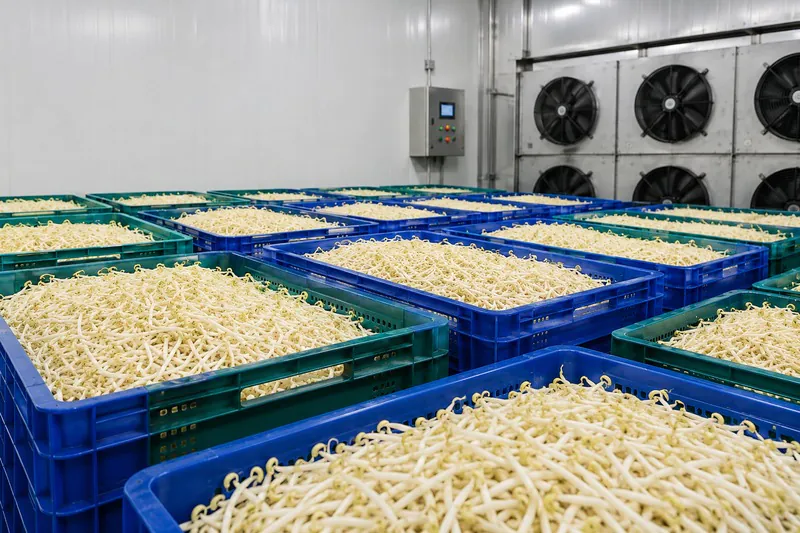
Bean sprouts are highly perishable because they are living, tender, water-rich plant tissue. Their commercial shelf life is usually measured in days, not weeks. Even when they look fresh after production, quality can decline quickly if temperature control is delayed or uneven.
The first issue is respiration. Bean sprouts continue to respire after harvest or production. If they remain warm, respiration stays high and the product consumes reserves while generating heat. In a dense pack, that heat is not always removed evenly. The center can remain warmer than the surface, especially when packaging restricts airflow.
The second issue is moisture. Bean sprouts contain a lot of water and show quality problems quickly when moisture balance is wrong. Too much free moisture can contribute to condensation and microbial pressure. Too much dehydration can create wilted tips and poor appearance. The exporter has to control both temperature and moisture, not one or the other.
This is why bean sprout pre-cooling should be treated as a critical control stage. The process must start soon after production or packing. Waiting time in a warm packing area is not a harmless buffer. It is the beginning of shelf-life loss.
For exporters, the basic planning question is: how quickly can each batch move from production temperature to stable holding temperature, and how uniform is that result across the full pack?
The Density Problem: Why Bulk Packs of Bean Sprouts Cool Unevenly Without the Right Approach
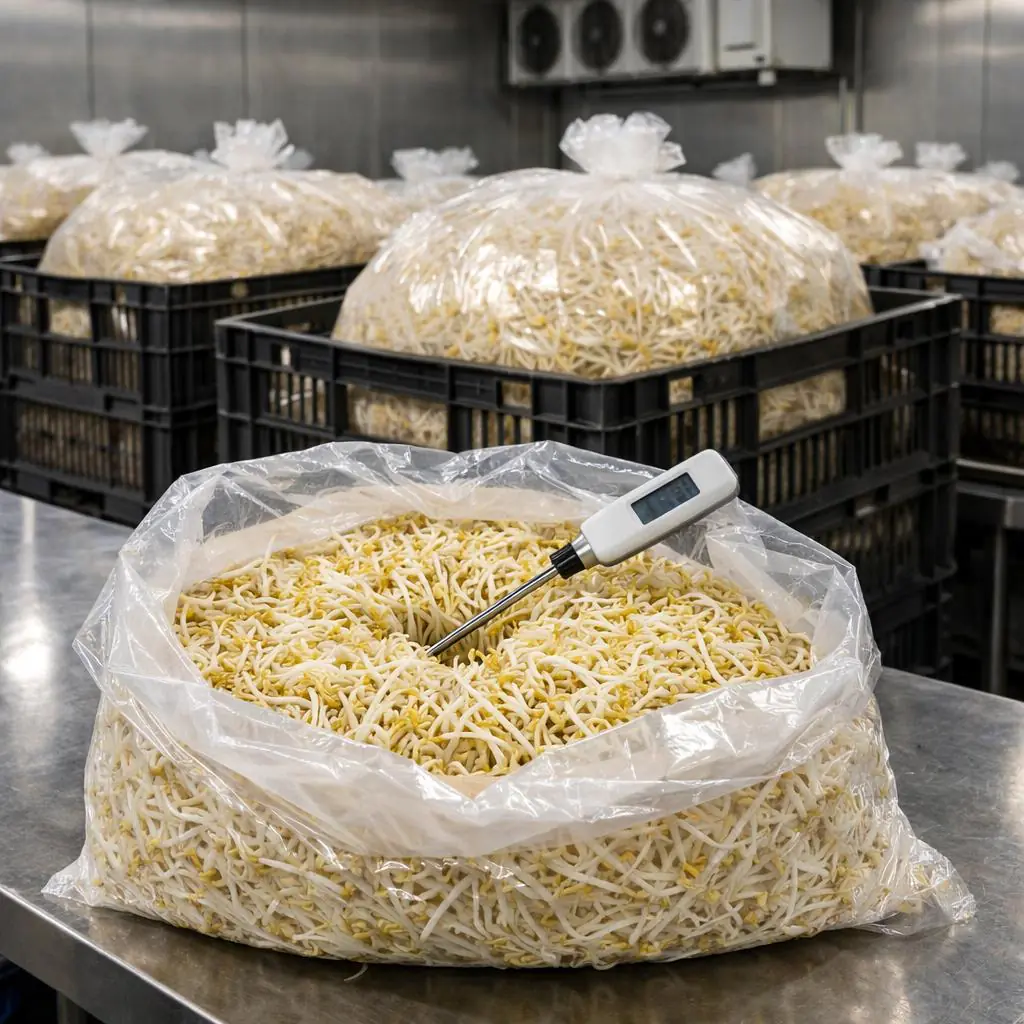
Bean sprouts are often packed densely because they are light and high volume. Bulk bags, lined crates, and retail packs can all create a dense product mass. This density is where many cooling problems begin.
In forced-air systems, cooling depends on airflow moving through or around the product. Dense bean sprout packs can resist airflow. The outer layer cools first, while the center remains warm. If the operator extends cooling time to reach the center, the outer product may become over-exposed, dehydrated, or stressed.
Vacuum cooling reduces some airflow dependence because heat removal happens through evaporation under reduced pressure. That is why it can be attractive for bean sprouts. However, density still matters. If packaging traps moisture, blocks vapor movement, or creates uneven product compaction, the cooling result can still vary.
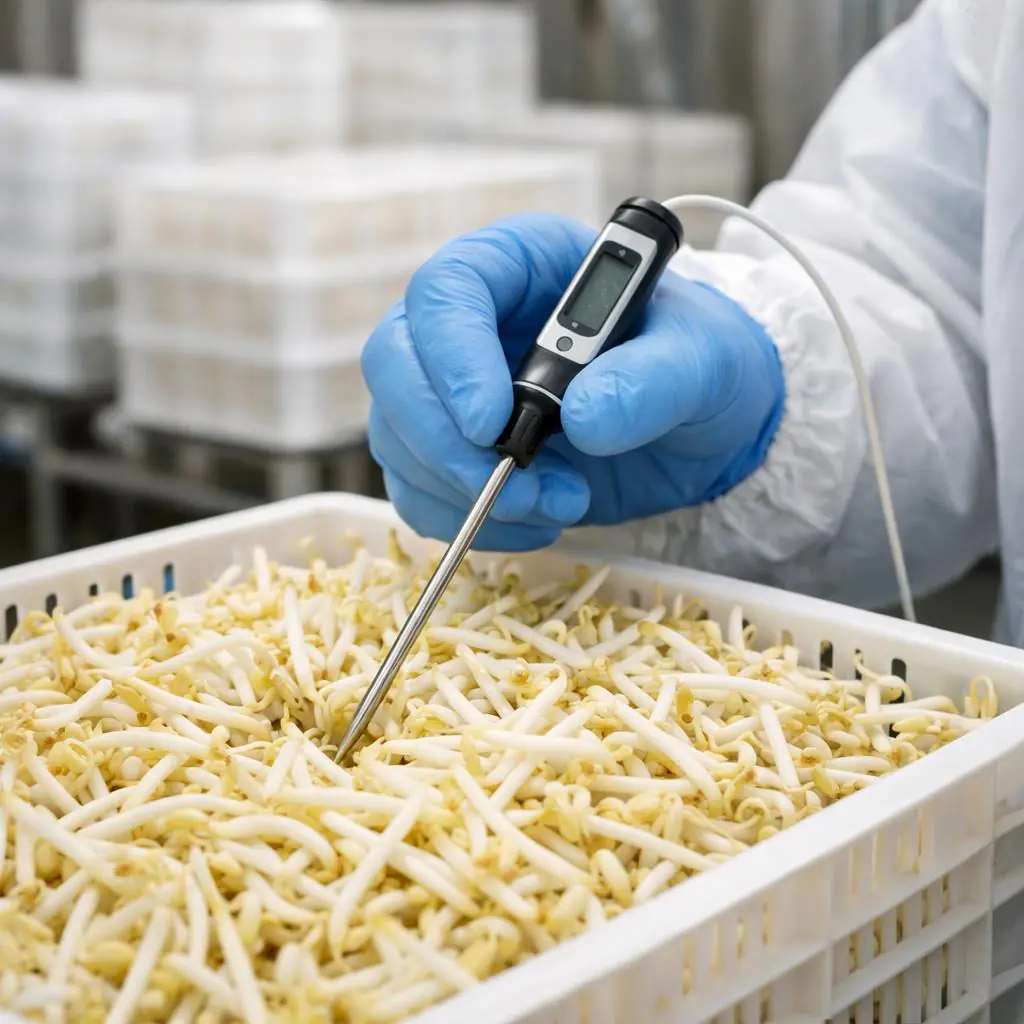
The center of the pack is the position exporters must respect. A surface measurement gives false confidence. A probe inserted only into an easy outer area may show that the batch is ready while the core is still too warm. For bean sprouts, the difference between surface and core can become a shelf-life problem quickly.
During project planning, buyers should test actual commercial pack sizes. Do not test a small loose tray and assume a large export bulk bag will perform the same.
A good validation process measures multiple points: top, center, bottom, edge, and middle of the pallet. It also checks product appearance after cooling and after storage. Uniform temperature is necessary, but not enough. The product must also remain visually clean and crisp.
Over-Cooling vs Under-Cooling: Why the Margin for Error Is Narrow
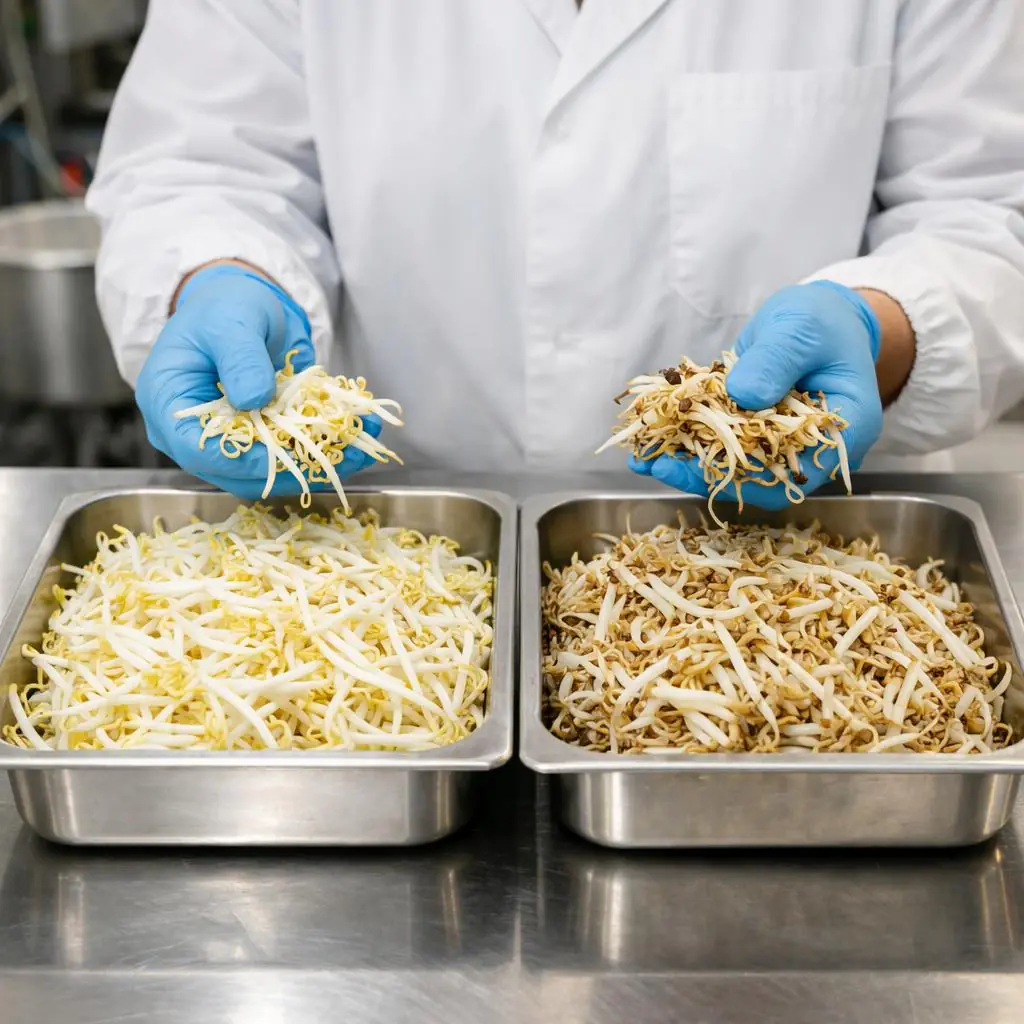
Bean sprouts have a narrow cooling margin. Under-cooling leaves heat in the product and shortens shelf life. Over-cooling or overly aggressive cycles can damage exposed tissue, increase browning risk, or create poor texture. Both mistakes can lead to rejection, but they come from opposite assumptions.
Under-cooling often happens when exporters rely on cold room holding to finish the job. The product enters the cold room too warm, especially in the core. The room air may be cold, but the dense pack cools slowly. During that delay, the center continues to respire and deteriorate.
Over-cooling happens when operators try to solve this problem by pushing the cycle too hard or too long. In vacuum cooling, excessive evaporation or unsuitable pressure control can stress delicate sprouts. The surface may lose quality while the center is still being chased down to target.
The right solution is not simply “more cooling.” It is better process control: a cycle profile that removes heat quickly but protects tissue.
Operators also need clear acceptance checks. Is the product bright? Are tips intact? Is there browning? Is there free water in the pack? Is the core temperature within range? Does the product still look acceptable after twenty-four or forty-eight hours of cold storage? These checks matter because bean sprout damage may become more visible after a short holding period.
This narrow margin is why bean sprouts should not be treated like a generic vegetable. A standard setting copied from leafy greens, lettuce, or mushrooms may not be appropriate. For broader parameter thinking, Allcold has covered why different vegetables need different cooling settings in optimal vacuum cooling parameters for different vegetables.
What Pre-Cooling Temperature Targets Actually Protect Bean Sprout Shelf Life
Temperature targets for bean sprouts should be based on buyer requirements, food safety expectations, shelf-life goals, and product tolerance. The exporter should define target product temperature, not only room temperature or truck temperature.
The most important distinction is between surface temperature and core temperature. Bean sprouts can feel cold on the outside while the center of a bulk pack remains warm. That warm center is where shelf-life risk continues. A target that does not specify measurement position is not strong enough for export control.
A practical target specification should include starting temperature range, target discharge temperature, acceptable temperature spread, measurement points, and maximum transfer time to cold storage.
The target should also avoid freezing or chilling stress. Bean sprouts are delicate and water-rich. Operating too close to damaging temperatures can create quality defects. The goal is rapid removal of field or process heat, followed by stable cold holding, without pushing the product beyond its tolerance.
For documentation, exporters should record batch ID, product type, packaging format, start time, end time, cycle recipe, temperature readings, operator name, and visual inspection result. These records help identify whether quality loss happened before cooling, during cooling, in storage, or in transport.
Buyers often ask for cold-chain proof, but a truck temperature log is not enough. If bean sprouts left the packing house with a warm core, the later cold-chain record may look good while the product continues to deteriorate. Pre-cooling data is the missing evidence.
How Packaging Format Affects Vacuum Cooling Uniformity for Bean Sprouts
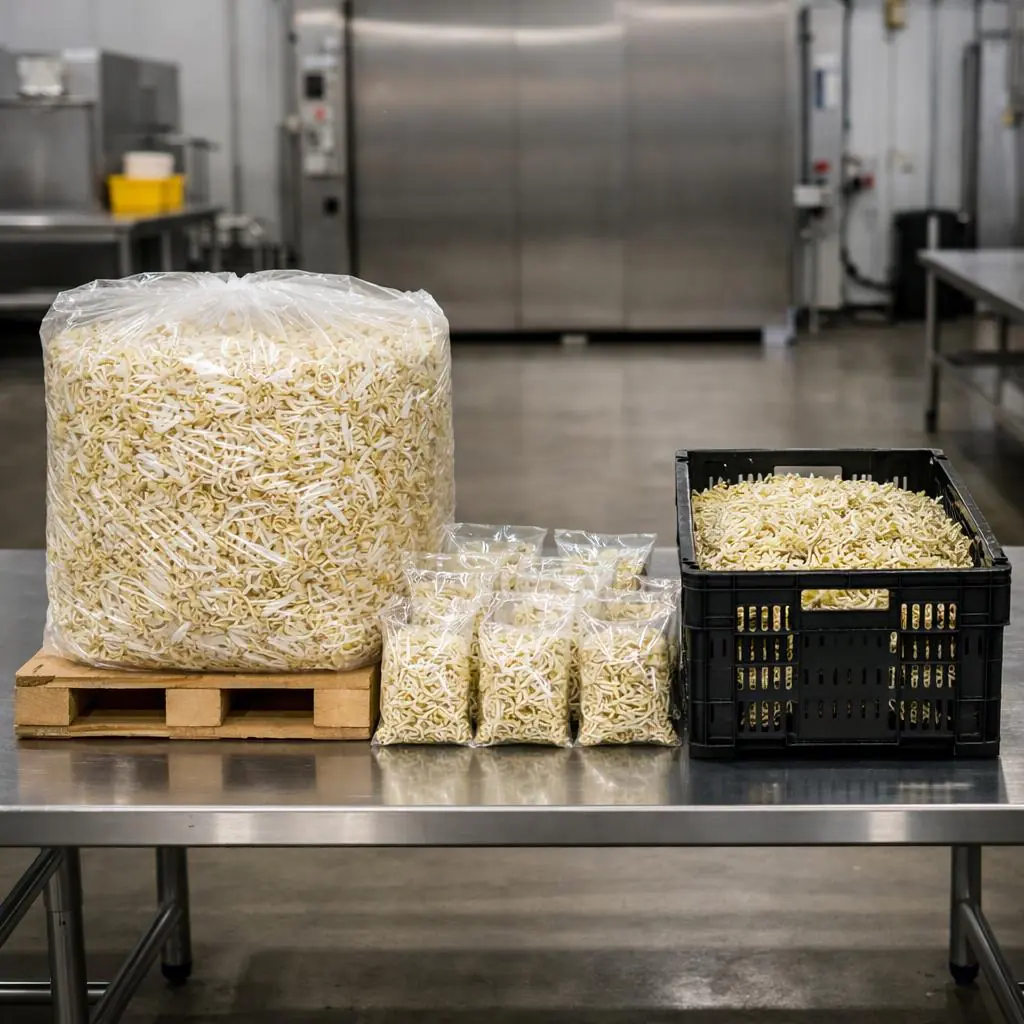
Packaging can make or break bean sprout cooling performance. Bulk bags, perforated bags, sealed retail packs, liners, shallow trays, and ventilated crates all behave differently.
Bulk bags create depth and density. Retail bags may restrict vapor movement. Liners can protect hygiene but slow cooling. Overfilled crates may compress the product and reduce uniformity. Cartons with poor ventilation may create temperature differences across the pallet.
For vacuum cooling, packaging must allow heat and vapor movement while still meeting hygiene and market requirements. This is a practical engineering compromise. The exporter cannot choose packaging only for appearance or cost and then expect the cooler to overcome every restriction.
Testing should be done with the actual export pack. If supermarket buyers require a specific bag size or carton configuration, that format must be validated. Measure product temperature in the center of bags, in inner cartons, and across different pallet positions. Also check condensation after cooling and during storage.
Packaging affects cycle time too. A loose ventilated crate may cool quickly, while a dense retail carton may need more time or a different loading pattern. If the exporter handles both wholesale and retail formats, separate recipes may be needed.
Allcold has discussed the wider question of cooling packaged vegetables in can you vacuum cool vegetables after they are packaged. Bean sprouts show why the answer depends on pack depth, material, ventilation, and acceptable moisture behavior.
When comparing suppliers, ask for packaging-specific testing. A general promise that “vacuum cooling is fast” is not enough. For bean sprouts, uniformity inside the real package is the project.
What a Bean Sprout Export Pre-Cooling Brief Should Cover Before You Compare Suppliers
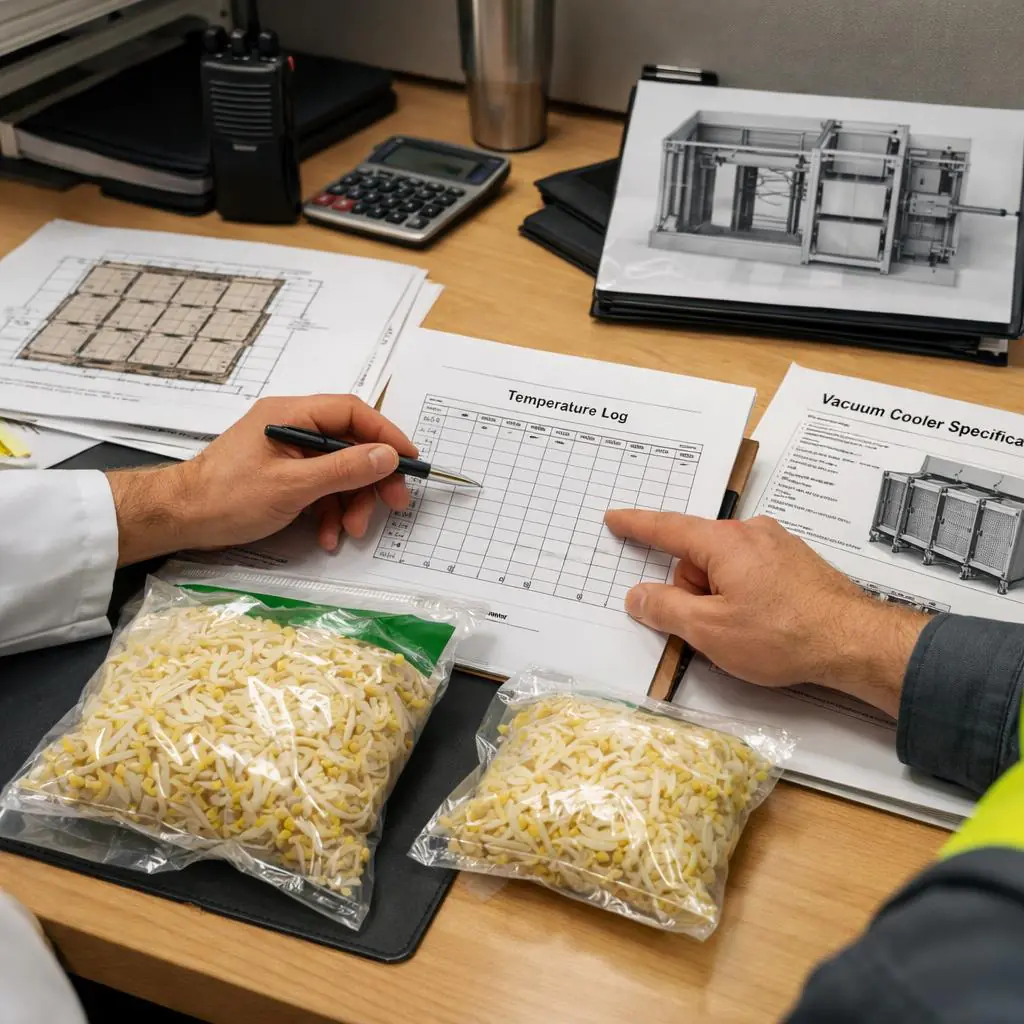
A proper bean sprout pre-cooling brief should begin with the product and process, not the machine. Suppliers need to know what they are cooling, how it is packed, how fast it arrives, and what the buyer expects at destination.
Start with product details: sprout type, production method, typical product temperature after processing, moisture condition, daily volume, peak-hour volume, and expected shelf-life target. Then define packaging: bulk bag weight, retail bag size, liner use, crate dimensions, carton ventilation, pallet pattern, and whether packaging changes by customer.
Next, define the cooling requirement. Include target core temperature, maximum temperature spread, expected cycle time, acceptable moisture loss, and visual quality acceptance. If the exporter has had previous problems such as browning, sour odor, condensation, or warm centers, include those problems in the brief.
The workflow is equally important. Where does the product wait before cooling? How long can it wait? How many batches arrive per hour? Is the cold room next to the cooler? A vacuum cooler with good technical capacity can still fail if the layout creates queues.
The brief should also request trial validation. The supplier should test or model the actual packaging format, not an idealized loose product. The acceptance test should include multiple measurement points, appearance checks, and post-cooling holding evaluation.
Finally, define records. For export bean sprouts, batch cooling logs, product temperature readings, and visual inspection records help protect the exporter’s process. They also support continuous improvement when destination complaints occur.
A good supplier will ask detailed questions before quoting. If the quotation ignores pack density, core temperature, packaging format, and cycle control, the exporter may be buying a chamber rather than a reliable pre-cooling process.
Conclusion
Bean sprouts are difficult to pre-cool because they combine high perishability, high moisture content, dense packaging, and narrow tolerance for cooling mistakes. Under-cooling leaves heat in the core. Over-cooling can damage delicate tissue. Both problems reduce shelf life and export confidence.
Vacuum cooling can be a strong method for bean sprouts, but only when the process is designed around real pack density, packaging format, target core temperature, and careful cycle control. The goal is not simply to make the product cold. The goal is to cool it uniformly, quickly, and gently enough to protect buyer-grade quality.
If you are planning a bean sprout export project, share your pack format, batch weight, peak-hour volume, current temperature problem, and buyer target. We can help review the main pre-cooling risks before you compare equipment suppliers.
External References
- UC Davis Postharvest Technology Center, commodity fact sheet resources
- FAO, *The role of post-harvest management in assuring the quality and safety of horticultural produce*
- FAO, *Manual for the preparation and sale of fruits and vegetables: From field to market*
- ASHRAE Handbook resources
- Postharvest Biology and Technology journal
- International Journal of Food Microbiology
Looking for the right vacuum cooler for your operation?
Allcold engineers work with packhouses and exporters to spec the right system for your product, volume, and site conditions.

Mila
You May Also Like
Used vs. New Vacuum Coolers: Is the Lower Price Worth It?
Buying a used vacuum cooler? Compare load fit, condition, relocation, installed cost and support with a new system before deciding if the saving is real.
Why Does Produce Sweat After Vacuum Cooling?
FRESH PRODUCE · POST-COOLING HANDLING The cooling cycle can finish correctly—and the load can still become wet on its way
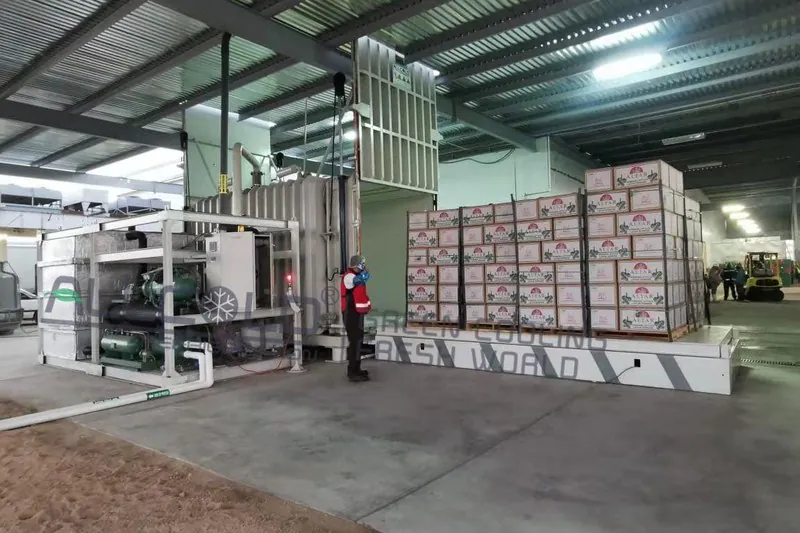
Vacuum Cooler Not Performing? Check Your Pallet Loading First
When a vacuum cooler produces inconsistent results—warm spots, longer cycle times, variable exit temperatures across the load—the machine is usually
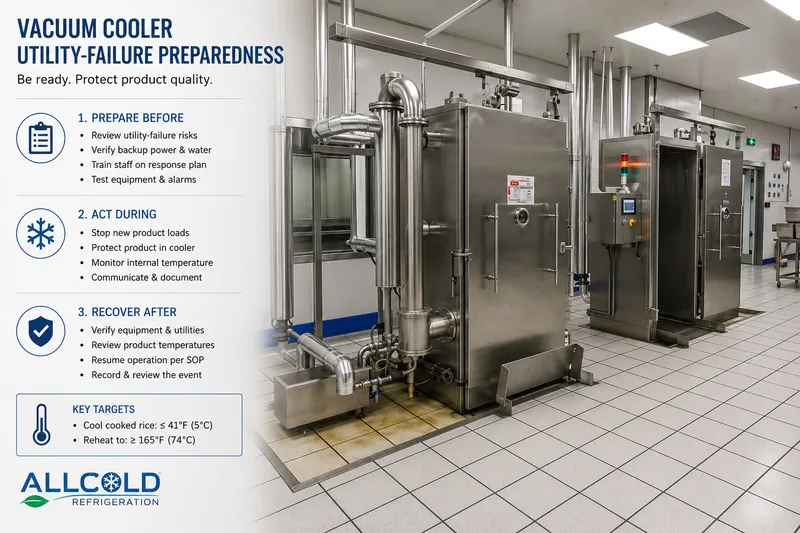
Why One Successful Cooked Rice Cooling Test Is Not Enough to Standardize a Central Kitchen Process
A cooked rice batch can pass a vacuum cooling test and still fail as a production process. That is the
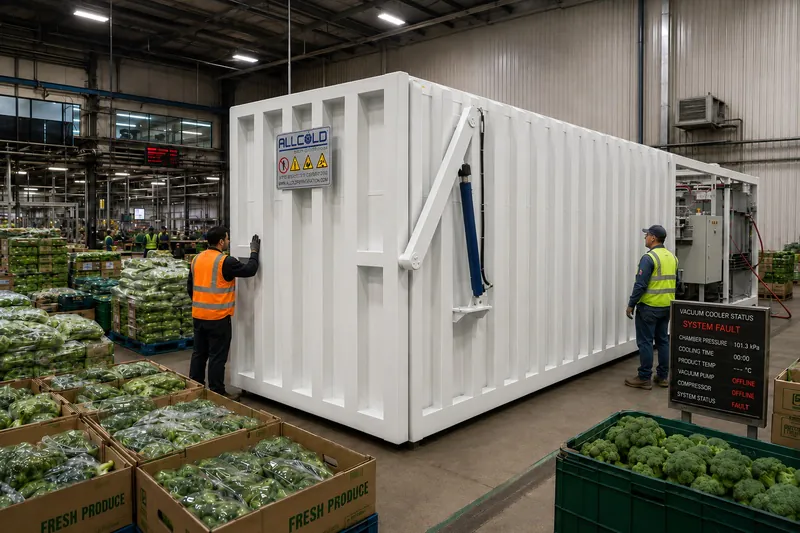
Why a Vacuum Cooler Utility Failure Becomes an Export Quality Problem Before It Becomes a Repair Problem
A vacuum cooler stoppage does not start as a maintenance problem. In a produce export operation, it becomes a quality
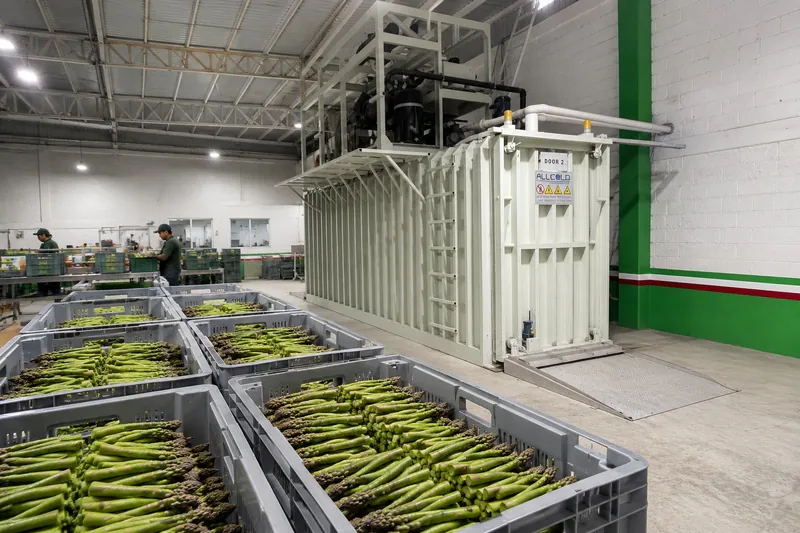
Why Asparagus Loses More Export Value in the First Two Hours After Cutting Than in the Entire Cold Chain That Follows
For fresh asparagus exporters, the most expensive quality loss often happens before the product even reaches the main cold chain.
Why Broccoli Loses Export Quality Faster Than Any Temperature Log Will Show
The complaint comes in from the buyer: yellowing, premature flowering, weak texture on arrival. The exporter reviews the cold room
Why Spinach Shipments That Leave Looking Perfect Arrive Looking Wrong
The complaint lands differently with spinach than with most other export vegetables. The exporter packed dark green, crisp product. The
How Exporters Can Reduce Produce Rejection Claims with Better Pre-Cooling Workflow
Learn how exporters can reduce produce rejection claims by improving pre-cooling workflow, timing control, packing handoff, and first-mile cold chain stability.
Buying a Vacuum Cooler for Fresh Produce Export? Avoid These Costly Procurement Mistakes
Buying a vacuum cooler for fresh produce export is not simply a machine purchase. It is a project decision that