
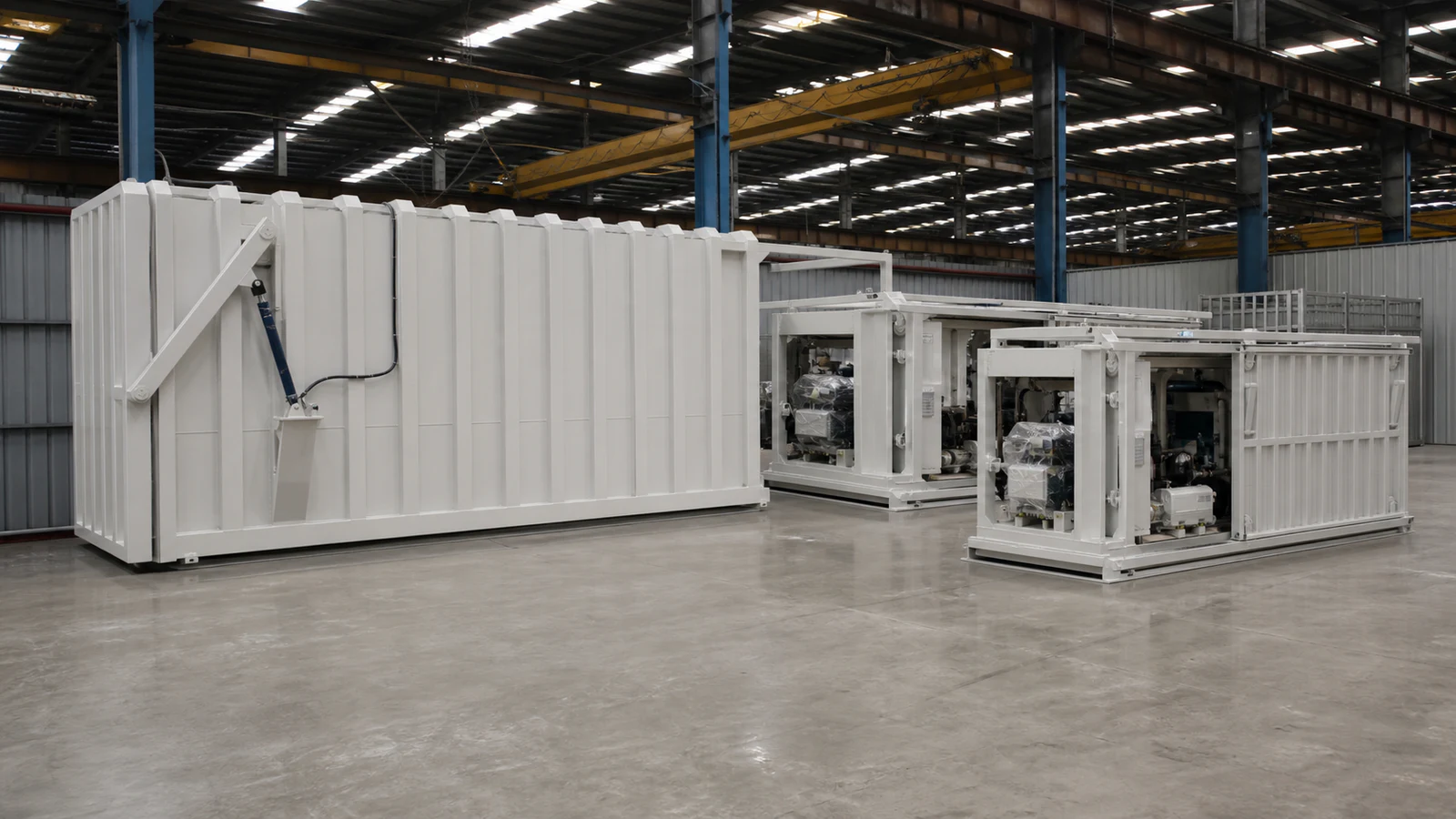
Two Vacuum Coolers Are Not Always Redundant: How to Compare One Large Unit with Two Smaller Units
Direct answer: choose one large vacuum cooler when batches are consistently large, floor space is constrained and a planned shutdown is operationally acceptable. Consider two smaller units when arrivals are variable, products need separate recipes, or some cooling capacity must remain during maintenance. But two chambers provide meaningful redundancy only when the failure that stops one does not also stop the other. If both depend on one vacuum train, condenser, PLC, power feeder or cooling-water loop, a single failure can still reduce site capacity to zero.
A daily tonnage figure does not settle this decision. A packhouse may receive most field heat during a short afternoon window, while another facility runs a stable shift with uniform pallet arrivals. Both may report the same tonnes per day, yet their queues, acceptable interruption and best equipment architecture can be very different.
Temperature management should start soon after harvest, and initial cooling is a distinct operation rather than a substitute for refrigerated storage.1 FAO packing-house guidance likewise treats scale, layout, operations and precooling as connected design decisions.2 The practical selection therefore has to combine product data, arrival pattern, complete cycle time, site utilities and the amount of capacity the business needs after a credible failure.
The Real Comparison Has Three Architectures
“One large unit or two small units?” hides an important middle case. Ask the supplier to identify which of these architectures is actually being quoted:
- One large complete process train: one chamber served by its specified vacuum, vapour-condensation, control and utility arrangement.
- Two chambers with a shared critical train: two loading spaces, but one or more components needed by both chambers are common. This may offer scheduling flexibility without providing full fault isolation.
- Two independent process trains: each chamber has the equipment and isolation needed to complete a cooling cycle without relying on the other train. Site-wide utilities may still remain common.
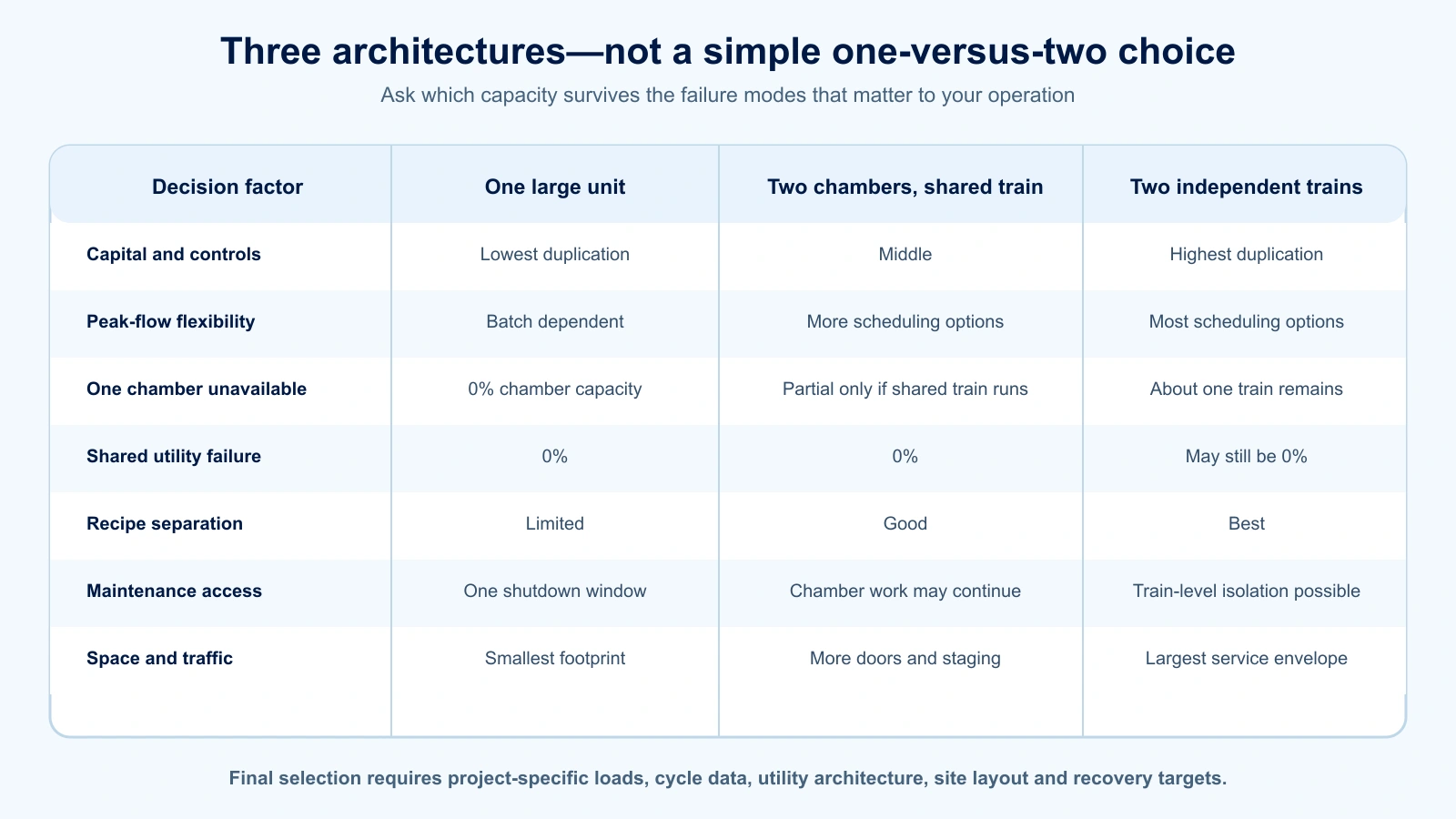
This distinction should appear in the process diagram and equipment list, not only in a sales description. A quotation that says “two chambers” but does not show pump allocation, condenser duty, automatic valves, control ownership and isolation points leaves the most important availability question unanswered. Our guide to detailed vacuum-cooler quotations explains why these assumptions belong in the commercial package.
Start with Peak-Window Demand, Not Average Tonnes per Day
Record how pallets actually arrive in 15- or 30-minute intervals during the busiest representative day. Then identify how long warm product may wait before cooling begins. The useful demand profile includes:
- pallets or bins arriving in each time interval;
- product type, starting temperature and target temperature;
- pallet dimensions, load height and packaging or liner configuration;
- the latest acceptable start and finish time for each batch;
- planned breaks, changeovers, cleaning and shift boundaries;
- downstream cold-room, grading and dispatch capacity.
Queueing cannot be judged from a daily average alone. Little’s Law establishes the general long-run relationship between the average number of items in a system, their arrival rate and their average time in the system.3 Applying that relationship to a packhouse is an engineering planning step: if arrivals temporarily exceed completed cooling cycles, the waiting queue grows. The calculation still requires the site’s own arrival and cycle data; the formula does not supply them.
For example, 80 pallets spread evenly over ten hours is not operationally equivalent to 80 pallets arriving between 14:00 and 18:00. The second profile may favour staggered chambers, temporary staging or a larger batch—depending on allowable waiting time and loading resources. Review the packing-house layout and vacuum-cooling throughput guide before treating chamber size as the only bottleneck.
Compare Complete Occupied-Cycle Time
A “30-minute cooling cycle” is not automatically one completed batch every 30 minutes. The chamber is occupied for the full sequence:
Occupied cycle time = loading + door close and lock + vacuum cooling + ventilation + unloading + turnaround
Theoretical pallet rate = pallets per completed cycle × 60 ÷ occupied cycle time in minutes
Then reduce the theoretical rate using project-specific evidence for planned stops, recipe changes, cleaning, operator delays and expected equipment availability. There is no honest universal utilization factor for every packhouse.
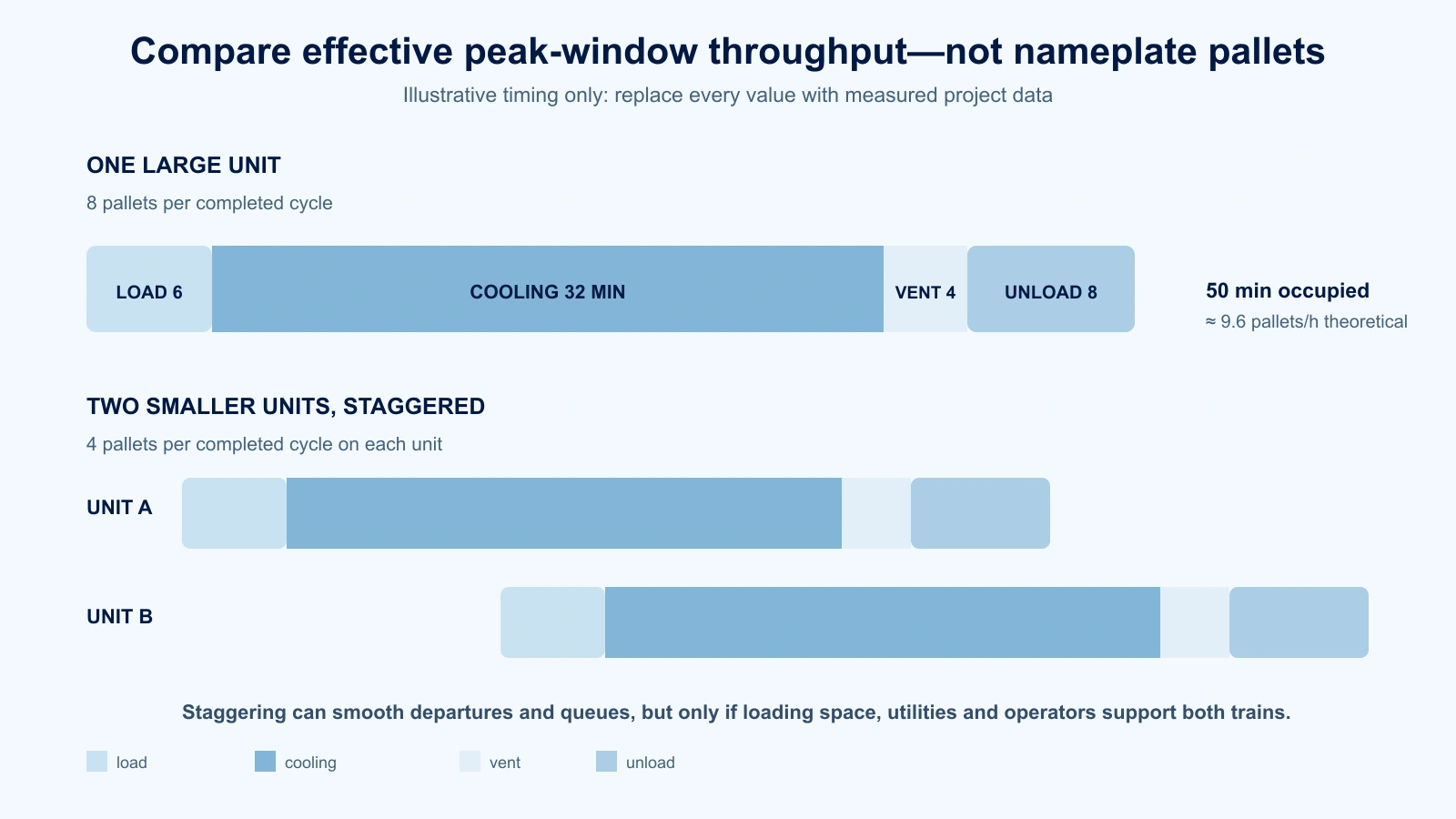
In the illustration, an eight-pallet unit with a 50-minute occupied cycle has a theoretical rate of 9.6 pallets per hour. Two four-pallet units with 46-minute occupied cycles would total about 10.4 pallets per hour if they can run concurrently and their cycles are staggered. These numbers are not product guarantees. Actual performance depends on commodity, starting and target temperatures, load construction, packaging airflow, system design and site conditions.
Before comparing proposals, obtain cycle records that show time, pressure and product-temperature behaviour. Our article on using vacuum-cooling cycle data for performance diagnosis describes the evidence that is more useful than a single claimed cycle time. Also confirm that pallet loading does not restrict vapour movement.
Draw the Redundancy Boundary Before Claiming Backup Capacity
Reliability engineering distinguishes independent backup from equipment that is vulnerable to a common cause. NIST notes that redundant solutions remain susceptible to common-mode failure, in which one event causes equivalent elements to fail in the same way.4 NIST’s own time-service architecture similarly notes that contingency systems should share few common points of failure.5 Applying those principles to a vacuum-cooling project is an engineering inference, not a claim that the cited NIST publications are vacuum-cooler standards.
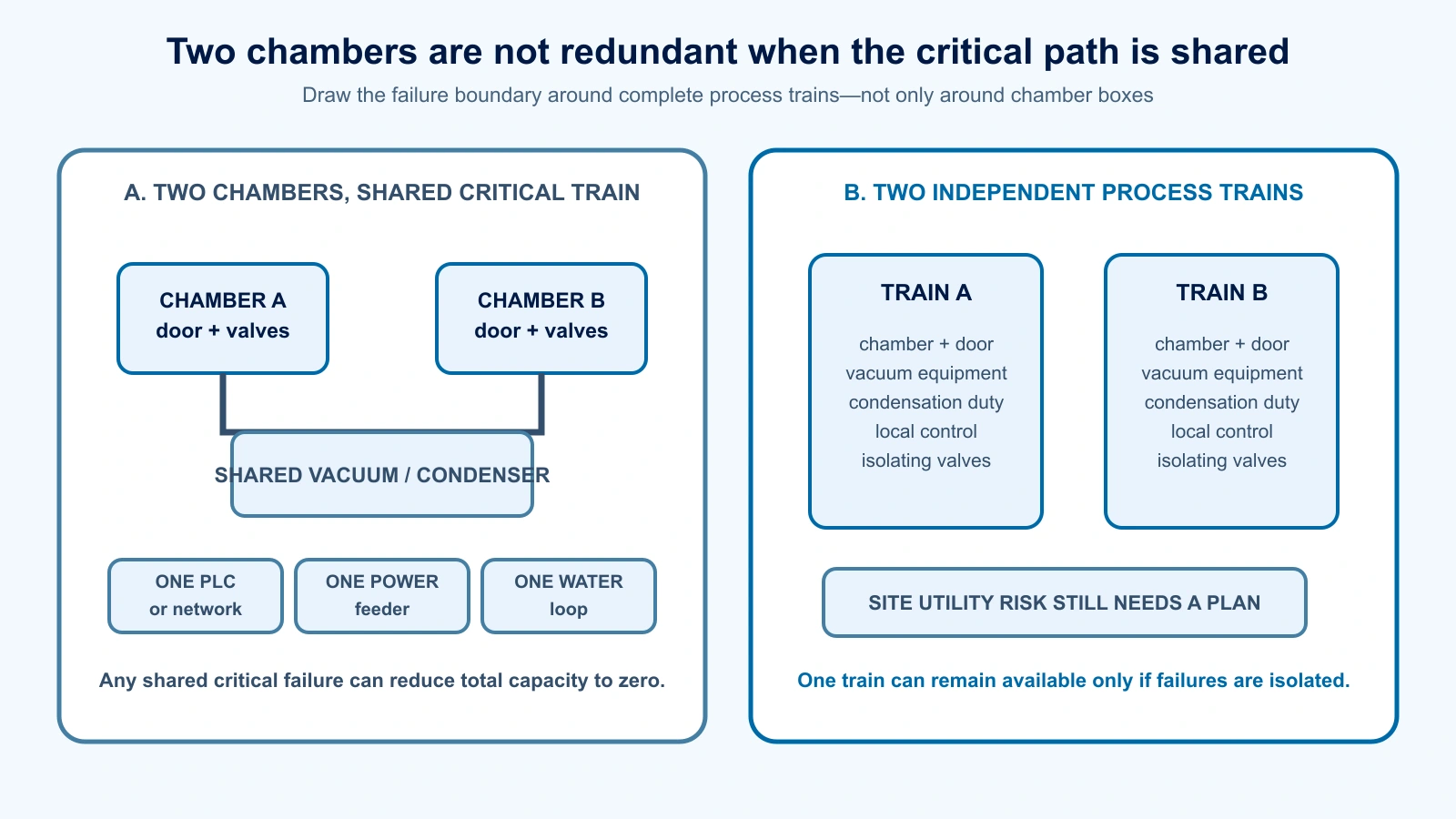
Trace each chamber through the complete path required to finish a batch:
| System boundary | Questions to ask | Possible common stop |
|---|---|---|
| Vacuum generation | Which pumps serve each chamber? Can one train be isolated and started independently? | One common pump, manifold or control starter |
| Vapour condensation / refrigeration | Is duty dedicated, shared or staged? What happens after one compressor, heat exchanger or valve fault? | Shared condensation duty cannot support either chamber |
| Control and instrumentation | Does each train have local control, sensors and a safe manual recovery procedure? | One PLC, network switch, HMI or common safety circuit |
| Electrical supply | Are feeders, protective devices and panels separated? Is the upstream source still common? | One transformer, switchboard or site outage |
| Cooling water / heat rejection | Can each train maintain required flow and temperature independently? | One pump, cooling tower, reservoir or blocked strainer |
| Product handling | Can pallets reach and leave both units if a forklift, dock or door is unavailable? | One narrow aisle, ramp, operator or staging area |
| Maintenance support | Are critical spares, tools and trained people available for both designs? | One specialised component with long replacement lead time |
Two independent four-pallet trains in the illustrative example might leave roughly 5.2 theoretical pallets per hour when one train is unavailable. Two chambers connected to a failed shared critical system might leave zero. For that reason, write the required fallback as a measurable operating target—for example, “the plant must retain enough capacity to process the priority crop within its maximum waiting time”—rather than simply asking for “redundancy.”
Utility architecture also deserves its own review. A second chamber will not protect production from unsuitable cooling-water conditions, and high inlet-water temperature can lengthen or destabilize performance. See the guide to summer cooling-water temperature and vacuum-cooler speed, plus the article on how a utility failure can become a product-flow problem.
When One Large Vacuum Cooler Is the Stronger Fit
One large unit can be the better engineering and commercial choice when:
- harvest and packing consistently create full large batches;
- the product mix uses similar cooling recipes and target conditions;
- the site has one well-defined loading route and limited equipment footprint;
- staffing does not support simultaneous loading and unloading at two units;
- planned maintenance can be scheduled outside the critical production window;
- the business has an acceptable contingency, such as another site, buffer time or planned service arrangement.
A single train normally avoids duplicating some controls, piping, service access and auxiliary equipment. But “less duplication” should not be translated automatically into a promised percentage saving. Installation, foundations, shipping envelope, utilities, doors and local labour can change the total project cost. Compare complete scope and lifecycle requirements instead of chamber price alone.
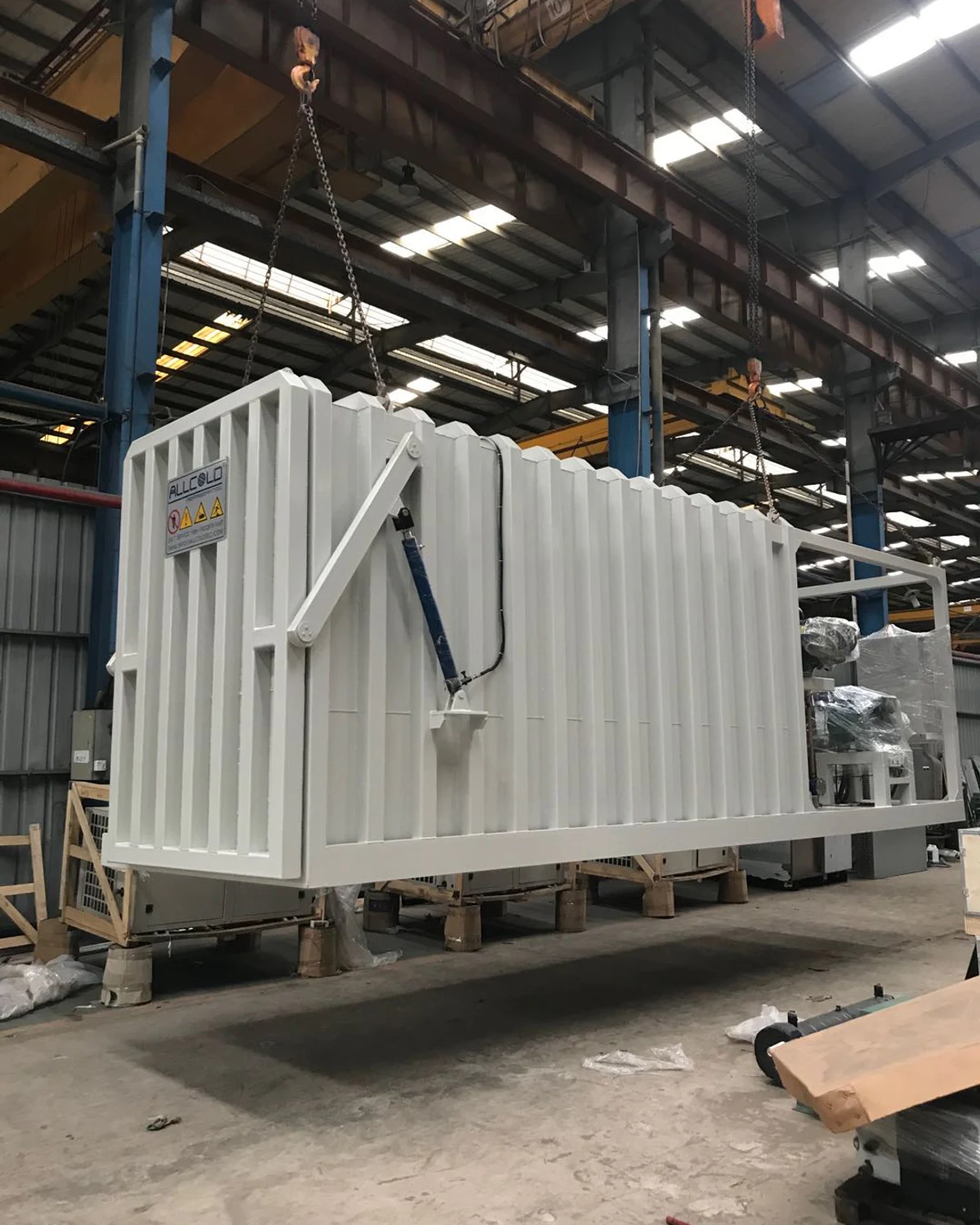
Door movement and service access still influence the usable footprint. The machine body may fit while its open-door envelope, forklift turn or rear maintenance area does not. Use the vegetable vacuum-cooler door selection guide to confirm whether an outward-opening, horizontal sliding or vertical-lift arrangement suits the site.
When Two Smaller Units Justify Their Added Complexity
Two smaller process trains are worth serious consideration when:
- pallet arrivals are uneven and smaller batches would otherwise wait to fill a large chamber;
- different crops or target temperatures need separate recipes at the same time;
- the packhouse wants to stage capacity as production grows;
- one train must remain available during defined maintenance or failure events;
- two loading positions improve flow without creating forklift conflicts;
- utilities and operators can genuinely support concurrent operation.
The strongest case is operational flexibility backed by fault isolation. If one unit can cool the highest-priority volume by itself, the second train can add peak output while also creating a planned maintenance window. If one unit cannot protect the priority volume, the buyer should describe the shortfall honestly rather than calling the architecture “50% backup.”
There is also a middle-ground design: two chambers sharing selected equipment. It can reduce duplication and offer more flexible batch scheduling, but its surviving capacity must be tested failure by failure. A shared system can be a deliberate and sensible design; it simply should not be sold or purchased as independent redundancy.
Check the Constraints That Do Not Appear in a Capacity Table
1. Simultaneous electrical and water demand
Two trains may start or pull down at overlapping times. Confirm connected load, maximum simultaneous demand, power quality, cooling-water flow, inlet temperature, drainage and heat rejection under the worst planned operating combination.
2. Loading labour and vehicle movements
Two available chambers do not double throughput if one forklift and one narrow staging lane serve both. OSHA requires safe clearances for mechanical handling in aisles, loading docks, doorways and turns, and requires aisles to remain clear.8 Translate that general requirement into a site-specific traffic and risk assessment.
3. Product and recipe separation
Separate trains can run different batches at the same time, but the production plan should state which commodities may overlap, how recipes are selected and how operators prevent the wrong batch assignment.
4. Maintenance access and isolation
Allow enough space to remove pumps, motors, heat-exchange components and door hardware without blocking the other train. “Independent” equipment that cannot be safely isolated or serviced while its neighbour runs may not deliver the expected maintenance benefit.
5. Recovery target and spare-parts strategy
ISO 22301 provides a general framework for preparing for and recovering from disruption.6 Use that business-continuity idea to define the maximum tolerable loss of cooling capacity and recovery time. ISO 14224 provides structured reliability and maintenance data concepts, although its formal industry scope is petroleum, petrochemical and natural gas equipment—not vacuum coolers.7 Its data discipline can still inspire a site log of failure mode, downtime, repair action and parts used.
Put These Questions in the RFQ
- What is the complete occupied cycle for each stated product and load, including handling and ventilation?
- What peak-window arrival profile and maximum queue was used for sizing?
- Are the quoted chambers served by shared equipment or independent process trains?
- Which pumps, condensers or refrigeration components, PLCs, panels, valves and utilities are common?
- Which single failures stop one chamber, and which stop the complete site?
- What capacity remains after each agreed failure scenario?
- Can one train be safely isolated, controlled and serviced while the other operates?
- What simultaneous electrical, cooling-water and heat-rejection duty must the site provide?
- What door clearances, pallet routes, staging areas and maintenance envelopes are required?
- Which operating data, drawings, critical spares and training are included?
For a project-specific comparison, send Allcold the hourly pallet-arrival profile, product list, starting and target temperatures, pallet configuration, available cooling window, utility data and site drawing. Start with the information requested on the fresh-produce vacuum-cooler page.
Compare Architectures, Not Just Chamber Counts
We can model one large unit, two chambers with shared equipment, or two independent process trains against your peak-hour flow and continuity target. The proposal can then show what is shared, what is isolated and what capacity remains under the failure cases that matter to your operation.
Frequently Asked Questions
Are two smaller vacuum coolers always more reliable than one large unit?
No. They provide better production continuity only when the relevant failure is isolated to one train and the surviving train has enough capacity for the priority load. Shared power, controls, pumps, cooling water or condensation equipment can stop both.
Do two four-pallet units equal one eight-pallet unit?
Not automatically. Compare complete occupied-cycle time, product conditions, concurrent utility limits, loading labour and queue behaviour. Two smaller units may offer better scheduling, while one large unit may handle uniform full batches with less duplication.
A project can be engineered with shared equipment, but the supplier must state permitted operating modes and remaining capacity after a shared-component fault. Two chambers sharing a critical train should not be assumed to offer two independent lines.
What data is most important before choosing?
The peak-window pallet-arrival profile, complete cycle time, maximum acceptable wait, product and packaging details, utility conditions, site layout and required capacity during maintenance or failure.
Is the lowest initial equipment price the lowest-risk choice?
Not necessarily. Compare installation, utilities, handling, lost-production exposure, maintenance access, spare parts and future expansion. The right choice is the architecture that meets the production and recovery targets at an acceptable total project cost.
References
- U.S. Department of Agriculture, Agricultural Research Service. Agriculture Handbook 66: The Commercial Storage of Fruits, Vegetables, and Florist and Nursery Stocks. Accessed 21 August 2026.
- Food and Agriculture Organization of the United Nations. Good practice in the design, management and operation of a fresh produce packing-house. Accessed 21 August 2026.
- Little, J. D. C. A Proof for the Queuing Formula: L = λW. Operations Research, 1961. Accessed 21 August 2026.
- National Institute of Standards and Technology. NIST SP 800-160 Vol. 1 Rev. 1 — Engineering Trustworthy Secure Systems, Appendix E.26. 2022. Accessed 21 August 2026.
- National Institute of Standards and Technology. Reliability of the UTC(NIST) Time Scale. Accessed 21 August 2026.
- International Organization for Standardization. ISO 22301:2019 — Security and resilience: Business continuity management systems. Accessed 21 August 2026.
- International Organization for Standardization. ISO 14224:2016 — Collection and exchange of reliability and maintenance data for equipment. Accessed 21 August 2026.
- U.S. Occupational Safety and Health Administration. 29 CFR 1910.176 — Handling materials: general. Accessed 21 August 2026.

Mila
You May Also Like
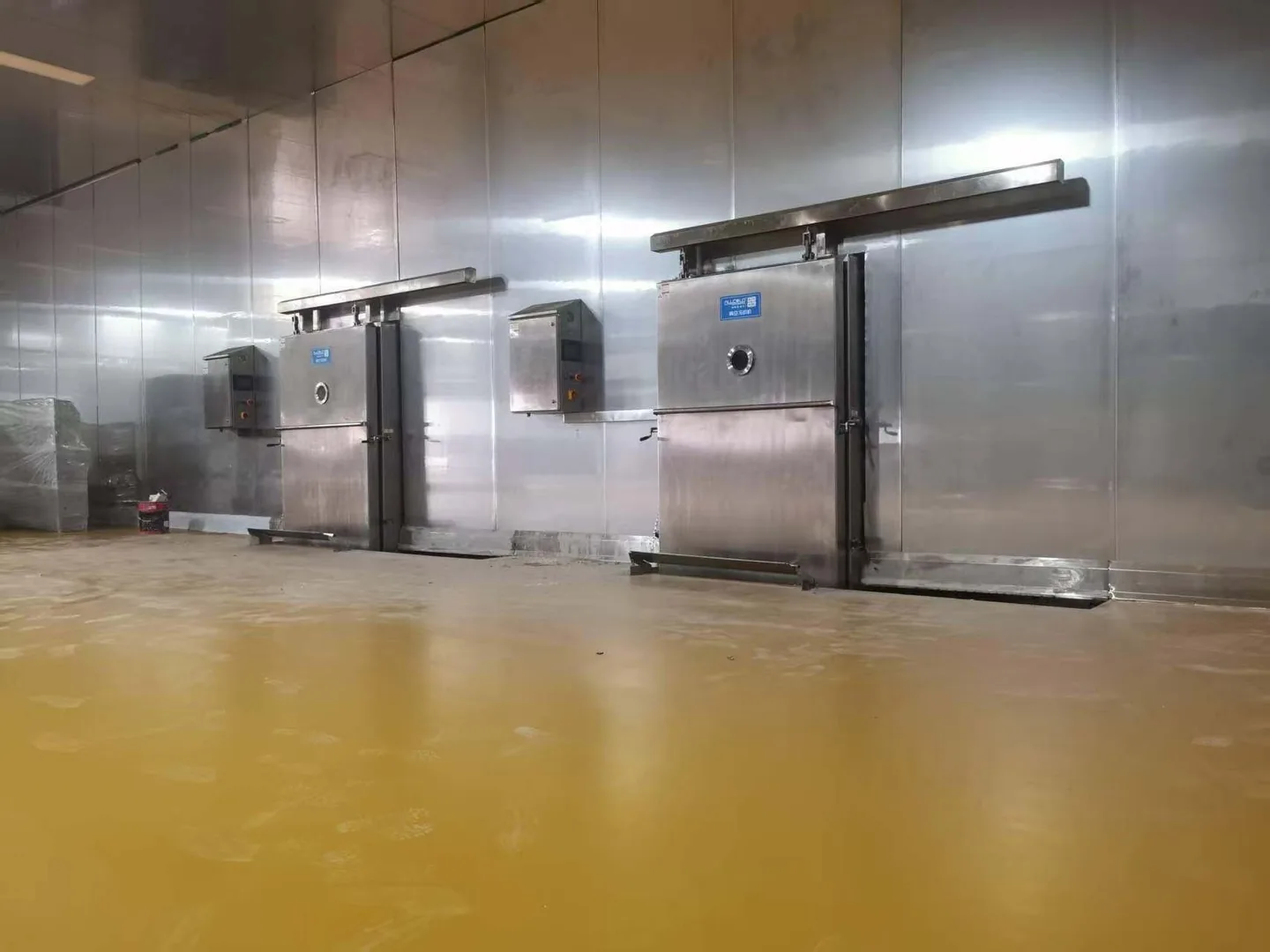
Can a Vacuum Cooler’s Chamber, Pump and Chiller Go in Different Rooms?
Keep the chamber convenient for production without assuming the machinery must sit beside it. A practical guide to reviewing a split vacuum cooling installation.
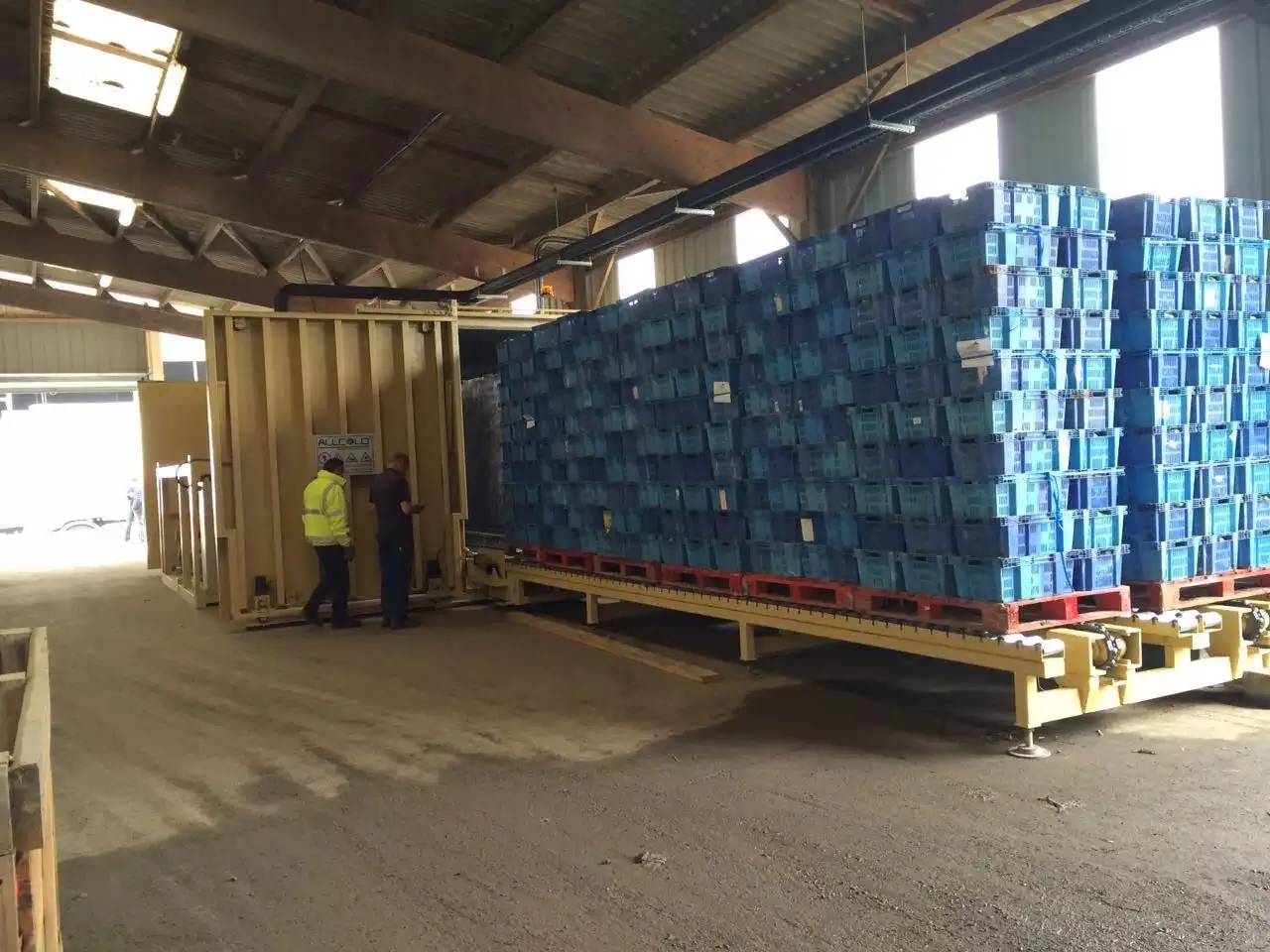
Vacuum Cooling Sweet Corn: Look Beyond Cooling Speed
Can sweet corn be vacuum cooled? Compare moisture control, husk and pack formats, hydrocooling alternatives, and the product checks to agree before buying.
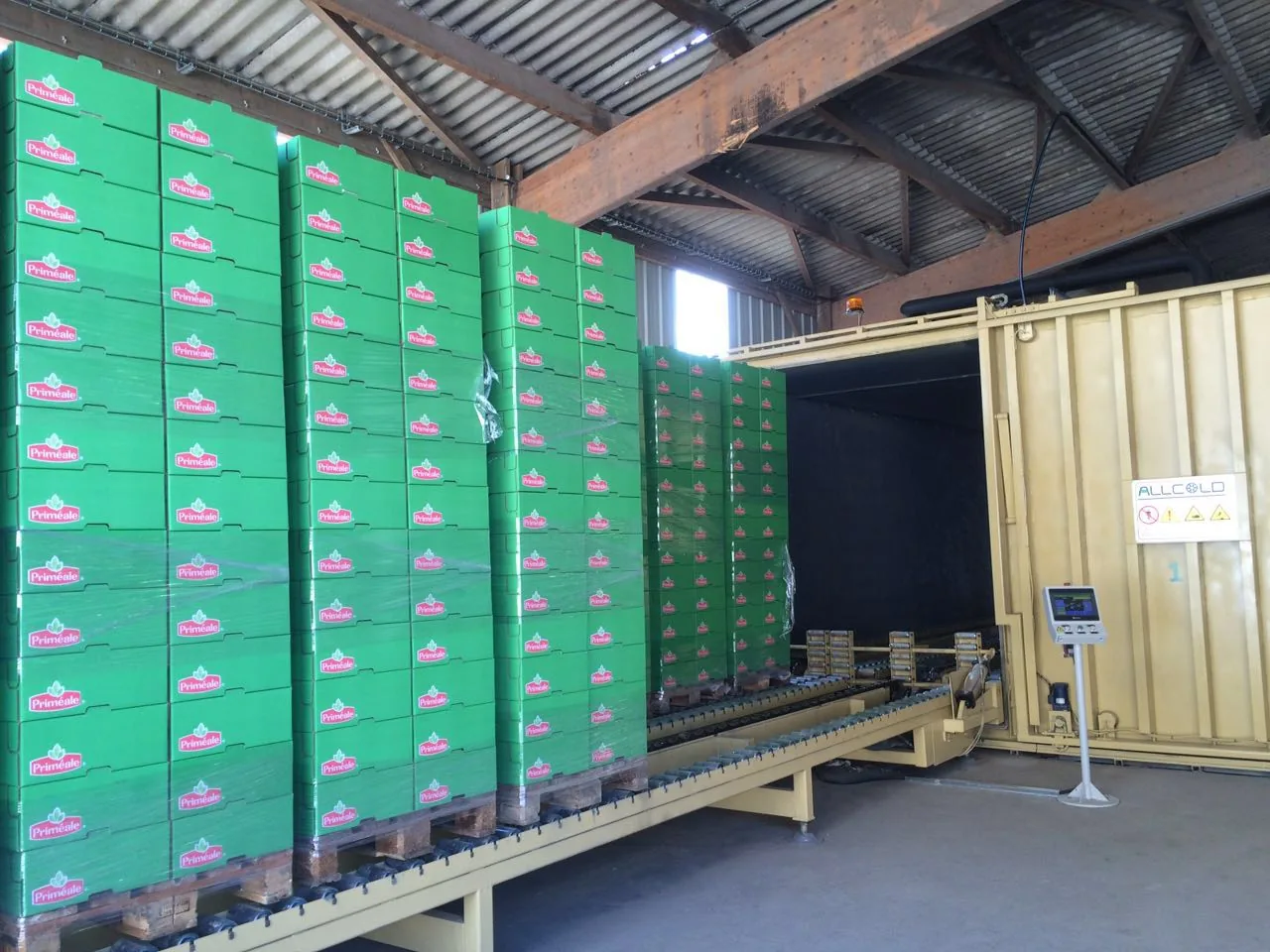
Vacuum Cooling Celery: Is It the Right Choice for Your Packing Line?
Can celery be vacuum cooled? Compare vacuum, hydro and forced-air cooling, then assess packaging, temperature, weight loss and real packing-line throughput.
Does a Bigger Vacuum Pump Mean Faster Vacuum Cooling?
Does a larger vacuum pump cool produce faster? Compare m³/h ratings, loaded cooling time and complete batch throughput before buying a vacuum cooler.
Which Refrigerant Should Your Vacuum Cooler Use?
Choosing a vacuum cooler refrigerant? Check local service support, destination rules, system performance and quotation details before ordering.
Can Your Floor Support a Vacuum Cooler? Look Beyond Tonnes per Square Metre
Check vacuum cooler floor loading before you buy: operating weight, support reactions, forklift wheel loads, ramps and the site data your engineer needs.
Buying a Vacuum Cooler Near the Coast? Specify More Than Paint
Coastal protection is more than chamber paint. Use this component-by-component checklist to compare vacuum cooler quotations, test evidence and maintenance scope.
50 Hz or 60 Hz? How to Confirm a Vacuum Cooler Will Work at Your Site
Buying a vacuum cooler for 50 Hz or 60 Hz power? Check whole-machine compatibility, auxiliaries, conversion scope and quoted performance before ordering.
Can You Move a Vacuum Cooler Between Farms for Different Harvest Seasons?
ALLCOLD · MULTI-SITE COOLING & EQUIPMENT PLANNING Sharing one cooler across two growing regions can look efficient on an annual
How Loud Is a Vacuum Cooler? Plan for Noise Before You Buy
ALLCOLD · EQUIPMENT SELECTION & SITE PLANNING A cooler can fit the available space and still be in the wrong