
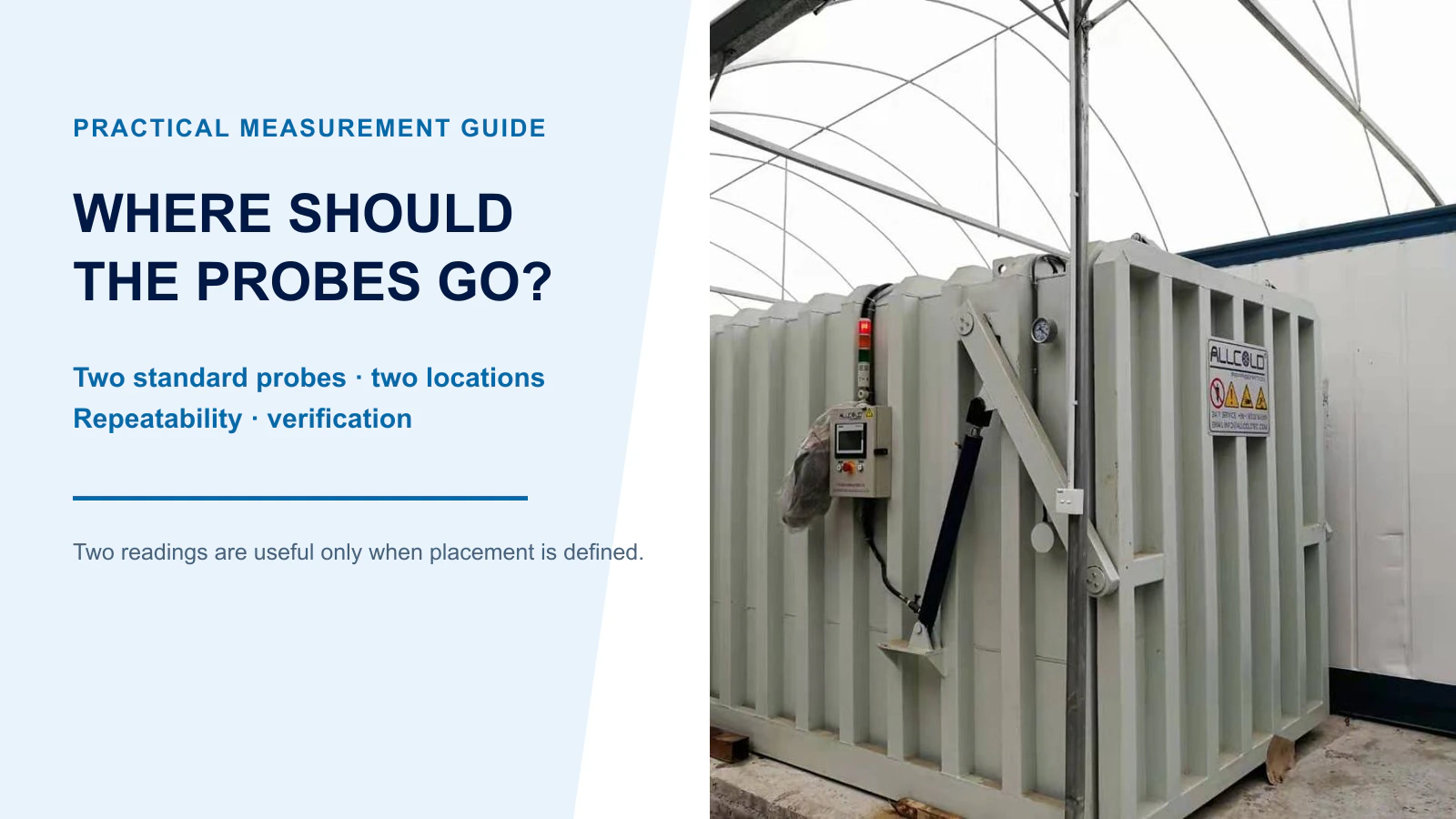
Where Should Two Product Temperature Probes Go in a Vacuum Cooler?
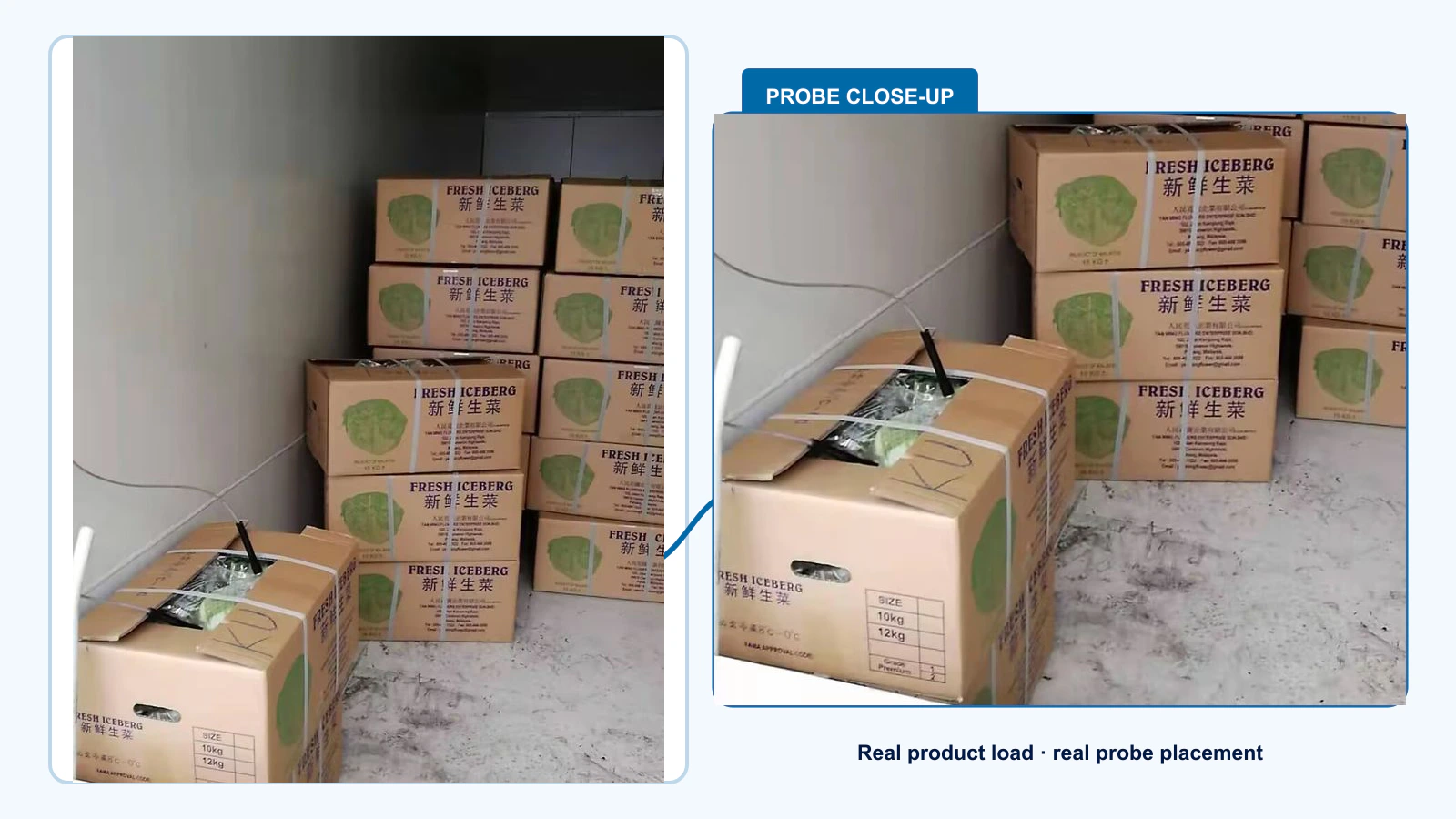
Short answer: Allcold vegetable vacuum coolers normally use two product-temperature probes as standard. Place both probes in representative product—not in free chamber air or against the carton wall—and define a different carton, product and insertion depth for each probe so operators can repeat the same two measurements in every batch. During initial product trials, the buyer’s quality team may use separate temporary reference instruments to compare candidate locations. Those trial instruments are not additional standard machine probes.
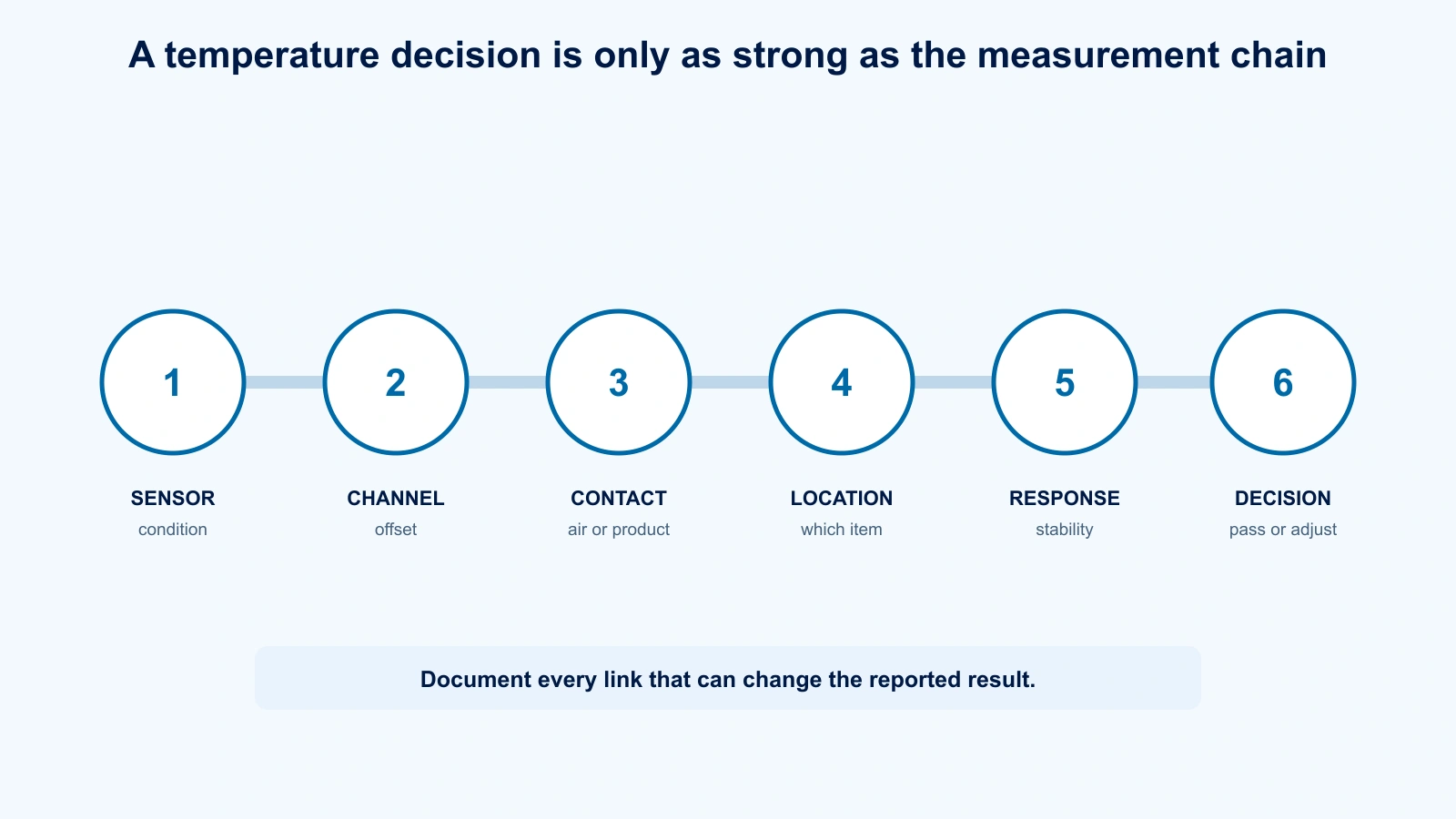
Temperature looks like a simple acceptance number: load the product, start the cycle and stop when the display reaches the target. In practice, the number is only as good as the location and contact behind it. A probe suspended between cartons may follow chamber conditions. A probe touching a package wall may respond faster than the product mass. A probe placed in a small, exposed item may reach target while a dense carton in the center remains warmer.
This distinction matters because vacuum cooling is a batch process. Pressure is shared by the chamber, but every measurement is local. Product geometry, packaging openings, starting temperature, pallet arrangement, moisture availability and load density can all influence the temperature path at a particular point. Good probe placement does not guarantee uniform cooling by itself; it gives the team evidence to see whether the selected cycle and load pattern are producing an acceptable result.
What does a temperature probe actually prove?
A probe proves the temperature at its sensing element, at that moment, within the uncertainty of the whole measurement system. It does not automatically prove the temperature of the surrounding carton, pallet or batch. This is why a technically correct sensor can still produce a misleading process decision.
| Probe condition | What the reading mainly represents | Why it can mislead |
|---|---|---|
| Suspended in chamber air | Local gas or nearby surface conditions | It is not a direct product-core measurement. |
| Touching a carton, tray or metal surface | Package or surface temperature | The contact surface can respond differently from the product mass. |
| Shallow insertion into a large item | Near-surface product temperature | The surface may cool earlier than the thermal center. |
| Inserted into a representative product | Temperature near the sensing tip | Useful only when the item and location represent the decision being made. |
| Placed in the easiest outside carton | An accessible edge location | It may miss the warmest or slowest-cooling zone. |
USDA inspection guidance illustrates the same measurement principle outside vacuum cooling: for precise product measurement, it recommends bringing the instrument toward the product environment, inserting the sensing point into the center of the product, allowing time for the reading to stabilize, and recording multiple temperatures rather than one convenient value.1 The exact handling method for your commodity must be decided by your quality team, but the lesson is broadly useful: define the measurand, contact and sampling method before interpreting the number.
How are the two machine probes different from temporary trial instruments?
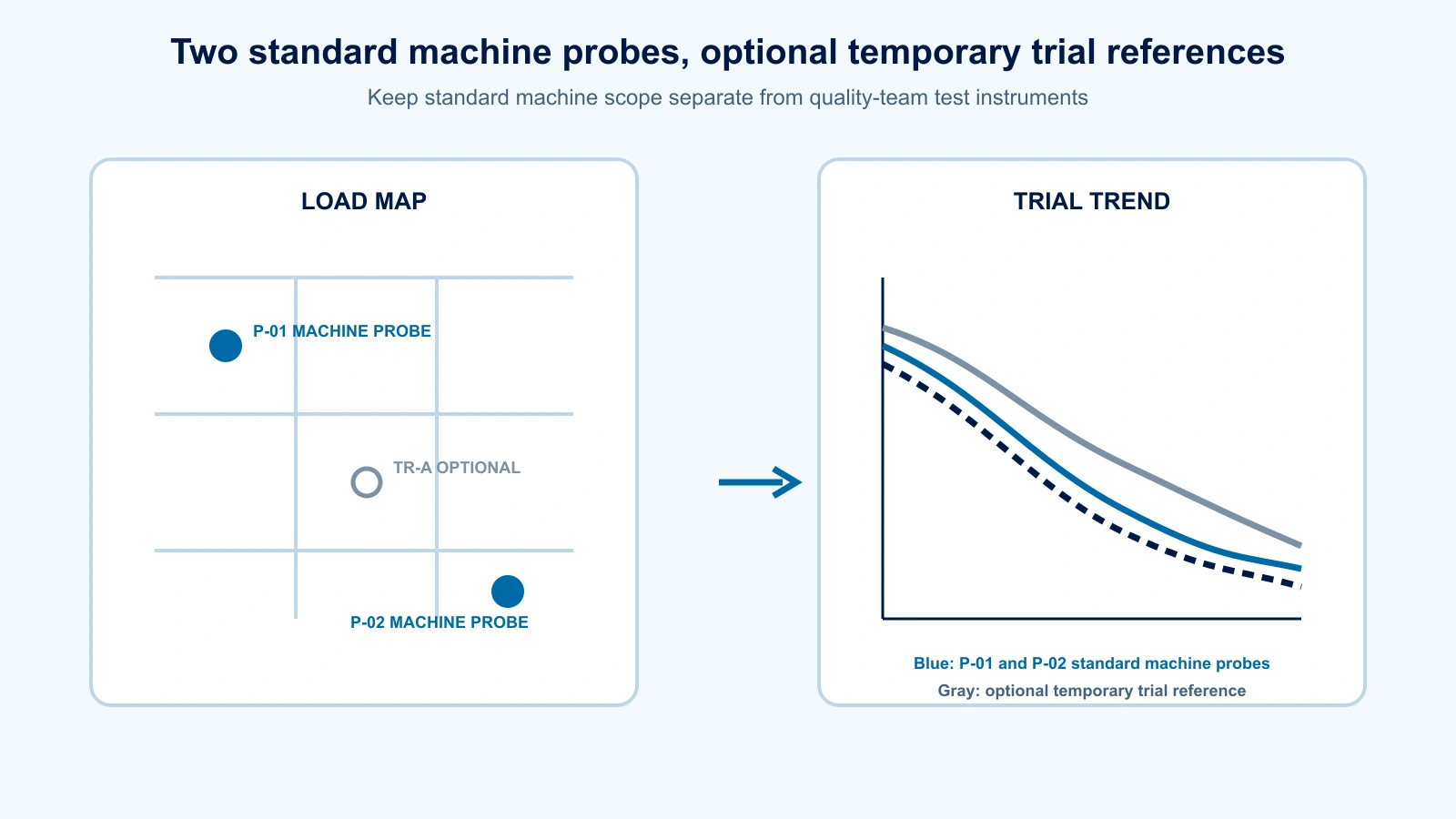
The normal Allcold vegetable-machine arrangement is two product-temperature probes. They provide two product readings during operation; the exact display or control role of those readings depends on the agreed machine configuration. During commissioning, a buyer may separately use portable thermometers or a temporary multi-channel logger to compare more positions. These are quality-team test instruments, not part of the two standard machine probes.
Use the machine’s two product probes for repeatable operation
A production operator needs two placements that can be repeated from batch to batch. The chosen item, carton, depth and location for P-01 and P-02 should be easy to describe in a work instruction. The two probes should provide useful comparison rather than sitting side by side in the same easy-to-cool carton. If every shift places them somewhere different, a temperature-based end condition can introduce unnecessary variation even when the machine itself is stable.
Use independent temporary instruments only when a trial needs broader evidence
For a new product, package or pallet pattern, the buyer’s quality team may compare several candidate positions with independent temporary instruments or across repeated test cycles. The aim is to identify two defensible, complementary and repeatable locations for the machine’s standard probes. Extra trial measurements are optional validation work; they should not be described as additional standard machine channels.
This approach complements, rather than duplicates, cycle-data diagnostics. A pressure-and-temperature trend is only interpretable when the team knows where both machine probes were placed. The guide to batch records and data logging explains how to specify records when required; historical logging, export and extra channels remain project-specific rather than universal standard features.
How should you choose two representative probe locations?
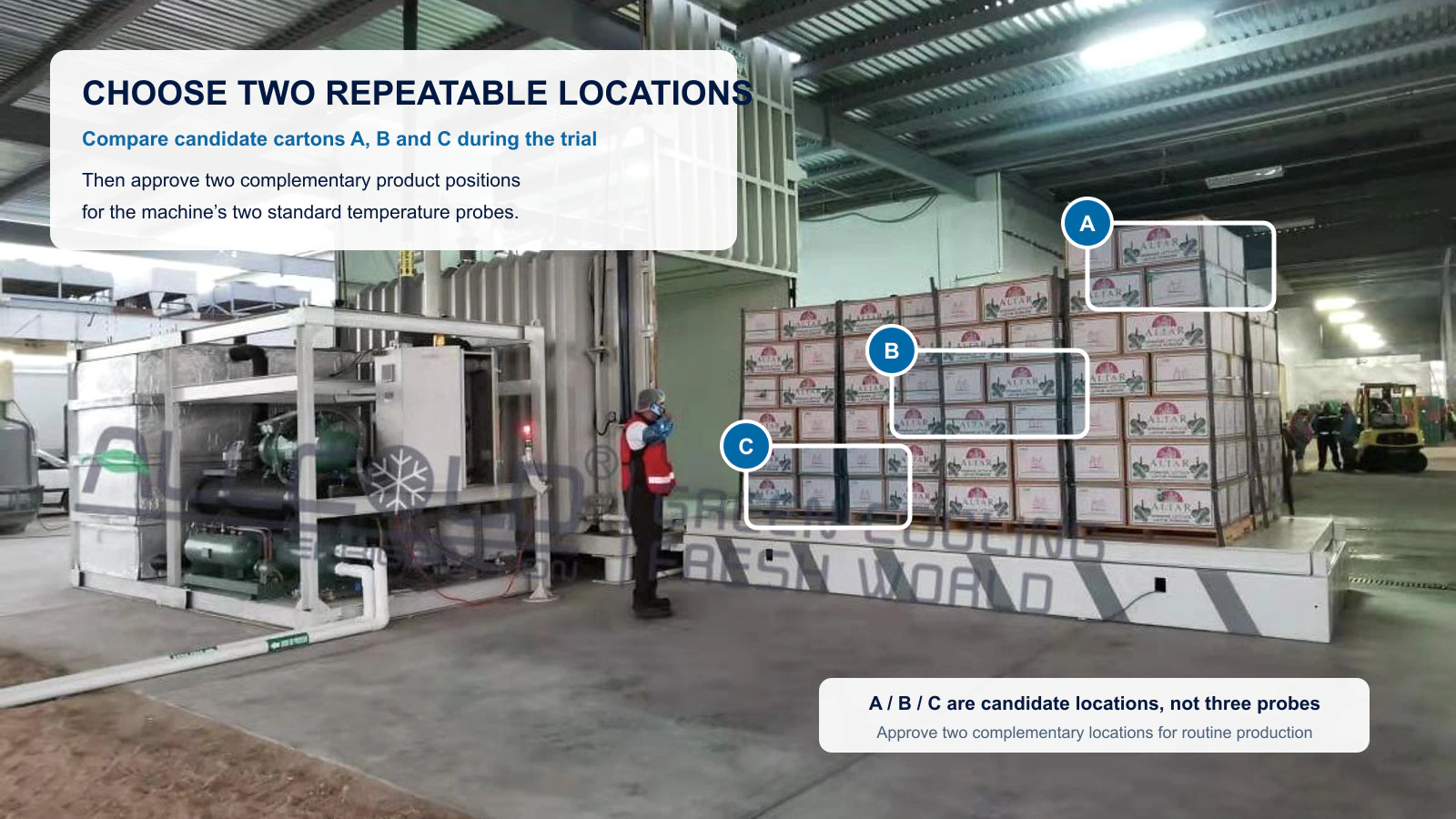
Start with the decision: which two repeatable locations will give operators useful, complementary indications of product cooling in routine production? During an initial full-load trial, the quality team can compare several candidate zones and then approve a product, carton, insertion direction and depth for each of the two machine probes. The following framework helps make that choice; it does not mean installing a probe at every candidate zone.
1. Compare candidate zones during the product trial
Think about the load by length, width and height, and consider more than one pallet when deciding where the slowest representative product may be. Candidate comparisons can use temporary reference instruments or repeated cycles with carefully controlled conditions. After the trial, select two routine locations and describe P-01 and P-02 unambiguously in the operator work instruction.
2. Identify the product most likely to cool slowly
Do not automatically select the largest visible item. Consider product mass, shape, pack density, carton ventilation and moisture condition. If one purchase order combines different pack styles or products, validate the combination that creates the highest uncertainty. Keep the product definition with the record: commodity, variety or cut, package, net mass, starting condition and pallet pattern.
3. Place the sensing element in the intended measurement zone
For a product-core measurement, the sensing element—not merely the visible metal stem—must reach the defined location. Probe construction differs, so confirm where the sensing element sits within the tip. Avoid voids, large air gaps and direct contact with the carton or tray. Use a repeatable insertion direction and depth.
4. Challenge the likely worst case without cherry-picking
A sensible trial compares a center-of-load or dense-package candidate with accessible boundary locations. Do not move either machine probe during a running cycle. If a sensing tip loses product contact, mark that result invalid, document what happened and repeat the run when the missing reading affects the decision.
The logic is consistent with USDA guidance to take multiple inspection readings when evaluating a lot and to record where those readings were taken.2 USDA’s market manual likewise calls for inspection measurements from various parts and layers of a load to understand the range.3 Those documents concern inspection rather than vacuum-cooler construction: they support temporary validation sampling and do not define how many probes the machine includes. Allcold’s standard vegetable-machine configuration is two product-temperature probes.
Which insertion and handling errors distort the result?
The probe was not allowed to stabilize
A reading taken immediately after insertion may still be moving toward the product temperature. Define a stability rule or minimum dwell time that fits the sensor response and the product. Record the actual value from the logger or display; do not round early just to show compliance.
The sensing tip moved during evacuation
Cables can shift as a load settles or as an operator closes the chamber. Provide strain relief outside the product contact point, route cables away from the door seal and moving hardware, and photograph the placements before closing the door. After the cycle, confirm that each tip remained in position.
The probe damaged the product or package
The measurement plan must respect commodity and hygiene requirements. Use an appropriate cleaned or sanitized food-contact probe under the site’s procedure, avoid contaminating one sample from another and define how punctured products will be handled. For delicate leaves or small pieces, your quality team may choose a product-mass method rather than forcing a large probe into a single leaf.
The probe channel was never checked
Calibration is not a sticker alone. NIST explains that metrological traceability belongs to the measurement result and requires a documented, unbroken chain of calibrations with stated uncertainties.4 NIST also recommends establishing an application tolerance and verifying thermometer performance, especially after suspected damage or unexpected drift.5 Before a critical trial, compare both machine probes and any temporary reference instrument at a common stable condition or against an appropriate reference under a documented procedure. A channel offset can otherwise look like a real product-temperature difference.
When are extra trial measurements useful?
Routine Allcold vegetable-machine operation generally uses the two standard product-temperature probes. Extra measurements may be useful temporarily when the customer is validating a new product, package or load pattern, investigating a complaint, or checking whether the two approved probe positions still represent the process. They can come from portable reference instruments or a temporary logger supplied for the trial; they are not automatically part of the machine.
| Situation | Practical sampling response | Decision to document |
|---|---|---|
| First trial of a new product or pack | The quality team may compare candidate locations with temporary references. | Which two complementary locations should be approved for routine use? |
| Known product, changed pallet pattern | Temporarily recheck the zones affected by density or height. | Do the previous two probe locations still represent the load? |
| Routine production check | Use P-01 and P-02 in their approved repeatable locations. | Were both placements consistent with the work instruction? |
| Mixed product or mixed starting temperature | The quality team may perform separate temporary checks on meaningful groups. | Can two operating locations represent this mixed load? |
| Customer complaint or performance drift | Recreate the load and add temporary reference measurements before changing settings. | Is the cause placement, loading, product or machine performance? |
Extra temporary measurements are not automatically better. A few clearly identified trial positions are more useful than many poorly documented readings. The goal is to confirm where the two standard machine probes should be placed for repeatable production. If the slowest point moves from run to run, the product or loading process may be too variable for the two approved locations to represent reliably without additional process controls.
When temperature spread is large, inspect the load before blaming the sensor or changing the vacuum program. The guide on pallet loading and vacuum-cooling performance explains how packing arrangement can affect results. For projects still defining capacity, verify that the real pallet envelope fits the usable chamber space; test data from a partial or rearranged load may not represent everyday production.
What should the trial record contain?
A trend chart without placement metadata is difficult to audit. Identify the two machine probes as P-01 and P-02 and mark both approved locations on a simple load drawing. If temporary trial instruments are used, give them separate reference IDs so nobody mistakes them for built-in machine channels.
| Record field | Why it matters |
|---|---|
| Batch, date, recipe revision and operator | Connects the measurement to the actual production event. |
| Product, package, pallet pattern and load mass | Shows whether two cycles are genuinely comparable. |
| Starting-temperature range | Prevents a warmer incoming load from being mistaken for machine drift. |
| P-01 and P-02 positions | Confirms both routine measurements were placed consistently. |
| Insertion item, direction and depth | Allows the placement to be repeated. |
| Instrument ID, check status and units | Supports confidence in the measurement chain. |
| Pressure trend, step timing and endpoint logic | Connects product response with machine operation. |
| Temporary reference IDs, if used | Keeps trial instruments separate from the machine’s two standard probes. |
| Exceptions and post-cycle probe check | Flags a moved, damaged or unreliable measurement. |
If the machine may operate on a generator or a constrained site supply, keep electrical conditions with the test record; the generator-sizing guide explains why running kW alone is not enough. If commissioning access is limited, plan instrumentation before delivery using the delivery and installation-access checklist.
What should a buyer put in the RFQ?
Allcold vegetable vacuum coolers generally use two product-temperature probes as standard. The RFQ should confirm that scope and then separate any buyer-requested trial instrumentation, additional integrated channels or historical logging as project-specific items.
- Measurement purpose: display only, recipe control, cycle endpoint, commissioning validation or routine quality check.
- Standard scope: two machine product-temperature probes and their normal display/control roles.
- Sensor details: sensor type, measurement range, stated accuracy, sensing-element location, cable construction and connector arrangement.
- Placement method: named product, carton/pallet position, insertion depth, cable routing and operator work instruction.
- Endpoint logic: whether either or both product probes contribute to the cycle endpoint, how a failed or conflicting reading is handled and what pressure/time safeguards remain active.
- Optional records: if historical logging or export is requested, define units, sample interval, labels, format and timestamp basis as project-specific requirements.
- Verification: calibration documentation, site check method, acceptance tolerance and responsibility for reference instruments.
- Trial protocol: real product, full load, starting-condition range, number of runs and agreed definition of success.
Allcold can review the product, pallet arrangement and intended cooling target with the buyer to define practical placements for the two standard product probes. If the buyer wants temporary multi-point validation or additional integrated channels, that separate scope should be agreed before the trial rather than assumed from a generic specification.
Frequently asked questions
Can chamber pressure replace the product-temperature probe?
No. Pressure is essential process information, but it does not directly prove the temperature of every product location. Pressure and product temperature should be interpreted together.
Can an infrared thermometer validate the product core?
Not by itself. An infrared instrument measures surface radiation within its field of view and is affected by emissivity and viewing conditions. It can be useful for rapid screening, but a surface result should not be presented as a core measurement.
Should the two product probes stop the cycle?
Their role depends on the agreed machine logic and validated recipe. If temperature contributes to the endpoint, both approved probe locations and the handling of a failed or conflicting reading must be defined. Pressure and time safeguards should be agreed with the supplier rather than inferred by the operator.
Do I need a new probe map for every product?
You need evidence that the two approved probe locations and recipe remain representative. A new commodity, pack style, pallet pattern, load height or starting-temperature range can justify temporary comparison measurements and a revised work instruction.
Conclusion
A temperature target is meaningful only when the measurement locations are meaningful. Put the machine’s two standard product probes in approved, repeatable and complementary locations. Use separate temporary instruments only when the quality team needs to compare additional candidate zones or investigate variation. This keeps the standard machine scope accurate while giving production teams a defensible measurement method.
References
- USDA Agricultural Marketing Service, Technical Procedures Manual — product-temperature measurement method and stabilization guidance.
- USDA AMS, Shipping Point and Market Inspection Instructions for Fresh-Cut Produce — multiple readings and location reporting.
- USDA AMS, General Market Manual — sampling temperatures from various parts and layers of a load.
- NIST, Metrological Traceability: FAQs and Policy — traceability, documented calibration chains and measurement uncertainty.
- NIST, What Is Traceability? — application tolerances, verification and calibration records.
Planning a product trial or a new vacuum cooler?
Send Allcold the product, package, pallet pattern, starting-temperature range, target and required throughput. We can discuss a practical machine configuration and the measurement information your team should define before the trial.

Mila
You May Also Like
50 Hz or 60 Hz? How to Confirm a Vacuum Cooler Will Work at Your Site
Buying a vacuum cooler for 50 Hz or 60 Hz power? Check whole-machine compatibility, auxiliaries, conversion scope and quoted performance before ordering.
Can You Move a Vacuum Cooler Between Farms for Different Harvest Seasons?
ALLCOLD · MULTI-SITE COOLING & EQUIPMENT PLANNING Sharing one cooler across two growing regions can look efficient on an annual
How Loud Is a Vacuum Cooler? Plan for Noise Before You Buy
ALLCOLD · EQUIPMENT SELECTION & SITE PLANNING A cooler can fit the available space and still be in the wrong
Air-Cooled, Water-Cooled or Evaporative: Which Vacuum Cooler Fits Your Site?
VACUUM COOLER BUYER’S GUIDE · SITE UTILITIES Three heat-rejection arrangements can mean very different utilities, maintenance and installed costs. Compare
Vacuum Cooling vs. Vacuum Packaging: Which Machine Do You Need?
ALLCOLD · EQUIPMENT SELECTION Two machines can both use a vacuum chamber and still solve completely different production problems. Before
Should You Buy a Vacuum Cooler or Use a Third-Party Cooling Service?
FARM INVESTMENT · OWNERSHIP VS. OUTSOURCING The cooling fee is easy to see. The cost of getting your harvest cooled
Can a Vacuum Cooler Work at High Altitude? A Buyer’s Guide for Farms
Buying a vacuum cooler for a high-altitude farm? Learn how altitude affects pressure readings, equipment selection and the site details your supplier needs.
What Should a Vacuum Cooler Record? A Buyer’s Guide to Batch Data, Alarms, and Remote Support
A practical buyer’s guide to specifying vacuum cooler batch records, sensor data, alarm history, exports, backups and controlled remote support.
Will Your Pallets Actually Fit? How to Specify the Usable Chamber Size of a Vacuum Cooler
A pallet count does not prove the real production load will fit. Learn how to define the loaded-pallet envelope, door throat, usable chamber space, handling path and drawing-approval evidence before ordering a vacuum cooler.
Can a Vacuum Cooler Run on a Generator? A Buyer's Guide to Sizing Beyond Running kW
A generator can have enough running power and still struggle when a vacuum cooler starts. Learn how to define the operating duty, starting events, supporting utilities and supplier responsibilities before selecting the generator set.